
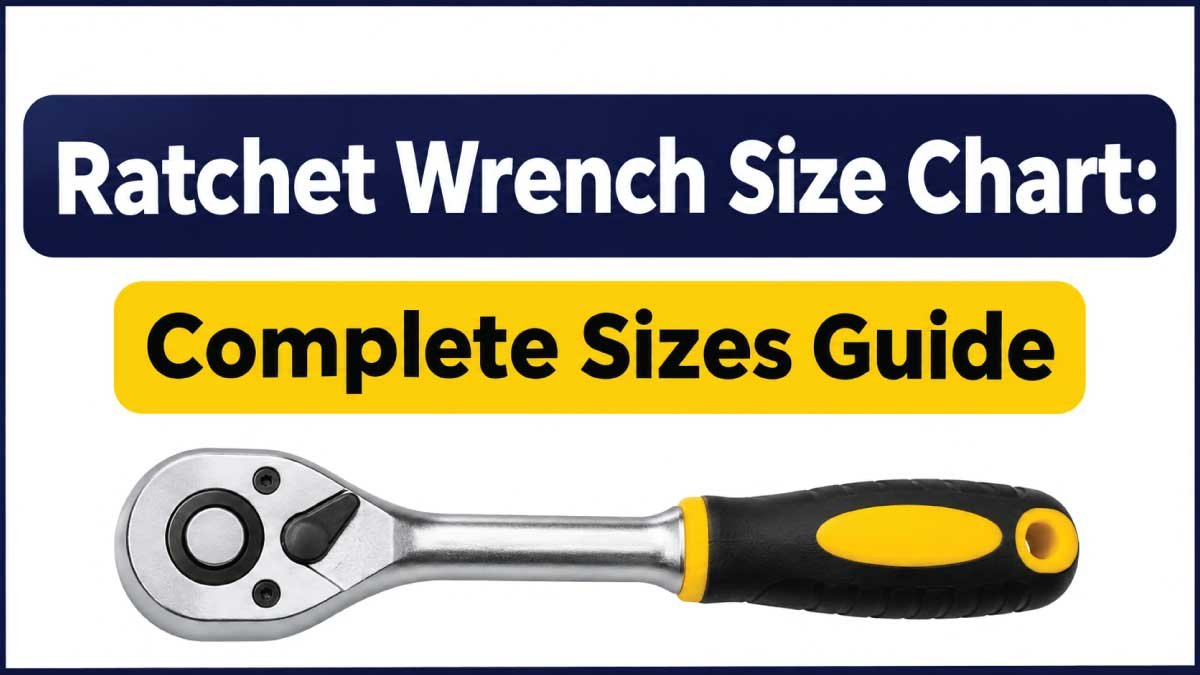
Choosing the correct ratchet wrench size makes mechanical work easier, faster, and more efficient. Whether you are repairing a vehicle, assembling machinery, working on household equipment, or performing general maintenance, using the right ratchet and socket combination helps prevent fastener damage and improves access in tight spaces.
This ratchet wrench size chart covers common ratchet drive sizes, metric and SAE socket measurements, applications, and tool selection. It also explains the differences between 1/4-inch, 3/8-inch, 1/2-inch, 3/4-inch, and 1-inch drive ratchets.
Understanding ratchet wrench sizes is particularly important because the drive size and socket size are two different measurements. The drive determines which ratchet fits the socket, while the socket size determines which bolt or nut it can turn. This guide explains both measurements so you can select the right tool for your work.
What Is a Ratchet Wrench?
A ratchet wrench is a hand tool designed to tighten or loosen threaded fasteners without repeatedly removing the tool from the bolt or nut.
It uses an internal ratcheting mechanism that allows the handle to move in one direction while the socket remains engaged with the fastener. When the handle moves back, the mechanism resets without turning the fastener in the opposite direction.
Most socket ratchets have a square drive that connects to interchangeable sockets. These sockets are available in different sizes to fit various nuts and bolts.
Common features of a ratchet wrench include:
- Ratchet mechanism: Allows continuous fastening movement without removing the socket.
- Square drive: Connects the ratchet to a compatible socket.
- Reversing switch: Changes the direction of rotation.
- Release button: Allows quick socket removal on many models.
- Handle: Provides leverage and a comfortable gripping surface.
- Socket compatibility: Allows one ratchet to work with multiple socket sizes.
Ratchet wrenches are widely used in automotive repair, mechanical assembly, industrial maintenance, plumbing, and general workshop applications.
Ratchet Wrench Drive Size Chart
Ratchet wrenches are commonly classified according to their square drive size. The drive size determines which socket connection fits the ratchet.
The following chart compares the most common ratchet wrench drive sizes and their typical applications.
| Ratchet Drive Size | Measurement (mm) | Common Applications | Typical Work |
|---|---|---|---|
| 1/4 inch | 6.35 mm | Small fasteners, electronics, bicycles | Light-duty work |
| 3/8 inch | 9.53 mm | Motorcycles, automotive repairs | General mechanical work |
| 1/2 inch | 12.70 mm | Cars, trucks, machinery | Medium and heavy-duty work |
| 3/4 inch | 19.05 mm | Heavy vehicles, industrial equipment | Heavy-duty fastening |
| 1 inch | 25.40 mm | Large machinery, construction equipment | Specialized industrial work |
Important: Drive size does not indicate the exact size of the bolt or nut. For example, a 1/2-inch drive ratchet can accept different socket sizes, including 10 mm, 13 mm, 17 mm, 19 mm, and larger sockets, provided they have the correct drive connection.
Common Ratchet Wrench Sizes and Their Applications
Different ratchet drive sizes are designed for different fastening requirements. Selecting the right size depends on the fastener, available working space, and amount of force required.
1/4-Inch Drive Ratchet Wrench
A 1/4-inch drive ratchet is a compact tool commonly used for small fasteners and light-duty mechanical work.
Its smaller head makes it useful when working in restricted areas where a larger ratchet may not fit.
Common applications include:
- Small engine components.
- Bicycle maintenance.
- Electronic equipment.
- Dashboard and interior automotive components.
- Small household appliances.
- Light mechanical assemblies.
A 1/4-inch ratchet is particularly useful when working with small sockets and fasteners that do not require substantial tightening force.
3/8-Inch Drive Ratchet Wrench
A 3/8-inch drive ratchet is a versatile option for everyday mechanical and automotive maintenance.
It offers a practical balance between size, accessibility, and leverage, making it suitable for many workshop tasks.
Common applications include:
- Motorcycle repairs.
- Automotive engine maintenance.
- General vehicle repairs.
- Household mechanical equipment.
- Medium-sized fasteners.
- Machine assembly and maintenance.
For many mechanics, a 3/8-inch ratchet is a useful general-purpose tool because it can handle a wide variety of common fastening jobs.
1/2-Inch Drive Ratchet Wrench
A 1/2-inch drive ratchet is commonly used for larger fasteners that require more leverage and stronger sockets.
Its larger square drive accommodates sockets designed for many automotive and mechanical applications.
Common applications include:
- Automotive suspension work.
- Vehicle maintenance.
- Larger engine fasteners.
- Truck repairs.
- Machinery maintenance.
- General workshop applications.
A 1/2-inch ratchet is especially useful when working with larger sockets. However, for extremely tight or seized fasteners, a suitable breaker bar may be more appropriate.
3/4-Inch Drive Ratchet Wrench
A 3/4-inch drive ratchet is designed for heavy-duty mechanical applications.
Its larger construction accommodates bigger sockets and fasteners commonly found on commercial vehicles and industrial equipment.
Common applications include:
- Heavy-duty trucks.
- Construction machinery.
- Agricultural equipment.
- Industrial maintenance.
- Large mechanical assemblies.
These ratchets are generally heavier and larger than smaller drive models. They are not normally necessary for routine household repairs.
1-Inch Drive Ratchet Wrench
A 1-inch drive ratchet is a specialized tool designed for large fastening applications.
It is generally used in environments where standard automotive ratchets cannot accommodate the required socket sizes or working demands.
Common applications include:
- Large industrial machinery.
- Heavy construction equipment.
- Commercial vehicle maintenance.
- Industrial assembly operations.
- Large mechanical fasteners.
Because of their size and intended applications, 1-inch drive ratchets are primarily found in specialized workshops and industrial maintenance facilities.
Metric Ratchet Socket Size Chart
Metric sockets are measured in millimeters across the flats of the hexagonal fastener they fit. They are commonly used with metric bolts and nuts found in automotive equipment, machinery, and household products.
The following chart lists commonly encountered metric socket sizes.
| Metric Socket Size | Equivalent Measurement (inches) | Common Applications |
|---|---|---|
| 4 mm | 0.1575 in | Small assemblies |
| 5 mm | 0.1969 in | Small mechanical fasteners |
| 6 mm | 0.2362 in | Electronics and equipment |
| 7 mm | 0.2756 in | Small automotive fasteners |
| 8 mm | 0.3150 in | Automotive and machinery |
| 9 mm | 0.3543 in | General mechanical work |
| 10 mm | 0.3937 in | Automotive maintenance |
| 11 mm | 0.4331 in | Mechanical assemblies |
| 12 mm | 0.4724 in | Automotive components |
| 13 mm | 0.5118 in | Vehicle and machinery repairs |
| 14 mm | 0.5512 in | Automotive maintenance |
| 15 mm | 0.5906 in | Mechanical equipment |
| 16 mm | 0.6299 in | Automotive and industrial work |
| 17 mm | 0.6693 in | Vehicle maintenance |
| 18 mm | 0.7087 in | Larger automotive fasteners |
| 19 mm | 0.7480 in | Wheel and suspension work |
| 21 mm | 0.8268 in | Automotive and machinery |
| 22 mm | 0.8661 in | Larger mechanical fasteners |
| 24 mm | 0.9449 in | Heavy-duty applications |
| 27 mm | 1.0630 in | Industrial and vehicle maintenance |
| 30 mm | 1.1811 in | Large mechanical assemblies |
| 32 mm | 1.2598 in | Heavy equipment |
These are common socket measurements rather than a universal list of fastener sizes. The required socket depends on the actual dimensions of the bolt or nut.
SAE Ratchet Socket Size Chart
SAE sockets use fractional-inch measurements and are commonly found in equipment manufactured for the United States market.
They are particularly useful for working with inch-based fasteners.
The following chart lists commonly available SAE socket sizes in ascending order.
| SAE Socket Size | Decimal Equivalent (inches) | Approximate Metric Equivalent |
|---|---|---|
| 1/4 in | 0.2500 | 6.35 mm |
| 5/16 in | 0.3125 | 7.94 mm |
| 3/8 in | 0.3750 | 9.53 mm |
| 7/16 in | 0.4375 | 11.11 mm |
| 1/2 in | 0.5000 | 12.70 mm |
| 9/16 in | 0.5625 | 14.29 mm |
| 5/8 in | 0.6250 | 15.88 mm |
| 11/16 in | 0.6875 | 17.46 mm |
| 3/4 in | 0.7500 | 19.05 mm |
| 13/16 in | 0.8125 | 20.64 mm |
| 7/8 in | 0.8750 | 22.23 mm |
| 15/16 in | 0.9375 | 23.81 mm |
| 1 in | 1.0000 | 25.40 mm |
| 1-1/16 in | 1.0625 | 26.99 mm |
| 1-1/8 in | 1.1250 | 28.58 mm |
| 1-1/4 in | 1.2500 | 31.75 mm |
| 1-1/2 in | 1.5000 | 38.10 mm |
SAE and metric socket sizes are not always interchangeable. Even when two sizes appear close, a small difference can cause slipping or damage to the fastener.
For tight or damaged fasteners, always use the correct measurement system and an accurately fitting socket.
Metric vs SAE Ratchet Wrench Sizes
Metric and SAE are two common measurement systems used for sockets and ratchet wrench accessories.
Metric sockets are measured in millimeters, while SAE sockets are measured in fractional inches.
| Feature | Metric System | SAE System |
|---|---|---|
| Measurement unit | Millimeters | Inches |
| Common socket sizes | 8, 10, 12, 13, 17, 19 mm | 5/16, 3/8, 1/2, 9/16 in |
| Common applications | Metric fasteners | Inch-based fasteners |
| Size identification | Numerical mm marking | Fractional-inch marking |
| Typical equipment | Metric machinery and vehicles | Inch-based machinery and vehicles |
Can Metric and SAE Sockets Be Interchanged?
Metric and SAE sockets sometimes have very similar dimensions, but they should not automatically be treated as interchangeable.
For example:
- A 19 mm socket is approximately 0.748 inches.
- A 3/4-inch socket measures exactly 0.750 inches.
- A 13 mm socket measures approximately 0.512 inches.
- A 1/2-inch socket measures exactly 0.500 inches.
Although some combinations may physically fit, the difference can cause a loose connection or damage the fastener.
Using the exact socket size is the safest approach, especially when dealing with tight, rusty, or high-load fasteners.
Related Guide:
Types of Ratchet Wrenches
Ratchet wrenches are available in several designs, each offering different advantages for specific applications.
Standard Socket Ratchet
A standard socket ratchet has a square drive that connects to interchangeable sockets.
It is one of the most versatile options for automotive and mechanical maintenance.
Advantages:
- Compatible with multiple socket sizes.
- Available in several drive sizes.
- Easy to use for general fastening.
- Suitable for many workshop applications.
Flex-Head Ratchet
A flex-head ratchet features a movable head that can pivot to different angles.
This design helps access fasteners located behind components or in confined spaces.
Advantages:
- Improved access to difficult fasteners.
- Flexible working angles.
- Useful for engine and machinery repairs.
Long-Handle Ratchet
A long-handle ratchet has an extended handle that provides additional leverage compared with a shorter model.
It is useful for reaching fasteners located farther inside an assembly.
However, extra leverage can make it easier to apply excessive force, so controlled operation is important.
Stubby Ratchet
A stubby ratchet has a short handle and compact construction.
It is particularly useful in restricted areas where a standard-length ratchet cannot move freely.
Common applications include:
- Engine compartments.
- Tight machinery assemblies.
- Automotive interior repairs.
- Confined mechanical spaces.
Ratcheting Combination Wrench
A ratcheting combination wrench combines an open-end jaw with a closed ratcheting ring.
Unlike a socket ratchet, it does not use interchangeable square-drive sockets. Instead, the ring end is designed for a particular fastener size.
It is useful when a socket cannot be positioned easily around a fastener.
Related Guide:
How to Choose the Correct Ratchet Wrench Size
Selecting the right ratchet wrench involves considering the drive size, socket measurement, working environment, and fastener requirements.
1. Identify the Fastener Size
First, determine the size of the bolt or nut you need to turn.
Use a suitable measuring tool or try an accurately fitting socket.
Remember that socket size refers to the distance across the flats of the hexagonal fastener, not its thread diameter.
2. Choose the Correct Drive Size
Select a ratchet with a square drive that matches your socket.
Common choices include:
- 1/4-inch drive for smaller fasteners.
- 3/8-inch drive for general mechanical work.
- 1/2-inch drive for larger automotive fasteners.
- 3/4-inch drive for heavy-duty equipment.
- 1-inch drive for specialized industrial work.
3. Consider the Working Space
The size of the ratchet head and handle can affect accessibility.
A compact ratchet is useful in narrow spaces, while a longer handle may be more convenient for reaching distant fasteners.
Consider the clearance available around the bolt before selecting the tool.
4. Check the Socket Type
Sockets are available in different designs, including:
- Shallow sockets: Suitable for fasteners with limited protruding threads.
- Deep sockets: Useful for long studs and recessed fasteners.
- Impact sockets: Designed for compatible impact tools and typically made for higher-impact loading.
- Universal sockets: Allow angled access to certain fasteners.
Always use sockets designed for the tool and application.
5. Consider the Ratchet Mechanism
Ratchets are available with different numbers of teeth and engagement positions.
A finer-tooth mechanism generally allows a smaller handle movement before the next engagement point.
This can be particularly useful in tight working spaces where the handle cannot swing very far.
However, tooth count alone does not determine tool strength or durability. Consider the manufacturer’s specifications and intended application.
Related Guide:
How to Use a Ratchet Wrench Correctly
Using a ratchet wrench properly helps reduce fastener damage and improves working efficiency.
Follow these general steps:
- Select the correct socket: Choose a socket that fits the fastener securely.
- Match the drive size: Confirm that the socket fits the ratchet’s square drive.
- Attach the socket: Push it onto the drive until it is securely connected.
- Set the direction: Move the reversing switch to the desired tightening or loosening direction.
- Position the socket: Place it fully over the bolt or nut.
- Move the handle: Apply controlled pressure through a comfortable range of movement.
- Reset the handle: Allow the ratchet mechanism to move back without turning the fastener in the opposite direction.
- Complete the operation: Continue until the fastener is sufficiently loosened or tightened.
If the fastener requires a specific tightening torque, use a calibrated torque wrench rather than estimating the final tightening force with a standard ratchet.
Ratchet Wrench vs Socket Wrench: What Is the Difference?
The terms ratchet wrench and socket wrench are sometimes used interchangeably, but they describe slightly different aspects of a fastening tool.
A socket wrench is a tool system that uses interchangeable sockets to fit different fasteners. A ratchet is a common handle mechanism used with that system.
| Feature | Ratchet Wrench | Standard Socket Handle |
|---|---|---|
| Working mechanism | Ratcheting mechanism | Depends on handle design |
| Continuous movement | Yes | Not always |
| Socket compatibility | Yes, with matching drive | Yes, with matching drive |
| Fastener engagement | Socket-based | Socket-based |
| Best application | Repeated fastening | General socket operation |
A ratchet is particularly useful when frequent tightening or loosening is required because the user does not need to remove the socket after every handle movement.
Common Ratchet Wrench Mistakes to Avoid
Incorrect tool selection and improper handling can damage both the ratchet and the fastener.
Avoid these common mistakes:
- Using the wrong socket size: A loose socket can slip and round off fastener corners.
- Confusing drive size with socket size: A 1/2-inch drive does not mean the socket must be 1/2 inch across the flats.
- Mixing metric and SAE sockets: Similar-looking sizes may not fit securely.
- Using a ratchet as a breaker bar: Excessive force can damage the ratchet mechanism.
- Applying excessive pressure: Sudden or uncontrolled force can cause slipping and injury.
- Using worn sockets: Damaged sockets may not grip fasteners correctly.
- Ignoring the reversing switch: Incorrect direction settings can make fastening difficult.
- Using incompatible impact tools: Standard chrome sockets should not be used with impact wrenches unless specifically rated for that application.
For heavily seized fasteners, use a suitable breaker bar or another appropriate loosening tool.
Ratchet Wrench Maintenance and Storage Tips
Regular maintenance helps keep ratchet wrenches operating smoothly and extends their service life.
Follow these practical recommendations:
- Clean the ratchet after use.
- Remove dirt, grease, and metal debris.
- Keep the ratchet mechanism properly lubricated according to the manufacturer’s instructions.
- Avoid exposing the tool to excessive moisture.
- Store sockets in an organized case or rack.
- Inspect the reversing switch and release mechanism regularly.
- Replace damaged or worn sockets.
- Avoid dropping the ratchet onto hard surfaces.
- Do not exceed the manufacturer’s recommended load limits.
If the ratchet begins slipping, skipping, or failing to engage properly, inspect the mechanism and have it serviced or replaced as appropriate.
Frequently Asked Questions (FAQs)
1. What is the most common ratchet wrench size?
The 3/8-inch and 1/2-inch drive ratchets are widely used in automotive and mechanical maintenance. A 3/8-inch model is useful for general repairs, while a 1/2-inch model is commonly used for larger fasteners.
2. What is the difference between a 1/4-inch and 3/8-inch ratchet?
A 1/4-inch ratchet has a smaller square drive and is generally used for small fasteners and light-duty work. A 3/8-inch ratchet has a larger drive and is suitable for a wider range of automotive and mechanical applications.
3. What size ratchet wrench is best for automotive work?
A 3/8-inch ratchet is a versatile option for many automotive repairs. A 1/2-inch ratchet is useful for larger fasteners, while a 1/4-inch model helps with smaller components and restricted spaces.
4. What does 1/2-inch drive mean on a ratchet?
A 1/2-inch drive refers to the approximate width of the ratchet’s square drive connection. It determines which socket drive size is compatible with the tool. It does not refer to the measurement across the socket opening.
5. Are metric and SAE ratchet sockets interchangeable?
Not necessarily. Metric sockets use millimeters, while SAE sockets use fractional inches. Some sizes are close, but even small differences can cause slipping or damage. Always use the correct socket measurement whenever possible.
6. What is the difference between a ratchet wrench and a torque wrench?
A ratchet wrench is designed to tighten or loosen fasteners through repeated handle movements. A torque wrench is designed to apply a specified amount of tightening torque. Use a torque wrench when the manufacturer requires a particular torque value.
7. What is a flex-head ratchet used for?
A flex-head ratchet has a pivoting head that allows the user to adjust the working angle. It is particularly useful for reaching fasteners in confined spaces or behind other components.
8. Can I use a ratchet wrench to loosen tight bolts?
Yes, a ratchet can loosen many ordinary fasteners. However, extremely tight, seized, or rusted bolts may require a breaker bar. Excessive force on a ratchet can damage its internal mechanism.
9. What is the difference between a shallow and deep socket?
A shallow socket has a shorter body and is suitable for fasteners with limited thread exposure. A deep socket has a longer body, allowing it to fit over longer studs or recessed fasteners.
Conclusion
Selecting the correct ratchet wrench size makes mechanical and automotive work more efficient while reducing the risk of fastener damage. Common drive sizes include 1/4-inch, 3/8-inch, 1/2-inch, 3/4-inch, and 1-inch models, each designed for different applications.
Use the ratchet wrench size chart to identify the appropriate drive size and compare metric and SAE socket measurements. Remember that the ratchet drive size and socket size are separate measurements, and both must match your requirements.
For reliable results, always use a properly fitting socket, select the appropriate ratchet, and avoid applying excessive force. Keeping your tools clean and maintained will also help ensure dependable performance during automotive repairs, machinery maintenance, and everyday mechanical work.

Engineer Hassan is a Mechanical Engineer with 16+ years of hands-on experience in mechanical hardware, fasteners, and workshop tools. He focuses on size selection, thread identification, and measurement, helping users choose the correct components with accuracy and safety.