
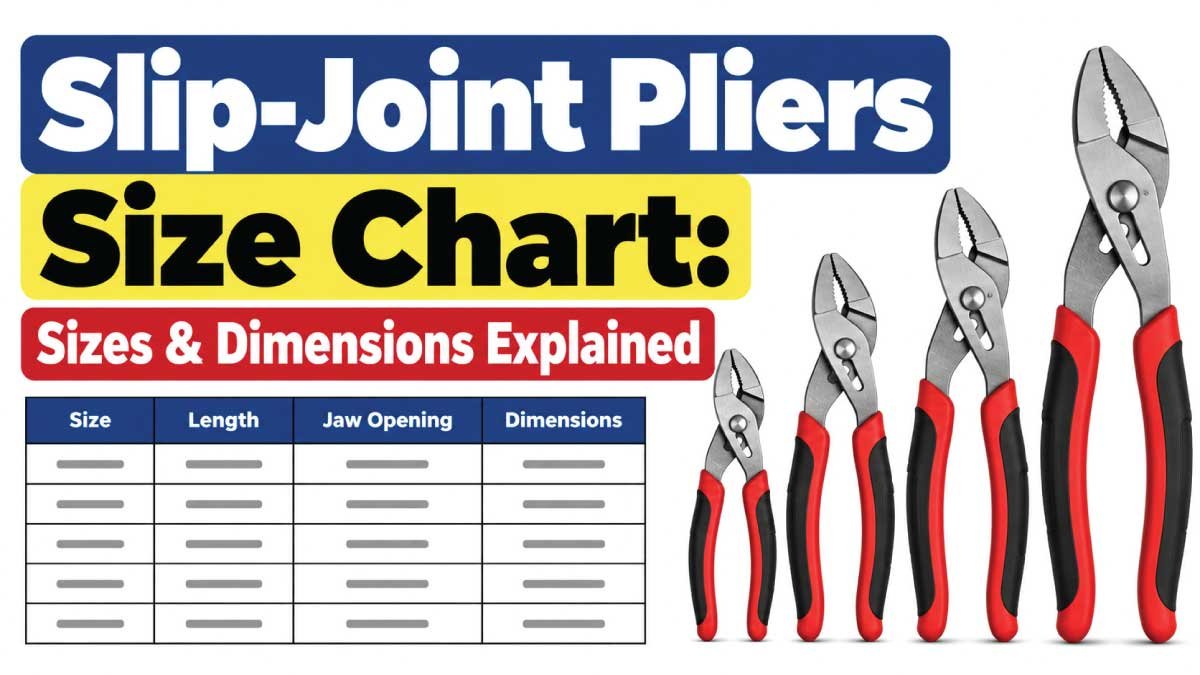
Slip-joint pliers are one of the most versatile hand tools for gripping, holding, turning, and adjusting a wide range of objects. Their adjustable pivot allows the jaws to open to different widths, making them useful for plumbing, automotive repairs, mechanical work, maintenance, and general household tasks.
Choosing the correct size, however, is not simply a matter of selecting the longest pair. Overall length, jaw opening, jaw profile, handle design, and intended application all affect how effectively a pair of slip-joint pliers performs.
This slip-joint pliers size chart explains common plier sizes, approximate dimensions, jaw capacity, applications, measurement methods, and selection considerations. Because dimensions can vary between manufacturers and specific designs, always verify the manufacturer’s specifications when an exact measurement is required.
What Are Slip-Joint Pliers?
Slip-joint pliers are adjustable gripping pliers with a pivot that can move between at least two positions. This sliding or repositionable joint changes the distance between the jaws, allowing the tool to grip objects of different sizes.
Unlike fixed-joint pliers, slip-joint pliers provide a useful combination of gripping flexibility and mechanical leverage. The jaws can generally be used for flat, irregular, or rounded objects, depending on their shape and tooth pattern.
Common features include:
- Adjustable slip-joint pivot
- Serrated gripping jaws
- Long handles for leverage
- Narrow or standard jaw profiles
- Integrated gripping areas
- Sometimes a built-in wire-cutting section
- Comfort or insulated handle coverings
They are commonly used when a job requires a general-purpose gripping tool rather than a highly specialized plier.
Slip-Joint Pliers Size Chart
The size of slip-joint pliers is commonly identified by their overall length, although jaw opening and gripping capacity are also important. The following chart provides practical common size categories rather than a universal manufacturing standard.
| Pliers Size | Approx. Overall Length | Typical Jaw Capacity | Typical Use |
|---|---|---|---|
| Small | 4–5 in | About 0.5–1.0 in | Light repairs, small components |
| Medium | 6–7 in | About 0.75–1.25 in | General maintenance |
| Standard | 8 in | About 1–1.5 in | General-purpose work |
| Large | 9–10 in | About 1.25–1.75 in | Plumbing and mechanical work |
| Extra Large | 12 in | About 1.5–2 in or more | Heavy-duty gripping |
Important: These are common size ranges, not universal specifications. Actual jaw capacity, handle length, jaw geometry, and opening can differ substantially between tool designs.
For everyday maintenance, 7-inch and 8-inch slip-joint pliers are common choices because they provide a useful balance between reach, grip, portability, and leverage.
Common Slip-Joint Pliers Sizes Explained
Different sizes are useful for different types of work. A smaller pair can provide better control in confined areas, while a longer pair generally provides greater leverage and can accommodate larger objects.
4-Inch Slip-Joint Pliers
Small slip-joint pliers are designed primarily for light-duty applications and smaller components.
Their compact handles make them useful where a full-size tool would be awkward. They may be suitable for small fasteners, light assembly work, craft-related mechanical tasks, and minor repairs.
The trade-off is reduced jaw capacity and leverage compared with larger pliers.
5-Inch Slip-Joint Pliers
Five-inch models provide slightly more gripping capacity while remaining compact. They can be useful for electronics-related mechanical assembly, light maintenance, small plumbing components, and household repairs where larger pliers are unnecessary.
They are particularly convenient when working in tight spaces.
6-Inch Slip-Joint Pliers
Six-inch pliers occupy a useful middle ground between compact and general-purpose tools. They offer more handle leverage than 4- or 5-inch models while remaining relatively easy to control.
They can work well for:
- General maintenance
- Small plumbing repairs
- Mechanical assembly
- Fastener gripping
- Holding small parts
7-Inch Slip-Joint Pliers
Seven-inch slip-joint pliers are practical general-purpose tools. They typically offer a larger jaw opening than compact models without becoming excessively bulky.
They are useful for maintenance technicians, mechanics, DIY users, and household repairs where moderate gripping force is required.
8-Inch Slip-Joint Pliers
Eight-inch models are among the most recognizable general-purpose slip-joint pliers. Their longer handles provide good leverage, while the adjustable jaw allows the tool to grip objects of different sizes.
They are frequently appropriate for:
- Plumbing maintenance
- Automotive work
- Mechanical repairs
- General workshop tasks
- Holding and turning components
- Gripping pipes and fittings within the tool’s capacity
10-Inch Slip-Joint Pliers
Ten-inch pliers provide greater reach and leverage than standard 6- to 8-inch models. Their longer handles can make them more effective when additional gripping force is needed.
However, larger does not automatically mean better. A 10-inch tool can be cumbersome when working around small components or confined spaces.
12-Inch Slip-Joint Pliers
Twelve-inch models are intended for larger and more demanding gripping applications. They provide substantial handle leverage and generally accommodate larger workpieces than compact models.
They are more appropriate for heavy maintenance and mechanical work than delicate assembly.
How Slip-Joint Pliers Are Measured
Understanding how pliers are measured prevents confusion when comparing different models.
Overall Length
Overall length is measured from the end of the handle to the front of the jaws when the tool is closed or in its normal reference position.
A pair described as 8-inch slip-joint pliers generally refers to its approximate overall length rather than its jaw opening.
This distinction is important because an 8-inch pair does not necessarily have an 8-inch gripping capacity.
Jaw Opening
Jaw opening describes how far the jaws can separate when the tool is opened.
For slip-joint pliers, jaw opening can change depending on which pivot position is selected. Therefore, two pairs with identical overall lengths can have different maximum capacities.
Jaw Length
Jaw length is the distance from the pivot region toward the gripping tip. Longer jaws may provide greater reach, while shorter jaws can offer more compact control.
Jaw geometry also affects how well the tool grips round, flat, or irregular objects.
Handle Length
Handle length influences leverage and hand positioning. Longer handles can increase mechanical advantage, but they can also make the tool less convenient in restricted spaces.
Slip-Joint Pliers Dimensions and Key Specifications
Size alone does not tell you everything about a pair of slip-joint pliers. When comparing tools, examine several dimensions and design characteristics together.
| Specification | What It Means | Why It Matters |
|---|---|---|
| Overall length | Total tool length | Affects reach and leverage |
| Jaw opening | Maximum distance between jaws | Determines gripping capacity |
| Jaw length | Length of gripping section | Affects reach and control |
| Jaw width | Width across the jaw area | Influences access and contact |
| Handle length | Length of gripping handles | Affects leverage and comfort |
| Pivot positions | Number of available joint settings | Controls adjustment range |
| Weight | Mass of the tool | Affects portability and fatigue |
| Jaw profile | Shape of gripping surfaces | Determines suitability for different objects |
Manufacturers may publish additional measurements such as maximum nut capacity, pipe-gripping capacity, handle span, or jaw thickness.
Types of Slip-Joint Pliers
Slip-joint pliers are available in several configurations. Their basic operating principle remains similar, but jaw design and handle construction can vary.
Standard Slip-Joint Pliers
Standard models feature serrated jaws and an adjustable pivot. They are designed as multipurpose gripping tools.
They are suitable for everyday mechanical and maintenance tasks where a general-purpose grip is sufficient.
Narrow-Jaw Slip-Joint Pliers
Narrow-jaw designs provide better access around smaller components or restricted areas.
They can be useful when a standard wide jaw cannot easily reach the workpiece.
Groove-Jaw Slip-Joint Pliers
Some slip-joint pliers use pronounced grooves or curved gripping areas to improve contact with round objects.
These designs can be useful for pipes, tubes, rods, and similarly shaped components.
Heavy-Duty Slip-Joint Pliers
Heavy-duty models generally feature larger dimensions, stronger construction, and handles designed for greater force.
They are intended for demanding maintenance applications rather than precision work.
Insulated-Handle Models
Some pliers are supplied with insulated or electrically rated handles. The presence of an insulated handle does not automatically make any pliers safe for energized electrical work.
For electrical applications, use a tool specifically rated and identified for the required electrical conditions.
How to Choose the Right Slip-Joint Pliers Size
The correct size depends primarily on the workpiece, available space, required leverage, and frequency of use.
Match the Jaw Capacity to the Workpiece
First determine approximately how large the object is. The jaws must open sufficiently to grip the workpiece without being forced beyond their intended range.
Avoid choosing a tool solely because its overall length sounds appropriate.
Consider Available Space
If you’re working inside an engine bay, cabinet, machinery enclosure, or narrow plumbing area, a large pair may be difficult to position.
A smaller tool can provide better maneuverability even if it offers less leverage.
Consider Required Force
For jobs involving stubborn components, a longer handle can provide greater leverage. However, the tool must still be appropriate for the workpiece and manufacturer-rated use.
Do not compensate for an undersized tool by applying excessive force.
Consider Frequency of Use
For occasional household repairs, a standard medium-size pair may cover many common applications.
For professional maintenance, it can be practical to keep multiple sizes available so the tool can be matched to the job.
Also Read:
Slip-Joint Pliers Size Comparison
The following comparison shows how common size groups differ in practical use.
| Size Group | Portability | Leverage | Typical Access | Best Suited For |
|---|---|---|---|---|
| 4–5 in | Excellent | Low | Excellent | Small repairs |
| 6–7 in | Very good | Moderate | Very good | General maintenance |
| 8 in | Good | Good | Good | General-purpose work |
| 9–10 in | Moderate | High | Moderate | Larger components |
| 12 in | Low | Very high | Limited | Heavy-duty applications |
This comparison is about general tool characteristics. Actual performance depends on jaw geometry, construction, pivot design, and manufacturer specifications.
Slip-Joint Pliers vs Other Pliers
Slip-joint pliers are versatile, but they are not the best choice for every task.
Slip-Joint vs Tongue-and-Groove Pliers
Tongue-and-groove pliers typically provide a much wider range of jaw adjustment than traditional slip-joint pliers. They are especially useful for larger pipes and fittings.
Slip-joint pliers are generally more compact and convenient for smaller general-purpose work.
Slip-Joint vs Groove-Joint Pliers
Groove-joint pliers use an adjustable groove or channel system that provides multiple jaw positions. They generally offer a larger adjustment range.
Slip-joint pliers have a simpler mechanism and are often convenient for routine gripping tasks.
Slip-Joint vs Combination Pliers
Combination pliers usually combine gripping jaws with cutting edges. Their fixed pivot makes them different from adjustable slip-joint designs.
Choose combination pliers when cutting and gripping are both required. Choose slip-joint pliers when adjustable jaw positioning is more important.
Slip-Joint vs Water-Pump Pliers
Water-pump pliers are designed around a wider adjustment mechanism and are commonly used for larger round objects and plumbing applications.
Slip-joint pliers are often easier to control for smaller general-purpose gripping tasks.
Also Read:
Common Applications of Slip-Joint Pliers
The adjustable jaw arrangement makes these pliers useful across many maintenance environments.
Common applications include:
- Gripping nuts and fittings
- Holding small mechanical components
- Turning suitable fasteners
- Working with rods and pins
- Plumbing maintenance
- Automotive repairs
- Appliance maintenance
- Workshop assembly
- General household repairs
- Holding parts during assembly
- Removing or positioning certain components
Their versatility comes from the ability to change jaw position rather than from being specialized for one particular task.
How to Use Slip-Joint Pliers Correctly
Using the correct technique improves grip and reduces the likelihood of damaging the workpiece.
Select the Correct Pivot Position
Open the handles and move the joint into the position that provides enough jaw opening for the workpiece.
Do not select a larger opening than necessary if a closer position provides a better grip.
Position the Jaws Properly
Place the gripping surfaces as squarely as practical against the workpiece. For rounded objects, align the jaws so the serrations engage securely.
Avoid gripping only the very tips when the workpiece can be positioned deeper into the jaws.
Apply Controlled Pressure
Close the handles gradually until the jaws hold the workpiece firmly. Excessive force can damage soft materials or slip the tool from the object.
For stubborn components, use a tool specifically designed for the required task rather than continuously increasing force on general-purpose pliers.
Also Read:
Common Mistakes When Choosing Slip-Joint Pliers
Several mistakes can reduce tool effectiveness or damage components.
Choosing only by overall length: An 8-inch tool may have a different jaw capacity from another 8-inch model.
Ignoring jaw shape: Serrated jaws, narrow jaws, and curved jaws behave differently.
Using oversized pliers in confined spaces: Larger handles may restrict movement.
Using undersized pliers for large workpieces: This can encourage excessive force.
Using pliers as a wrench: Pliers are not a substitute for the correct wrench when a precise fastener fit is required.
Gripping delicate finished surfaces directly: Serrated jaws can leave marks.
Ignoring manufacturer limitations: Tool capacity and intended applications vary.
Using damaged pliers: Excessive wear, damaged teeth, or a compromised pivot can reduce safe control.
Tips for Measuring an Existing Pair
If you already own slip-joint pliers and want to identify their size, you can measure several characteristics.
Step 1: Measure Overall Length
Use a ruler or tape measure to measure from the handle end to the front of the jaws.
Record the result in inches or millimeters.
Step 2: Measure Maximum Jaw Opening
Open the jaws to their widest intended position and measure the gap between the gripping surfaces.
Avoid forcing the handles beyond their normal operating range.
Step 3: Count Pivot Positions
Check how many adjustment positions are available. The number and arrangement of positions can vary between designs.
Step 4: Record Jaw Dimensions
If detailed identification is needed, measure jaw length, width, and thickness. These dimensions can help distinguish between otherwise similar tools.
Maintenance and Care
Proper maintenance helps preserve the movement and gripping performance of slip-joint pliers.
Keep the pivot area clean and free of debris. If the manufacturer recommends lubrication, apply an appropriate lubricant sparingly to the moving joint.
Inspect the tool regularly for:
- Loose or damaged pivot components
- Excessive jaw wear
- Broken or cracked handles
- Corrosion
- Damaged gripping teeth
- Restricted joint movement
- Misaligned jaws
Store pliers in a dry environment when possible. Wipe away moisture and contaminants after use, particularly when the tool has been exposed to corrosive substances.
Frequently Asked Questions
What is the most common slip-joint pliers size?
Eight-inch slip-joint pliers are a common general-purpose size. They offer a practical balance between gripping capacity, leverage, and portability. However, the best size depends on the workpiece and application.
Are 6-inch or 8-inch slip-joint pliers better?
Neither size is universally better. 6-inch pliers are generally easier to maneuver around smaller components, while 8-inch pliers typically provide more leverage and capacity.
What size slip-joint pliers are good for plumbing?
Medium and larger sizes can be useful for plumbing maintenance, but the appropriate choice depends on the pipe or fitting size. For larger plumbing components, tongue-and-groove or water-pump pliers may provide a more suitable adjustment range.
How do I know what size my slip-joint pliers are?
Measure their overall length from the end of the handle to the front of the jaws. The resulting measurement gives you the approximate tool size, such as 6, 8, or 10 inches.
Can slip-joint pliers replace a wrench?
They can grip and turn some suitable components, but they should not automatically replace a correctly sized wrench. A wrench generally provides a more precise fit on compatible fasteners and can reduce surface damage.
Do larger slip-joint pliers grip larger objects?
Generally, larger tools can provide greater jaw capacity and leverage, but size alone does not determine capacity. Always check the specific jaw-opening and manufacturer specifications.
What are slip-joint pliers mainly used for?
They are mainly used for general gripping, holding, turning, and adjustment tasks. Their adjustable pivot makes them useful for objects of different sizes.
Are slip-joint pliers suitable for electrical work?
Only pliers specifically designed and appropriately rated for electrical work should be considered for electrical applications. Ordinary slip-joint pliers should not be treated as electrically safe simply because their handles have a plastic covering.
Key Points to Remember
A slip-joint pliers size chart is useful for comparing tool dimensions, but overall length is only one part of the selection process. Jaw opening, jaw shape, pivot adjustment, handle length, and intended application all influence performance.
For many general maintenance tasks, medium-sized models provide a practical balance. Smaller pliers are advantageous where access and control matter, while larger models can provide additional leverage and gripping capacity.
Before purchasing or using a pair, consider the size of the workpiece, available working space, required force, and the type of grip needed. When exact capacity or dimensional compatibility matters, verify the individual manufacturer’s specifications rather than relying only on nominal plier size.
Conclusion
The right slip-joint pliers size depends on more than the number printed in the product description. Overall length, jaw opening, jaw geometry, leverage, and workspace should all be considered together.
Small 4- to 6-inch models are convenient for light and confined work, while 7- to 8-inch pliers are versatile choices for general maintenance. Larger 9- to 12-inch tools can provide additional reach and leverage for bigger jobs.
Use the slip-joint pliers size chart as a starting point, then compare the actual jaw capacity and specifications of the tool before selecting it for a particular application.

Engineer Hassan is a Mechanical Engineer with 16+ years of hands-on experience in mechanical hardware, fasteners, and workshop tools. He focuses on size selection, thread identification, and measurement, helping users choose the correct components with accuracy and safety.