
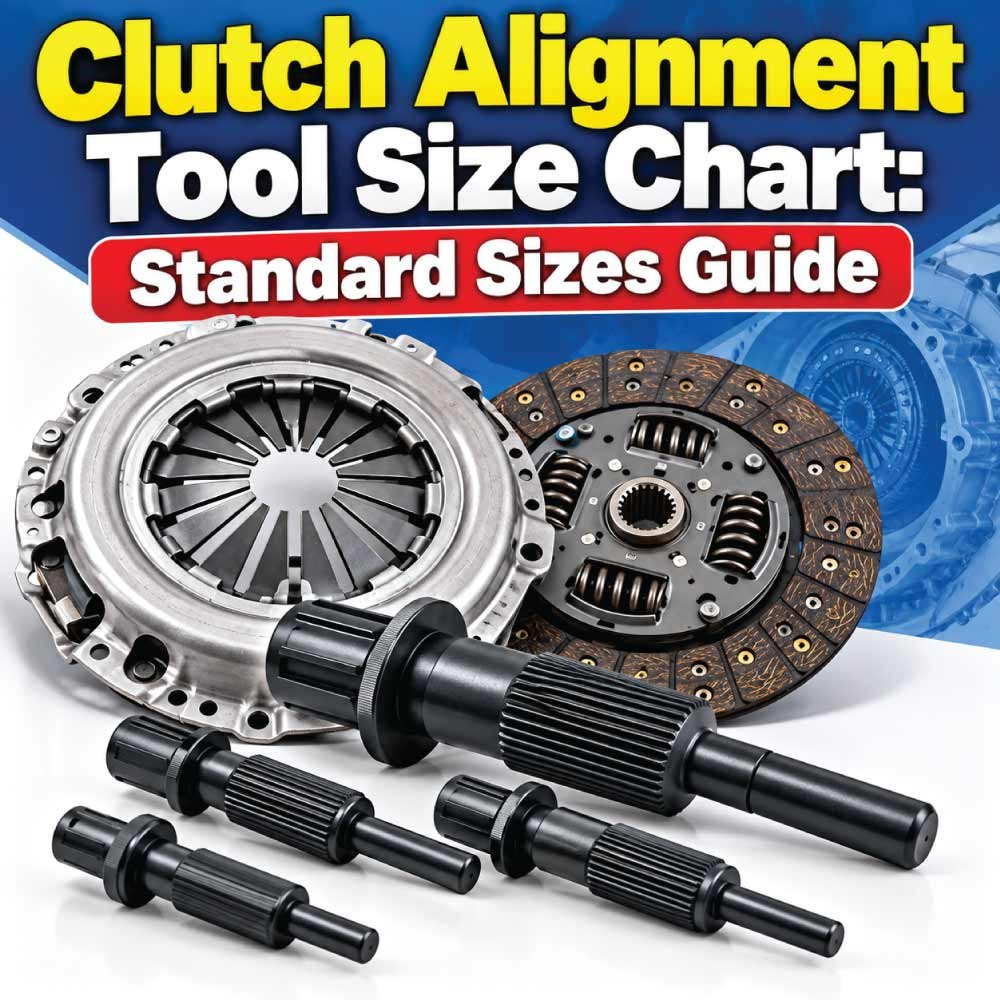
Choosing the correct clutch alignment tool is essential when installing a manual transmission clutch. The tool centers the clutch disc on the flywheel so the transmission input shaft can enter the disc and pilot bearing or bushing without excessive force. A tool that is too large, too small, or has the wrong spline pattern can make installation difficult or produce poor alignment.
A clutch alignment tool size chart is useful because clutch tools are not sized by overall length alone. The important dimensions include the pilot tip diameter, spline diameter, spline count, spline profile, and shaft fit. Different vehicles and clutch kits can use substantially different combinations.
This guide explains clutch alignment tool dimensions, common tool types, how to measure your clutch, how to select the correct tool, and what to check before installation.
What Is a Clutch Alignment Tool?
A clutch alignment tool is a cylindrical or shaft-shaped device used to position the clutch disc concentrically with the flywheel and pilot bearing. During clutch installation, the disc is sandwiched between the flywheel and pressure plate. Without proper alignment, the transmission input shaft may not pass through the center of the disc.
The tool temporarily occupies the center of the clutch disc and simulates the position of the transmission input shaft.
A typical alignment tool has three important areas:
- Pilot tip: Fits into the pilot bearing or pilot bushing.
- Spline section: Fits through the clutch disc hub.
- Handle or body: Allows the mechanic to hold and position the tool.
Some tools are designed for one specific clutch application, while others use interchangeable pilot adapters or expandable sections.
Why Correct Tool Size Matters
The tool must hold the clutch disc in the correct position while the pressure plate is tightened. If the pilot section is significantly undersized, the disc may move away from the true center. If the spline section does not properly match the clutch hub, the tool may not support the disc correctly.
Proper alignment helps:
- Position the clutch disc centrally.
- Make transmission installation easier.
- Reduce the chance of damaging the disc hub.
- Prevent unnecessary force during transmission installation.
- Keep the pilot area correctly positioned.
- Improve the overall clutch installation process.
The tool itself does not determine clutch adjustment, pedal feel, or clutch engagement. Its primary job is accurate disc alignment during assembly.
Clutch Alignment Tool Size Chart
There is no single universal clutch alignment tool size. The correct dimensions depend on the clutch disc, transmission input shaft, pilot bearing or bushing, and vehicle application.
The following chart provides a practical way to understand the dimensions that must be matched rather than presenting unsupported universal vehicle specifications.
| Tool Dimension | What It Matches | Why It Matters |
|---|---|---|
| Pilot tip diameter | Pilot bearing or bushing bore | Centers the tool and clutch disc |
| Spline outside diameter | Clutch disc hub spline area | Supports the disc hub |
| Spline count | Transmission input shaft/clutch hub | Ensures correct engagement |
| Spline profile | Matching clutch hub | Prevents incorrect tool fit |
| Pilot tip length | Pilot bearing/bushing depth | Provides adequate engagement |
| Spline section length | Clutch hub width | Keeps the disc supported |
| Overall tool length | Installation clearance | Provides sufficient working access |
| Handle/body diameter | Mechanic’s hand or adapter system | Affects handling, not clutch fit |
The most important point is that a tool’s overall diameter alone does not identify whether it is correct. Two tools can have similar external dimensions while using different pilot and spline configurations.
Key Clutch Alignment Tool Dimensions
Understanding the individual measurements makes it much easier to compare tools.
Pilot Tip Diameter
The pilot tip is the portion inserted into the pilot bearing or pilot bushing. Its diameter needs to correspond closely with the opening it is designed to enter.
The pilot tip is one of the most important measurements because it establishes the center point around which the clutch disc is aligned.
A tool with the wrong pilot diameter may:
- Fail to enter the pilot bearing.
- Fit excessively loosely.
- Sit off-center.
- Prevent proper transmission installation.
Always measure the actual pilot bearing or bushing opening when the application information is uncertain.
Spline Diameter
The spline section passes through the clutch disc hub. Its dimensions must correspond to the clutch hub’s internal spline configuration.
Spline diameter alone is not enough to identify a compatible tool. A correct match can require both diameter and spline count, along with the appropriate spline form.
Spline Count
Spline count refers to the number of teeth or ridges around the clutch hub’s internal spline.
For example, two clutch hubs may have similar diameters but different numbers of splines. A tool designed for one cannot automatically be assumed to work with the other.
This is why product descriptions that list only a diameter can be insufficient for selecting an alignment tool.
Pilot Tip Length
Pilot tip length determines how far the alignment tool can enter the pilot bearing or bushing.
The tip should engage enough of the pilot area to stabilize the tool without creating an interference problem. Exact requirements vary with clutch and engine configuration.
Spline Section Length
The spline section needs to extend through the clutch hub sufficiently to support the disc while the pressure plate is installed.
An alignment tool does not necessarily need to duplicate the complete length of the transmission input shaft. Its purpose is to provide enough support to hold the disc correctly during installation.
Common Types of Clutch Alignment Tools
Several clutch alignment tool designs are available. Their differences affect how they fit different clutch assemblies.
Single-Size Alignment Tool
A single-size tool is designed around a particular clutch hub and pilot arrangement.
These tools are straightforward to use and can provide a precise fit when the application is known.
They are particularly useful when:
- The clutch kit specifies a dedicated tool.
- The vehicle application is known.
- The clutch has an unusual hub configuration.
- Repeat work involves the same clutch type.
Universal Clutch Alignment Tool
Universal tools use interchangeable components or multiple sizing features to accommodate a wider range of clutch discs.
They are convenient for general repair work because one kit can cover numerous applications.
However, universal does not mean that every possible clutch will fit. The actual pilot and hub dimensions still need to match the available adapters.
Expandable Alignment Tool
Expandable designs use adjustable fingers or expanding sections to grip the inside of the clutch hub.
Their advantage is flexibility. Instead of relying on a fixed spline profile, the mechanism can accommodate different hub openings within its designed range.
Correct adjustment remains important because excessive expansion can damage the hub or create unnecessary resistance.
Spline-Type Alignment Tool
Spline-style tools reproduce the clutch hub’s spline geometry more closely. They can provide strong support through the hub when the correct application-specific tool is available.
These are often useful when an exact clutch kit application requires a particular hub configuration.
How to Measure for a Clutch Alignment Tool
When the correct tool is not obvious, measuring the clutch assembly is more reliable than choosing by appearance.
Step 1: Identify the Clutch Application
Start with the vehicle or equipment information.
Record:
- Vehicle make and model.
- Model year.
- Engine configuration.
- Transmission type.
- Clutch manufacturer.
- Clutch kit or part number, if available.
This information can significantly narrow down the correct tool.
Step 2: Measure the Pilot Opening
Use a suitable measuring instrument to determine the diameter of the pilot bearing or pilot bushing opening.
A caliper is generally more useful than a ruler because the difference between similar diameters can be difficult to determine visually.
Measure carefully and avoid forcing the instrument into the bearing.
Step 3: Measure the Clutch Hub
Measure the internal dimensions of the clutch disc hub.
Important observations include:
- Approximate spline outside diameter.
- Number of splines.
- Hub opening.
- Hub length.
- Spline profile.
If the clutch manufacturer provides these specifications, use those dimensions rather than relying solely on visual measurement.
Step 4: Compare the Tool Dimensions
Compare the measured clutch and pilot dimensions with the alignment tool specifications.
A suitable tool should provide:
- Correct pilot engagement.
- Correct clutch hub support.
- Compatible spline or expanding mechanism.
- Adequate length for the clutch assembly.
- No interference with surrounding components.
Step 5: Perform a Dry Fit
Before installing the pressure plate, place the alignment tool through the clutch disc and into the pilot area.
The tool should sit naturally and support the disc without requiring excessive force.
Do not hammer an incorrectly sized tool into place.
How to Choose the Correct Clutch Alignment Tool
The best selection method is to match the tool to the actual clutch assembly, not simply to the vehicle.
Check the Clutch Kit First
Many replacement clutch kits include an alignment tool or specify the appropriate tool dimensions.
If an alignment tool came with the clutch kit, it should normally be the first option to consider, provided the clutch components match the kit.
Match the Pilot and Hub
The pilot tip and clutch hub section serve different purposes.
A tool may fit the clutch hub but still have the wrong pilot diameter. Conversely, the pilot may fit while the hub section does not properly support the disc.
Both areas must be considered.
Confirm Spline Compatibility
When using a fixed spline tool, verify:
- Spline count.
- Spline diameter.
- Spline configuration.
- Hub compatibility.
Never assume that a similar-looking spline is automatically compatible.
Consider the Tool Material
Alignment tools are commonly manufactured from plastic, composite materials, aluminum, or steel.
Material selection can influence durability and rigidity.
For occasional service work, a suitable molded tool may be adequate. For frequent professional use, a more durable reusable tool can be advantageous.
Also Read:
Clutch Alignment Tool Size Comparison
Different tool designs solve the alignment problem in different ways.
| Tool Type | Main Sizing Method | Flexibility | Typical Advantage |
|---|---|---|---|
| Single-size | Fixed pilot and hub dimensions | Low | Simple and direct |
| Spline type | Spline count and diameter | Medium | Accurate hub support |
| Universal | Interchangeable adapters | High | Covers many applications |
| Expandable | Adjustable hub engagement | High | Useful for varied hubs |
| Kit-based | Multiple dedicated pieces | High | Broad application coverage |
A universal tool is not automatically better than an application-specific tool. The important factor is whether the tool provides the required alignment for the particular clutch.
Signs You Have the Wrong Size Tool
Several problems can indicate an incorrect alignment tool.
The Pilot Tip Will Not Enter
If the pilot tip does not fit into the pilot bearing or bushing, check the diameter first.
Do not force it. A larger-than-required pilot tip can damage the bearing, bushing, or tool.
The Tool Is Extremely Loose
A small amount of clearance may be normal depending on the tool design, but excessive movement can prevent accurate centering.
If the tool moves substantially inside the pilot opening, verify the specified pilot diameter.
The Spline Section Does Not Fit the Hub
A fixed spline tool should enter the clutch hub in the manner intended by its design.
If the splines do not engage correctly, check the spline count and diameter rather than forcing the tool.
The Clutch Disc Moves Off Center
If the disc shifts significantly while the pressure plate is being installed, the tool may not be supporting the hub correctly.
The tool should remain positioned until the pressure plate has secured the disc.
Also Read:
Why Clutch Disc Alignment Is Important
A clutch disc that is not centered can interfere with transmission installation.
The transmission input shaft must pass through the center of the clutch disc and reach the appropriate pilot area. If the disc is displaced, the shaft may contact the hub or fail to enter smoothly.
Correct alignment can make installation substantially easier because the transmission shaft approaches the clutch assembly along the intended centerline.
However, an alignment tool cannot compensate for every mechanical problem. If a transmission still refuses to seat after correct alignment, other issues should be investigated rather than using additional force.
Common Mistakes When Using a Clutch Alignment Tool
Even the correct tool can produce poor results if it is used incorrectly.
Choosing by Appearance
Tools can look almost identical while having different pilot diameters or spline configurations.
Always verify measurements or application compatibility.
Ignoring the Pilot Bearing
Some installers focus only on the clutch hub.
The pilot bearing or bushing is equally important because it provides the central reference point for the tool.
Forcing the Transmission
If the transmission will not seat properly, do not use the transmission bolts to pull it into position.
This can place unnecessary loads on clutch components and may indicate a misalignment or another installation problem.
Removing the Tool Too Early
The alignment tool should remain in place while the pressure plate is being positioned and tightened according to the clutch manufacturer’s procedure.
Using an Incorrect Universal Adapter
A universal kit still has dimensional limits. Selecting an adapter simply because it is close in size can result in poor centering.
Also Read:
Clutch Alignment Tool Installation Tips
Use the following practices for a cleaner and more reliable installation:
- Inspect the clutch disc before installation.
- Confirm the correct orientation of the disc.
- Verify the pilot bearing or bushing condition.
- Match the alignment tool to the clutch hub.
- Insert the tool straight rather than at an angle.
- Center the disc before tightening the pressure plate.
- Tighten the pressure plate according to the applicable service instructions.
- Keep the alignment tool in position until the disc is secured.
- Remove the tool carefully after installation.
- Never use excessive force to make an incompatible tool fit.
Cleanliness is also important. Avoid contaminating friction surfaces with grease, oil, or other substances unless the component manufacturer specifically calls for lubrication in a particular location.
Application-Specific Considerations
Clutch alignment tools are used across many types of manual-transmission systems, but the dimensions can differ substantially.
Automotive Clutches
Passenger vehicles may use different clutch hub and pilot configurations depending on engine and transmission design.
Vehicle model alone may not always be enough, particularly where multiple transmission options were offered.
Truck and Commercial Clutches
Heavy-duty clutch systems can use different hub arrangements and larger components than many passenger vehicles.
For these applications, manufacturer specifications and clutch part numbers become especially important.
Performance and Modified Vehicles
Modified vehicles may use aftermarket clutch kits that differ from the original equipment configuration.
In such cases, selecting the tool based only on the original vehicle specifications can lead to an incorrect match.
The clutch kit part number and actual clutch dimensions should take priority.
Frequently Asked Questions
Are clutch alignment tools universal?
Some are designed as universal tools, while others are application-specific. A universal tool usually achieves flexibility through interchangeable adapters or an expandable mechanism. It still has a defined operating range, so the actual clutch dimensions must be checked.
What is the most important clutch alignment tool measurement?
There is no single measurement that works for every application. The pilot diameter, spline configuration, and clutch hub dimensions collectively determine compatibility.
Can I use a smaller alignment tool?
A smaller tool may not properly center or support the clutch disc. Whether a particular amount of clearance is acceptable depends on the tool design. If the disc can move noticeably around the tool, verify the specified dimensions.
Can I make a clutch alignment tool?
A temporary homemade alignment tool may be possible for some applications, but it must reproduce the necessary pilot and hub dimensions accurately. An improperly sized tool can leave the clutch off-center, so a correctly specified tool is generally preferable.
Does the alignment tool stay in the clutch?
No. It is a temporary installation aid. The tool is removed after the clutch disc has been secured by the pressure plate and before final transmission installation.
Why won’t my transmission slide into place after using the tool?
Possible causes include incorrect clutch disc orientation, inadequate alignment, an incompatible tool, a pilot bearing issue, transmission alignment problems, or another mechanical obstruction. Do not force the transmission into position with its mounting bolts.
Does clutch disc diameter determine alignment tool size?
Not by itself. The outside diameter of the clutch disc does not determine the alignment tool’s pilot or spline dimensions. The hub and pilot arrangement are more directly relevant.
How do I know whether a universal tool fits my clutch?
Check the universal tool’s supported pilot diameter range and hub or spline adjustment range against the clutch assembly. The tool must provide secure centering without excessive movement.
Final Clutch Alignment Tool Selection Checklist
Before installing a clutch, verify these points:
- Clutch part number: Confirm the exact replacement clutch.
- Pilot diameter: Match the pilot tip to the pilot bearing or bushing.
- Spline count: Confirm the number of clutch hub splines when applicable.
- Spline diameter: Compare the hub and tool specifications.
- Spline profile: Ensure the tool is designed for the hub configuration.
- Tool length: Confirm sufficient engagement and working clearance.
- Tool type: Choose fixed, spline, universal, or expandable based on the clutch.
- Disc orientation: Install the clutch disc in the correct direction.
- Pressure plate procedure: Follow the applicable installation instructions.
- Final alignment: Ensure the disc remains centered before removing the tool.
Conclusion
A clutch alignment tool is a simple but important installation aid. The correct size depends primarily on the pilot diameter, clutch hub dimensions, spline count, spline profile, and tool design rather than the overall tool length alone.
When selecting a tool, start with the clutch kit or part number, verify the pilot and hub dimensions, and compare them with the tool specifications. If the application is uncertain, measuring the actual components is safer than choosing a tool based on appearance.
Using the correct clutch alignment tool size helps keep the disc centered and makes transmission installation smoother while reducing the temptation to force components together.

Engineer Hassan is a Mechanical Engineer with 16+ years of hands-on experience in mechanical hardware, fasteners, and workshop tools. He focuses on size selection, thread identification, and measurement, helping users choose the correct components with accuracy and safety.