
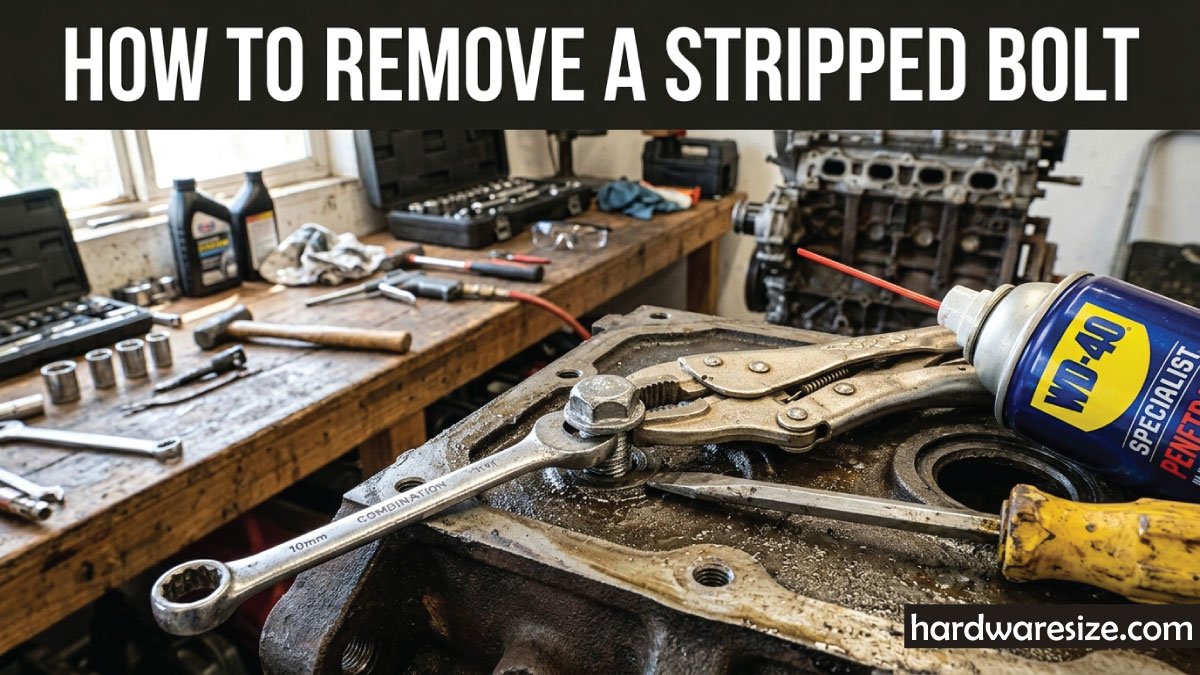
One of those little issues which may become a big problem is the stripped bolt. You begin with a straightforward repair, use a wrench or screwdriver, and the head of the bolt is rounded or chewed or even smooth all the way.
At that stage, the conventional tools fail and frustration sets in. The good news? You can not end your project with a stripped bolt. The correct method, equipment and a fair share of patience will see you able to strip even the most stubborn stripped bolt, without causing any harm to the adjacent components.
This guide takes you through the established techniques, beginning with the simplest solutions to the more complex techniques such that you can select the one that best fits your case.
What Is a Stripped Bolt?
A stripped bolt is a bolt whose head or threads are damaged to the point where standard tools can no longer grip it properly. This usually happens when:
- The wrong size tool is used
- Too much force is applied
- The bolt is rusted or seized
- Power tools are used carelessly
When the bolt head is rounded, or the internal drive (such as Phillips, Allen or Torx) is destroyed, it must be removed with some difficulty, however not with impossibility.
Tools You May Need
It is much easier and safer to remove a stripped bolt with the right tools. Not all of these items might be needed on the list, yet the tools are significant under various circumstances.
Adequate planning can eliminate additional destruction and time is saved in the process of removal.
Before beginning to work, prepare some usual tools. You will not need all of them, yet it is good to have a choice.
- Penetrating oil (WD-40, PB Blaster, etc.)
- Adjustable wrench or locking pliers
- Hammer
- Flathead screwdriver
- Bolt extractor set
- Drill and drill bits
- Heat source (heat gun or propane torch)
- Safety gloves and eye protection
Step 1: Apply Penetrating Oil and Wait
This is the simplest and the least harmful procedure and it must always be taken first. Spray in oil generously on the head and thread of the bolts.
The oil gets into crevices, loosening rust and corrosion which could be holding the bolt. Allow to rest at least 10-15 minutes.
In the case of severely rusted bolts, one hour, and even a night, can be a giant difference. Waiting then attempt to remove the bolt with the appropriate size tool. Use gradual forms of pressure instead of abrupt pressure.
Step 2: Use a Slightly Smaller or Tighter Tool
If the bolt head is partially stripped but not completely destroyed, switching tools can help.
- Try a slightly smaller socket or Allen key
- Tap it gently into the bolt head with a hammer
- Apply steady pressure while turning slowly
This method works especially well for hex and Allen bolts where the internal edges are only mildly damaged.
Step 3: Tap the Bolt to Break the Grip
The bolt is occasionally resistant due to rust or thread locking compound. Some controlled taps would do. Any hammer may be used directly on the head of the bolt and struck a few times.
This vibration has the ability to rupture the rust bonds and enable the flow of penetrating oil into the threads further. After tapping, try loosening the bolt again.
Step 4: Use Locking Pliers for External Grip
When the bolt head is rounded and yet uncovered, locking pliers (Vise-Grips) may prove to be quite effective. Grasp the pliers firmly on the head of the bolt.
The firmer the hold, the more successful it is possible. Turn the pliers in a slow, steady manner as soon as it is locked.
No jerking movements, that may slide and do more harm. This technique is effective when the head of the bolts has enough sticking out to hold.
Step 5: Cut a Slot for a Flathead Screwdriver
When the Phillips or Allen head of bolts is ruined, it is possible to make another opening to the rescue. A rotary tool or a hacksaw is used to cut a straight line across the bolt head.
The slot must not be too shallow to allow a flathead screwdriver to fit in. Use a big flat headed screwdriver, push it down and turn it gradually. Surprisingly, this method can be used on medium-size bolts.
Step 6: Apply Heat to Loosen the Bolt
Heat causes metal to expand. It can be used to break rust and loosen seized bolts when done with great caution.
Use a heat gun or propane torch to heat the bolt head for 20–30 seconds. Avoid overheating nearby plastic or rubber parts. Once heated, let it cool slightly, then apply penetrating oil.
The cooling is done to assist in drawing the oil further down the threads. Attempt to take off the bolt when it is still warm.
⚠️ Safety tip: Always wear gloves and eye protection when using heat.
Step 7: Use a Bolt Extractor Kit
Bolt extractors are specifically designed for stripped bolts and are often the most reliable solution.
How to use a bolt extractor:
- Select the correct extractor size
- Tap it into the stripped bolt head with a hammer
- Attach a wrench or socket
- Turn counterclockwise slowly
The extractor’s reverse threads bite into the bolt, allow it to turn out. Go slow—rushing can snap the extractor, which is much harder to drill out.
Step 8: Drill the Bolt Head Off
The last and most violent method is drilling in case nothing can be done. A drill bit just a bit larger than the bolt head should be used and straight into the center they should be drilled.
After the head is removed, move the part that is still attached. Then you may attached the rest of the bolt shaft with pliers and twist it out. This technique is patient and accurate and effective even in drastic situations.
Common Mistakes to Avoid
There are so many stripped bolts which can be prevented by tiny yet dangerous errors. The improper tool size or excess force at a premature stage is likely to ruin the bolt head.
It is even worse when one skips penetrating oil and runs through the process and failure to wear the safety gear will cause injuries.
- Using the wrong tool size
- Apply excessive force too early
- Skip penetrating oil
- Rushing the process
- Not wear safety gear
Take your time often saves tools, bolts, and nerves.
How to Prevent Stripped Bolts in the Future
Use of stripped bolts is time-saving, tool-saving and frustration-saving. Select the right tool size and tighten bolts to appropriate torque.
Performing anti-seize on exposed bolts, use of worn tools should be avoided, and use of hand tools should be used when doing small jobs which can be very critical.
Prevention is always easier than removal. Follow these tips to avoid stripped bolts altogether:
- Always use the correct tool size
- Apply anti-seize compound on bolts exposed to moisture
- Tighten bolts to recommended torque settings
- Avoid cheap or worn-out tools
- Use hand tools instead of power tools when precision matters
Final Thoughts
One of the things every DIYer, mechanic and homeowner should know is how to take off a stripped bolt. Although a stripped bolt may seem to be a catastrophe in the initial stage, the appropriate approach,
In this case, properly applied will resolve the issue almost every time. Begin with the most basic methods such as penetrating oil, tool adjustments, proceed to locking pliers, heat or extractors when necessary.
Only drill as a last resort. You will save time, money and frustration that you would have wasted in future projects with practice.
Discover More:

Engineer Hassan is a Mechanical Engineer with 16+ years of hands-on experience in mechanical hardware, fasteners, and workshop tools. He focuses on size selection, thread identification, and measurement, helping users choose the correct components with accuracy and safety.