
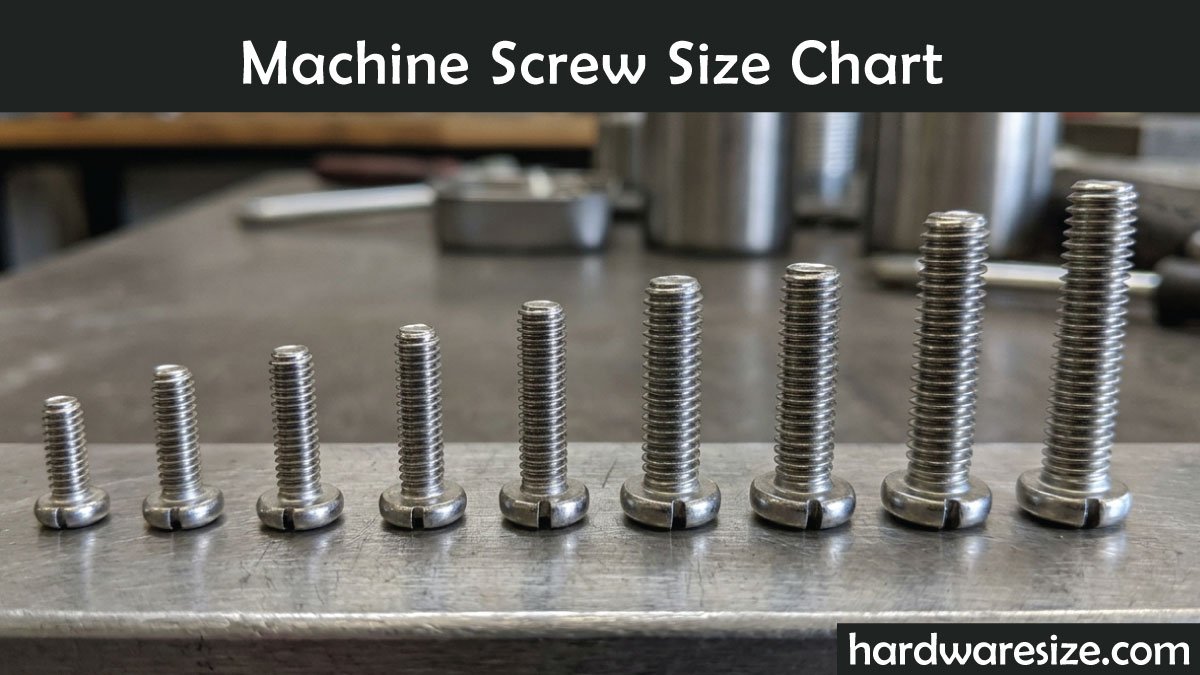
Machine screws can be tiny though they are essential elements of mechanical ensembles, electronics, auto parts and even industrial machines.
Not only is the issue of getting the right size about matching diameter but thread pitch, length, head style, material strength, and the application requirements.
This expanded guide explains machine screw size charts in detail, including imperial and metric systems, how to measure screws correctly, how to read size markings, and how to choose the right screw for your project.
What Is a Machine Screw?
A machine screw is a precision-threaded fastener designed to be used with a pre-tapped hole or a nut. Unlike self-tapped or wood screws, machine screws have consistent, uniform thread along the entire shaft.
They are typically used in:
- Metal-to-metal fasten
- Electrical equipment
- Industrial machinery
- Automotive components
- Appliance assembly
Machine screws are accurate in their clamping force since they are designed with tight tolerances. This renders them suitable in the applications where vibration resistance and alignment are important.
They can be in stainless steel, alloy steel, brass finished and coated finish depending on the environmental conditions.
Understand Machine Screw Sizing Systems
Machine screws are categorized under two major sizing systems:
- Imperial (Inches – UNC/UNF)
- Metric (Millimeters – ISO Standard)
There are various systems in which diameter and thread pitch are defined. You have to comprehend both of them in case you deal with international hardware or imported equipment.
Imperial Machine Screw Size Chart (UNC / UNF)
In the imperial system, machine screw sizes start with a number (#0, #2, #4, etc.) before move to fractional sizes like 1/4″, 5/16″, and 3/8″.
The number represents the major diameter. As the number increases, the diameter increases.
Common Imperial Machine Screw Chart
| Size | Major Diameter (inches) | UNC (TPI) | UNF (TPI) |
|---|---|---|---|
| #2 | 0.0860 | 56 | 64 |
| #4 | 0.1120 | 40 | 48 |
| #6 | 0.1380 | 32 | 40 |
| #8 | 0.1640 | 32 | 36 |
| #10 | 0.1900 | 24 | 32 |
| 1/4″ | 0.2500 | 20 | 28 |
| 5/16″ | 0.3125 | 18 | 24 |
| 3/8″ | 0.3750 | 16 | 24 |
What Does TPI Mean?
TPI stands for Threads Per Inch.
- Higher TPI = finer thread
- Lower TPI = coarser thread
Fine threads provide stronger holding in high-vibration environments. Coarse threads are faster to assemble and better for softer materials.
Metric Machine Screw Size Chart
Metric machine screw sizes are based on the international AS ISO standard and are extensively used in motor vehicles, industrial and mechanical purposes.
Their labeling system is simple and can be easily deciphered and their size identification is quicker and there are less chances of a thread not matching during assembly.
Metric machine screws use a simpler format:
M + Diameter (mm) × Pitch (mm)
For example: M6 × 1.0
- M6 = 6mm diameter
- 1.0 = 1mm thread pitch
Common Metric Machine Screw Chart
| Size | Major Diameter (mm) | Standard Pitch (mm) | Fine Pitch (mm) |
|---|---|---|---|
| M3 | 3.0 | 0.5 | 0.35 |
| M4 | 4.0 | 0.7 | 0.5 |
| M5 | 5.0 | 0.8 | 0.5 |
| M6 | 6.0 | 1.0 | 0.75 |
| M8 | 8.0 | 1.25 | 1.0 |
| M10 | 10.0 | 1.5 | 1.25 |
| M12 | 12.0 | 1.75 | 1.5 |
Understanding Thread Pitch
Pitch is the distance between threads in millimeters.
- Smaller pitch = finer thread
- Larger pitch = coarser thread
Metric pitch is easier to measure because it is expressed directly in millimeters.
Machine Screw Length Chart & Measurement Rules
It is imperative to select the appropriate machine screw length to obtain the right amount of clamping force and secure thread engagement.
The measurement of length is different according to the style of head and improper measurements may lead to poor joints, surface bulge, or inadequate fastening power.
The length of screw varies depending on the type of head and the way the screw is placed on the material surface. Knowing these rules of measurement helps get the correct size and even mechanical activity.
1- Flat Head Screws
The machine screws used are flat head machine screws that countersink into the material surface. Since the head will be involved in the profile of the surface, the measurement will be important to ensure the finish is smooth, and the alignment is taken correctly.
The flat head screws are then calculated using the very top of the head down to the tip of the screw. This will cover the part of the angled head, which will see to it that the total installed depth is done properly.
2- Pan, Round, and Hex Head Screws
The screws (SC-427) come as pan, round and hex head screws, which spring out of the surface of the material, not into it.
The threaded portion is the only one that provides depth on fastening and interaction with material since the head is not covered.
In these styles of heads length is taken through what is below the head to the screw tip. The measurement of measurements should be to the bearing surface to obtain proper joint strength and thread penetration.
3- Common Length Ranges
Machine screws come in many standard lengths so that they can fit the thickness of the material, and various design needs. Choose the right length will be a good solution as it will not be overly engaged and it will not stick out too much out of the nut or tap hole.
Imperial Lengths:
- 1/4″
- 3/8″
- 1/2″
- 3/4″
- 1″
- 1-1/2″
- 2″
Metric Lengths:
- 6mm
- 8mm
- 10mm
- 12mm
- 16mm
- 20mm
- 25mm
- 30mm
- 40mm
- 50mm
Length selection depends on material thickness and required thread engagement.
Machine Screw Drive Types
There are types of machine screw drive that control the application of torque in installation and removal. Although the drive style has no impact on thread size,
It greatly influences the tool compatibility, the torque capacity, stripping resistance and the overall fastening efficiency.
Drive type affects installation method but not thread size.
Common types include:
- Phillips
- Slotted
- Torx
- Allen (Hex socket)
- Square drive
Torx and hex socket drives allow higher torque without stripping compared to slotted drives.
How to Read a Machine Screw Size
It is necessary to know the markings of the machine screw size to avoid the mismatch of threads and errors in installation.
Size labels clearly define diameter, thread pitch or TPI, and length, allowing proper selection for compatible nuts, tapped holes, and mechanical assemblies.
Understand the screw labeling prevents installation mistakes.
Example (Imperial)
#8-32 × 1″
- #8 = diameter
- 32 = threads per inch
- 1″ = length
Example (Metric)
M5 × 0.8 × 20
- M5 = 5mm diameter
- 0.8 = pitch
- 20 = 20mm length
If no pitch is listed in metric screws, it usually indicates standard coarse pitch.
Machine Screw Tap Drill Chart
A machine screw tap drill chart is a guide that gives the appropriate size of a bit of a drill to be used before cutting internal threads.
With the correct drill, the thread formations are precise, the engagement is robust, the tool is unlikely to break and the long-term fastening is secure.
Proper tapping requires correct drill size.
1- Imperial Examples
| Screw | Tap Drill |
|---|---|
| #6-32 | #36 |
| #8-32 | #29 |
| #10-24 | #25 |
| 1/4-20 | #7 |
2- Metric Examples
| Screw | Tap Drill |
|---|---|
| M4 × 0.7 | 3.3mm |
| M5 × 0.8 | 4.2mm |
| M6 × 1.0 | 5.0mm |
| M8 × 1.25 | 6.8mm |
Using the wrong drill size results in weak threads or broken taps.
Discover More:
Strength Grades and Material Selection
The load capacity, durability and corrosion are established by Machine screw strength grades and type of material.
The appropriate choice of grade and material will provide the fastener with the mechanical load, exposure to the environment, and performance that are required based on the application.
Machine screws come in different strength ratings.
Metric property classes:
- 8.8
- 10.9
- 12.9
Higher numbers indicate greater tensile strength.
Material options include:
- Stainless steel (corrosion resistance)
- Carbon steel (general purpose)
- Alloy steel (high strength)
- Brass (electrical & decorative use)
Material choice depends on environment, load, and corrosion exposure.
Common Applications of Machine Screws
Machine screws are important precision screws being utilized in a wide range of industries where maintenance, error-free and repeatable assembly is necessary.
They are uniform threaded as well as dimensionally stable and thus preferred where mechanical systems require strength, alignment and durability.
Machine screws are widely used in:
- CNC machinery
- Electrical enclosures
- Automotive brackets
- HVAC systems
- Robotics
- Consumer electronics
Their high precision is such that they are recommended to tight tolerances with one of the core applications being in assemblies where tight tolerances, vibration tolerance and structural stability are required to allow safe and efficient operation.
Installation Best Practices
It is essential to have proper installation methods to ensure integrity of the thread and long lasting performance of fastening. Even machine screws of the right size may not work when they are not set correctly or are tightened more than should be.
To ensure proper fastening:
- Match metric with metric only
- Avoid mixing UNC and UNF
- Use correct driver bit
- Do not over-tighten
- Use thread locker when needed
- Apply anti-seize for stainless steel
Following correct installation practices prevents stripped threads, loosen under load, and premature mechanical failure.
Final Thoughts
To be safe when assemble mechanically it is necessary to understand a machine screw size chart. In group work, in either metric or imperial system, always verify:
- Diameter
- Thread pitch or TPI
- Length
- Head type
- Strength grade
Machine screws can be tiny parts that are very important in the stability of the structure and the reliability of the equipment. It is worth investing time in picking the right size so that it has professional results and minimized maintenance problems and enhances overall performance.
Discover More:
🔋 Explore the complete battery wing nut size chart! Discover all dimensions, thread sizes, and compatibility tips to choose the perfect wing nut for your battery connections. Read the full post for detailed guidance and practical insights!

Engineer Hassan is a Mechanical Engineer with 16+ years of hands-on experience in mechanical hardware, fasteners, and workshop tools. He focuses on size selection, thread identification, and measurement, helping users choose the correct components with accuracy and safety.