
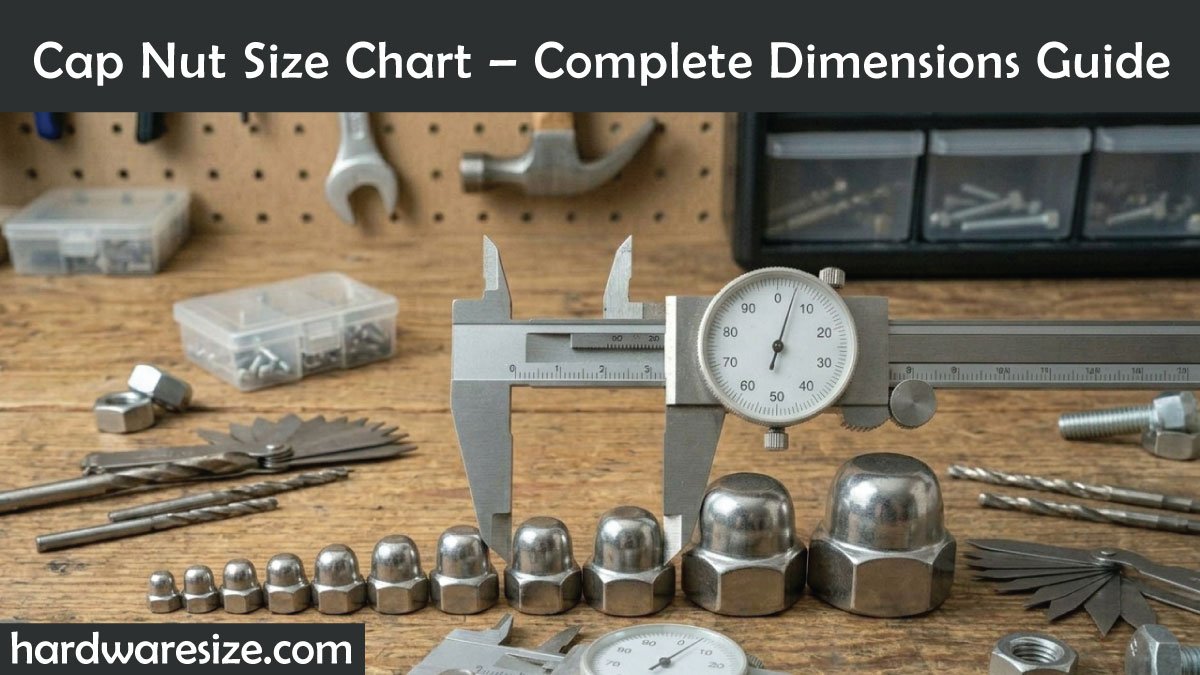
Cap nuts or acorn nuts or dome nuts are commonly used in mechanical, automotive, construction and furniture. They not only ensure that bolts are secured but also give a clean and finished look to the exposed threads coupled with the prevention of the damages, dirt and corrosion that could affect the exposed threads.
In this complete guide, you will learn:
- What a cap nut is
- Standard cap nut size charts (metric & imperial)
- Thread pitch and dimension details
- Material types and grades
- How to choose the right cap nut
- Common applications
If you are working with bolts, threaded rods, or machinery fasteners, this guide will help you select the correct cap nut size confidently.
What Is a Cap Nut?
A cap nut, also called an acorn or dome nut, is a closed-end fastener designed to cover and protect the exposed threaded end of a bolt.
It improves safety, prevents thread damage, and provides the clean, professional finish in mechanical and decorative assemblies.
Key Features:
Hexagonal base for wrench tightening
- Dome-shaped top
- Internal threading
- Available in metric and imperial sizes
Cap nuts are protectionist and strong. Their base is hex and can be installed easily with the help of standard tools, with the top being a dome that contains sharp ends of bolts.
They are produced with accurate internal threads so that they can be fixed securely in the various industrial and household applications.
Why Use Cap Nuts?
Cap nuts are used when performance and looks are of concern. They protect bare threads against dirt, moisture and corrosion as well as alleviate the risk of injuries that may happen due to sharp ends of bolts.
The rounded dome shape also adds to the total appearance of the constructions put up.
- Protect exposed threads
- Improve safety (no sharp bolt ends)
- Enhance visual appearance
- Prevent corrosion and contamination
They are commonly used in automotive parts, playground equipment, furniture, railing systems, and machinery assemblies where safety and durability are essential.
Standard Metric Cap Nut Size Chart
Metric cap nuts follow ISO standards and are identified by “M” sizes such as M4, M6, or M10. The “M” number represents the bolt’s nominal diameter in millimeters.
These standardized sizes ensure proper compatibility with metric bolts used in machinery and construction.
Metric Cap Nut Size Chart
| Thread Size | Pitch (mm) | Width Across Flats (mm) | Height (mm) |
|---|---|---|---|
| M4 | 0.7 | 7 | 8 |
| M5 | 0.8 | 8 | 10 |
| M6 | 1.0 | 10 | 12 |
| M8 | 1.25 | 13 | 15 |
| M10 | 1.5 | 17 | 18 |
| M12 | 1.75 | 19 | 22 |
| M16 | 2.0 | 24 | 28 |
| M20 | 2.5 | 30 | 34 |
Understand Metric Cap Nut Dimensions
The concept of metric dimensions avoids the mismatched fasteners and failures in installation. The thread size should be equal to the diameter of the bolts, pitch determines the distance between the threads.
The width over flats defines the size of the wrench and the height encompasses the dome-shaped part that wraps the end of the bolt.
- Thread Size (M6, M8, etc.) – Matches bolt diameter
- Pitch – Distance between threads
- Width Across Flats – Wrench size
- Height – Overall cap nut length include dome
Always ensure the thread pitch matches your bolt to avoid cross-threading.
Standard Imperial (SAE) Cap Nut Size Chart
Imperial cap nuts are popular in the United States and they are in-measured in inches. They are identified in terms of diameter and threads per inch (TPI). These sizes are in accordance to both SAE and ASME rules of compatibility with the UNC and UNF bolts.
Imperial (SAE) Cap Nut Size Chart
| Thread Size | Threads Per Inch (TPI) | Wrench Size (inch) | Height (inch) |
|---|---|---|---|
| 1/4″-20 | 20 | 7/16″ | 1/2″ |
| 5/16″-18 | 18 | 1/2″ | 9/16″ |
| 3/8″-16 | 16 | 9/16″ | 11/16″ |
| 1/2″-13 | 13 | 3/4″ | 7/8″ |
| 5/8″-11 | 11 | 15/16″ | 1″ |
| 3/4″-10 | 10 | 1-1/8″ | 1-1/8″ |
Cap Nut Size Chart PDF
A Cap Nut Size Chart PDF provides a convenient, printable reference for both metric and imperial dome nuts. It has thread dimensions, pitch, wrench, and height in general so as to be used quickly in the workshop.
It is in the form of PDF which makes it easy to access, select, and securely fastened in case of installation, maintenance or mechanical activities.
Coarse vs Fine Threads
Imperial cap nuts are available in coarse (UNC) and fine (UNF) thread types. Rough threads are simpler to install and work in less rigid materials whereas finer threads is more vibration resistant and yielding in high load applications.
- UNC (Coarse Thread)
- UNF (Fine Thread)
Fine threads provide better vibration resistance, while coarse threads are easier to install.
Cap Nut Dimension Diagram Explained
The design of a cap nut has a number of significant measurements that define compatibility and performance. These are thread diameter, internal thread depth, dome height, hex width and the general height.
This is done through proper measuring so that the bolt fits perfectly without bottoming out in the dome.
- Thread diameter
- Thread depth
- Dome height
- Hex width
- Overall height
When selecting a cap nut, verify the internal depth fully covers the bolt length.
Cap Nut Materials and Grades
Cap nuts are produced in different materials depending on the requirements of the strength, corrosion resistance and appearance.
The choice of materials will be based on the environmental exposure, load requirement, and aesthetic requirements which will guarantee quality performance both in structural, decorative and mechanical uses.
1. Stainless Steel Cap Nuts
Stainless steel cap nuts are highly resistant to corrosion and long-life. They are suited to outdoor, marine and humid conditions in which rust prevention is of paramount importance, yet still offer extreme mechanical and clean attractive finish.
- Corrosion resistant
- Ideal for outdoor and marine use
- Common grades: 304, 316
2. Carbon Steel Cap Nuts
Carbon steel cap nuts are strong, cost-effective, and widely used in structural and automotive assemblies. They are sometimes zinc plated to make them more resistant to corrosion, and in various grades of strength to suit bolt specification.
- Strong and durable
- Often zinc plated
- Used in structural and automotive assemblies
3. Brass Cap Nuts
Brass cap nuts are often used in the ornamental and light-weight use. They have natural corrosion resistance and attractive finish thus suitable in furniture, railings and decorative fixtures where appearance is crucial.
- Decorative finish
- Corrosion resistant
- Common in furniture and railing
4. Chrome-Plated Cap Nuts
Chrome-plated cap nuts provide a polished, reflective surface often used in automotive customization and visible installations. The chrome finish enhances the looks and provides moderate resistance to corrosion to exposed assemblies.
- Attractive finish
- Popular in automotive customization
Common Cap Nut Standards
Cap nuts are produced based on accepted standards which specify size, tolerances and strength.
These standards provide standardized quality, safe and interchangeability with other bolts of like type in industrial and construction uses.
- Metric cap nuts usually follow:
- DIN 1587 (standard dome cap nut)
- ISO 4033 / ISO standards
- Imperial cap nuts follow:
- SAE specifications
- ASME B18.2.2
- These standards define:
- Thread tolerance
- Height
- Hex dimensions
- Strength requirements
How to Choose the Right Cap Nut Size
The choice of the right size of cap nut must be performed by evaluating the correct dimensions of bolts, the type of thread, the strength of the material and the environmental conditions.
It is not sufficient to match the diameter. Adequate selection has the effect of providing safe fastening, avoiding thread damage and the performance in mechanical or structural use over the long term.
Choosing the correct cap nut involves more than matching diameter.
Step 1: Identify Bolt Diameter
The initial and the most significant process entails verification of the nominal diameter of the bolt. This is the size to match the cap nut.
The bolt head markings could be checked or the outer thread diameter could be checked with a vernier caliper to be identified correctly. Check the bolt marking or measure using calipers.
Step 2: Determine Thread Pitch
Thread pitch should be identical to prevent cross threading and failure of installation. In the case with metric bolts, a thread pitch gauge is used to measure the distance between threads.
In the case of imperial bolts, the threads per inch (TPI) should be checked to make sure that they are compatible.
Use a thread gauge to confirm pitch (metric) or TPI (imperial).
Step 3: Check Bolt Length
Trying to ensure that the length of the bolt is not longer than the internal thread depth of cap nut.
The bolt may bottom out in the dome, or worse still, too long a bolt will not fit tight enough to secure into place and provide adequate clamping force.
Ensure that the bolt is not more than the inside depth of the cap nut.
Step 4: Consider Environment
There are environmental conditions which greatly influence the selection of materials. Stainless steel cap nuts are better resistant to corrosion in the case of an outdoor or a humid environment. When there is heavy load or structural requirements, carbon steel cap nuts are more important because of the high grade of steel that is stronger and more durable.
Outdoor? Use stainless steel.
High strength needed? Choose higher-grade carbon steel.
Step 5: Verify Wrench Size
Make sure the appropriate wrench or socket size has been used according to the width of flats on the cap nut before installation.
The correct tool will guarantee the correct torque is used, the hex shape will not be rounded off, and will retain fastening integrity.
Confirm you have the correct tool for installation.
Read More:
Final Thoughts
A cap nut is a small item, and it is important to choose the size and material properly to ensure its safety, longevity, and a professional look.
Do you have automotive customization, furniture assembly, or structure, the dimensions and standards of cap nuts will make sure that they are installed.
By using the metric and imperial cap nut size charts provided in this guide, you can confidently match your bolt and nut combination without errors.
If you regularly work with fasteners, keep a printed cap nut size chart in your workshop can save time and prevent costly mistakes.
Read More:

Engineer Hassan is a Mechanical Engineer with 16+ years of hands-on experience in mechanical hardware, fasteners, and workshop tools. He focuses on size selection, thread identification, and measurement, helping users choose the correct components with accuracy and safety.