
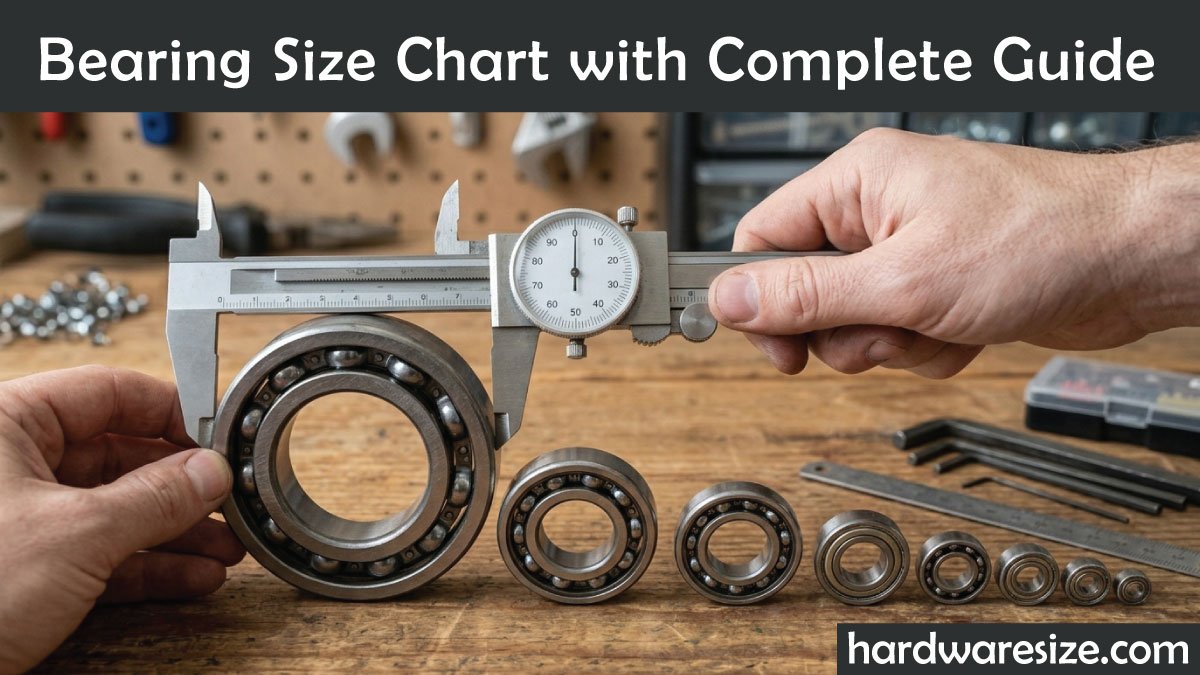
Bearings One of the most significant parts of mechanical systems is bearings. They minimize friction, carry weights and enable easy rotations in machines. Bearings are employed in all areas including bicycles and electric motors as well as industrial machinery and automotive wheels.
Nonetheless, the choice of a bearing size is very important regarding the proper performance and durability. In the event of wrong bearing size, excessive friction, and vibration, overheating or even machine breakdown may occur.
In this complete guide, you will learn how bearing sizes work, how to read bearing numbers, how to measure a bearing, and how to use a bearing size chart to choose the correct one.
What Is a Bearing?
A bearing is the mechanical component that aims at minimizing friction between moving objects and even supporting loads. It permits components like shafts, wheels and gears to move in a smooth manner.
Bearings usually consist of the following parts:
- Inner ring – Mounted on the rotating shaft
- Outer ring – Fixed inside the housing
- Rolling elements – Balls or rollers that reduce friction
- Cage – Keeps rolling elements evenly spaced
These components work together to support loads and ensure smooth rotation.
Why Bearing Size Matters
The proper selection of the bearing size is very crucial to the stability and long life of the machine. Mechanical systems have bearings matching the proper sizes and these help them to run smoothly reducing friction and unnecessary wear and vibration may destroy equipment.
A properly sized bearing ensures:
-
Smooth and efficient rotation
-
Reduced friction and heat buildup
-
Longer equipment and component life
-
Lower maintenance and repair costs
-
Balanced and even load distribution
When the bearing is too small it can easily break when heavily loaded or at high speed. Provided it is excessively large, it might not fit into the housing or the shaft correctly and lead to misalignment, vibration and early wear of the machine.
Standard Bearing Size Chart
A bearing size chart It is used to find bearings that are commonly used in a short time. These three charts are very convenient to engineers, technicians, mechanics, and DIY users during the process of picking or replacing bearings in machines and equipment.
Below is a common deep groove ball bearing size chart used in many mechanical applications.
| Bearing Number | Inner Diameter (mm) | Outer Diameter (mm) | Width (mm) |
|---|---|---|---|
| 6000 | 10 | 26 | 8 |
| 6001 | 12 | 28 | 8 |
| 6002 | 15 | 32 | 9 |
| 6003 | 17 | 35 | 10 |
| 6004 | 20 | 42 | 12 |
| 6005 | 25 | 47 | 12 |
| 6006 | 30 | 55 | 13 |
| 6007 | 35 | 62 | 14 |
| 6008 | 40 | 68 | 15 |
| 6009 | 45 | 75 | 16 |
| 6010 | 50 | 80 | 16 |
This chart assists engineers and technicians to find the right dimensions of bearings fast and is more convenient to choose the right replacement bearing to the motors, pumps, machinery, and other rotating equipment.
Bearing Size Chart Pdf
📄 Bearing Size Chart PDF helps engineers, mechanics, and DIY users quickly find accurate bearing dimensions. It includes clear size charts for common bearing series with inner diameter, outer diameter, and width measurements, making bearing selection, replacement, and maintenance easier and more reliable.
Also Read:
👉 Cap Nut Size Chart helps you quickly find accurate cap nut dimensions for different bolt sizes. In this guide, you’ll learn standard measurements, sizing tips, and practical applications. Read the full post to choose the right cap nut size easily. 🔩📏
How to Read Bearing Numbers
It might seem strange that bearing numbers are arranged in this way, however, in fact, it is simply an international number system. The bearing number bears a number with each digit giving critical details on the type, size, and load capacity of the bearing.
Example:
6205
This number is not random. It has a coded information, which details bearing design, strength series and bore diameter. Getting familiar with the methods of interpreting these numbers will make you be able to find the proper bearing very fast without having to measure it.
1. First Digit – Bearing Type
The digit of the bearing number that comes before the decimal point is used to show the type of bearing, and its internal design. Various types of bearings are not all made to perform the same function in mechanical systems and bear various loads, speeds, and operating conditions.
Examples include:
-
6 – Deep groove ball bearing
-
7 – Angular contact bearing
-
2 – Spherical roller bearing
Deep groove ball bearings are the most widely used of these since it offers high speed, low friction and reliable operation in a variety of applications.
2. Second Digit – Bearing Series
The second digit denotes the series of the bearing that shows the strength, thickness and the carrying capacity of the bearing. Bearing that is of a greater series tends to rotate on a heavier ring and be able to carry a greater load.
Common bearing series include:
| Series | Description |
|---|---|
| 60 | Extra light |
| 62 | Light |
| 63 | Medium |
| 64 | Heavy |
For example:
-
6205 belongs to the light series, suitable for moderate loads and high speeds.
-
6305 belongs to the medium series, which has stronger construction and greater load capacity.
3. Last Two Digits – Bore Size
The final two figures in the bearing number are the bore size, or the inner diameter of the bearing that is mounted on the shaft. This check is quite significant in the fitting of the shafts.
For bearing numbers 04 and higher, the bore size is calculated by multiply the last two digits by 5.
Example:
| Code | Bore Size |
|---|---|
| 04 | 20 mm |
| 05 | 25 mm |
| 06 | 30 mm |
| 07 | 35 mm |
| 08 | 40 mm |
So for example:
6205 → 05 × 5 = 25 mm bore diameter
This implies that the bearing accommodates a shaft of 25 mm in diameter which is a very standard size in electric motors, pumps and industrial machinery.
How to Measure Bearing Size
In case of missing bearing number or worn out bearing or unreadable, you can still check the correct bearing by doing it manually by measuring.
Proper measurement will assist you to know the right replacement bearing and will fit well into the machine or housing. In order to measure a bearing accurately, a Vernier caliper or digital caliper is required.
The accuracy of these instruments is in millimeters. There are three dimensions that should always be measured, which include carrying width, inner diameter, and outer diameter.
1. Inner Diameter (ID)
The shaft fits into the hole in the center of the bearing and is known as the inner diameter (ID). A proper inner diameter is important because it will make sure that the bearing does not slip or produce vibration on the shaft.
Steps:
-
Place the caliper jaws inside the bearing hole
-
Expand them until they touch the inner ring
-
Read and record the measurement
Example: 25 mm
2. Outer Diameter (OD)
The diameter of the bearing (OD) is the overall size of the bearing. This check is used to establish whether the bearing can fit correctly in the housing or the mounting area of the machine.
Steps:
-
Place the caliper jaws around the outer ring
-
Measure the full outside diameter
-
Record the measurement carefully
Example: 52 mm
3. Bearing Width
The distance between the two flat sides of the bearing is referred to as the bearing width (thickness) or the thickness of the bearing. The dimension is significant as it dictates the amount of the space that is taken by the bearing in the assembly.
Steps:
-
Place the caliper jaws across the bearing sides
-
Measure the side width
-
Record the dimension
Example: 15 mm
Also Read:
👉 Machine Screw Size Chart helps you quickly understand standard machine screw dimensions, thread sizes, and common applications. This guide makes it easier to choose the correct screw for your project. Read the full post to explore the complete size chart and selection tips.
Example Measurement
If your measured dimensions are:
-
Inner diameter: 25 mm
-
Outer diameter: 52 mm
-
Width: 15 mm
The bearing is probably 6205 that is a very common deep groove ball bearing applied in motors, pumps, fans, and numerous industrial machines.
Common Bearing Types
The machines have different load, speed and operating conditions that demand various types of bearings. The types of bearings are developed to meet particular mechanical forces but minimize friction, and enhance the efficiency of equipment’s.
The following are some of the most widespread types of bearings that are utilized in the industry and in the field of mechanical applications.
1. Deep Groove Ball Bearings
Deep groove ball bearings are the most common types of bearings as they are universal, tough, and can be used in high speed. They are smooth in rotation and in most cases, they have minimum maintenance.
Features:
-
High speed capability
-
Low friction operation
-
Simple and reliable design
-
Low maintenance requirements
Common applications include:
-
Electric motors
-
Fans and blowers
-
Washing machines
-
Water pumps
2. Roller Bearings
Roller bearings Roller bearings have rollers rather than balls to support loads. The contact area is larger with roller bearings hence able to bear heavier loads in comparison with standard ball bearings.
Advantages:
-
Higher load carrying capacity
-
Better shock and impact resistance
Common applications include:
-
Heavy industrial machinery
-
Gearboxes
-
Construction equipment
3. Tapered Roller Bearings
Tapered roller bearings The design is developed to bear radial and axial loads at the same time. Their angled shape enables them to support heavy forces and be in the right position of operation.
They are commonly used in:
-
Automotive wheel hubs
-
Truck wheel assemblies
-
Industrial gear systems
4. Needle Bearings
Needles bearers are designed with miniature rollers that are cylindrical and thus can carry heavy loads using minimum space. They are small in size and thus can be used in applications where there is a space constraint.
Benefits:
-
Compact design
-
High load capacity for small spaces
Common uses include:
-
Automotive transmissions
-
Gear mechanisms
Bearing Size Chart for Common Series
Size chart of 6200 series is among the most widely used manuals in mechanical engineering. These bearings find extensive applications in motors, pumps, conveyors, and industry equipment since they are good in speed performance with medium load capacity.
| Bearing | ID (mm) | OD (mm) | Width (mm) |
|---|---|---|---|
| 6200 | 10 | 30 | 9 |
| 6201 | 12 | 32 | 10 |
| 6202 | 15 | 35 | 11 |
| 6203 | 17 | 40 | 12 |
| 6204 | 20 | 47 | 14 |
| 6205 | 25 | 52 | 15 |
| 6206 | 30 | 62 | 16 |
| 6207 | 35 | 72 | 17 |
| 6208 | 40 | 80 | 18 |
| 6209 | 45 | 85 | 19 |
| 6210 | 50 | 90 | 20 |
These bearings are commonly installed in electric motors, pumps, compressors, fans, and industrial machinery.
Also Read:
👉 Standard Metric Bolt Sizes Chart helps you quickly understand common metric bolt diameters, thread sizes, and dimensions used in mechanical and industrial applications. Read the full post to explore the complete bolt size chart and learn how to choose the right bolt.
Metric vs Inch Bearing Sizes
The manufacture of bearings is in two main measurement systems, one being the metric and the other being inch-based measure. Knowledge of the difference can be used to provide compatibility in the replacement of bearings in newer or older equipment.
1- Metric Bearings
The most popular and used today bearing systems are metric bearings, and they are provided with international standards. They are quantified in millimeters, thus easier to differentiate in terms of international industries.
Examples include:
-
6204
-
6205
-
6306
Metric bearings are commonly used in modern industrial machinery, electric motors, and automotive systems.
2- Inch Bearings
Bearings are measured in inches as opposed to millimeters. These bearings are frequently coming across older machines and equipment’s that were constructed with imperial measurement systems.
Examples include:
-
1/2 inch bore bearing
-
3/4 inch shaft bearing
They are commonly used in:
-
Agricultural equipment
-
Older industrial machinery
Bearing Clearance and Fit
The bearing and shaft fit is quite crucial to the machine performance that is reliable. Fitting allows the prevention of slipping, vibration, and the uneven distribution of loads as well as allows the bearing to work smoothly and efficiently.
There are three common types of bearing fits.
1. Clearance Fit
When in clearance fit, the bearing is easily fit on the shaft without the need to force. This sort of fit is often applied in situations where bearings have to be removed or changed on a regular basis.
Used in:
-
Light load applications
-
High speed machinery
2. Interference Fit
In an interference fit, a bearing is firmly clamped onto the shaft either with some sort of force or with special tools. This is to guarantee a safe connection and it avoids movement in case of heavy loads.
Used for:
-
Heavy load machinery
-
High vibration environments
3. Transition Fit
A transition fit is an intermediate between clearance and interference fit. It gives precise centering and a moderate force is needed to install hence it is applicable in precision mechanical systems.
Common Applications of Bearings
Bearings are basic constituents that are employed in nearly all forms of mechanical systems. They assist machines in the rotary motion as well as bearing loads as well as increasing friction between moving components.
Common applications include:
1- Automotive
-
Wheel hubs
-
Alternators
-
Transmission systems
2- Industrial Machinery
-
Conveyor systems
-
Pumps
-
Air compressors
3- Household Appliances
-
Washing machines
-
Air conditioners
-
Ceiling fans
4- Tools and Equipment
-
Power drills
-
Grinding machines
-
CNC machines
Also Read:
👉 Battery Wing Nut Size Chart helps you quickly find the correct dimensions and thread sizes used in battery terminals and electrical connections. Read the full post to explore the complete size chart and learn how to choose the right battery wing nut.
Tips for Choosing the Right Bearing
It is important to choose the appropriate bearing to be used in machines to ensure efficiency, durability and safety. The right bearing has the potential of enhancing performance and minimizing the probability of mechanical failure.
The following factors should be considered in the selection of a bearing.
1. Load Capacity
Determine the type of load the bearing must handle:
-
Radial loads
-
Axial loads
-
Combined loads
Choose the bearing designed for the correct load type prevents premature wear and failure.
2. Speed
Bearings in high-speed machinery must be of low friction and must be stable. Deep groove ball bearings tend to be the most suitable bearing to be used in high speed applications due to their smoothness.
3. Environment
Consider the operating environment where the bearing will be used.
Important factors include:
-
Dust
-
Moisture
-
Temperature
Sealed or shielded bearings are recommended for harsh environments.
4. Lubrication
Proper lubrication is essential for reducing friction and preventing overheating in bearings.
Common lubrication methods include:
-
Grease lubrication
-
Oil lubrication
Good lubrication improves bearing life and machine reliability.
Bearing Maintenance Tips
Routine maintenance may increase the life of the bearings by a very long way and enhance the performance of a machine. Good maintenance inhibits unforeseen breakdowns and cuts down maintenance expenses.
Follow these simple maintenance practices.
1- Keep Bearings Clean: Dust, dirt, and debris can damage rolling elements and cause premature wear.
2- Use Proper Lubrication: Always use the recommended grease or oil specified for the bearing.
3- Avoid Overloading: Operating beyond the load capacity can quickly damage bearings.
4- Check Alignment: Misaligned shafts can cause vibration, noise, and uneven wear.
Common Bearing Problems
Even high quality bearings may fail in case they are installed improperly or work under inappropriate conditions. The knowledge of common bearing problems aids technicians to diagnose problems before they escalate.
Common bearing problems include:
-
Overheating
-
Noise and vibration
-
Excessive wear
-
Lubrication failure
Costly machine downtime can be avoided with regular inspection and proper care of the machine and this will also lengthen bearing life.
Final Thoughts
A bearing size chart is a critical source of reference that is used by engineers, mechanics, and other DIY users. Knowledge of bearing dimensions, numbering systems and methods of measurement are used to select the most appropriate bearing to any machine.
When replacing a bearing always remember to check the inner diameter, outer diameter and width. The appropriate size can be used to facilitate easy working, low maintenance, and reliability of equipment.
Whether repairing motor, maintaining industrial machinery or mechanical project, having knowledge of how to read a bearing size chart will simplify your job and do it more correctly.

Engineer Hassan is a Mechanical Engineer with 16+ years of hands-on experience in mechanical hardware, fasteners, and workshop tools. He focuses on size selection, thread identification, and measurement, helping users choose the correct components with accuracy and safety.