
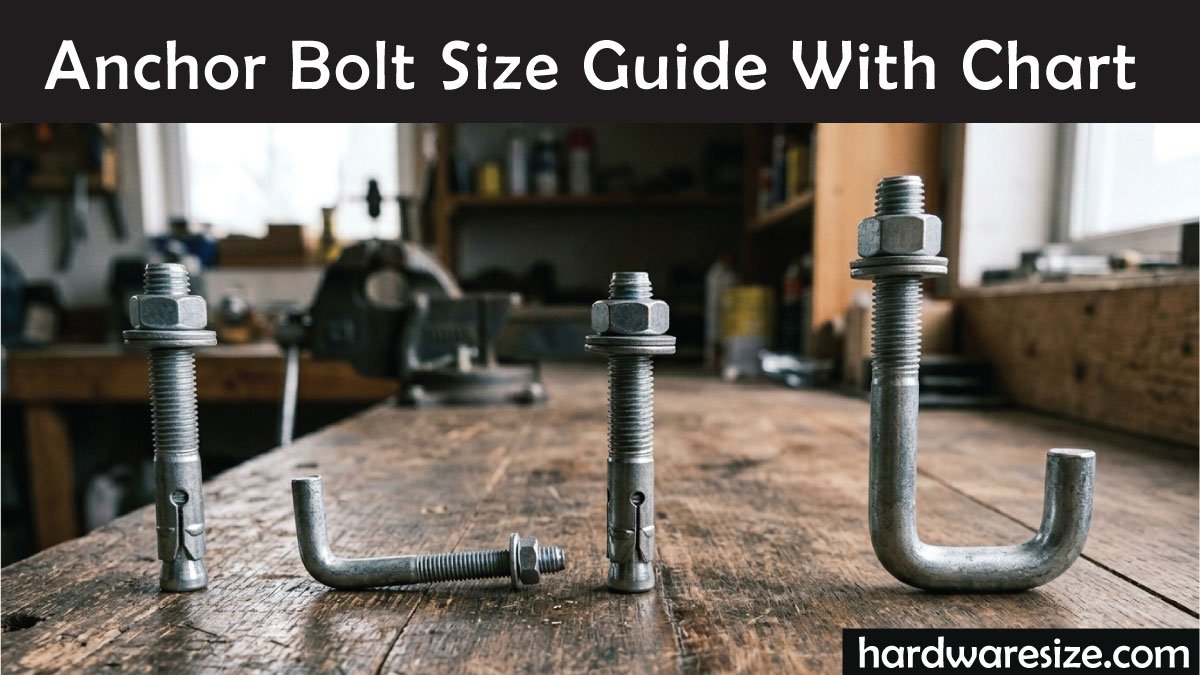
Anchor bolts are essential components in construction and mechanical work. They establish a safe bond between structures and concrete which guarantees stability, safety and durability.
It is important to know the sizes of anchor bolts whether you are putt in place machinery, structural steel, or are doing a DIY project.
This complete guide explains anchor bolt size charts, dimensions, selection methods, and usage in the simple, practical way.
What Are Anchor Bolts?
Anchor bolts are attachment tools that are used to fix objects on the surface of concrete. They are not normal bolts, since they can be either embedded in concrete when poure or installed afterwards either by mechanical or chemical means.
Their main purpose is to safely pass loads of a structure into the concrete base. This renders them an important component in both the light-duty and heavy-duty applications.
Anchor Bolt Size Chart (Metric)
Below is a simplified and practical metric size chart commonly used in engineering and construction:
| Size (mm) | Drill Hole (mm) | Recommended Embedment (mm) | Typical Use |
|---|---|---|---|
| M6 | 8 | 40–50 | Light fixtures, brackets |
| M8 | 10 | 50–60 | Shelving, small frames |
| M10 | 12 | 60–80 | Medium-duty installations |
| M12 | 14 | 80–100 | Steel plates, railings |
| M16 | 18 | 100–120 | Machinery base fixing |
| M20 | 24 | 120–150 | Heavy equipment |
| M24 | 28 | 150–200 | Structural applications |
| M30 | 35 | 200–250 | Industrial and high-load structures |
This chart gives a general idea, but actual performance depends on concrete strength, space, and installation quality.
Anchor Bolt Size Chart (Inch System)
For projects use imperial units, the following chart is widely accepted:
| Size (Inch) | Drill Size (Inch) | Embedment Depth (Inch) | Typical Use |
|---|---|---|---|
| 1/4″ | 5/16″ | 1.5–2 | Light-duty fastening |
| 3/8″ | 1/2″ | 2–2.5 | General purpose |
| 1/2″ | 5/8″ | 2.5–3 | Medium loads |
| 5/8″ | 3/4″ | 3–4 | Structural attachments |
| 3/4″ | 7/8″ | 4–5 | Heavy-duty applications |
| 1″ | 1-1/8″ | 5–6 | Industrial installations |
Anchor Bolt Size Chart
Also Read 👉 Nut Size Chart covers types, materials, and practical applications, helping you choose the right nut for any project. Save time, avoid errors, and work efficiently—read the full post now for complete guidance and expert tips!
Understand Anchor Bolt Dimensions
Anchor bolt sizes are not merely numbers to be remembered and to be used but are what make the difference in the strength, stability and longevity. In order to select the appropriate anchor bolt, it is of great essence that you clearly comprehend how each dimension interrelates in actual application and load situations.
1. Diameter
The thickness of the anchor bolt is the diameter and is the most important consideration of strength. A bigger diameter raises the load bearing capacity, particularly in heavy-duty work, although a bigger hole and spacing are needed.
2. Length
Length of an anchor bolt = Length of that part that is embedded in the concrete and the length of the exposed part above the surface. The correct choice of length allows sufficient gripping within the concrete and the components can be securely fastened.
3. Thread Length
Thread length- This is the part of the bolt which screws the nuts and the fixtures firmly in position. Proper threading is necessary to have correct clamp force and inadequate thread length may result in a loose connection or difficulty in installation.
4. Embedment Depth
Embedment depth is the depth of the anchor on the concrete to which the anchor bolts are embedded in. It is the most influential on the holding strength. Increased embedment tends to enhance load capacity, although it should be done according to recommendation to avoid the destruction of concrete.
A common example is M12 × 120 mm, which means the bolt has a 12 mm diameter and a total length of 120 mm, including both embedded and exposed sections.
How to Choose the Right Anchor Bolt Size
The proper anchor bolt size is essential in safety, stability and long life. The wrong kind or dimension may cause failures, expensive repairs or even hazards to life. There are various considerations that define the most appropriate project decision.
1- Load Requirements
Before choosing an anchor bolt, it is always important to compute how much weight it will have to support. This has tension (pulling force) and shear (sideways force). The safety factor allows choosing a bolt of higher load capacity than the required to avoid structural failures under pressure.
2- Concrete Strength
The holding capacity of a bolt is directly proportional to the strength and the quality of the concrete. Thick and solid concrete can be used so that the smaller bolts can support heavier loads whereas thin, cracked, or old concrete can be used with bigger bolts, deeper embedment, or chemical anchors to achieve its functionality.
3- Application Type
The type of application helps determine the appropriate bolt size:
Light-duty work: M6 to M10 bolts, suitable for small fixtures or brackets.
Medium-duty work: M10 to M16 bolts, used for machinery bases or moderate structural components.
Heavy-duty work: M16 and above, ideal for industrial equipment, steel structures, or critical load-bearing applications.
4- Embedment Depth
Embedment depth is the distance into which the bolt is embedded in the concrete. The further embedment enhances the holding power and pull out resistance. Nevertheless, going beyond recommended depths may hurt concrete or decrease the anchor effect, therefore, specifications are to be adhered to.
5- Environmental Conditions
The place of installation of the anchor bolt is also an issue. In wet or corrosive conditions or outdoors, stainless steel or galvanized bolts are suggested in order to withstand corrosion and rust. The correct choice of materials is a guarantee of long-term service life and reduced maintenance.
Installation Guide (Step-by-Step)
The correct installation of anchor bolts is as important as appropriate choice of size. Proper installation will guarantee ultimate bearing strength, deter structural damages and will increase the lifespan of the screw and the mount.
Step 1: Mark the Position
Start by properly marking on where the anchor bolt is going to be placed. Precision at this stage ensures proper alignment of fixtures and avoids misplacement, which can compromise both safety and structural integrity.
Step 2: Drill the Hole
Choose a drill bit with equal size to the anchor bolt. Use drill and to specific depth needed. During drilling, it is important that the anchor should be properly drilled so that it can fit well and be able to carry the weight intended in place and not move or loosen.
Step 3: Clean the Hole
Clean the hole where the drilling had been done with a brush or a compressed air. A clean hole is also required particularly in chemical anchors because dust may weaken the bond between the anchor and undermine the performance of the anchor.
Step 4: Insert the Anchor
Tightly fit the anchor into the hole. Gently tap it in case necessary to get full seating. Placing it well will make the anchor well positioned and properly strained to support the targeted load without failure or slipping out.
Step 5: Tighten Properly
Tighten the anchor with an anchoring machine or a method that is advised by the manufacturer. The anchor should not be over-tightened and this might cause damage to the anchor and the concrete around it. The proper tightening is the way to guarantee good grip and stability.
Also Read 👉 Bolt Size Chart explains diameters, lengths, and thread types, helping you choose the right bolt for any project. Avoid mistakes and work efficiently—read the full post now for complete guidance and practical tips!
Common Mistakes to Avoid
Simple, yet crucial failures are the cause of many of the anchor bolts. The correct installation practice is a good way to avoid spending money on repairs, increase the level of security, and provide the successful performance of the equipment in both light-duty and heavy-duty applications.
- Use incorrect hole size
- Skip the hole cleaning
- Choose the wrong anchor type
- Over-tightening or under-tightening
- Ignore the load calculations
Avoid these mistakes significantly improves the durability and reliability of anchor bolt installations.
Real Insight (Experience-Based Tip)
One of the most frequent errors in the practice work is the miscalculation of load conditions, in particular, dynamic forces such as vibration. An example is a small workshop that was equipped with machinery using M10 anchors.
The installation appeared to be okay initially but after a couple of weeks, the bolts started loosening as they were subjected to constant vibrations. It was not the problem of the quality of the bolts, but it was the fact that they were too small and of the wrong type to support the dynamic loads.
M10 anchors that had conventional embedment failed to sustain the repeated stress. The solution to this was to upgrade to M16 chemical anchors with greater depth of embedding. Such modification gave the required grip, vibrations resistance, and long-term stability.
The moral of the story is that whenever erecting anchor bolts it is always prudent to consider dynamic forces as opposed to weight alone. To eliminate failures and secure a safe, stable installation in practice, it is necessary to size the system properly, choose the type, and embed the latter correctly, as well as to select the depth of the embedment.
Tips for Better Performance
In a bid to make anchor bolts work satisfactorily and safely, adherence to best practices is necessary. These failures can be avoided by proper installation, a regular check and proper choice of material that will help reduce the life of the structures and also increase the life of the anchors.
- Always follow recommended torque values
- Use proper drilling tools
- Select the correct anchor type for the material
- Inspect bolts regularly in critical applications
- Avoid reuse the old anchors in structural work
Final Thoughts
Sizing of anchor bolts is not a matter of picking a number on a list. It is all about knowing the combination of diameter, depth, load and application.
In the case of light applications, sizes of M6 to M10 will be adequate. M16 and over are more dependable in structural or heavy work. Nevertheless, the most appropriate decision will always be job specific.
Properly installed and selected anchor bolt provides security, stability and long-term efficiency. Conversely, a bad decision may result into severe failures.
Get your time, assess your needs and make a good selection, since in construction and any other mechanical endeavors strength is always laid at the base.

Engineer Hassan is a Mechanical Engineer with 16+ years of hands-on experience in mechanical hardware, fasteners, and workshop tools. He focuses on size selection, thread identification, and measurement, helping users choose the correct components with accuracy and safety.