
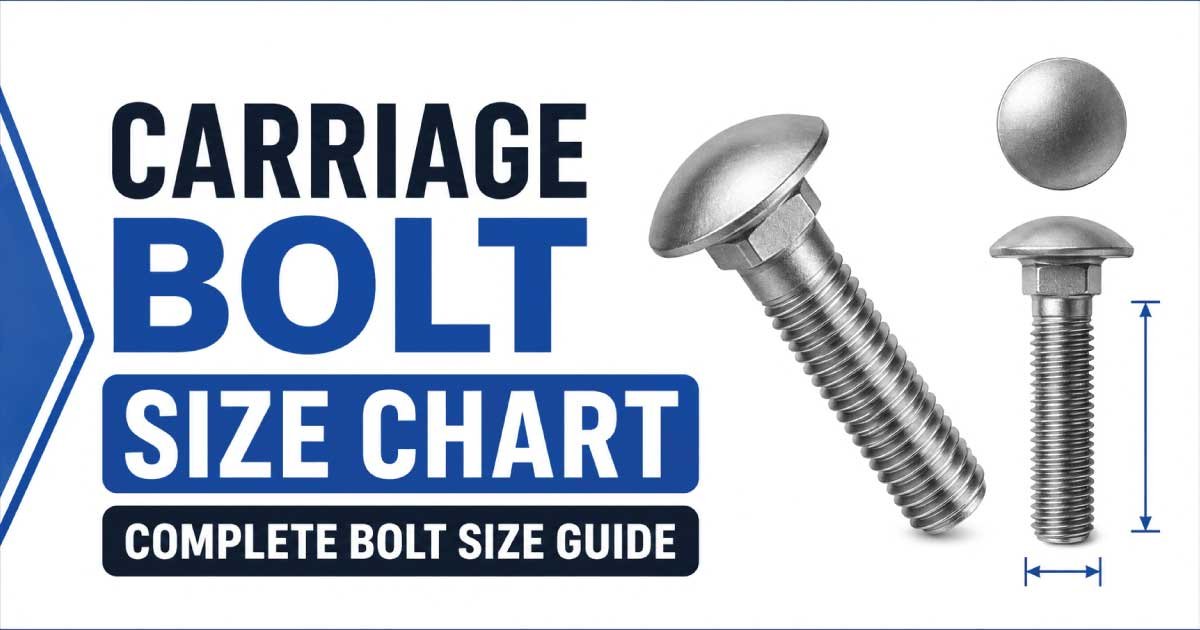
Carriage bolts are widely used fasteners for woodworking, construction, furniture assembly, machinery, metal fabrication, trailers, outdoor structures, and general maintenance. Their distinctive rounded head and square neck allow the bolt to be installed without easily turning when the nut is tightened.
Choosing the correct carriage bolt size requires more than knowing the bolt diameter. You also need to consider bolt length, thread pitch, head diameter, square neck dimensions, material, strength grade, and the type of joint where the fastener will be installed.
This carriage bolt size chart and complete guide explains common metric and imperial carriage bolt sizes, how carriage bolts are measured, how to select the correct length, the difference between metric and SAE carriage bolts, common applications, washer and nut selection, and important differences between carriage bolts and other fasteners.
Whether you are replacing an old carriage bolt, building a wooden structure, repairing equipment, or selecting fasteners for a fabrication project, this guide will help you identify the correct size.
What Is a Carriage Bolt?
A carriage bolt is a type of fastener with a smooth, rounded or domed head and a square section directly underneath the head. The square neck is designed to grip the material and prevent the bolt from rotating while the nut is tightened.
Unlike a conventional hex bolt, a carriage bolt is generally tightened from the nut side. This makes it particularly useful where the visible side of the assembly needs a smooth, finished appearance.
Carriage bolts are commonly available in:
- Carbon steel
- Stainless steel
- Zinc-plated steel
- Galvanized steel
- High-strength steel
- Metric sizes
- Imperial or SAE sizes
They are frequently used in wood-to-wood, wood-to-metal, and metal-to-metal connections.
Understanding Carriage Bolt Dimensions
Before selecting a carriage bolt, it is important to understand its main dimensions.
A carriage bolt is generally identified by its diameter, length, thread pitch, head diameter, and square neck dimensions.
Bolt Diameter
The nominal diameter refers to the approximate diameter of the threaded shaft.
Common metric sizes include:
- M5
- M6
- M8
- M10
- M12
- M16
- M20
Common imperial sizes include:
- 1/4 inch
- 5/16 inch
- 3/8 inch
- 1/2 inch
- 5/8 inch
- 3/4 inch
Bolt Length
Carriage bolt length is normally measured from the underside of the rounded head to the end of the threaded shaft.
For example, an M10 × 60 mm carriage bolt has:
- 10 mm nominal diameter
- 60 mm nominal length
The rounded head is not normally included in the stated bolt length.
Thread Pitch
Metric carriage bolts use thread pitch measured in millimeters.
For example:
M8 × 1.25
means an 8 mm nominal diameter and 1.25 mm thread pitch.
Imperial carriage bolts generally use threads per inch, or TPI.
Head Diameter
The head diameter is measured across the widest portion of the rounded or domed head.
This dimension matters when the bolt head needs to sit against a visible surface or fit into a countersunk or specially prepared recess.
Square Neck
The square neck is the section directly below the carriage bolt head.
Its purpose is to prevent the bolt from rotating when the nut is tightened.
The square neck dimensions vary according to the bolt diameter and applicable standard.
Metric Carriage Bolt Size Chart
Metric carriage bolts are identified using the letter M, followed by the nominal diameter in millimeters.
The following chart provides common metric carriage bolt sizes and typical coarse thread pitches.
| Carriage Bolt Size | Nominal Diameter | Common Coarse Pitch | Typical Application |
|---|---|---|---|
| M5 | 5 mm | 0.8 mm | Light-duty assemblies |
| M6 | 6 mm | 1.0 mm | Furniture and brackets |
| M8 | 8 mm | 1.25 mm | General construction |
| M10 | 10 mm | 1.5 mm | Machinery and frames |
| M12 | 12 mm | 1.75 mm | Heavy-duty assemblies |
| M14 | 14 mm | 2.0 mm | Industrial applications |
| M16 | 16 mm | 2.0 mm | Heavy construction |
| M18 | 18 mm | 2.5 mm | Heavy machinery |
| M20 | 20 mm | 2.5 mm | Large structural assemblies |
| M22 | 22 mm | 2.5 mm | Heavy-duty applications |
| M24 | 24 mm | 3.0 mm | Large industrial assemblies |
Exact carriage bolt head and neck dimensions can vary depending on the applicable product standard and manufacturer, so the nominal diameter and pitch should not be used as the only dimensional specification for precision applications.
Imperial Carriage Bolt Size Chart
Imperial carriage bolts are normally identified by their nominal diameter in inches and thread count.
For example, 1/2-13 means a 1/2-inch diameter carriage bolt with 13 threads per inch.
| Imperial Carriage Bolt | Nominal Diameter | Common TPI | Typical Use |
|---|---|---|---|
| 1/4-20 | 0.250 in | 20 | Light-duty fastening |
| 5/16-18 | 0.313 in | 18 | Furniture and woodworking |
| 3/8-16 | 0.375 in | 16 | General construction |
| 7/16-14 | 0.438 in | 14 | Equipment assemblies |
| 1/2-13 | 0.500 in | 13 | Heavy woodworking |
| 9/16-12 | 0.563 in | 12 | Machinery |
| 5/8-11 | 0.625 in | 11 | Heavy-duty structures |
| 3/4-10 | 0.750 in | 10 | Large structural assemblies |
| 7/8-9 | 0.875 in | 9 | Heavy equipment |
| 1-8 | 1.000 in | 8 | Large industrial applications |
The actual head and square-neck dimensions should be checked against the applicable carriage bolt specification when exact replacement or interchangeability is required.
How to Read a Carriage Bolt Size
Carriage bolt dimensions are usually written using diameter and length, with the thread specification sometimes included.
For example:
M10 × 80 mm
means:
- M = metric
- 10 = nominal diameter of 10 mm
- 80 mm = bolt length
If the full specification is:
M10 × 1.5 × 80 mm
then:
- M10 = 10 mm nominal diameter
- 1.5 = 1.5 mm thread pitch
- 80 mm = bolt length
An imperial example would be:
1/2-13 × 3 in
This means:
- 1/2 inch nominal diameter
- 13 threads per inch
- 3-inch bolt length
Discover More: Bolt Cutter, Size Chart, Types, Uses And How to Choose
How to Measure a Carriage Bolt
Measuring an existing carriage bolt is one of the easiest ways to identify its replacement size.
Step 1: Measure the Diameter
Use a caliper to measure the outside diameter of the threaded shaft.
For example, a measurement close to 8 mm may indicate an M8 carriage bolt.
For imperial bolts, a measurement close to 0.500 inch may indicate a 1/2-inch carriage bolt.
Step 2: Measure the Length
Measure from the underside of the rounded head to the end of the bolt.
Do not normally include the head in the specified bolt length.
Step 3: Determine the Thread Pitch
Use a metric thread pitch gauge for metric bolts.
For imperial bolts, use a thread gauge to determine threads per inch.
This step is important because bolts with similar diameters can have different thread pitches.
Step 4: Measure the Head Diameter
Measure across the widest part of the carriage bolt head.
This can help identify the correct product standard.
Step 5: Measure the Square Neck
Measure the width and length of the square section below the head.
The neck must fit properly into the prepared hole or material.
Step 6: Check the Material and Markings
Inspect the bolt for surface finish, corrosion protection, manufacturer markings, or strength markings.
This information can help determine whether the replacement bolt has equivalent characteristics.
Carriage Bolt Length Guide
Choosing the correct carriage bolt length is important for achieving sufficient thread engagement.
The required length depends on:
- Material thickness
- Washer thickness
- Nut thickness
- Number of components being joined
- Required thread engagement
- Joint design
For example, if two wooden boards are 30 mm thick and a washer and nut are installed on the opposite side, a carriage bolt longer than 30 mm will be required.
The exact length should allow the nut to engage properly without leaving excessive unused bolt length.
A carriage bolt that is too short may not provide adequate thread engagement. A bolt that is excessively long can protrude unnecessarily and create clearance or safety problems.
Carriage Bolt Head and Neck Dimensions
The unique design of a carriage bolt comes from its head and square neck.
The rounded head provides a smooth exterior surface, while the square neck locks into the material.
Round Head
The rounded head is designed to provide a finished appearance.
It is particularly useful when the head is exposed on the outside of a wooden structure, panel, or piece of furniture.
Square Neck
The square neck prevents rotation.
When the carriage bolt is inserted into a suitable square-neck hole, the surrounding material grips the square section while the nut is tightened from the opposite side.
The square neck is especially effective in wood and other materials where the bolt can embed slightly into the surface.
Carriage Bolt Hole Size
The hole size for a carriage bolt depends on the bolt diameter, square neck dimensions, material, and required fit.
A normal clearance hole must be large enough for the threaded shaft to pass through.
However, the square-neck portion often requires a different hole arrangement.
In wood, the square neck can press into or grip the material. In metal, a specially prepared square or appropriately sized hole may be required.
The hole should not be made excessively large because the square neck may fail to grip the material properly.
For precision fabrication, follow the dimensional requirements of the relevant fastener standard.
Carriage Bolt vs Hex Bolt
Carriage bolts and hex bolts are both threaded fasteners, but their head designs serve different purposes.
| Feature | Carriage Bolt | Hex Bolt |
|---|---|---|
| Head shape | Rounded / domed | Six-sided |
| Driving method | Usually tightened from nut side | Head and/or nut |
| Anti-rotation feature | Square neck | Usually none |
| Visible appearance | Smooth rounded head | Hexagonal head |
| Common applications | Wood, furniture, construction | Machinery, equipment, fabrication |
| Socket directly on head | No | Yes |
A carriage bolt is often preferred when the exposed side needs a smooth appearance and the fastener must resist rotation during installation.
A hex bolt is generally preferred when direct access to the bolt head is required for tightening or when a conventional hex-head fastener is specified.
Discover More: Eye Bolt Size Chart: Types, Uses and Complete Guide
Carriage Bolt vs Lag Screw
A carriage bolt is installed through a hole and normally secured using a nut.
A lag screw, by contrast, is threaded into the material itself and does not normally require a nut.
Carriage bolts are useful when access to both sides of a joint is available.
Lag screws are useful when the back side of the material cannot be accessed for installing a nut.
The choice depends on the joint design, material, load, and installation requirements.
Carriage Bolt vs Coach Bolt
In many regions, carriage bolt and coach bolt are names used for essentially the same general type of fastener: a bolt with a rounded head and square neck.
The terminology can vary by country, industry, supplier, and standard.
If you are ordering a replacement, it is better to specify the actual dimensions rather than relying only on the name.
A useful specification includes:
- Diameter
- Length
- Thread pitch or TPI
- Material
- Finish
- Head dimensions
- Square neck dimensions
- Applicable standard
Common Carriage Bolt Materials
Carriage bolts are manufactured from several materials to suit different environments.
Zinc-Plated Steel
Zinc-plated carriage bolts provide improved corrosion resistance compared with plain steel.
They are commonly used for general indoor and outdoor applications where moderate corrosion protection is required.
Stainless Steel
Stainless steel carriage bolts are useful where corrosion resistance and appearance are important.
They are commonly used in outdoor structures, marine-related environments, furniture, and applications exposed to moisture.
Galvanized Steel
Galvanized carriage bolts have a protective zinc coating and are commonly used in outdoor construction, fencing, agricultural applications, and other environments where corrosion resistance is important.
Plain Steel
Plain steel carriage bolts are suitable for controlled environments where corrosion protection is not a primary requirement or where an additional protective finish will be applied.
Carriage Bolt Grades and Strength
The strength of a carriage bolt depends on its material, grade, diameter, and applicable product specification.
Not every carriage bolt is intended for high-load structural applications.
When selecting a carriage bolt for a load-bearing connection, consider:
- Tensile strength
- Yield strength
- Shear loading
- Bolt diameter
- Material strength
- Joint design
- Washer dimensions
- Nut grade
- Environmental conditions
Do not assume that a larger diameter automatically makes a carriage bolt suitable for every structural application.
For safety-critical or engineered connections, use a fastener that meets the required specification and strength classification.
How to Choose the Right Carriage Bolt
Selecting the correct carriage bolt involves several steps.
Choose the Diameter
Determine the required bolt diameter based on the joint and existing hole.
Common general-purpose sizes include M6, M8, M10, M12, 1/4 inch, 5/16 inch, 3/8 inch, and 1/2 inch.
Choose the Length
Measure the total material thickness and allow sufficient space for the washer and nut.
Match the Thread
The thread pitch must match the mating nut.
Never force a carriage bolt into a nut with a different thread pitch.
Select the Material
Choose steel, stainless steel, galvanized steel, or another material based on the environment.
Select the Finish
For outdoor applications, corrosion-resistant finishes such as galvanizing or suitable plating may be preferred.
Check the Square Neck
Make sure the square neck is compatible with the hole and material.
Choose the Correct Nut and Washer
The nut should match the bolt’s diameter, thread type, and strength requirements.
The washer should have a suitable inside diameter and sufficient outside diameter for the joint.
Carriage Bolt Washer and Nut Sizes
A carriage bolt normally works with a compatible nut and washer.
For example, an M10 carriage bolt requires an M10-compatible nut with the same thread pitch.
Common combinations include:
| Carriage Bolt | Matching Nut | Common Washer |
|---|---|---|
| M6 | M6 | M6 washer |
| M8 | M8 | M8 washer |
| M10 | M10 | M10 washer |
| M12 | M12 | M12 washer |
| M16 | M16 | M16 washer |
| 1/4 in | 1/4 in | 1/4 in washer |
| 5/16 in | 5/16 in | 5/16 in washer |
| 3/8 in | 3/8 in | 3/8 in washer |
| 1/2 in | 1/2 in | 1/2 in washer |
| 5/8 in | 5/8 in | 5/8 in washer |
The washer outside diameter and thickness should be selected based on the material and joint requirements rather than only the bolt diameter.
Large washers can be particularly useful in softer materials such as wood because they distribute the clamping force over a larger area.
Discover More: Rivet Size Chart: Types, Uses and Complete Guide
Where Are Carriage Bolts Used?
Carriage bolts are popular because their design combines secure fastening with a clean exterior appearance.
Common applications include:
- Wooden decks
- Garden structures
- Fences
- Wood framing
- Furniture
- Picnic tables
- Benches
- Trailers
- Metal brackets
- Machinery
- Agricultural equipment
- Outdoor structures
- Playground equipment
- Construction assemblies
They are especially useful where one side of the connection is visible and a protruding hexagonal bolt head would be undesirable.
Advantages of Carriage Bolts
Carriage bolts offer several useful characteristics.
Smooth Head Appearance
The rounded head creates a clean appearance and reduces exposed sharp edges.
Anti-Rotation Design
The square neck helps prevent the bolt from spinning during nut installation.
Easy Installation
Once the square neck is properly seated, tightening the nut is relatively straightforward.
Versatile Applications
Carriage bolts can be used in woodworking, construction, equipment assembly, and many general fastening applications.
Wide Size Selection
They are available in numerous metric and imperial diameters and lengths.
Common Carriage Bolt Problems
Using the wrong carriage bolt can cause installation and performance problems.
Bolt Spins During Installation
If the square neck cannot grip the material, the bolt may rotate when the nut is tightened.
This can happen when the hole is too large or the square neck does not properly engage the material.
Wrong Thread Pitch
A bolt with the wrong thread pitch will not correctly match the nut.
Insufficient Length
A bolt that is too short may not provide enough thread engagement.
Excessive Length
An unnecessarily long bolt can create clearance problems and an unattractive protrusion.
Corrosion
Using unprotected steel in a wet or corrosive environment can lead to rust and reduced service life.
Incorrect Washer
A small washer may dig into soft wood or thin material instead of distributing the clamping force effectively.
Carriage Bolt Size Chart Quick Reference
For quick identification, these are some of the most frequently encountered carriage bolt sizes:
| Size | Metric / Imperial | Common Thread | General Use |
|---|---|---|---|
| M6 | Metric | 1.0 mm | Light assemblies |
| M8 | Metric | 1.25 mm | General construction |
| M10 | Metric | 1.5 mm | Machinery and frames |
| M12 | Metric | 1.75 mm | Heavy assemblies |
| M16 | Metric | 2.0 mm | Heavy construction |
| 1/4 in | Imperial | 20 TPI | Light fastening |
| 5/16 in | Imperial | 18 TPI | Woodworking |
| 3/8 in | Imperial | 16 TPI | General construction |
| 1/2 in | Imperial | 13 TPI | Heavy woodworking |
| 5/8 in | Imperial | 11 TPI | Heavy-duty assemblies |
| 3/4 in | Imperial | 10 TPI | Large structures |
Use this as a quick reference, then verify the exact dimensions and specification before purchasing a replacement fastener.
Frequently Asked Questions About Carriage Bolt Sizes
What is the most common carriage bolt size?
There is no single universal carriage bolt size because applications vary. However, M8, M10, M12, 5/16 inch, 3/8 inch, and 1/2 inch are common sizes for construction, woodworking, machinery, furniture, and general fastening. The correct size depends on the material thickness, joint design, and required strength.
How is a carriage bolt measured?
A carriage bolt is normally measured by its diameter and length. Diameter is measured across the threaded shaft, while length is measured from the underside of the rounded head to the end of the bolt. Thread pitch, head diameter, and square-neck dimensions can also be measured for complete identification.
What is the square part under a carriage bolt head for?
The square section under the head is called the square neck. Its main purpose is to prevent the carriage bolt from rotating while the nut is tightened. The neck grips the surrounding material, making the bolt particularly useful for woodworking and applications where access to the bolt head is limited.
What size nut fits a carriage bolt?
The nut must have the same nominal diameter and thread specification as the carriage bolt. For example, an M10 carriage bolt requires a compatible M10 nut with the correct pitch. A 1/2-13 carriage bolt requires a 1/2-13 compatible nut. Metric and imperial nuts should not be mixed.
Are carriage bolts stronger than regular bolts?
A carriage bolt is not automatically stronger or weaker than another bolt simply because of its head design. Strength depends on the material, diameter, grade, manufacturing specification, and application. For high-load connections, select a carriage bolt specifically rated for the required mechanical and structural requirements.
Can carriage bolts be used in metal?
Yes, carriage bolts can be used in metal when the hole and square neck are properly designed for the application. Depending on the material and bolt specification, the square neck may require a suitable square or specially prepared hole to prevent rotation.
What is the difference between a carriage bolt and a coach bolt?
Carriage bolt and coach bolt are often used as names for the same general fastener design: a rounded head with a square neck and threaded shaft. Terminology varies by region and supplier, so dimensions and the applicable standard are more reliable than the name alone.
How much longer should a carriage bolt be than the material thickness?
The bolt should be long enough to pass through the joined materials, washer, and nut while providing adequate thread engagement. There is no single universal extra length because washer thickness, nut dimensions, material thickness, and joint requirements vary. Avoid choosing a bolt solely by adding a fixed amount.
Final Thoughts
A carriage bolt size chart makes it easier to identify and select the correct fastener for woodworking, construction, furniture, machinery, trailers, outdoor structures, and general mechanical applications.
The most important dimensions to consider are bolt diameter, bolt length, thread pitch or TPI, head diameter, and square neck size. Material and corrosion resistance are also important when carriage bolts are used outdoors or in demanding environments.
Metric carriage bolts are commonly identified by sizes such as M6, M8, M10, M12, and M16, while imperial carriage bolts are commonly identified by sizes such as 1/4 inch, 5/16 inch, 3/8 inch, 1/2 inch, 5/8 inch, and 3/4 inch.
The defining feature of a carriage bolt is its rounded head and square neck. The rounded head provides a smooth exterior appearance, while the square neck helps stop the fastener from rotating during installation.
When replacing an existing carriage bolt, do not rely on diameter alone. Measure the diameter, length, thread pitch, head dimensions, and square neck, then match the replacement bolt with the appropriate nut and washer.
For general projects, the chart in this guide provides a useful starting point. For structural, safety-critical, or engineered applications, always verify the fastener dimensions, material, strength, and applicable standard before installation.

Engineer Hassan is a Mechanical Engineer with 16+ years of hands-on experience in mechanical hardware, fasteners, and workshop tools. He focuses on size selection, thread identification, and measurement, helping users choose the correct components with accuracy and safety.