
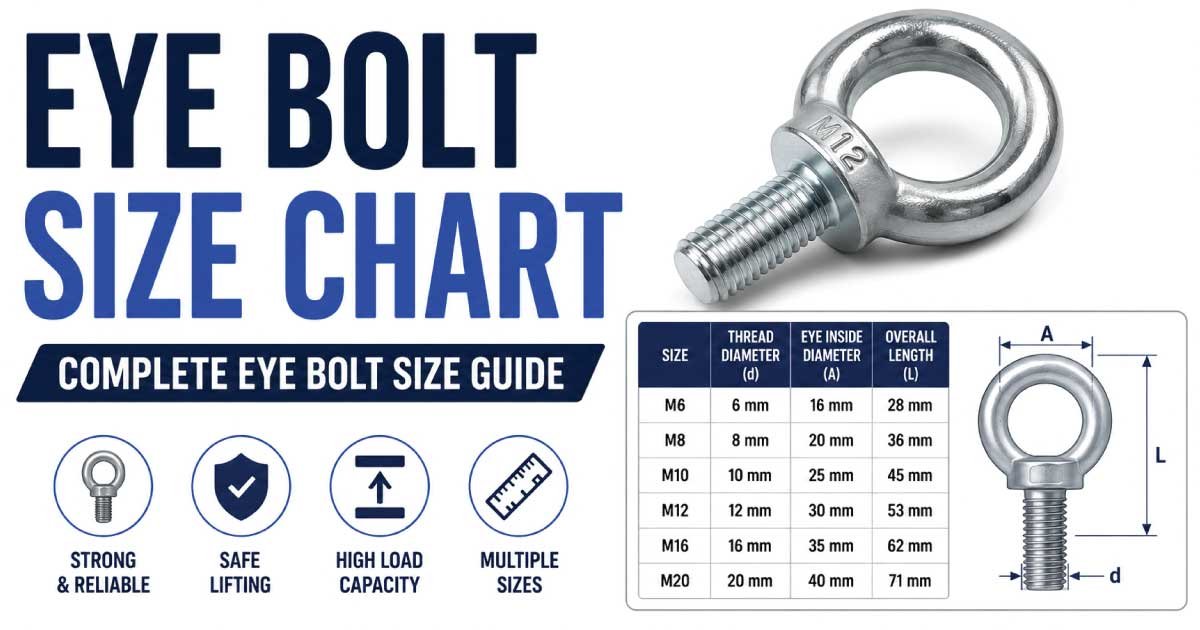
Eye bolts are specialized fasteners with a looped eye at one end and a threaded shank at the other. They are widely used for lifting, rigging, anchoring, tensioning, securing equipment, and general mechanical applications. However, not every eye bolt is designed for lifting, and selecting the correct type and size is essential for safety.
The term eye bolt size can refer to several different dimensions, including thread diameter, shank length, eye inside diameter, eye outside diameter, eye thickness, and thread pitch. The correct dimension depends on the type of eye bolt and its intended application.
This eye bolt size chart and complete guide explains common metric and imperial eye bolt sizes, how eye bolts are measured, the difference between regular and shoulder eye bolts, lifting eye bolts, open and closed eye bolts, thread types, working load considerations, installation requirements, and how to choose the right eye bolt.
Important: Never assume that a generic eye bolt is suitable for overhead lifting. Lifting applications require eye bolts specifically rated and approved for the intended load, loading direction, installation method, and applicable safety standard.
What Is an Eye Bolt?
An eye bolt is a threaded fastener with a circular or oval-shaped eye at one end and a threaded shank at the other.
The eye provides an attachment point for:
- Wire rope
- Cable
- Chain
- Hooks
- Shackles
- Rope
- Tensioning hardware
- Lifting equipment
- Anchoring systems
Eye bolts are available in many configurations. Some are intended for general fastening, while others are specifically designed for lifting.
Common types include:
- Regular eye bolts
- Shoulder eye bolts
- Machinery eye bolts
- Forged eye bolts
- Welded eye bolts
- Lifting eye bolts
- Closed eye bolts
- Open eye bolts
- Ring eye bolts
The design of the eye bolt is important because different styles can have very different load capacities.
Understanding Eye Bolt Dimensions
Before selecting an eye bolt, it is important to understand the measurements used to describe it.
Thread Diameter
Thread diameter is the nominal diameter of the threaded shank.
For example:
- M6 = approximately 6 mm nominal thread diameter
- M8 = approximately 8 mm
- M10 = approximately 10 mm
- M12 = approximately 12 mm
- M16 = approximately 16 mm
- 1/2 inch = 0.500 inch
- 3/4 inch = 0.750 inch
Thread diameter is one of the easiest dimensions to measure, but it does not by itself determine the safe working load of an eye bolt.
Thread Length
Thread length refers to the portion of the shank containing usable threads.
A longer threaded section may be required when the eye bolt is installed through thicker material or into a sufficiently deep threaded hole.
Eye Inside Diameter
The eye inside diameter is the opening through which a rope, cable, hook, shackle, or other attachment passes.
This dimension is particularly important when matching an eye bolt to lifting or rigging hardware.
Eye Outside Diameter
Eye outside diameter is measured across the widest external part of the eye.
It helps describe the overall size of the eye and can be useful when determining available clearance.
Eye Thickness
Eye thickness is the material thickness around the eye.
For lifting applications, the eye geometry and material thickness are important parts of the manufacturer’s rated design.
Overall Length
Overall length can refer to the complete length of the eye bolt, although manufacturers may define dimensions differently depending on the product standard.
Always check the manufacturer’s dimensional drawing when precise dimensions are required.
Metric Eye Bolt Size Chart
Metric eye bolts are identified by the nominal diameter of the threaded shank.
The following table provides common metric thread sizes and general identification information.
| Eye Bolt Size | Nominal Diameter | Common Coarse Pitch | General Application |
|---|---|---|---|
| M5 | 5 mm | 0.8 mm | Light-duty fastening |
| M6 | 6 mm | 1.0 mm | Small equipment |
| M8 | 8 mm | 1.25 mm | General fastening |
| M10 | 10 mm | 1.5 mm | Machinery and equipment |
| M12 | 12 mm | 1.75 mm | General industrial use |
| M14 | 14 mm | 2.0 mm | Larger assemblies |
| M16 | 16 mm | 2.0 mm | Heavy mechanical assemblies |
| M18 | 18 mm | 2.5 mm | Industrial applications |
| M20 | 20 mm | 2.5 mm | Heavy-duty fastening |
| M22 | 22 mm | 2.5 mm | Large equipment |
| M24 | 24 mm | 3.0 mm | Heavy-duty applications |
| M30 | 30 mm | 3.5 mm | Large industrial assemblies |
These values are useful for general thread identification. Exact eye dimensions and load ratings vary according to the eye bolt type, standard, material, manufacturer, and intended use.
Imperial Eye Bolt Size Chart
Imperial eye bolts are commonly specified by their nominal thread diameter in inches and thread count per inch.
| Eye Bolt Size | Nominal Diameter | Common Coarse TPI | General Application |
|---|---|---|---|
| 1/4-20 | 0.250 in | 20 | Light-duty applications |
| 5/16-18 | 0.313 in | 18 | General fastening |
| 3/8-16 | 0.375 in | 16 | Equipment and fixtures |
| 7/16-14 | 0.438 in | 14 | General industrial use |
| 1/2-13 | 0.500 in | 13 | Machinery and equipment |
| 9/16-12 | 0.563 in | 12 | Heavy fastening |
| 5/8-11 | 0.625 in | 11 | Equipment and structural assemblies |
| 3/4-10 | 0.750 in | 10 | Heavy-duty applications |
| 7/8-9 | 0.875 in | 9 | Large equipment |
| 1-8 | 1.000 in | 8 | Heavy industrial applications |
The thread size does not tell you the safe lifting capacity. For lifting, always use the manufacturer’s rated capacity for the exact eye bolt configuration.
How to Read an Eye Bolt Size
Eye bolt sizes are usually specified by thread diameter and length.
For example:
M12 × 50 mm
means:
- M = metric
- 12 = 12 mm nominal thread diameter
- 50 mm = specified length
If a thread pitch is included:
M12 × 1.75 × 50 mm
means:
- M12 = 12 mm nominal diameter
- 1.75 mm = thread pitch
- 50 mm = specified length
An imperial example is:
1/2-13 × 3 in
This means:
- 1/2 inch nominal diameter
- 13 threads per inch
- 3-inch specified length
The eye dimensions are normally provided separately in a manufacturer’s dimensional chart.
How to Measure an Eye Bolt
Measuring an eye bolt correctly helps identify a replacement and prevents thread mismatch.
Step 1: Measure the Thread Diameter
Use a caliper to measure the outside diameter of the threaded shank.
Compare the measurement with a metric or imperial size chart.
Step 2: Measure the Thread Pitch
For a metric eye bolt, determine the distance between adjacent thread peaks.
For an imperial eye bolt, determine the threads per inch.
A thread pitch gauge is the easiest tool for this measurement.
Step 3: Measure the Thread Length
Measure the length of the threaded portion of the shank.
This helps determine whether the replacement eye bolt will provide enough engagement.
Step 4: Measure the Eye Opening
Measure the inside diameter of the eye.
This tells you how much space is available for a hook, shackle, cable, or other attachment.
Step 5: Measure the Eye Outside Diameter
Measure across the widest external portion of the eye.
Step 6: Inspect the Shoulder
If the eye bolt has a shoulder beneath the eye, measure the shoulder diameter and height.
The shoulder is an important part of a shoulder eye bolt’s design.
Discover More: Nut Size Chart: Complete Guide to Nut Types and Sizes
Eye Bolt Thread Sizes and Common Applications
Different eye bolt diameters are suitable for different applications, but diameter alone should never be used to determine lifting capacity.
M6 Eye Bolt
M6 eye bolts are relatively small fasteners commonly used for light-duty fastening, small fixtures, panels, and equipment.
They should not be assumed to be suitable for lifting simply because they have an eye.
M8 Eye Bolt
M8 eye bolts are commonly used for equipment mounting, light mechanical applications, fixtures, and general-purpose attachment points.
The specific product rating should be checked before applying a load.
M10 Eye Bolt
M10 eye bolts provide a larger threaded connection and are widely available for machinery, equipment, mounting, and general fastening.
Lifting suitability depends on the eye bolt’s design and certification rather than diameter alone.
M12 Eye Bolt
M12 is a common industrial eye bolt size. It can be found in equipment mounting, mechanical assemblies, anchoring, and specialized lifting products.
For lifting, verify the manufacturer’s working load limit and loading conditions.
M16 Eye Bolt
M16 eye bolts have a larger nominal diameter and are commonly available in heavy-duty configurations.
Forged or rated M16 lifting eye bolts can be used in suitable applications when installed and loaded according to the manufacturer’s requirements.
Shoulder Eye Bolt vs Regular Eye Bolt
One of the most important distinctions is between a shoulder eye bolt and a regular or non-shoulder eye bolt.
Shoulder Eye Bolt
A shoulder eye bolt has a larger shoulder section directly beneath the eye.
The shoulder can help distribute the load against the mounting surface and is important in applications where the eye bolt is designed for specific loading conditions.
Regular Eye Bolt
A regular eye bolt generally has a straight shank without a substantial shoulder.
Its application and load capability can differ significantly from a shoulder eye bolt.
The two types should not be substituted for each other without confirming that the replacement is suitable for the intended loading conditions.
What Is a Lifting Eye Bolt?
A lifting eye bolt is an eye bolt specifically designed and rated for lifting loads.
This is an important distinction because not every eye bolt is a lifting eye bolt.
Lifting eye bolts are manufactured and tested according to applicable product requirements and are supplied with a specified working load limit or other capacity information.
Important factors can include:
- Eye bolt material
- Thread diameter
- Eye geometry
- Shoulder design
- Manufacturing method
- Loading direction
- Installation torque
- Thread engagement
- Surface condition
- Working load limit
Always follow the manufacturer’s instructions for lifting applications.
Eye Bolt Working Load Limit
The working load limit (WLL) is the maximum load a rated lifting component is intended to support under specified conditions.
It is not possible to determine a safe WLL simply by looking at the thread diameter.
For example, two eye bolts with the same M16 thread could have different capacities because their:
- Materials differ
- Eye designs differ
- Manufacturing processes differ
- Shoulder designs differ
- Standards differ
- Loading conditions differ
For this reason, never use a generic eye bolt size chart as a substitute for the manufacturer’s certified working load information.
Eye Bolt Loading Direction
Loading direction is especially important for lifting eye bolts.
An eye bolt designed for an axial load may not have the same capacity when the load is applied at an angle.
Side loading can create additional bending forces in the eye bolt and may significantly reduce the allowable load.
Before lifting:
- Check the manufacturer’s instructions.
- Verify the permitted loading direction.
- Confirm the working load limit.
- Inspect the eye bolt for damage.
- Ensure the bolt is properly installed.
- Use compatible lifting equipment.
- Do not exceed the rated capacity.
If an application requires angular loading, use an eye bolt specifically designed and rated for that loading condition.
Discover More: Spring Pin Size Chart, Types, Uses With Complete Guide
Open Eye Bolt vs Closed Eye Bolt
Eye bolts are available with different eye configurations.
Closed Eye Bolt
A closed eye forms a continuous loop.
This design is useful when a permanent or enclosed connection is desired.
Open Eye Bolt
An open eye has a break or opening in the loop.
This can make installation and removal of ropes or cables easier.
However, an open eye should not automatically be treated as a lifting component.
The product’s intended application and rated capacity should always be verified.
Forged Eye Bolt vs Welded Eye Bolt
Eye bolts can be manufactured using different production methods.
Forged Eye Bolts
Forging shapes the metal under controlled heat and pressure.
Forged eye bolts are commonly used where high strength and consistent material properties are required.
Some lifting eye bolts use forged construction and are manufactured to specific standards.
Welded Eye Bolts
Welded eye bolts are produced by forming and joining components through welding.
They may be suitable for specific general-purpose applications, but their strength characteristics depend on the design and manufacturing specification.
For lifting applications, use a product specifically rated and approved for lifting rather than selecting a welded eye bolt solely by size.
Eye Bolt Materials
The material of an eye bolt affects strength, corrosion resistance, and suitability for the working environment.
Carbon Steel
Carbon steel eye bolts are widely used for general mechanical and industrial applications.
They may be supplied with protective coatings to improve corrosion resistance.
Stainless Steel
Stainless steel eye bolts are useful where corrosion resistance is important.
Common applications include:
- Outdoor equipment
- Marine environments
- Food-related equipment
- Architectural applications
- Moist environments
The exact stainless steel grade should be selected according to the environment and required mechanical properties.
Galvanized Steel
Galvanized eye bolts have a zinc coating that provides improved corrosion resistance.
They are commonly used in outdoor and construction applications.
How to Choose the Correct Eye Bolt Size
Selecting an eye bolt requires consideration of more than the thread diameter.
1. Determine the Thread Size
Measure the existing threaded hole or bolt.
2. Match the Thread Pitch
The eye bolt thread must exactly match the mating thread.
3. Select the Required Length
Ensure that the eye bolt provides adequate thread engagement without bottoming out or creating unwanted interference.
4. Check the Eye Opening
Make sure the eye opening is large enough for the intended hook, shackle, cable, or other connection.
5. Select the Correct Type
Choose between:
- Regular eye bolt
- Shoulder eye bolt
- Lifting eye bolt
- Forged eye bolt
- Open eye
- Closed eye
6. Check the Load
For lifting applications, confirm the manufacturer’s working load limit.
7. Check the Loading Direction
Make sure the eye bolt is designed for the direction in which the load will be applied.
8. Consider Corrosion
Select an appropriate material or protective coating for the environment.
Eye Bolt Nut and Washer Selection
Eye bolts installed through a material may require a compatible nut and washer.
The nut must match:
- Nominal diameter
- Thread pitch
- Thread standard
- Required strength
The washer should provide adequate bearing area and be appropriate for the material and application.
For example, an M12 eye bolt requires an appropriately threaded M12 nut if the design calls for a nut.
Do not use an incorrectly threaded nut simply because it appears to fit.
Eye Bolt Installation Guide
Correct installation is particularly important for lifting applications.
Clean the Threads
Ensure that the eye bolt and mating threads are clean and free from debris.
Inspect the Eye Bolt
Look for:
- Cracks
- Bends
- Corrosion
- Damaged threads
- Deformation
- Wear
Damaged lifting hardware should not be used.
Install Correctly
Install the eye bolt according to the manufacturer’s instructions.
For shoulder eye bolts, the shoulder may need to seat properly against the mounting surface.
Avoid Unapproved Modifications
Do not weld, bend, machine, or otherwise modify a rated lifting eye bolt unless specifically permitted by the manufacturer or applicable specification.
Check Alignment
Ensure that the eye is correctly oriented for the intended load direction.
Discover More: Flange Size Chart: Types and Uses With Complete Guide
Common Eye Bolt Mistakes
Several mistakes can reduce the reliability of an eye bolt connection.
Using a Generic Eye Bolt for Lifting
A general-purpose eye bolt is not automatically a lifting component.
Ignoring Load Direction
Side loading can create forces that the eye bolt was not designed to handle.
Using the Wrong Thread
A mismatched thread can damage the mounting hole and produce an unreliable connection.
Overloading the Eye Bolt
Never exceed the manufacturer’s rated capacity.
Using Damaged Hardware
Bent, cracked, heavily corroded, or deformed eye bolts should not be used for critical applications.
Using the Wrong Eye Bolt Type
A regular eye bolt and a shoulder eye bolt can have different load characteristics.
Eye Bolt Size Chart Quick Reference
The following table provides a quick reference for common eye bolt thread sizes.
| Size | Nominal Diameter | Common Metric Pitch / Imperial TPI | Typical Category |
|---|---|---|---|
| M6 | 6 mm | 1.0 mm | Small eye bolt |
| M8 | 8 mm | 1.25 mm | General purpose |
| M10 | 10 mm | 1.5 mm | Equipment |
| M12 | 12 mm | 1.75 mm | Industrial |
| M16 | 16 mm | 2.0 mm | Heavy-duty |
| M20 | 20 mm | 2.5 mm | Large equipment |
| 1/4 in | 0.250 in | 20 TPI | Small applications |
| 5/16 in | 0.313 in | 18 TPI | General fastening |
| 3/8 in | 0.375 in | 16 TPI | Equipment |
| 1/2 in | 0.500 in | 13 TPI | Industrial |
| 5/8 in | 0.625 in | 11 TPI | Heavy-duty |
| 3/4 in | 0.750 in | 10 TPI | Large assemblies |
This is a thread-size reference, not a lifting-capacity chart. Always use the manufacturer’s specifications for rated lifting applications.
Frequently Asked Questions About Eye Bolt Sizes
What are the most common eye bolt sizes?
Common eye bolt sizes include M6, M8, M10, M12, M16, M20, 1/4 inch, 5/16 inch, 3/8 inch, 1/2 inch, 5/8 inch, and 3/4 inch. The appropriate size depends on the application, mounting material, thread requirements, eye opening, and load requirements.
How is an eye bolt measured?
An eye bolt is measured by its thread diameter, thread length, overall dimensions, and eye dimensions. The eye can also be measured by its inside diameter, outside diameter, and material thickness. A caliper and thread pitch gauge are useful for accurately identifying an existing eye bolt.
Can any eye bolt be used for lifting?
No. A general-purpose eye bolt should not automatically be used for lifting. Lifting requires an eye bolt specifically designed, rated, and approved for the intended load and loading direction. Always check the manufacturer’s working load limit and installation requirements before using an eye bolt in a lifting application.
What is the difference between a regular eye bolt and a shoulder eye bolt?
A regular eye bolt generally has a straight shank beneath the eye, while a shoulder eye bolt has a larger shoulder beneath the eye. The shoulder affects how the eye bolt transfers load to the mounting surface. The two types should not be substituted without confirming suitability for the application.
What size nut fits an M12 eye bolt?
An M12 eye bolt requires a compatible M12 nut with the correct thread pitch when the design uses a nut. A common coarse metric M12 thread has a 1.75 mm pitch, but the exact pitch should always be confirmed before selecting the nut.
What is the difference between M12 and 1/2-inch eye bolts?
M12 has a nominal diameter of 12 mm, while 1/2 inch has a nominal diameter of 12.7 mm. Although the sizes are relatively close, their thread standards and pitches differ. They should not be considered interchangeable unless the exact mating threads are confirmed.
How much weight can an eye bolt hold?
There is no universal weight rating based only on eye bolt diameter. The safe working load depends on the eye bolt design, material, manufacturing specification, installation, thread engagement, loading direction, and manufacturer’s rated working load limit. For lifting, use only rated hardware with verified capacity.
Can an eye bolt be side loaded?
A standard eye bolt should not automatically be side loaded. Angular or side loading can introduce bending forces and substantially change the stresses in the eye bolt. If side loading is required, use an eye bolt specifically designed and rated for that loading condition and follow the manufacturer’s instructions.
Final Thoughts
An eye bolt size chart is useful for identifying common thread sizes and selecting the appropriate fastener for mechanical, anchoring, equipment, and general fastening applications. However, eye bolt selection requires more care than selecting an ordinary bolt because the eye can be subjected to tension, bending, and attachment loads.
The most important dimensions include thread diameter, thread pitch, thread length, eye inside diameter, eye outside diameter, eye thickness, and overall dimensions.
Common metric eye bolt sizes include M6, M8, M10, M12, M16, and M20, while common imperial sizes include 1/4 inch, 5/16 inch, 3/8 inch, 1/2 inch, 5/8 inch, and 3/4 inch.
The most important safety distinction is between a general-purpose eye bolt and a rated lifting eye bolt. Thread diameter alone does not determine lifting capacity. For lifting applications, always verify the exact product’s working load limit, loading direction, installation requirements, material, and applicable standard.
Before purchasing a replacement, measure the existing eye bolt carefully and match its diameter, thread pitch, length, eye opening, and eye configuration. For safety-critical lifting applications, rely on the manufacturer’s certified specifications rather than a generic eye bolt size chart.
When correctly selected and installed, the right eye bolt provides a practical and versatile attachment point for a wide range of mechanical, industrial, construction, and equipment applications.

Engineer Hassan is a Mechanical Engineer with 16+ years of hands-on experience in mechanical hardware, fasteners, and workshop tools. He focuses on size selection, thread identification, and measurement, helping users choose the correct components with accuracy and safety.