
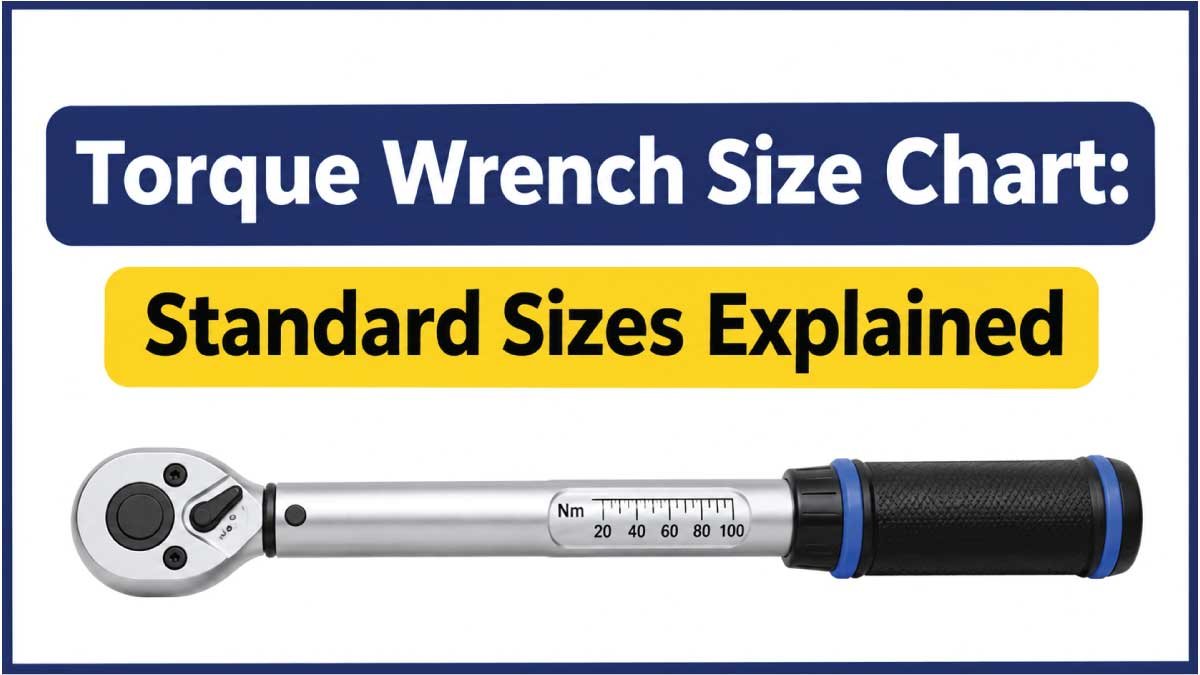
Choosing the correct torque wrench size is essential for tightening bolts and nuts accurately without damaging threads, fasteners, or connected components. A wrench that is too small may not provide the required torque, while an oversized wrench can make accurate tightening difficult, particularly on smaller fasteners.
This torque wrench size chart explains the common drive sizes, their applications, torque measurement units, and the differences between 1/4-inch, 3/8-inch, 1/2-inch, 3/4-inch, and 1-inch torque wrenches. You will also learn how to select the right wrench for automotive repairs, mechanical work, machinery, and general maintenance.
Whether you are working on engine components, wheel lug nuts, suspension parts, or industrial equipment, understanding torque wrench sizes helps you select an appropriate tool and achieve reliable fastening results.
What Is a Torque Wrench?
A torque wrench is a precision hand tool designed to apply a specific amount of rotational force to a threaded fastener. Unlike an ordinary ratchet or spanner, it allows the user to tighten a bolt or nut to a predetermined torque value.
Torque is the rotational force applied around an axis. It is commonly measured in:
- Newton-meters (Nm): The standard metric torque unit.
- Foot-pounds (ft-lb): Commonly used in automotive and mechanical applications in the United States.
- Inch-pounds (in-lb): Used for lower-torque applications and smaller fasteners.
- Kilogram-force meters (kgf·m): An older torque measurement unit still encountered in some technical references.
A torque wrench helps prevent two common fastening problems:
- Under-tightening: The fastener may become loose because insufficient clamping force has been applied.
- Over-tightening: Excessive force can stretch bolts, damage threads, deform components, or cause fastener failure.
The correct torque depends on the fastener, material, lubrication condition, assembly design, and manufacturer’s specifications.
Torque Wrench Size Chart
Torque wrenches are commonly categorized by their square drive size. The drive connects the wrench to a compatible socket and helps determine the type of fastening work the tool can handle.
The following chart compares common torque wrench drive sizes and their typical applications.
| Drive Size | Drive Measurement | Common Applications | Typical Work |
|---|---|---|---|
| 1/4 inch | 6.35 mm | Small fasteners, electronics, bicycles | Low-torque assembly |
| 3/8 inch | 9.53 mm | Motorcycles, automotive components | Light to medium fastening |
| 1/2 inch | 12.70 mm | Cars, trucks, wheel lug nuts | Medium to high-torque fastening |
| 3/4 inch | 19.05 mm | Heavy vehicles, industrial machinery | High-torque applications |
| 1 inch | 25.40 mm | Large machinery, industrial equipment | Very high-torque fastening |
Important: Drive size does not establish an exact torque capacity. Two torque wrenches with the same drive size can have different operating ranges depending on their design and manufacturer. Always check the tool’s specified torque range before using it.
Common Torque Wrench Sizes and Their Applications
Each torque wrench size is designed for particular fastening requirements. Selecting the correct size improves handling, accuracy, and working convenience.
1/4-Inch Torque Wrench
A 1/4-inch torque wrench is generally used for small fasteners that require relatively low tightening torque.
It is particularly useful when working with delicate components where excessive tightening could damage threads or surrounding materials.
Common applications include:
- Small engine components.
- Bicycle components and accessories.
- Electronics and precision assemblies.
- Small mechanical fasteners.
- Light automotive maintenance.
These wrenches are often available in compact designs, making them convenient for working in confined spaces.
3/8-Inch Torque Wrench
The 3/8-inch torque wrench is a versatile option for light and medium-duty mechanical work. It provides a useful balance between tool size, accessibility, and fastening capability.
Common applications include:
- Motorcycle maintenance.
- Automotive engine components.
- Spark plugs, where specified.
- Small suspension components.
- General mechanical assemblies.
- Bicycle maintenance requiring higher torque than smaller tools provide.
It is a practical choice for users who regularly perform maintenance work on vehicles and machinery.
1/2-Inch Torque Wrench
A 1/2-inch torque wrench is one of the most commonly used sizes in automotive maintenance. It is designed for applications requiring greater torque than many smaller drive tools can provide.
Common applications include:
- Automotive wheel lug nuts.
- Brake and suspension components.
- Larger engine fasteners.
- Truck maintenance.
- General automotive repairs.
A 1/2-inch model is particularly useful for wheel installation because vehicle manufacturers specify exact tightening torque values for wheel fasteners.
However, always select a wrench whose operating range includes the required torque rather than assuming every 1/2-inch model is suitable.
3/4-Inch Torque Wrench
A 3/4-inch torque wrench is designed for heavier fastening applications. Its larger drive accommodates sockets intended for larger fasteners and mechanical assemblies.
Common applications include:
- Heavy-duty trucks.
- Industrial machinery.
- Construction equipment.
- Large mechanical assemblies.
- Heavy vehicle maintenance.
These tools are generally larger and heavier than 1/2-inch models. They are not normally necessary for routine passenger-car maintenance.
1-Inch Torque Wrench
A 1-inch torque wrench is used for specialized heavy-duty applications involving large fasteners and substantial tightening requirements.
Common applications include:
- Industrial machinery.
- Large equipment assemblies.
- Heavy construction machinery.
- Industrial maintenance operations.
- Large structural and mechanical connections.
Because these applications can involve critical fastening requirements, the specified torque procedure and calibrated equipment are especially important.
Torque Wrench Measurement Units Chart
Understanding torque measurement units is important when using technical manuals, automotive specifications, and mechanical drawings.
Different manufacturers and industries may specify torque in different units.
| Torque Unit | Full Name | Common Usage |
|---|---|---|
| Nm | Newton-meter | Metric automotive and mechanical specifications |
| ft-lb | Foot-pound | Automotive and mechanical work in the United States |
| in-lb | Inch-pound | Small fasteners and precision assemblies |
| kgf·m | Kilogram-force meter | Older mechanical specifications |
The following conversions are useful when reading specifications provided in different measurement systems.
| Conversion | Equivalent Value |
|---|---|
| 1 Nm | 0.7376 ft-lb |
| 1 Nm | 8.8507 in-lb |
| 1 ft-lb | 1.3558 Nm |
| 1 ft-lb | 12 in-lb |
| 1 in-lb | 0.11298 Nm |
| 1 kgf·m | 9.80665 Nm |
For example, if a manufacturer’s manual specifies 100 Nm, the equivalent value is approximately 73.76 ft-lb.
Always use the correct measurement setting on your torque wrench. Avoid confusing inch-pounds with foot-pounds because the difference is substantial.
Types of Torque Wrenches and Their Differences
Torque wrenches are available in several designs. Each type uses a different mechanism to measure or indicate the applied torque.
Click-Type Torque Wrench
A click-type torque wrench is one of the most widely used mechanical designs.
The user sets the desired torque value, tightens the fastener, and receives an audible or tactile click when the selected setting is reached.
Advantages:
- Easy to operate.
- Adjustable torque settings.
- Suitable for automotive maintenance.
- Provides a clear indication when the preset torque is reached.
Limitations:
- Requires correct setting and handling.
- Can lose accuracy if dropped or poorly maintained.
- Some models need to be returned to their minimum specified setting after use.
Beam-Type Torque Wrench
A beam-type torque wrench uses a pointer and calibrated scale to indicate the applied torque.
As the handle moves under load, the pointer indicates the torque value on the scale.
Advantages:
- Simple mechanical construction.
- Does not require batteries.
- Allows continuous torque readings.
- Generally easy to inspect.
Limitations:
- Requires the user to read the scale carefully.
- Can be difficult to use in restricted spaces.
- The operator must maintain the correct viewing angle.
Digital Torque Wrench
A digital torque wrench uses electronic sensors and a display to show the applied torque.
Many models include audible alerts, visual indicators, and selectable measurement units.
Advantages:
- Easy-to-read digital display.
- Multiple measurement units on many models.
- Useful for precision fastening.
- Some models include data storage and angle measurement.
Limitations:
- Requires batteries or another power source.
- Usually more expensive than basic mechanical models.
- Electronic components require appropriate care.
Dial-Type Torque Wrench
A dial-type torque wrench displays the applied torque through a mechanical dial indicator.
It is commonly used where the operator needs to observe torque continuously rather than rely only on a preset click.
Advantages:
- Provides a visible torque reading.
- Useful for monitoring applied force.
- Suitable for certain inspection and assembly tasks.
Limitations:
- The dial requires careful reading.
- The tool can be less convenient in confined locations.
- Proper calibration is important.
Related Guide:
How to Choose the Correct Torque Wrench Size
Selecting a torque wrench requires more than matching the socket drive to a fastener. You must also consider the required torque, working conditions, and tool specifications.
1. Check the Required Torque Specification
First, identify the tightening torque specified by the equipment or vehicle manufacturer.
Do not select a torque wrench based only on the bolt diameter or appearance. Two fasteners with similar dimensions can require different torque values depending on their materials and applications.
2. Match the Torque Range
Every torque wrench has a specified operating range.
Choose a tool that covers the required torque value and allows you to work comfortably within its rated range.
For example, if a fastener requires 80 Nm, select a wrench whose specified operating range includes 80 Nm.
Avoid using a wrench outside its rated limits.
3. Select the Appropriate Drive Size
Choose a drive size that accommodates the required socket and fastening application.
- Choose 1/4 inch for suitable low-torque work.
- Choose 3/8 inch for many light and medium mechanical applications.
- Choose 1/2 inch for many automotive and larger fastening jobs.
- Choose 3/4 inch or 1 inch for appropriate heavy-duty applications.
These are general selection guidelines rather than fixed torque classifications.
4. Consider Working Space
The physical size of the wrench matters when working around engines, suspension systems, and machinery.
A large wrench may provide the required torque but could be difficult to position in a confined area.
Consider handle length, head clearance, socket access, and the available working angle.
5. Check Accuracy and Calibration
A torque wrench is a measuring instrument, so accuracy matters.
Check the manufacturer’s accuracy specifications and calibration recommendations. If the tool has been dropped, overloaded, or damaged, have its accuracy checked before relying on it for critical work.
Related Guide:
How to Measure and Set Torque Correctly
Using a torque wrench properly is essential for obtaining consistent fastening results.
Follow these general steps when using an adjustable torque wrench.
- Identify the specified torque: Check the service manual or manufacturer’s assembly instructions.
- Select the correct socket: Use a compatible socket that fits the fastener securely.
- Inspect the fastener: Check for damaged threads, contamination, or other problems.
- Set the torque value: Adjust the wrench to the required specification using the correct measurement unit.
- Position the socket: Place it fully onto the fastener to reduce the risk of slipping.
- Apply steady force: Pull smoothly using the handle’s designated gripping area.
- Stop at the indication: For a click-type wrench, stop when the click occurs. For digital and beam models, follow their respective indicators.
- Check the assembly: Confirm that the fastening procedure has been completed according to the manufacturer’s instructions.
Do not continue tightening after reaching the specified torque unless the manufacturer’s procedure specifically requires another step.
Some assemblies require a staged tightening sequence, a torque-plus-angle procedure, or a particular tightening pattern. Follow those instructions rather than relying on a single torque reading.
Torque Wrench Size Comparison: Which One Should You Buy?
The best torque wrench depends on the type of work you perform most frequently.
| Torque Wrench Size | Best Suited For | General Recommendation |
|---|---|---|
| 1/4 inch | Small precision fasteners | Small mechanical and bicycle work |
| 3/8 inch | Light and medium fastening | Motorcycle and general automotive work |
| 1/2 inch | Larger automotive fasteners | Wheel and suspension maintenance |
| 3/4 inch | Heavy-duty fastening | Trucks and industrial machinery |
| 1 inch | Large industrial fasteners | Specialized heavy equipment |
If you perform routine vehicle maintenance, a 3/8-inch or 1/2-inch torque wrench may cover many of your needs. However, the required torque ranges should determine the final selection.
Professional mechanics and industrial technicians may need multiple torque wrenches because one tool rarely covers every fastening requirement accurately and conveniently.
Related Guide:
Common Torque Wrench Mistakes to Avoid
Even a high-quality torque wrench can produce unreliable results when used incorrectly.
Avoid these common mistakes:
- Using the wrong torque range: A fastener should not be tightened using a wrench outside its specified operating range.
- Confusing measurement units: Always distinguish between Nm, ft-lb, and in-lb.
- Using a torque wrench as a breaker bar: Most torque wrenches are not designed to loosen extremely tight fasteners.
- Applying sudden force: Pull smoothly instead of jerking the handle.
- Ignoring calibration: Accuracy can change through wear, damage, and improper handling.
- Using damaged sockets: Worn or incorrectly sized sockets can slip and damage fasteners.
- Ignoring tightening sequences: Some assemblies require a specific order to distribute clamping force correctly.
- Over-tightening after the click: Stop when the wrench indicates that the preset torque has been reached.
Another important mistake is assuming that every bolt of the same diameter requires identical torque. Thread pitch, material, lubrication, coating, and joint design can all influence the required specification.
Torque Wrench Maintenance and Storage Tips
Proper maintenance helps preserve the accuracy and service life of a torque wrench.
Follow these practical recommendations:
- Clean the wrench after use to remove dirt, oil, and debris.
- Store it in its protective case when possible.
- Avoid dropping or striking the tool.
- Do not exceed its specified torque capacity.
- Keep the calibration certificate and service records when applicable.
- Follow the manufacturer’s calibration and inspection schedule.
- For adjustable click-type models, follow the manufacturer’s instructions for storage settings.
- Keep the tool away from excessive moisture and conditions that could damage its internal mechanism.
Calibration intervals depend on the manufacturer, frequency of use, working conditions, and applicable quality requirements. There is no single interval suitable for every torque wrench.
For critical industrial or automotive applications, use a calibration service that can verify the tool against appropriate measurement standards.
Frequently Asked Questions (FAQs)
1. What size torque wrench is best for automotive work?
A 1/2-inch torque wrench is commonly used for automotive wheel fasteners and many larger vehicle components. A 3/8-inch model is useful for smaller mechanical and engine fasteners. The required torque range is more important than drive size alone.
2. What is the most common torque wrench drive size?
The 1/2-inch drive is widely used for automotive maintenance, particularly wheel lug nuts and larger fasteners. However, 3/8-inch and 1/4-inch models are also common for smaller applications.
3. What is the difference between a 3/8-inch and 1/2-inch torque wrench?
The main difference is the square drive size. A 3/8-inch wrench is commonly used for light and medium fastening, while a 1/2-inch wrench is frequently selected for larger automotive fasteners. Their actual torque ranges depend on the individual models.
4. Can I use a torque wrench to loosen bolts?
Most torque wrenches are intended for tightening, not loosening. Using them as breaker bars can damage their internal mechanisms or affect accuracy. Use an appropriate ratchet or breaker bar to loosen fasteners.
5. How often should a torque wrench be calibrated?
Calibration frequency depends on manufacturer recommendations, usage, storage, and required accuracy. Some workplaces establish regular calibration schedules. A wrench that has been dropped or overloaded should be checked before further critical use.
6. What does Nm mean on a torque wrench?
Nm stands for Newton-meter, a metric unit of torque. It represents the rotational effect of a force applied at a distance from an axis. It is widely used in automotive and mechanical specifications.
7. Is a digital torque wrench more accurate than a click-type wrench?
Not automatically. Accuracy depends on the specific model, calibration, operating conditions, and correct use. A properly calibrated click-type wrench can be highly accurate, while a digital model may offer additional display and measurement features.
8. Can I use an adapter to change torque wrench drive size?
Yes, compatible drive adapters can connect different socket sizes to a torque wrench. However, extensions and adapters can affect torque delivery depending on their configuration. Follow the manufacturer’s instructions and use a suitable adapter without compromising the required accuracy.
9. Should a torque wrench be stored at zero?
Not necessarily. Many adjustable click-type torque wrenches should be returned to their manufacturer’s recommended minimum storage setting, which may not be zero. Always follow the specific storage instructions for your model.
Conclusion
Choosing the correct torque wrench size helps ensure reliable fastening, reduces the risk of component damage, and improves the quality of mechanical work. The most common drive sizes include 1/4-inch, 3/8-inch, 1/2-inch, 3/4-inch, and 1-inch models, each serving different applications.
Use the torque wrench size chart to understand the differences between these tools, but remember that drive size alone does not determine torque capacity. Always check the manufacturer’s torque range, select the correct measurement unit, and follow the equipment manufacturer’s tightening specifications.
A properly selected, calibrated, and maintained torque wrench is an essential tool for accurate automotive repairs, mechanical assembly, and industrial maintenance.

Engineer Hassan is a Mechanical Engineer with 16+ years of hands-on experience in mechanical hardware, fasteners, and workshop tools. He focuses on size selection, thread identification, and measurement, helping users choose the correct components with accuracy and safety.