
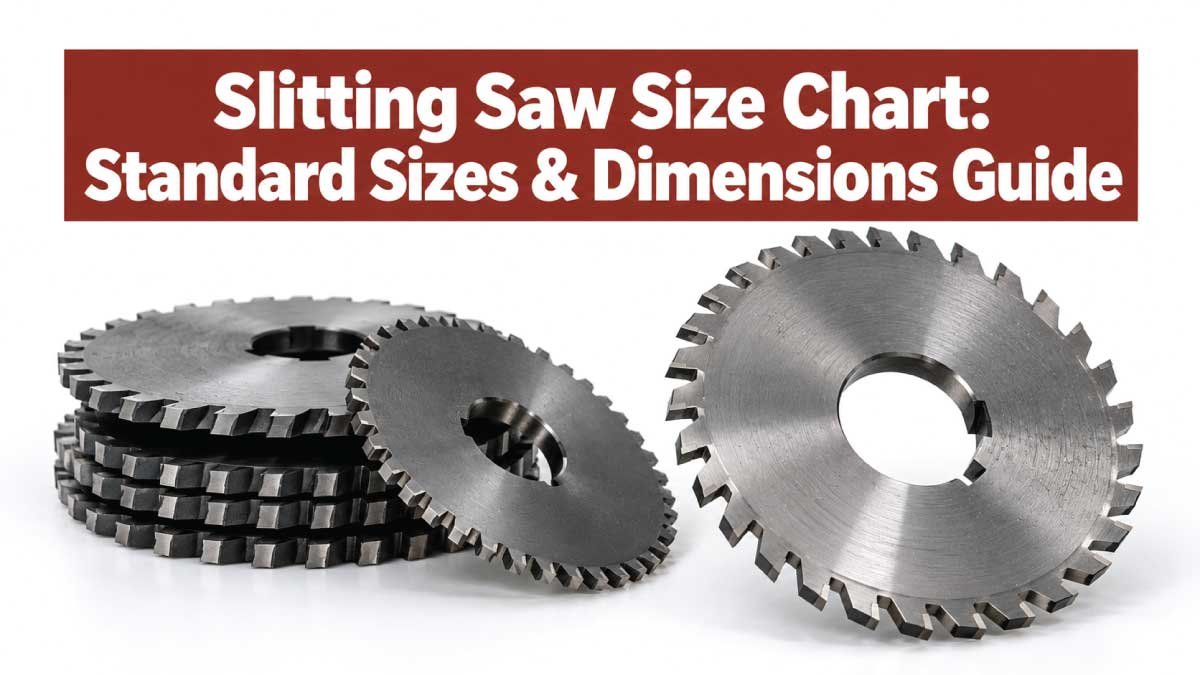
Choosing the correct slitting saw depends on more than the outside diameter. Blade thickness, arbor hole, tooth count, tooth form, material, and cutting depth all affect how a saw performs. A blade that is too thick may remove unnecessary material, while one that is too thin can deflect or vibrate if the setup is not rigid enough.
This slitting saw size chart explains the most important dimensions and helps you compare common saw diameters, thicknesses, arbor sizes, and tooth-count ranges. It also covers slitting saw types, how to measure one, how to select the right blade, and common machining problems.
What Is a Slitting Saw?
A slitting saw is a circular milling cutter designed primarily for narrow slots, grooves, cutoffs, and parting operations. It resembles a thin circular blade but is manufactured with cutting teeth around its circumference.
Slitting saws are commonly used on milling machines, CNC machining centers, and other machines capable of securely holding an arbor-mounted cutter.
Unlike an ordinary circular saw, a milling slitting saw is selected according to the machine’s spindle, arbor system, workpiece material, required slot width, and cutting conditions.
Typical applications include:
- Cutting narrow slots
- Parting small components
- Making deep grooves
- Cutting keyways and narrow channels
- Separating machined parts
- Producing slots between closely spaced features
- Cutting thin sections of metal
- Creating intermittent or specialized grooves
The main dimensions you will encounter are outside diameter, blade thickness, arbor hole diameter, tooth count, and cutting depth.
Slitting Saw Size Chart
The following chart shows commonly encountered nominal slitting saw dimensions. These values are useful for comparing blade sizes, but they should not be treated as a universal manufacturing standard. Exact combinations vary by manufacturer, cutter design, tooth form, and arbor system.
Common Slitting Saw Diameter Sizes
| Outside Diameter | Approx. Diameter in Inches | Typical Use |
|---|---|---|
| 40 mm | 1.57 in | Small slots and light cutting |
| 50 mm | 1.97 in | General-purpose work |
| 63 mm | 2.48 in | Medium-depth slots |
| 80 mm | 3.15 in | General machining |
| 100 mm | 3.94 in | Larger grooves and cutoffs |
| 125 mm | 4.92 in | Deep cutting applications |
| 160 mm | 6.30 in | Large workpieces |
| 200 mm | 7.87 in | Large-diameter machining |
| 250 mm | 9.84 in | Specialized heavy-duty work |
A larger diameter generally provides greater potential cutting depth, but it also increases the space required around the cutter and can change the appropriate spindle speed.
Common Slitting Saw Thicknesses
| Saw Thickness | Approx. Inch Thickness | Typical Application |
|---|---|---|
| 0.20 mm | 0.008 in | Very narrow precision slots |
| 0.30 mm | 0.012 in | Thin-slot applications |
| 0.50 mm | 0.020 in | Fine slotting |
| 0.75 mm | 0.030 in | Narrow general-purpose slots |
| 1.00 mm | 0.039 in | Light slotting |
| 1.50 mm | 0.059 in | General slotting |
| 2.00 mm | 0.079 in | Medium slots |
| 2.50 mm | 0.098 in | Heavier slotting |
| 3.00 mm | 0.118 in | Wider slots and cutoffs |
| 4.00 mm | 0.157 in | Heavy slotting |
| 5.00 mm | 0.197 in | Large slots and parting |
| 6.00 mm | 0.236 in | Heavy-duty applications |
Thickness is one of the most important dimensions because it largely determines the width of the slot produced by the cutter. Actual finished slot width can also be affected by cutter runout, tooth geometry, material behavior, and machine conditions.
Slitting Saw Dimensions You Need to Know
A slitting saw should be described using several dimensions rather than its diameter alone.
Outside Diameter
The outside diameter is the overall diameter measured across the circular cutter.
For example, a 100 mm slitting saw has a nominal outside diameter of 100 mm.
Diameter influences:
- Maximum practical cutting depth
- Spindle-speed requirements
- Available tooth engagement
- Machine clearance
- Cutter rigidity
- Workpiece accessibility
A larger saw is not automatically better. If the required slot is shallow, a smaller cutter may provide easier setup and better machine clearance.
Blade Thickness
Blade thickness determines the approximate width of material removed during a slotting operation.
Thin blades are useful when minimizing material loss or creating narrow slots. However, extremely thin cutters require careful setup because they are more susceptible to deflection and vibration.
Arbor Hole
The arbor hole is the central opening through which the saw is mounted.
Common arbor-hole sizes vary considerably between cutter families. Metric cutters may be supplied with sizes such as 16 mm, 22 mm, 25.4 mm, 27 mm, 32 mm, or other manufacturer-specific dimensions.
Always match the cutter’s arbor hole with the actual arbor and mounting hardware.
Tooth Count
Tooth count describes the number of cutting teeth around the circumference.
A low tooth count provides relatively large spaces between teeth, while a high tooth count provides more teeth in contact with the workpiece.
Tooth count should be selected according to:
- Workpiece material
- Blade diameter
- Cutting depth
- Feed rate
- Slot width
- Machine rigidity
- Required surface finish
Cutting Depth
The theoretical maximum radial cutting depth is related to the saw’s radius, but the usable depth is also limited by the machine, arbor, workpiece arrangement, and cutter geometry.
For example, a 100 mm diameter saw has a nominal radius of 50 mm. That does not mean every setup can safely produce a 50 mm-deep slot.
Slitting Saw Size Chart by Tooth Count
Tooth count is another important specification when comparing blades. There is no single tooth count that is correct for every diameter and application.
The following ranges are representative rather than universal.
| Saw Diameter | Typical Tooth-Count Range | General Character |
|---|---|---|
| 40 mm | 20–40 teeth | Fine to general cutting |
| 50 mm | 24–50 teeth | General slotting |
| 63 mm | 30–60 teeth | General-purpose machining |
| 80 mm | 36–80 teeth | Medium-duty slotting |
| 100 mm | 40–100 teeth | General and fine cutting |
| 125 mm | 50–120 teeth | Larger slotting work |
| 160 mm | 60–160 teeth | Large-workpiece applications |
These ranges should be used for understanding the relationship between diameter and tooth count, not as a substitute for the manufacturer’s actual cutter specification.
A blade with too many teeth for the chosen feed rate can produce inadequate chip space. Conversely, a blade with too few teeth may produce a rougher cut or create undesirable cutting conditions.
Types of Slitting Saws
Slitting saws are available in several designs. The appropriate type depends on the workpiece, required slot, machine, and cutting conditions.
Plain Slitting Saw
A plain slitting saw has teeth arranged around the circumference without specialized side-tooth geometry.
It is commonly used for:
- Narrow slots
- Grooves
- Parting operations
- General-purpose machining
Its simple construction makes it suitable for many conventional milling applications.
Side-Cutting Slitting Saw
A side-cutting design has geometry intended to provide cutting action beyond the basic circumference.
This type can be useful when the operation requires greater side-cutting capability or a particular groove profile.
Staggered-Tooth Slitting Saw
Staggered-tooth cutters use tooth geometry that alternates across the cutting area.
They may provide improved chip clearance and cutting action for certain materials and applications. The exact geometry varies between cutter designs.
Thin-Kerf Slitting Saw
Thin-kerf saws are designed to remove a very small amount of material.
They are useful where:
- Material conservation matters
- A narrow slot is required
- Components need to be separated with minimal kerf
- The machine setup can support a thin cutter
Thin cutters require especially careful alignment and rigid mounting.
Carbide-Tipped Slitting Saw
Carbide-tipped designs use carbide cutting edges or inserts rather than relying solely on high-speed steel.
They can be selected for applications where higher cutting performance, wear resistance, or difficult materials justify the cutter design and cost.
HSS vs Carbide Slitting Saw
Material selection is important because the cutter must withstand the heat, abrasion, and mechanical forces generated during milling.
| Feature | HSS Slitting Saw | Carbide Slitting Saw |
|---|---|---|
| Material | High-speed steel | Carbide cutting material |
| Typical Advantage | Toughness and versatility | Wear resistance and high cutting capability |
| Common Use | General machining | Higher-performance applications |
| Rigidity Requirement | Moderate | Often higher |
| Shock Tolerance | Generally good | Can be more sensitive to impact |
| Selection Priority | Versatility and toughness | Material, speed, and productivity |
Neither material is universally correct. The best choice depends on the workpiece material, machine rigidity, cutter geometry, cutting parameters, and production requirements.
How to Choose the Correct Slitting Saw Size
Selecting a slitting saw should begin with the slot or cutoff requirement, not simply the largest available cutter.
1. Determine the Required Slot Width
If the finished slot needs to be approximately 2 mm wide, begin by looking for a cutter around that thickness.
However, do not assume that cutter thickness alone guarantees final slot width. Runout and machining conditions can influence the result.
2. Determine Required Cutting Depth
Measure how deep the saw must enter the workpiece.
Choose a diameter that provides enough radial reach while maintaining adequate machine clearance.
A very large cutter can create unnecessary clearance problems, while a very small cutter may not reach the required depth.
3. Check the Arbor Hole
The saw must fit the available arbor correctly.
Never select a blade based only on diameter and thickness. Verify:
- Arbor-hole diameter
- Arbor length
- Key or drive arrangement
- Spacer requirements
- Washer or flange compatibility
- Machine spindle limitations
4. Consider the Workpiece Material
Different materials require different tooth forms and cutting conditions.
For example:
Aluminum generally benefits from geometry that promotes chip evacuation.
Mild steel can be machined with appropriate HSS or carbide designs.
Stainless steel requires careful control of heat and cutting conditions.
Hardened materials may require specialized cutter materials and geometry.
Plastics require attention to heat generation and chip removal.
5. Select an Appropriate Tooth Count
Tooth count should work together with feed rate and material.
A high tooth count is not automatically better. The cutter must have sufficient space to carry chips away from the cutting zone.
Also Read:
How to Measure a Slitting Saw
If you already have a slitting saw but its specifications are unknown, you can identify its principal dimensions with basic measuring tools.
Measure the Outside Diameter
Use a caliper to measure directly across the widest part of the circular cutter.
For greater accuracy, measure at more than one position to check whether the reading remains consistent.
Measure the Thickness
Measure the blade body away from the teeth where practical.
For very thin cutters, a suitable micrometer can provide better resolution than a general-purpose caliper.
Measure the Arbor Hole
Measure the internal diameter of the center hole.
Do not confuse the arbor-hole diameter with the outside diameter of any keyway or mounting feature.
Count the Teeth
For a complete cutter, count every tooth around the circumference.
If the tooth count is difficult to count manually, mark the starting tooth and work around the cutter systematically.
Record the Full Specification
A useful identification record should include:
- Outside diameter
- Thickness
- Arbor-hole diameter
- Tooth count
- Cutter material
- Tooth form
- Manufacturer or part number, if available
- Any marked specification
This information makes replacement much easier.
Also Read:
Slitting Saw Size Chart: Metric to Inch Conversion
Because milling equipment may use metric or inch dimensions, understanding basic conversions helps when comparing cutters.
| Metric Size | Approx. Inch Equivalent |
|---|---|
| 0.50 mm | 0.020 in |
| 1.00 mm | 0.039 in |
| 1.50 mm | 0.059 in |
| 2.00 mm | 0.079 in |
| 2.50 mm | 0.098 in |
| 3.00 mm | 0.118 in |
| 4.00 mm | 0.157 in |
| 5.00 mm | 0.197 in |
| 6.00 mm | 0.236 in |
| 50 mm diameter | 1.969 in |
| 63 mm diameter | 2.480 in |
| 80 mm diameter | 3.150 in |
| 100 mm diameter | 3.937 in |
| 125 mm diameter | 4.921 in |
Conversions are rounded for practical reference. When ordering a cutter, use the manufacturer’s stated nominal dimension rather than relying on a rounded conversion.
Slitting Saw Cutting Performance Factors
The physical size of a saw is only one part of successful machining. Several other variables affect performance.
Spindle Speed
A larger-diameter saw reaches a greater peripheral speed at the same RPM than a smaller saw.
For this reason, spindle speed should be selected using the cutter manufacturer’s recommendations and the appropriate cutting-speed calculation for the material.
Running a cutter too fast can increase heat and wear.
Feed Rate
Feed must be compatible with tooth count and cutting conditions.
If the feed is too low, teeth can rub rather than cut efficiently. If it is too high, cutting forces can increase substantially.
Machine Rigidity
A rigid machine and secure workholding are especially important for thin slitting saws.
Any movement between the cutter and workpiece can result in:
- Chatter
- Deflection
- Oversized slots
- Poor surface finish
- Tooth damage
- Premature cutter wear
Coolant and Lubrication
The appropriate coolant or cutting fluid depends on the cutter and workpiece material.
The primary goals are generally to manage heat, assist chip evacuation, and reduce unwanted friction. Always follow the cutter and machine manufacturer’s recommendations.
Also Read:
Common Slitting Saw Problems and Solutions
Saw Chatter
Chatter often appears as vibration, noise, or visible marks on the machined surface.
Possible contributors include:
- Insufficient workholding
- Excessive cutter projection
- Incorrect cutting parameters
- Poor arbor condition
- Cutter runout
- An unsuitable tooth configuration
Reducing unnecessary overhang and improving rigidity can help.
Cutter Deflection
A thin saw can deflect when cutting forces become excessive.
Check whether:
- The blade is unnecessarily thin
- The cutter is projecting too far
- Feed is excessive
- The workpiece is inadequately supported
- The arbor mounting is secure
Poor Slot Width
If the slot is wider than expected, inspect cutter runout and mounting first.
The nominal blade thickness is not the only factor controlling the final slot.
Rapid Tooth Wear
Rapid wear can result from unsuitable speed, feed, material selection, inadequate cooling, or an incorrect cutter for the workpiece.
Review the complete cutting setup rather than changing only the blade diameter.
Slitting Saw Safety and Setup Tips
Slitting saws have sharp teeth and rotate at high speed, so proper setup is essential.
Before cutting:
- Verify the cutter is suitable for the machine.
- Inspect the blade for damage.
- Ensure the arbor and mounting surfaces are clean.
- Secure the workpiece firmly.
- Minimize unnecessary cutter overhang.
- Confirm adequate machine clearance.
- Use appropriate guarding and personal protective equipment.
- Set cutting parameters according to the cutter and workpiece.
- Remove chips using a safe method rather than by hand near a rotating cutter.
Never use a damaged or visibly cracked saw.
A thin cutter should receive particular attention because small alignment errors can have a significant effect on its behavior.
Slitting Saw vs End Mill
Both tools can produce slots, but their geometry and typical applications differ.
| Characteristic | Slitting Saw | End Mill |
|---|---|---|
| Shape | Thin circular cutter | Cylindrical cutter |
| Primary Slotting Use | Narrow slots and cutoffs | Slots, pockets, profiles |
| Kerf | Often very narrow | Determined by tool diameter |
| Deep Narrow Cut | Often useful | Depends on tool geometry |
| Parting Operations | Common application | Less typical |
| Side Milling | Design dependent | Common capability |
| Setup | Arbor-mounted | Typically spindle-mounted |
A slitting saw is particularly useful when a narrow, relatively deep cut or cutoff is needed. An end mill provides greater flexibility for pockets, profiles, and general milling.
Frequently Asked Questions
What size slitting saw should I use?
Choose the saw according to the required slot width, cutting depth, arbor compatibility, workpiece material, tooth count, and machine capacity. Do not select the cutter from diameter alone.
What does slitting saw thickness mean?
Thickness is the nominal width of the cutter body or cutting section. It generally corresponds closely to the kerf produced by the saw, although actual slot width can be affected by runout and machining conditions.
What is the most common slitting saw diameter?
There is no single universal diameter. Sizes around 50 mm, 63 mm, 80 mm, and 100 mm are commonly encountered, while smaller and substantially larger cutters are also available.
Are thin slitting saws better?
Thin saws are useful when a narrow slot or low material removal is required. They are not automatically better because thin blades can be more sensitive to deflection, vibration, and setup errors.
How many teeth should a slitting saw have?
The appropriate tooth count depends on diameter, workpiece material, feed rate, cutting depth, and cutter geometry. Use the manufacturer’s recommended configuration whenever available.
Can a slitting saw cut steel?
Yes. Slitting saws are widely used for steel machining when the cutter material, tooth geometry, and cutting parameters are appropriate for the specific steel grade.
Can I use a slitting saw on aluminum?
Yes. Aluminum can be machined with suitable slitting saws. Cutter geometry and chip evacuation are particularly important because aluminum chips can pack into inappropriate tooth spaces.
How do I know what arbor hole I need?
Measure or identify the arbor on the machine and select a saw with a compatible arbor-hole specification. The arbor, key, spacers, and mounting hardware must work together correctly.
Does a larger slitting saw cut deeper?
Generally, a larger outside diameter provides greater potential radial reach. However, actual usable cutting depth depends on the machine, arbor, workpiece setup, cutter geometry, and required clearance.
Final Slitting Saw Selection Checklist
Before ordering or installing a slitting saw, verify the complete specification.
Use this checklist:
Outside diameter: Is the diameter sufficient for the required cut?
Thickness: Does it match the required slot or kerf?
Arbor hole: Does it fit the available arbor?
Tooth count: Is it suitable for the material and feed?
Cutter material: Is HSS, carbide, or another construction appropriate?
Tooth form: Does the geometry match the operation?
Cutting depth: Can the saw reach the required depth?
Machine clearance: Is there enough space around the cutter?
Workholding: Is the workpiece rigidly supported?
Cutting parameters: Are speed, feed, and coolant appropriate?
Manufacturer specification: Does the actual cutter documentation confirm the dimensions?
Conclusion
A slitting saw size chart is useful for comparing the dimensions that matter most when selecting a milling cutter. The key specifications are outside diameter, thickness, arbor hole, tooth count, cutter material, and tooth geometry.
For narrow slots, a thin saw may be appropriate, while deeper cuts may require a larger diameter. The correct tooth configuration depends on the workpiece material and machining conditions. Most importantly, never treat nominal dimensions as universal specifications because available sizes and configurations vary between manufacturers.
Before purchasing a replacement slitting saw, match the complete cutter specification to the machine, arbor, workpiece, slot dimensions, and cutting requirements. A properly selected and securely mounted saw can produce accurate slots while reducing unnecessary material removal and machining problems.

Engineer Hassan is a Mechanical Engineer with 16+ years of hands-on experience in mechanical hardware, fasteners, and workshop tools. He focuses on size selection, thread identification, and measurement, helping users choose the correct components with accuracy and safety.