
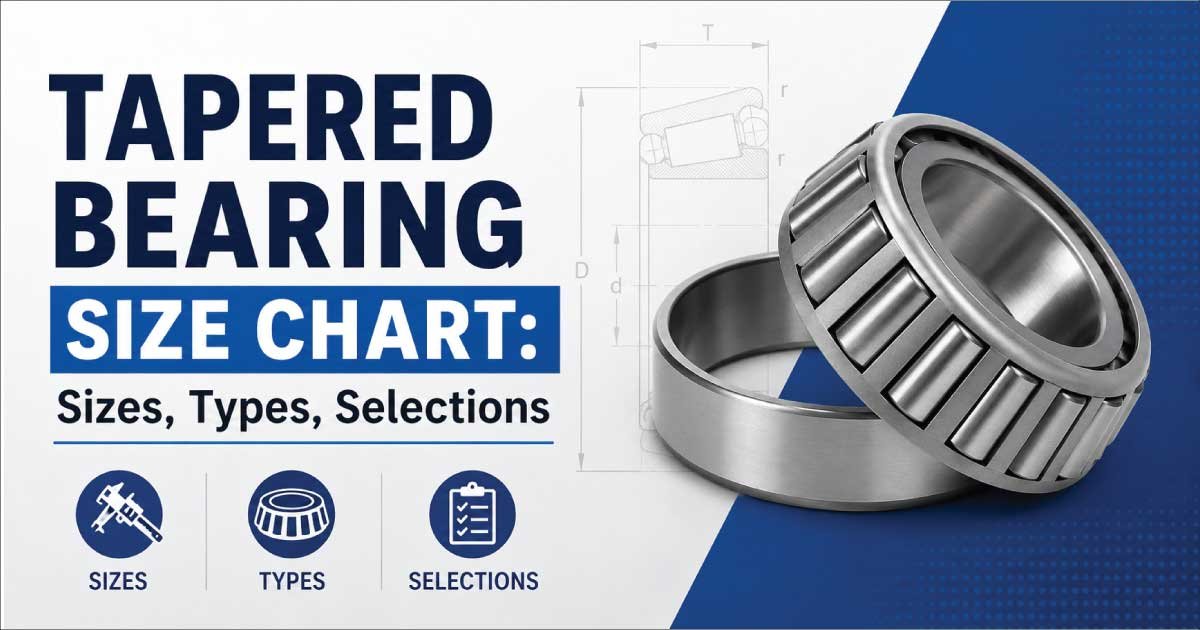
Tapered roller bearings are among the most widely used bearings in automotive, industrial, agricultural, and heavy machinery applications. They are designed to handle both radial and axial loads simultaneously, making them ideal for demanding environments where strength, durability, and reliability are essential.
Understanding a tapered bearing size chart is important when replacing bearings, designing machinery, or performing maintenance. Selecting the wrong bearing size can lead to premature wear, excessive heat, reduced performance, and costly downtime.
This guide explains tapered roller bearing dimensions, numbering systems, common sizes, applications, and how to choose the right bearing for your equipment.
What Is a Tapered Roller Bearing?
A tapered roller bearing is a type of rolling-element bearing specifically designed to handle both radial and axial loads simultaneously. Its unique geometry allows forces to be distributed evenly across the bearing, making it highly effective in applications that involve heavy loads and demanding operating conditions. Tapered roller bearings are widely used in automotive, industrial, agricultural, and construction equipment where strength, durability, and reliability are essential.
Main Components
- Inner ring (cone)
- Outer ring (cup)
- Tapered rollers
- Cage
The tapered rollers are positioned between the inner and outer rings in such a way that the extended tapered surfaces of all components converge at a common point along the bearing axis. This arrangement enables the bearing to manage combined loads efficiently while maintaining smooth rotational movement. The cage keeps the rollers evenly spaced, reducing friction and ensuring proper roller alignment during operation.
Unlike standard ball bearings, tapered roller bearings provide line contact between the rollers and raceways rather than point contact. This larger contact area allows them to distribute loads more effectively, resulting in higher load-carrying capacity, improved shock resistance, and reduced stress on bearing components. As a result, tapered roller bearings often deliver longer service life and superior performance in heavy-duty applications where reliability is critical.
Why Tapered Roller Bearings Are Important
Many machines experience a combination of radial and thrust forces during operation. Standard ball bearings may struggle under these conditions, while tapered roller bearings are specifically designed to handle both load types efficiently. Their unique design improves load distribution, enhances durability, reduces wear, and helps equipment operate more reliably under demanding conditions.
Benefits of Tapered Bearings
- High load capacity
- Excellent durability
- Reduced friction
- Longer bearing life
- Better shock load resistance
- Suitable for high-speed applications
- Supports combined radial and axial loads
These advantages make tapered roller bearings a popular choice across many industries.
Standard Tapered Bearing Size Chart
The following chart includes some commonly used tapered roller bearing sizes.
| Bearing Number | Bore (d) mm | Outer Diameter (D) mm | Width (T) mm |
|---|---|---|---|
| 30202 | 15 | 35 | 11.75 |
| 30203 | 17 | 40 | 13.25 |
| 30204 | 20 | 47 | 15.25 |
| 30205 | 25 | 52 | 16.25 |
| 30206 | 30 | 62 | 17.25 |
| 30207 | 35 | 72 | 18.25 |
| 30208 | 40 | 80 | 19.75 |
| 30209 | 45 | 85 | 20.75 |
| 30210 | 50 | 90 | 21.75 |
| 30211 | 55 | 100 | 22.75 |
| 30305 | 25 | 62 | 18.25 |
| 30306 | 30 | 72 | 20.75 |
| 30307 | 35 | 80 | 22.75 |
| 30308 | 40 | 90 | 25.25 |
| 30309 | 45 | 100 | 27.25 |
| 30310 | 50 | 110 | 29.25 |
These dimensions represent standard metric tapered roller bearings commonly used worldwide.
Understanding Bearing Dimensions
Tapered roller bearing dimensions are essential for selecting the correct bearing from a size chart and ensuring proper fit, alignment, and performance in a machine. These measurements determine how well the bearing fits on the shaft, inside the housing, and how effectively it can handle applied loads. Understanding these basic dimensions helps prevent installation errors and improves overall equipment reliability.
1. Bore Diameter (d)
The bore diameter is the internal diameter of the bearing that directly fits onto the shaft. It is one of the most important dimensions because it must match the shaft size precisely for secure mounting and efficient load transfer. Even a small mismatch can lead to vibration, slippage, or premature wear of both the shaft and bearing.
Example: A 30206 bearing has a bore diameter of 30 mm, meaning it is designed to fit a 30 mm shaft.
2. Outer Diameter (D)
The outer diameter is the external measurement of the bearing that fits inside the housing or machine casing. Proper matching of the outer diameter ensures correct seating, stability, and alignment during operation. If the housing is too loose or too tight, it can negatively affect performance and reduce the bearing’s service life.
3. Width (T)
The width refers to the total thickness of the bearing assembly from one face to the other. This dimension influences the bearing’s load distribution and structural strength. In general, bearings with greater width are capable of handling higher loads and provide better durability in heavy-duty or high-stress applications.
Common Tapered Bearing Series
Manufacturers classify tapered roller bearings into different series based on their dimensions, design structure, and load-carrying capacity. Each series is engineered for specific operating conditions, ranging from light-duty applications to extremely heavy industrial use. As the series number increases, the bearing generally becomes stronger and capable of handling higher radial and axial loads with improved durability and performance.
302 Series
The 302 series is one of the most commonly used light-to-medium duty tapered roller bearing series. It is designed for applications that require balanced performance, moderate load capacity, and reliable operation under standard working conditions. These bearings are widely used in automotive and light industrial machinery where efficiency and cost-effectiveness are important.
Examples:
- 30204
- 30205
- 30206
- 30207
Applications include:
- Automotive wheel hubs
- Agricultural machinery
- Small industrial equipment
303 Series
The 303 series provides higher load-carrying capacity compared to the 302 series, making it suitable for more demanding mechanical systems. These bearings are built to handle increased stress and offer better durability under continuous operation. They are commonly used in medium- to heavy-duty applications where strength and reliability are essential.
Examples:
- 30305
- 30306
- 30308
Applications include:
- Gearboxes
- Construction equipment
- Heavy-duty vehicles
322 Series
The 322 series is designed with larger contact areas, allowing it to support higher load ratings and improved shock resistance. These bearings are well-suited for environments where heavy radial and axial forces are present. Their robust construction ensures stable performance even in challenging industrial conditions.
Examples:
- 32205
- 32206
- 32208
Applications include:
- Mining machinery
- Industrial conveyors
- Heavy manufacturing equipment
323 Series
The 323 series is engineered for extremely heavy radial and axial loads, making it ideal for high-stress industrial applications. These bearings are built to perform under severe working conditions where durability and strength are critical. They are commonly used in large-scale machinery that operates under continuous heavy pressure.
Applications include:
- Crushers
- Large pumps
- Industrial drive systems
Inch Series Tapered Bearing Chart
Many North American machines use inch-series bearings instead of metric sizes.
Common Inch Sizes
| Bearing Number | Bore (inch) | Outer Diameter (inch) |
|---|---|---|
| LM11949/10 | 0.75 | 1.781 |
| LM67048/10 | 1.25 | 2.328 |
| L44643/10 | 1.00 | 1.98 |
| 25580/20 | 1.75 | 3.265 |
| 387A/382A | 2.25 | 3.813 |
Always verify dimensions carefully before replacing bearings because metric and inch bearings are not interchangeable.
How to Read a Tapered Bearing Number
Bearing numbers are standardized codes that provide important details about a bearing’s size, series, and design. Understanding these numbers helps engineers, mechanics, and technicians quickly identify the correct replacement bearing without confusion or measurement errors. Each part of the code represents specific dimensional and structural information used in manufacturing standards.
Example: Bearing 30206
In the bearing number 30206, each digit has a specific meaning that helps define its structure and size. The first part identifies the bearing series, while the remaining digits indicate dimensional series and bore size. This system makes it easier to match bearings accurately in industrial and automotive applications.
Breakdown:
- 30 = bearing series
- 2 = dimensional series
- 06 = bore code
Bore Code and Diameter Chart
The bore code is one of the most important parts of the bearing number because it represents the inner diameter of the bearing. This code allows users to quickly determine the shaft size compatibility without direct measurement. It follows a standardized system used across most metric tapered roller bearings.
In most metric bearings:
| Bore Code | Bore Diameter |
|---|---|
| 04 | 20 mm |
| 05 | 25 mm |
| 06 | 30 mm |
| 07 | 35 mm |
| 08 | 40 mm |
| 09 | 45 mm |
| 10 | 50 mm |
Importance of Understanding Bearing Codes
Knowing how to read bearing numbers helps prevent installation errors and ensures proper fitment in machinery. It allows quick identification of replacement parts, reduces downtime, and improves maintenance efficiency. Accurate selection based on bearing codes also enhances equipment performance and extends overall service life.
How to Choose the Right Tapered Bearing Size
Selecting the correct tapered bearing size is essential for ensuring smooth machine operation, long service life, and reliable performance. Proper evaluation of working conditions, load demands, and environmental factors helps prevent premature failure, reduce maintenance costs, and improve overall efficiency of mechanical systems in industrial and automotive applications.
1. Load Requirements
Load capacity is the first and most important factor in bearing selection. You must determine both radial and axial loads acting on the bearing during operation. Choosing a bearing with proper load ratings ensures it can handle stress effectively without deformation, overheating, or early failure under working conditions.
Determine both:
- Radial load
- Axial load
- Choose a bearing with adequate load ratings.
2. Shaft Diameter
The bearing bore must match the shaft diameter precisely for correct installation and performance. Any mismatch can cause vibration, misalignment, and uneven load distribution. Proper sizing ensures smooth rotation, stability, and long-term durability of both the shaft and bearing assembly.
3. Housing Dimensions
The bearing housing must be designed to fit the outer diameter of the bearing correctly. A proper fit ensures stable alignment and prevents unwanted movement during operation. Incorrect housing size can lead to poor performance, increased wear, and reduced service life of the bearing system.
4. Operating Speed
Operating speed plays a major role in bearing selection because high-speed applications generate more heat and friction. Bearings designed for higher speeds provide better thermal control and reduced wear, ensuring safe and efficient operation under continuous or high-speed working conditions.
5. Environmental Conditions
Environmental factors significantly affect bearing performance and durability. Conditions such as dust, moisture, temperature changes, and corrosion must be carefully considered. In harsh environments, special seals or corrosion-resistant materials may be required to protect the bearing and extend its operational life.
Consider:
- Dust
- Moisture
- Temperature
- Corrosion
- Special seals or materials may be required.
6. Service Life Expectations
Service life requirements help determine the quality and durability of the bearing needed. For critical or high-load equipment, selecting bearings with higher load ratings and stronger construction is essential. This ensures longer operational life, fewer breakdowns, and reduced maintenance in demanding applications.
Single vs Double Row Tapered Bearings
Tapered roller bearings are available in both single-row and double-row designs, each suited for different load conditions and performance requirements. The choice between them depends on factors such as load capacity, rigidity, alignment needs, and the complexity of the application. Understanding their differences helps ensure better machine efficiency and longer service life.
1. Single Row Bearings
Single-row tapered roller bearings are the most widely used design due to their simple structure and versatility. They consist of one set of tapered rollers arranged between the inner and outer rings. These bearings are easy to install, cost-effective, and efficient, making them suitable for general-purpose applications where moderate loads are present.
Advantages:
- Affordable
- Easy installation
- High efficiency
Applications:
- Wheel hubs
- Industrial machinery
- Pumps
2. Double Row Bearings
Double-row tapered roller bearings are designed to handle higher loads and provide improved stability. They contain two rows of rollers, which increases load distribution and rigidity. This design also improves alignment accuracy and reduces deflection, making them suitable for heavy-duty and high-performance industrial systems requiring strong support.
Advantages:
- Higher rigidity
- Increased load support
- Better alignment
Applications:
- Heavy equipment
- Industrial drives
- Large gearboxes
Materials Used in Tapered Bearings
The performance and durability of tapered roller bearings largely depend on the materials used in their construction. Different materials are selected based on load conditions, operating environment, speed requirements, and service life expectations. Choosing the right material helps improve strength, reduce wear, and ensure reliable operation in various industrial applications.
1. Chrome Steel
Chrome steel is the most commonly used material in tapered roller bearings due to its excellent balance of strength, hardness, and affordability. It provides high resistance to wear and fatigue, making it suitable for a wide range of general-purpose and industrial applications where long service life is required.
Benefits:
- High strength
- Excellent wear resistance
- Long life
2. Stainless Steel
Stainless steel bearings are designed for environments where moisture, chemicals, or corrosion are major concerns. This material helps prevent rust formation and maintains performance in wet or hygienic conditions. It is commonly used in industries where cleanliness and corrosion resistance are essential.
Benefits:
- Rust resistance
- Suitable for food processing equipment
- Longer life in wet conditions
3. Special Alloy Steels
Special alloy steels are used in extreme-duty applications where standard materials may not perform effectively. These steels offer superior toughness, fatigue resistance, and strength under high stress. They are ideal for heavy machinery and environments with continuous load impact and demanding operational conditions.
Maintenance Tips for Tapered Bearings
Proper maintenance is essential for ensuring the long service life, efficiency, and reliability of tapered roller bearings. Regular care helps detect early signs of damage, prevents unexpected failures, and reduces costly downtime. A well-maintained bearing system also improves machine performance and operational safety.
1. Inspect Bearings Regularly
Routine inspection helps identify early warning signs of bearing problems before they become serious failures. Checking vibration, noise levels, heat buildup, and wear patterns allows maintenance teams to detect issues such as misalignment, lubrication failure, or excessive load conditions in time.
Check for:
- Vibration
- Noise
- Heat buildup
- Wear patterns
2. Maintain Proper Lubrication
Proper lubrication reduces friction, prevents overheating, and minimizes wear between rolling elements and raceways. Always use the lubricant recommended by the manufacturer, as the correct type and quantity ensure smooth operation and extend bearing service life under varying load and speed conditions.
3. Prevent Contamination
Contaminants such as dust, dirt, and moisture can significantly reduce bearing performance and lifespan. Installing proper seals and maintaining a clean working environment helps protect internal components from damage, ensuring smooth operation and reducing the risk of premature failure.
4. Monitor Bearing Temperature
Temperature monitoring is an important part of bearing maintenance. Excessive heat often indicates problems such as poor lubrication, overloading, or misalignment. Keeping the operating temperature within safe limits helps maintain efficiency and prevents long-term damage to the bearing system.
5. Replace Worn Bearings Promptly
Timely replacement of worn or damaged bearings is crucial to prevent further mechanical damage. Delaying replacement can lead to shaft wear, housing damage, and complete system failure. Early intervention ensures smoother operation and reduces overall repair costs in the long run.
Conclusion
A tapered bearing size chart is an essential reference for selecting the correct bearing for automotive, industrial, agricultural, and heavy machinery applications. Understanding bore diameter, outer diameter, width, load requirements, and bearing series helps ensure proper fit and optimal performance. By choosing the correct tapered roller bearing size and maintaining it properly, equipment owners can improve reliability, reduce downtime, and extend machinery life significantly.
Frequently Asked Questions
1. What is a tapered bearing used for?
A tapered bearing is used to support both radial and axial (thrust) loads at the same time, making it highly suitable for demanding applications. It is commonly found in automotive wheel hubs, gearboxes, heavy machinery, and industrial equipment where combined load handling, stability, and durability are essential for smooth and reliable operation.
2. How do I identify a tapered bearing size?
You can identify a tapered bearing size by measuring three main dimensions: bore diameter, outer diameter, and width. These measurements are then compared with a standard tapered bearing size chart. Accurate measurement ensures correct fit, proper load handling, and prevents installation issues such as vibration, misalignment, or premature wear during operation.
3. Can tapered bearings handle thrust loads?
Yes, tapered roller bearings are specifically designed to handle significant thrust (axial) loads in addition to radial loads. Their angled rolling elements distribute forces efficiently, allowing them to perform well under combined loading conditions. This makes them ideal for applications where both directional forces act on the shaft simultaneously during operation.
4. Are tapered bearings better than ball bearings?
Tapered bearings generally perform better than standard ball bearings in applications involving heavy radial and axial loads. They offer higher load-carrying capacity, improved durability, and better stability under stress. However, ball bearings are still preferred for high-speed, low-load applications where minimal friction and simpler design are more important.
5. How long do tapered roller bearings last?
The lifespan of tapered roller bearings depends on several factors, including applied load, lubrication quality, operating speed, alignment, and maintenance practices. When properly installed and regularly maintained, these bearings can deliver long service life and reliable performance, often lasting several years in industrial and automotive applications without major issues.

Engineer Hassan is a Mechanical Engineer with 16+ years of hands-on experience in mechanical hardware, fasteners, and workshop tools. He focuses on size selection, thread identification, and measurement, helping users choose the correct components with accuracy and safety.