
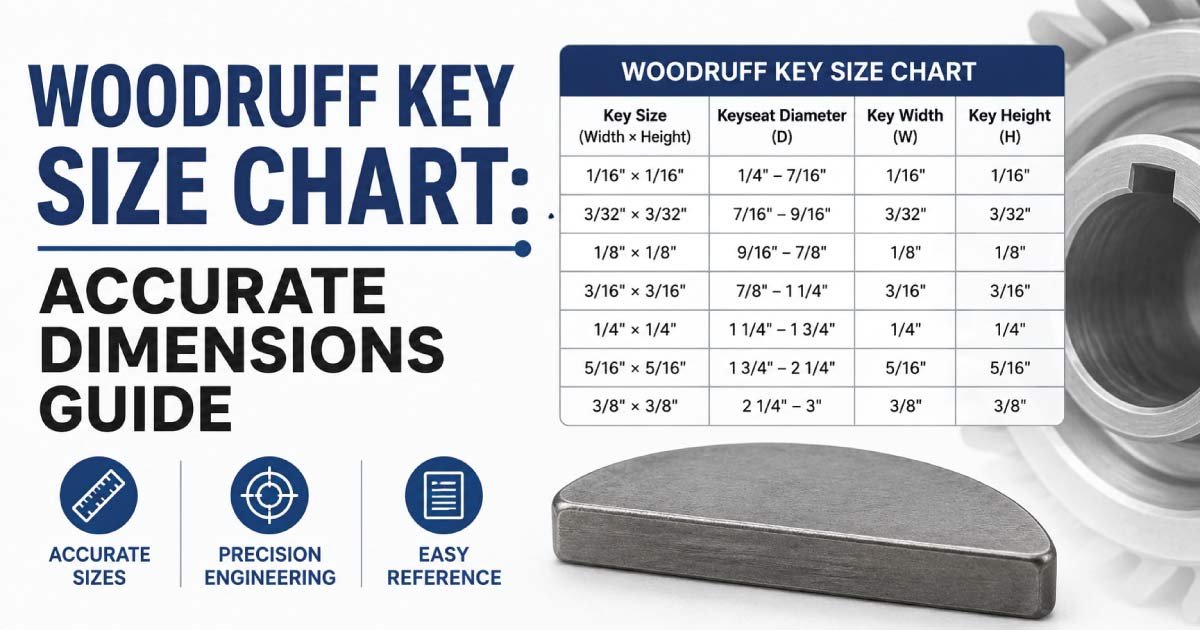
Woodruff keys are small but extremely important mechanical components used to lock gears, pulleys, and other rotating parts onto shafts. They ensure proper torque transmission and prevent slipping between connected parts in machines, motors, and automotive systems.
Understanding a Woodruff Key Size Chart is essential for selecting the correct key width, diameter, and depth for reliable mechanical performance. In this guide, you will learn everything about woodruff key sizes, dimensions, types, applications, and selection methods.
What Is a Woodruff Key?
A Woodruff key is a semi-circular, half-moon shaped metal component used to connect a rotating machine element to a shaft. It is designed to fit into a curved slot (keyway) in the shaft, ensuring a secure and precise mechanical connection for torque transmission.
Woodruff keys are widely used in mechanical systems where reliable alignment and strong torque transfer are required between rotating parts.
Common uses include:
- Gears
- Pulleys
- Couplings
- Sprockets
- Electric motor assemblies
- Automotive drivetrain components
How Does a Woodruff Key Work?
A Woodruff key works by mechanically locking the shaft and the mounted component together so both rotate as a single unit without any slipping. It ensures proper torque transfer between the shaft and the attached machine part.
1. Working Process
The operation of a Woodruff key is simple but highly effective in transmitting rotational force.
- A semicircular slot is cut into the shaft
- The Woodruff key is placed into the slot
- The mating component (gear or pulley) is fitted over the key
- The key transfers torque from the shaft to the component
- Rotation remains synchronized without slipping
2. Self-Aligning Feature
Because of its curved (semi-circular) shape, the Woodruff key automatically adjusts itself during installation. This self-aligning property helps achieve accurate positioning, better contact, and a secure mechanical fit between the shaft and the mounted part.
Advantages of Woodruff Keys
Woodruff keys provide several important engineering advantages that make them highly suitable for precision mechanical systems. Their unique semi-circular design improves fitting accuracy, load handling, and assembly performance.
- Self-aligning during installation
- Good load distribution
- Suitable for tapered shafts
- Reduced stress concentration
- Easy assembly and removal
- Reliable torque transfer
These advantages make Woodruff keys widely used in precision machinery where accuracy, durability, and stable torque transmission are required.
Woodruff Key Size Chart (Standard Imperial Sizes)
Woodruff key sizes are standardized to match specific shaft diameters and ensure proper torque transmission in mechanical assemblies. Selecting the correct size is essential for accurate fit, smooth operation, and long service life.
| Key Size | Width (Inches) | Width (mm) | Diameter (Shaft Range) |
|---|---|---|---|
| 404 | 1/8″ | 3.2 mm | 3/8″ – 7/16″ |
| 405 | 5/32″ | 4.0 mm | 7/16″ – 1/2″ |
| 406 | 3/16″ | 4.8 mm | 1/2″ – 9/16″ |
| 407 | 7/32″ | 5.6 mm | 9/16″ – 5/8″ |
| 408 | 1/4″ | 6.4 mm | 5/8″ – 3/4″ |
| 409 | 5/16″ | 7.9 mm | 3/4″ – 7/8″ |
| 410 | 3/8″ | 9.5 mm | 7/8″ – 1″ |
| 411 | 1/2″ | 12.7 mm | 1″ – 1-1/4″ |
These sizes are widely used in industrial machinery, automotive systems, and heavy mechanical assemblies where secure torque transmission is required.
Metric Woodruff Key Size Chart
Metric Woodruff keys are commonly used in ISO-standard systems and are widely adopted in European and Asian machinery for precision fitting and standardized engineering practices.
| Key Size | Width (mm) | Typical Shaft Diameter |
|---|---|---|
| 2 | 2 mm | 6–8 mm |
| 3 | 3 mm | 8–10 mm |
| 4 | 4 mm | 10–12 mm |
| 5 | 5 mm | 12–17 mm |
| 6 | 6 mm | 17–22 mm |
| 8 | 8 mm | 22–30 mm |
| 10 | 10 mm | 30–38 mm |
| 12 | 12 mm | 38–45 mm |
Metric sizes are especially common in modern machinery where standardized international measurements improve compatibility and manufacturing efficiency.
Woodruff Key Dimensions Explained
A Woodruff key is a semi-circular mechanical key used to secure rotating machine elements such as gears, pulleys, and couplings on a shaft. Its performance depends on precise dimensional matching. Correct understanding of each measurement ensures proper fit, load transfer, and safe operation in mechanical assemblies.
1. Width (W)
The width of a Woodruff key refers to its thickness and is one of the most critical dimensions. It determines how well the key fits into the keyway slot of the shaft and hub. A properly selected width ensures adequate load-carrying capacity, prevents slipping, and maintains strong torque transmission under operating conditions.
2. Diameter (D)
The diameter represents the curved, semi-circular base of the Woodruff key. This dimension allows the key to sit properly inside the rounded keyseat cut into the shaft. Correct diameter selection ensures stable seating, reduces stress concentration, and improves alignment between the shaft and mounted component for smooth mechanical performance.
3. Height (H)
Height refers to the total projection of the key above the shaft once installed. This dimension is essential for engaging the mating component’s keyway. Proper height ensures sufficient contact area for torque transmission while avoiding excessive projection that could cause misalignment, wear, or interference with surrounding machine components during operation.
4. Seat Depth
Seat depth is the depth of the semi-circular keyway cut into the shaft that holds the Woodruff key. Accurate machining of this depth is crucial for proper fit and stability. If too shallow or too deep, it can weaken the shaft or prevent correct engagement of the key.
5. Importance of Dimensional Matching
All Woodruff key dimensions must be carefully matched with shaft and hub specifications. Proper alignment ensures efficient torque transfer, prevents mechanical failure, and increases the lifespan of the assembly. Incorrect sizing can lead to slippage, uneven load distribution, or damage to both the key and connected components.
How to Read a Woodruff Key Size
Woodruff key sizes are marked using a standardized numbering system that represents the key series and its dimensional specifications. Understanding this format is important for selecting the correct key for proper shaft fit and torque transmission.
1. Imperial Size Example
A typical Woodruff key marking looks like:
Woodruff Key 404
Meaning:
- 4 = Series number
- 04 = Size identifier
- Refers to standard width and matching shaft range
In this system, the code defines both the key dimensions and the compatible shaft diameter range based on engineering standards.
2. Metric Size Example
A metric Woodruff key size may appear as:
6 × 9 Woodruff Key
Meaning:
- 6 mm = Key width
- 9 mm = Reference diameter value
Metric sizes are commonly used in ISO-standard machinery where precise dimensional matching is required for smooth torque transfer and proper alignment.
3. Understanding the System
In both imperial and metric systems, the size marking helps identify the correct key for the shaft and hub combination. Proper selection ensures secure fitting, accurate torque transmission, and prevents slipping or mechanical failure during operation.
How to Choose the Correct Woodruff Key Size
Selecting the correct Woodruff key size is essential for safe torque transmission, proper alignment, and long-term machine reliability. The key must match shaft and hub requirements accurately to prevent slippage, wear, or failure. Several engineering factors determine the correct selection for different mechanical applications and operating conditions.
1. Shaft Diameter
Shaft diameter is the primary factor in selecting a Woodruff key because each key size is designed for a specific shaft range. The key must fit securely within the keyseat without looseness or excessive stress. Proper matching ensures efficient torque transfer, stable alignment, and prevents damage to the shaft or hub.
2. Torque Load
Torque load directly affects the required strength and size of the Woodruff key. Higher torque applications need wider and stronger keys to handle rotational forces without shearing or slipping. Proper sizing ensures stable power transmission, reduces mechanical stress, and improves durability in heavy-duty industrial and rotating machinery systems under load.
3. Material Type
The material of both shaft and key plays an important role in performance and durability. Steel shafts typically require hardened steel keys for maximum strength and wear resistance. Material compatibility ensures better load sharing, reduces deformation, and prevents premature failure. Proper selection improves reliability in high-stress and precision engineering applications.
4. Speed of Rotation
High-speed rotating systems require precise balancing and accurate key fitment to avoid vibration and instability. A poorly matched Woodruff key can cause imbalance, leading to noise, wear, or mechanical failure. Proper sizing ensures smooth rotation, minimal vibration, and safe operation, especially in engines, turbines, and high-speed machinery components.
5. Application Type
Application type determines the overall size and strength requirements of the Woodruff key. Light-duty applications such as small machines use smaller keys, while heavy machinery requires larger and stronger keys for safety and durability. Matching key size to application ensures efficient performance, reduced wear, and long-lasting mechanical stability under working conditions.
Materials Used for Woodruff Keys
Woodruff keys are manufactured from different materials depending on strength requirements, wear resistance, corrosion protection, and application environment. Proper material selection ensures efficient torque transmission and long service life.
1. Carbon Steel
Carbon steel is the most commonly used material for Woodruff keys due to its balance of strength and cost-effectiveness. It performs well in standard mechanical applications where extreme conditions are not present.
Features:
- Most common
- High strength
- Cost-effective
2. Alloy Steel
Alloy steel Woodruff keys are heat-treated to improve hardness and durability. They are designed for heavy-duty applications where higher loads and greater resistance to wear are required.
Features:
- Heat-treated
- High durability
- Used in heavy machinery
3. Stainless Steel
Stainless steel Woodruff keys provide excellent resistance to corrosion, making them suitable for harsh environments. They are commonly used in outdoor, marine, and moisture-prone applications.
Features:
- Corrosion resistant
- Ideal for outdoor use
- Used in marine environments
4. Brass
Brass Woodruff keys are used in specialized applications where low friction, non-sparking properties, and electrical safety are important. They are suitable for light-duty and sensitive environments.
Features:
- Low friction
- Non-sparking
- Used in special electrical applications
Applications of Woodruff Keys
Woodruff keys are widely used in mechanical systems where reliable torque transmission and accurate shaft alignment are required. Their self-aligning design makes them especially suitable for rotating equipment in multiple industries.
1. Automotive Industry
Woodruff keys are commonly used in automotive systems where rotating components must remain securely locked to shafts under varying loads and speeds.
Used in:
- Crankshafts
- Camshafts
- Transmission systems
2. Industrial Machinery
In industrial applications, Woodruff keys help ensure stable torque transfer between rotating machine components, especially in high-load and continuous operation systems.
Used in:
- Gearboxes
- Pumps
- Compressors
3. Agricultural Equipment
Agricultural machines operate under heavy stress and rough working conditions, making Woodruff keys ideal for maintaining secure mechanical connections.
Used in:
- Tractors
- Harvesters
- Drive systems
4. Electrical Motors
Woodruff keys are widely used in electric motors to securely mount rotating parts on shafts and ensure smooth power transmission without slippage.
Used in:
- Motor shafts
- Rotor assemblies
- Coupling systems
Woodruff Key vs Parallel Key
| Feature | Woodruff Key | Parallel Key |
|---|---|---|
| Shape | Semi-circular | Rectangular |
| Alignment | Self-aligning | Fixed position |
| Shaft Type | Tapered shafts | Straight shafts |
| Strength | Moderate | High |
| Installation | Easy | Moderate |
Woodruff keys are preferred where alignment flexibility is needed.
Common Installation Mistakes
Proper installation of a Woodruff key is essential for achieving reliable torque transmission, correct alignment, and long service life of rotating machinery. Incorrect fitting or machining can weaken the shaft, reduce efficiency, and cause premature failure. Understanding these common mistakes helps ensure safe and accurate assembly.
1. Incorrect Size Selection
Choosing the wrong Woodruff key size can lead to serious mechanical issues. If the key is too small, it may slip under load and fail to transmit torque effectively. If it is too large, it can damage the shaft or hub keyway. Proper sizing ensures secure engagement and stable power transmission.
2. Overcut Keyway Depth
Cutting the keyway too deep into the shaft significantly weakens its structural strength. This reduces the shaft’s ability to handle torque and may lead to cracking or complete failure under load. Maintaining correct machining depth is critical to preserve shaft integrity and ensure safe and long-term mechanical performance.
3. Loose Fit
A loose fit between the Woodruff key and keyseat reduces contact area and torque transfer efficiency. This can cause vibration, movement, and gradual wear of both the key and shaft. Proper tight fit ensures stable positioning, effective load transfer, and minimizes mechanical losses during operation in rotating systems.
4. Improper Material Choice
Using unsuitable materials for the key or shaft can lead to wear, deformation, or corrosion. Incompatible or low-strength materials reduce durability and increase failure risk under load. Selecting hardened steel or compatible alloys ensures better strength, improved wear resistance, and long-term reliability in demanding mechanical environments.
Advantages of Proper Woodruff Key Selection
Choosing the correct Woodruff key size is essential for ensuring efficient performance and long-term reliability of mechanical systems. Proper selection helps maintain accurate torque transmission and reduces the risk of mechanical failure.
Using the correct size ensures:
- Efficient torque transfer
- Longer machine life
- Reduced maintenance
- Better alignment
- Safe operation
Maintenance and Inspection
Regular inspection of Woodruff keys is important to prevent unexpected failures and maintain smooth machine operation. Continuous monitoring helps identify early signs of wear or damage.
Check for:
- Wear on key edges
- Shaft keyway damage
- Looseness or movement
- Corrosion or rust
Replacement Guidelines
Damaged or worn Woodruff keys should be replaced immediately. Timely replacement helps maintain proper torque transmission, prevents shaft damage, and ensures safe and reliable machine performance.
Conclusion
A Woodruff Key Size Chart is an essential reference for engineers, machinists, and technicians working with rotating machinery. Selecting the correct key size ensures proper torque transmission, mechanical stability, and long-term reliability.
By understanding woodruff key dimensions, materials, and applications, you can confidently choose the right size for any shaft and ensure safe, efficient machine operation in industrial and automotive systems.
👉 Flange Size Chart: Types and Uses With Complete Guide is a valuable resource for understanding flange dimensions, pressure classes, standards, and industrial applications. Learn how to select the correct flange for piping systems, valves, pumps, and equipment connections. Read the full guide for detailed size charts, flange types, installation considerations, and practical engineering uses.

Engineer Hassan is a Mechanical Engineer with 16+ years of hands-on experience in mechanical hardware, fasteners, and workshop tools. He focuses on size selection, thread identification, and measurement, helping users choose the correct components with accuracy and safety.