
Flanges are essential components in piping systems, industrial plants, water supply networks, oil and gas facilities, power stations, and manufacturing industries. They provide a reliable method for connecting pipes, valves, pumps, and other equipment while allowing easy maintenance and inspection.
Choosing the correct flange size is critical for ensuring leak-free connections, proper pressure handling, and system reliability. Understanding flange dimensions, pressure ratings, and standards helps engineers, contractors, and maintenance professionals select the right flange for their applications.
In this complete flange size chart guide, you’ll learn about standard flange dimensions, types, pressure classes, materials, applications, and how to choose the correct flange size.
What Is a Flange?
A flange is a mechanical component used to connect pipes, fittings, valves, pumps, and equipment within a piping system. Flanges are typically bolted together with a gasket placed between them to create a leak-proof seal.
Flanges are widely used in:
- Oil and gas pipelines
- Water treatment plants
- Chemical processing facilities
- Power generation plants
- HVAC systems
- Marine applications
- Food processing equipment
- Industrial manufacturing
Because flanges can be disassembled, they simplify maintenance, inspection, and system modifications.
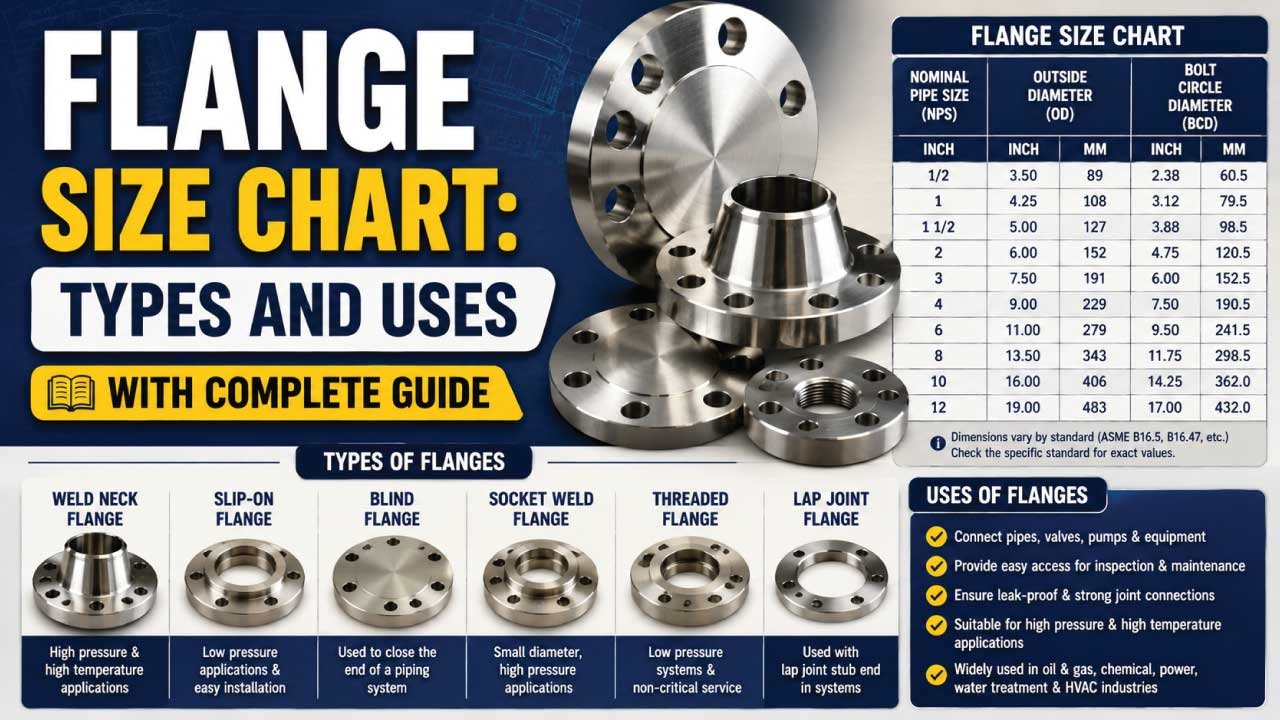
Standard Pipe Flange Size Chart
The following chart shows common flange sizes based on Nominal Pipe Size (NPS).
| NPS Size | DN Size | Outside Diameter (OD) |
|---|---|---|
| 1/2″ | DN15 | 89 mm |
| 3/4″ | DN20 | 99 mm |
| 1″ | DN25 | 108 mm |
| 1-1/4″ | DN32 | 117 mm |
| 1-1/2″ | DN40 | 127 mm |
| 2″ | DN50 | 152 mm |
| 3″ | DN80 | 191 mm |
| 4″ | DN100 | 229 mm |
| 6″ | DN150 | 279 mm |
| 8″ | DN200 | 343 mm |
| 10″ | DN250 | 406 mm |
| 12″ | DN300 | 483 mm |
| 16″ | DN400 | 597 mm |
| 20″ | DN500 | 711 mm |
| 24″ | DN600 | 813 mm |
Actual dimensions vary depending on pressure class and flange standard.
ANSI Flange Size Chart
ANSI/ASME flanges are among the most commonly used worldwide.
| Pipe Size | Class 150 OD | Class 300 OD |
|---|---|---|
| 1″ | 108 mm | 124 mm |
| 2″ | 152 mm | 165 mm |
| 4″ | 229 mm | 254 mm |
| 6″ | 279 mm | 318 mm |
| 8″ | 343 mm | 381 mm |
| 10″ | 406 mm | 445 mm |
| 12″ | 483 mm | 521 mm |
Higher pressure classes generally have larger dimensions and thicker construction.
Flange Pressure Class Chart
Pressure class determines the maximum pressure a flange can safely handle.
| Pressure Class | Common Designation |
|---|---|
| Class 150 | Low Pressure |
| Class 300 | Medium Pressure |
| Class 400 | Medium-High Pressure |
| Class 600 | High Pressure |
| Class 900 | Very High Pressure |
| Class 1500 | Severe Service |
| Class 2500 | Extreme Pressure |
Always verify pressure ratings according to operating temperature and applicable standards.
Common Types of Flanges
Different industrial systems require different flange designs based on pressure, temperature, installation method, and maintenance needs. Flanges are essential components in piping systems because they provide strong, leak-proof connections between pipes, valves, pumps, and other equipment. Selecting the correct flange type ensures safety, durability, and efficient system performance.
1. Weld Neck Flange
The weld neck flange is one of the strongest and most reliable flange types. It features a long tapered hub that gradually transfers stress from the flange to the pipe, making it ideal for high-pressure and high-temperature environments. It is typically connected using a butt-weld, which creates a smooth and strong joint.
Features:
- Long tapered hub
- Butt-weld connection
- Excellent stress distribution
Applications:
- High-pressure systems
- High-temperature pipelines
- Critical process equipment
2. Slip-On Flange
Slip-on flanges are designed to slide over the pipe before being welded in place. They are easier to install compared to weld neck flanges and are commonly used in low-pressure systems where cost and simplicity are important factors.
Advantages:
- Easy installation
- Lower cost
- Good alignment
Applications:
- Water systems
- Low-pressure pipelines
- General industrial service
3. Blind Flange
Blind flanges are solid discs used to seal the end of a pipeline or pressure vessel. They are essential for blocking flow in systems that may require future expansion, maintenance, or pressure testing.
Applications:
- Future system expansion
- Pressure testing
- Pipeline termination
Advantages:
- Leak prevention
- Easy access for maintenance
4. Socket Weld Flange
Socket weld flanges are designed for small-diameter, high-pressure pipes. The pipe is inserted into a socket and then welded, creating a strong and secure connection suitable for demanding applications.
Features:
- Socket connection
- Internal shoulder
- Strong joint
Applications:
- Hydraulic systems
- Steam lines
- High-pressure piping
5. Threaded Flange
Threaded flanges use screw threads to connect to pipes, eliminating the need for welding. This makes them ideal for systems where welding is not possible or frequent disassembly is required.
Advantages:
- No welding required
- Easy installation
- Suitable for maintenance work
Applications:
- Utility systems
- Low-pressure applications
6. Lap Joint Flange
Lap joint flanges are used together with a stub end and are ideal for systems requiring frequent disassembly. They allow the flange to rotate freely, making alignment easier during installation.
Advantages:
- Easy alignment
- Reusable backing flange
- Cost savings on expensive materials
Applications:
- Stainless steel systems
- Frequent maintenance environments
Common Flange Materials
Material selection plays a crucial role in determining the strength, durability, corrosion resistance, and temperature performance of flanges. Different industrial environments require different materials to ensure safe operation, long service life, and reliable sealing in piping systems.
1. Carbon Steel Flanges
Carbon steel is the most widely used material for flanges due to its high strength and cost-effectiveness. It performs well in general industrial environments where corrosion exposure is moderate and extreme conditions are not present.
Advantages:
- Strong
- Affordable
- Widely available
Applications:
- Industrial piping
- Construction
- Manufacturing
2. Stainless Steel Flanges
Stainless steel flanges are highly resistant to corrosion, rust, and chemical exposure. They are ideal for hygienic and harsh environments where durability and cleanliness are important. Their long service life makes them suitable for demanding industries.
Advantages:
- Rust resistant
- Long lifespan
- Hygienic properties
Applications:
- Food processing
- Chemical plants
- Marine systems
3. Alloy Steel Flanges
Alloy steel flanges are designed for high-pressure and high-temperature environments. By adding alloying elements to steel, these flanges achieve superior mechanical strength and resistance to extreme operating conditions.
Advantages:
- High strength
- Heat resistance
- Pressure resistance
Applications:
- Refineries
- Power plants
- Petrochemical facilities
4. Cast Iron Flanges
Cast iron flanges are commonly used in low-pressure applications due to their cost-effectiveness and adequate durability. They are suitable for water and drainage systems where high strength is not required.
Advantages:
- Cost-effective
- Durable
Applications:
- Water distribution systems
- Drainage systems
5. PVC Flanges
PVC flanges are used in plastic piping systems and offer excellent resistance to corrosion and chemicals. They are lightweight and easy to install, making them ideal for non-metallic piping applications.
Advantages:
- Lightweight
- Corrosion resistant
- Easy installation
Applications:
- Water treatment
- Chemical handling
- Irrigation systems
👉 U Bolt Dimensions and Selection Guide for Your Project is a complete resource to understand standard U bolt sizes, dimensions, materials, threading, and applications. Perfect for plumbing, construction, automotive, and industrial use, this guide helps you choose the right U bolt easily. Read the full post for charts, tips, and expert selection advice.
Common Flange Standards
Flange standards define the dimensions, pressure ratings, materials, and testing requirements for flanges used in piping systems. These standards ensure safe, leak-free connections and allow compatibility between components manufactured in different regions and industries.
1. ASME B16.5
ASME B16.5 is a widely used American standard that covers pipe flanges and flanged fittings up to 24 inches in diameter. It defines dimensions, pressure classes, materials, and tolerances. This standard is commonly used in industrial piping, oil and gas, and chemical systems.
2. ASME B16.47
ASME B16.47 is designed for large-diameter flanges typically above 24 inches. It is divided into Series A and B, each with different design specifications. These flanges are used in heavy-duty pipelines where large flow capacity and high strength are required.
3. DIN Standards
DIN flange standards are widely used in Europe and define metric-based dimensions and pressure ratings. They are common in industrial plants, mechanical systems, and engineering applications where standardized European components are required.
4. EN 1092-1
EN 1092-1 is the European standard for circular flanges. It specifies dimensions, materials, and pressure classes for steel flanges. This standard ensures uniformity across European industries and supports safe and reliable piping connections.
5. JIS Standards
JIS (Japanese Industrial Standards) flanges are commonly used in Japan and other parts of Asia. They define flange sizes, pressure ratings, and design requirements suited for regional industrial systems, ensuring compatibility within local manufacturing practices.
6. ISO Standards
ISO flange standards provide international specifications for dimensions and performance. They help ensure global compatibility, making it easier to integrate piping systems and components across different countries and industries.
Using standardized flanges improves safety, ensures proper fitment, and guarantees reliable performance in piping systems worldwide.
How to Measure a Flange
Accurate flange measurement is essential for proper replacement, compatibility, and safe installation in piping systems. Even small errors can lead to leaks, misalignment, or system failure, so each dimension must be carefully checked.
1. Measure Outside Diameter
Use a caliper or measuring tape to determine the outside diameter of the flange. This is the total width from one outer edge to the other. It helps identify the flange size and ensures it fits correctly within the piping layout and available space.
2. Count Bolt Holes
Count the total number of bolt holes on the flange face. This is a key identification factor because different flange standards use different bolt patterns. Matching the correct number of holes ensures proper alignment during installation.
3. Measure Bolt Circle Diameter
Measure the bolt circle diameter (BCD) by finding the center-to-center distance between opposite bolt holes. This imaginary circle ensures correct bolt alignment and even pressure distribution when the flange is tightened.
4. Measure Bore Diameter
Check the internal opening of the flange, known as the bore diameter. This must match the pipe’s internal diameter to allow smooth fluid flow and reduce turbulence or flow restriction in the system.
5. Determine Pressure Class
Inspect the flange markings to identify the pressure class rating. This rating indicates the maximum pressure the flange can safely handle. Always ensure the replacement flange matches or exceeds the required pressure class for safe operation.
These measurements together help accurately identify flange specifications and ensure correct, safe, and efficient system performance.
👉 Complete Guide to Stud Bolt Sizes and Applications helps you understand standard stud bolt dimensions, thread types, lengths, materials, and industrial uses. Ideal for flanges, piping systems, construction, and machinery, this guide ensures accurate selection every time. Read the full post to explore detailed size charts, installation tips, and expert recommendations.
How to Choose the Correct Flange Size
Selecting the correct flange size is essential for ensuring a safe, leak-free, and efficient piping system. The right choice depends on pipe compatibility, pressure levels, operating conditions, and material requirements. Proper selection helps maintain system integrity and long-term reliability.
1. Match Pipe Size
The flange must match the nominal pipe size (NPS) to ensure proper alignment and connection. A correct size match guarantees smooth installation, prevents leakage, and maintains consistent flow within the piping system without unnecessary stress on the joint.
2. Consider Pressure Requirements
Different applications require different pressure ratings. Always select a flange with an appropriate pressure class that can safely handle the system’s maximum operating pressure. Higher pressure systems require stronger flanges to prevent deformation or failure.
3. Evaluate Operating Temperature
Temperature plays a major role in flange performance. High-temperature environments may require specialized materials or higher-grade flanges to maintain strength and stability. Proper selection ensures safe operation under thermal expansion and heat stress conditions.
4. Assess Corrosion Conditions
Environmental exposure such as moisture, chemicals, or saltwater can cause corrosion. Choose flange materials that are resistant to the operating environment, such as stainless steel or coated alloys, to improve durability and prevent premature failure.
5. Verify Industry Standards
Always use flanges that comply with recognized industry standards. Standardized flanges ensure proper dimensions, reliable performance, and compatibility with other system components. This reduces installation errors and enhances overall safety.
By considering these factors, you can select the correct flange size that ensures efficiency, durability, and safe operation in any piping system.
Common Uses of Flanges
Flanges are essential components in piping systems because they provide strong, secure, and leak-proof connections between pipes, valves, pumps, and other equipment. They also allow easy assembly, disassembly, inspection, and maintenance, making them widely used across many industrial sectors.
1. Oil and Gas Industry
In the oil and gas industry, flanges are critical for handling high-pressure and high-temperature fluids and gases. They ensure safe and reliable connections in complex pipeline networks and processing facilities, where system integrity is extremely important.
Applications include:
- Pipeline systems
- Refineries
- Offshore platforms
2. Water Treatment Plants
Flanges are commonly used in water treatment systems to connect pumps, filtration units, and distribution pipelines. They help maintain a secure flow of water while allowing easy maintenance and system upgrades when needed.
Used for:
- Pumps
- Filtration systems
- Water distribution lines
3. Chemical Processing
In chemical industries, flanges are used to handle corrosive and hazardous fluids safely. They provide strong sealing in pipelines and storage systems, ensuring leak prevention and operational safety in chemical transfer processes.
Applications include:
- Reactor systems
- Chemical transfer lines
- Storage facilities
4. Power Generation
Power plants use flanges in high-temperature and high-pressure systems such as steam and cooling circuits. They help maintain reliable connections in boilers, turbines, and auxiliary systems that require consistent performance.
Used in:
- Steam systems
- Cooling systems
- Boiler connections
5. Marine Industry
In marine applications, flanges are used in ship piping systems where durability and corrosion resistance are essential. They help manage fuel transfer, cooling systems, and other onboard fluid handling operations in harsh sea environments.
Applications include:
- Ship piping
- Cooling systems
- Fuel transfer systems
These wide-ranging applications make flanges a vital component in industrial piping systems, ensuring safety, flexibility, and efficient operation across multiple sectors.
👉 Anchor Bolt Sizes: How to Choose the Right Size is a complete guide to standard anchor bolt dimensions, types, materials, load capacity, and real-world applications. Ideal for construction, structural steel, and foundation work, this guide helps ensure strong and safe installations. Read the full post to explore detailed size charts, selection tips, and expert recommendations.
Advantages of Flanged Connections
Flanged connections are widely used in piping systems because they offer a strong, reliable, and practical method for joining pipes, valves, and equipment. Their design provides both durability and ease of use, making them suitable for many industrial applications.
1. Easy Maintenance
One of the main advantages of flanged connections is their ease of maintenance. Components can be quickly unbolted and separated without cutting or damaging the pipeline. This makes inspection, repair, and replacement much faster and more efficient, reducing system downtime.
2. Reliable Sealing
Flanges use gaskets between mating surfaces to create a tight, leak-resistant seal. When properly installed and tightened, this sealing system effectively prevents fluid or gas leakage, ensuring safe and efficient operation even under demanding conditions.
3. Equipment Accessibility
Flanged joints allow easy access to internal components such as valves, pumps, and filters. This accessibility simplifies servicing and maintenance tasks, making it easier to inspect or replace parts without dismantling large sections of the piping system.
4. Flexibility
Flanged connections offer great flexibility in system design. They allow for modifications, expansions, or upgrades without major reconstruction. This adaptability makes them ideal for systems that may require future changes or reconfiguration.
5. Strength
Flanges are designed to handle high pressure and temperature conditions, making them suitable for heavy-duty industrial applications. Their strong bolted connection ensures stability and reliability, even in demanding operating environments.
These advantages make flanged connections one of the most trusted and widely used methods in modern piping systems.
Flange Installation Tips
Proper flange installation is essential for ensuring a leak-free, safe, and durable piping system. Even small installation errors can lead to gasket failure, leakage, or uneven stress on the joint. Following correct procedures helps improve reliability and long-term performance.
1. Inspect Flange Faces
Before installation, carefully inspect the flange faces for scratches, dents, corrosion, or other damage. Any surface irregularity can prevent proper sealing and lead to leaks. Clean and smooth flange faces ensure better gasket contact and a secure joint.
2. Use Correct Gaskets
Always select a gasket material that matches the application requirements, including pressure, temperature, and chemical exposure. The correct gasket ensures proper sealing and prevents leakage under operating conditions. Incompatible materials may fail prematurely or reduce system efficiency.
3. Tighten Bolts Evenly
Tighten flange bolts using a star or cross-pattern sequence. This method distributes pressure evenly across the flange face and prevents distortion. Uneven tightening can cause gasket damage or misalignment, leading to leaks or reduced joint strength.
4. Apply Proper Torque
Follow the manufacturer’s recommended torque specifications when tightening bolts. Correct torque ensures proper clamping force without overstressing the gasket or bolts. Over-tightening or under-tightening can compromise the integrity of the flange connection.
5. Verify Alignment
Ensure that both flanges are properly aligned before tightening bolts. Misalignment can create uneven pressure, increase stress on the joint, and cause leakage. Proper alignment improves sealing performance and extends the lifespan of the entire system.
Common Flange Selection Mistakes
Selecting the correct flange is critical for ensuring safe, leak-free, and long-lasting piping system performance. Many system failures occur not because of poor quality parts, but due to incorrect selection or improper installation. Avoiding common mistakes helps improve safety, reduce maintenance costs, and ensure reliable operation in industrial piping systems.
1. Choosing Incorrect Pressure Classes
Each flange is designed for a specific pressure rating. Selecting a flange with a lower pressure class than required can lead to leakage, deformation, or catastrophic system failure under operating conditions.
2. Using Incompatible Materials
Using flange materials that are not compatible with the fluid, gas, or environment can result in corrosion, wear, and reduced service life. Material compatibility is essential for long-term reliability.
3. Ignoring Temperature Ratings
Flanges must be selected based on the operating temperature of the system. Ignoring temperature limits can weaken the flange material and compromise sealing performance.
4. Selecting Improper Gasket Materials
The gasket plays a key role in sealing the flange joint. Using the wrong gasket material can cause leaks, poor sealing, or chemical degradation when exposed to specific fluids or temperatures.
5. Incorrect Bolt Sizing
Bolts must match the flange specifications in size, strength, and grade. Incorrect bolt selection can lead to uneven pressure distribution and joint failure.
6. Poor Alignment During Installation
Misaligned flanges can cause uneven gasket compression, leading to leaks and increased stress on the piping system. Proper alignment is essential before tightening bolts.
7. Mixing Incompatible Standards
Using flanges from different standards (such as metric and imperial systems or different rating systems) can result in poor fit and unsafe connections.
Proper planning, correct selection, and careful installation help prevent costly failures and ensure safe, efficient, and long-lasting flange performance in all industrial applications.
Conclusion
Understanding flange sizes, pressure classes, materials, and standards is essential for designing safe and reliable piping systems. Whether you’re working in oil and gas, manufacturing, water treatment, power generation, or construction, selecting the correct flange ensures leak-free performance and long-term reliability.
By using the flange size charts and selection guidelines in this guide, you can confidently choose the right flange for your piping system while improving safety, maintenance efficiency, and overall system performance.
FAQs:
What is the most common flange standard?
ASME B16.5 is one of the most widely used flange standards worldwide. It covers flange dimensions, pressure ratings, materials, tolerances, and marking requirements for pipe sizes up to 24 inches. Many industries, including oil and gas, power generation, and chemical processing, rely on this standard.
How do I determine flange size?
To determine flange size, measure the pipe’s nominal size, flange outside diameter, bolt circle diameter, number of bolt holes, and bolt hole dimensions. Comparing these measurements with a flange size chart helps identify the correct standard, pressure class, and flange specification for the application.
What does Class 150 mean?
Class 150 refers to a flange pressure rating defined by ASME standards. It indicates the pressure and temperature limits the flange can safely withstand under specified operating conditions. Higher classes such as 300, 600, and 900 are designed for applications requiring greater pressure capabilities.
Which flange type is strongest?
Weld neck flanges are generally considered the strongest flange type because of their long tapered hub design. This structure distributes stress evenly between the pipe and flange, making them highly suitable for high-pressure, high-temperature, and critical service applications where reliability is essential.
Can different flange standards be mixed?
Mixing flange standards is generally not recommended because dimensions, bolt patterns, pressure ratings, and sealing surfaces may differ. Using incompatible standards can lead to poor alignment, leakage, installation difficulties, and safety concerns. Always verify that both flanges comply with the same applicable standard.
What materials are flanges commonly made from?
Flanges are commonly manufactured from carbon steel, stainless steel, alloy steel, cast iron, brass, and specialized corrosion-resistant alloys. Material selection depends on factors such as pressure, temperature, fluid type, corrosion exposure, and industry requirements to ensure safe and reliable system performance.
Why are gaskets used between flanges?
Gaskets are placed between flange faces to create a leak-tight seal. When bolts are tightened, the gasket compresses and fills surface imperfections, preventing fluid or gas leakage. Proper gasket selection is important because different materials perform better under specific temperatures, pressures, and chemical conditions.
How often should flanges be inspected?
Flanges should be inspected regularly as part of routine maintenance programs. Inspections should check for corrosion, cracks, leaks, gasket deterioration, bolt damage, and alignment issues. The inspection frequency depends on operating conditions, system criticality, industry regulations, and the service environment.

Engineer Hassan is a Mechanical Engineer with 16+ years of hands-on experience in mechanical hardware, fasteners, and workshop tools. He focuses on size selection, thread identification, and measurement, helping users choose the correct components with accuracy and safety.