
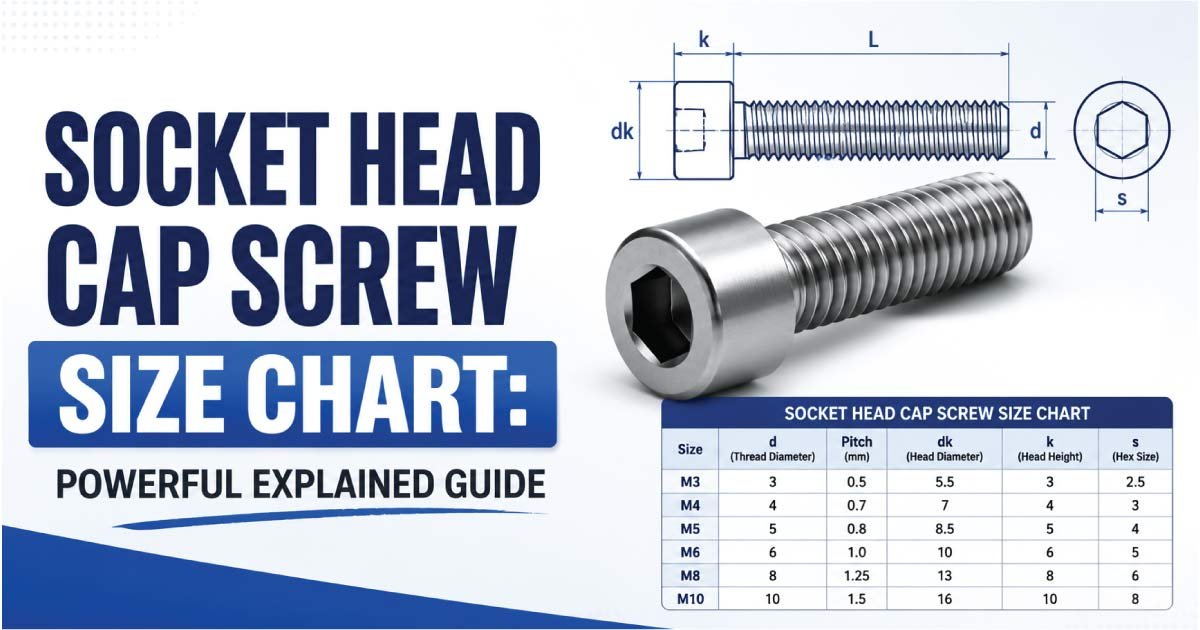
Socket Head Cap Screws (SHCS) are among the strongest and most widely used fasteners in machinery, manufacturing, automotive assemblies, aerospace equipment, and industrial applications. Their cylindrical head and internal hex drive allow high tightening torque while requiring less installation space than traditional hex bolts.
Understanding a Socket Head Cap Screw Size Chart is essential for selecting the proper screw diameter, thread pitch, head dimensions, and length for your application. This guide explains socket head cap screw sizes, dimensions, types, materials, applications, and selection methods.
What Is a Socket Head Cap Screw?
A Socket Head Cap Screw is a precision-engineered high-strength fastener used in mechanical and industrial applications where strong clamping force, compact design, and reliable performance are required. It features a cylindrical head with an internal hex socket drive, allowing installation with an Allen wrench or hex key. These screws are commonly used in machinery, automotive systems, and engineering assemblies where space is limited and high-strength fastening is essential.
The screw is tightened using a hex key, which allows high torque application without damaging the head. Because of its strong structure and clean design, it is widely preferred in applications where both appearance and performance matter.
These fasteners are commonly used where:
- High clamping force is required
- Space is limited
- A clean appearance is desired
- High-strength fastening is necessary
How Does a Socket Head Cap Screw Work?
A Socket Head Cap Screw works by converting applied rotational torque into strong axial clamping force, which securely holds components together. When the screw is tightened, it stretches slightly, creating tension that locks the joined parts firmly in place.
The installation process involves:
- Inserting the screw into a threaded hole or nut
- Tightening with a hex key
- Generating tension in the screw
- Clamping components together securely
Its deep internal socket design allows higher torque application compared to many conventional screw types, making it ideal for heavy-duty mechanical assemblies and precision engineering applications.
Socket Head Cap Screw Size Chart (Imperial)
The Socket Head Cap Screw Size Chart provides standard UNC screw sizes along with their major diameters in inches and millimeters. These measurements help in selecting the correct fastener for accurate fit, strength, and compatibility in different industrial and mechanical applications.
| Screw Size | Major Diameter (Inches) | Diameter (mm) |
|---|---|---|
| #4-40 | 0.112 | 2.84 |
| #6-32 | 0.138 | 3.51 |
| #8-32 | 0.164 | 4.17 |
| #10-24 | 0.190 | 4.83 |
| 1/4″-20 | 0.250 | 6.35 |
| 5/16″-18 | 0.312 | 7.94 |
| 3/8″-16 | 0.375 | 9.53 |
| 7/16″-14 | 0.438 | 11.11 |
| 1/2″-13 | 0.500 | 12.70 |
| 5/8″-11 | 0.625 | 15.88 |
These sizes are widely used in industrial machinery, automotive systems, construction equipment, and heavy-duty engineering assemblies where precision fastening and high strength are required.
Metric Socket Head Cap Screw Size Chart
Metric socket head cap screws are commonly manufactured according to ISO 4762 and DIN 912 standards.
| Metric Size | Diameter (mm) |
|---|---|
| M3 | 3 mm |
| M4 | 4 mm |
| M5 | 5 mm |
| M6 | 6 mm |
| M8 | 8 mm |
| M10 | 10 mm |
| M12 | 12 mm |
| M16 | 16 mm |
| M20 | 20 mm |
| M24 | 24 mm |
Metric sizes are identified using the “M” designation.
Common Socket Head Cap Screw Lengths
Available lengths vary depending on diameter and standard specifications.
| Length (Inches) | Length (mm) |
|---|---|
| 1/4″ | 6.35 mm |
| 3/8″ | 9.53 mm |
| 1/2″ | 12.7 mm |
| 3/4″ | 19.05 mm |
| 1″ | 25.4 mm |
| 1-1/4″ | 31.75 mm |
| 1-1/2″ | 38.1 mm |
| 2″ | 50.8 mm |
| 3″ | 76.2 mm |
| 4″ | 101.6 mm |
Length selection depends on required thread engagement and material thickness.
Socket Head Cap Screw Head Dimensions
Socket head cap screw head dimensions are standardized to ensure proper fit, consistent performance, and compatibility across mechanical and industrial applications. These measurements help determine torque capacity, tool selection, and space requirements during installation.
Key Head Dimensions Include:
- Head diameter
- Head height
- Hex socket size
- Socket depth
Each of these dimensions directly affects how the screw performs under load and how easily it can be installed in confined spaces.
Example Head Dimension Chart
| Size | Head Diameter | Head Height |
|---|---|---|
| M6 | 10 mm | 6 mm |
| M8 | 13 mm | 8 mm |
| M10 | 16 mm | 10 mm |
| M12 | 18 mm | 12 mm |
These dimensions may vary slightly depending on manufacturer standards, material grade, and application requirements, but they generally remain within standardized industrial ranges to ensure proper interchangeability and reliable performance.
Types of Socket Head Cap Screws
Several variations of socket head cap screws are available to meet different mechanical, structural, and design requirements. Each type is engineered for specific load conditions, space limitations, and installation needs in industrial and precision applications.
1. Standard Socket Head Cap Screw
The standard socket head cap screw is the most widely used type in industrial and mechanical assemblies. It is known for its strength, reliability, and ability to handle high torque applications using an internal hex drive system.
Features:
- Cylindrical head
- Internal hex drive
- High-strength construction
Applications:
- Machinery
- Industrial equipment
- Automotive assemblies
2. Low Head Socket Cap Screw
Low head socket cap screws are designed for applications where space is limited and a standard head cannot be used. They provide sufficient strength while maintaining a reduced profile for tight clearance areas.
Features:
- Reduced head height
- Limited clearance requirement
- Suitable for tight spaces
3. Button Head Socket Screw
Button head socket screws feature a rounded, low-profile design that provides a smooth and visually appealing finish. They also offer a wider bearing surface, which helps distribute load more evenly across the material.
Features:
- Rounded low-profile head
- Attractive appearance
- Wider bearing surface
Applications:
- Electronics
- Consumer products
- Decorative assemblies
4. Flat Head Socket Cap Screw
Flat head socket cap screws are designed to sit flush with the surface of the material. Their countersunk design makes them ideal for applications where a smooth and level finish is required.
Features:
- Countersunk design
- Flush surface finish
- Clean appearance
Applications:
- Aerospace
- Machinery covers
- Precision equipment
5. Shoulder Socket Screw
Shoulder socket screws include a precision-machined shoulder section that allows controlled movement and alignment. They are commonly used in applications requiring accurate positioning and rotational movement.
Features:
- Precision shoulder section
- Accurate positioning
- Smooth rotation support
Applications:
- Bearings
- Pivots
- Rotating assemblies
How to Choose the Correct Socket Head Cap Screw Size
Selecting the correct socket head cap screw size is essential for achieving strong clamping force, reliable fastening, and long-term mechanical stability. The right choice depends on load demands, material thickness, available space, environmental exposure, and assembly requirements.
1. Load Requirements
Load requirements are a key factor in screw selection. Applications with higher loads need larger diameter screws made from stronger grades of steel to handle stress safely. Light-duty applications can use smaller sizes, but heavy machinery requires high-strength screws to prevent failure, deformation, or loosening under pressure.
2. Material Thickness
Material thickness determines how much thread engagement is possible. The screw must be long enough to fully engage the material and provide secure holding strength without being too short or excessively long. Proper engagement ensures stability, prevents stripping, and improves overall joint strength in mechanical assemblies.
3. Space Constraints
Space limitations often influence the type of socket head cap screw used. In tight or compact assemblies, low-head or button-head designs are preferred because they require less clearance while still providing strong fastening. Selecting the correct head style ensures proper fit without interfering with nearby components.
4. Environmental Conditions
Environmental conditions directly affect screw durability. Outdoor, humid, or corrosive environments require stainless steel or coated socket head cap screws to resist rust and corrosion. In dry indoor settings, standard alloy steel is usually sufficient. Proper material selection ensures long service life and maintains consistent fastening strength over time.
5. Assembly Requirements
Assembly requirements include selecting the correct screw length, thread pitch, and drive type for the application. The right combination ensures smooth installation and proper torque application. Incorrect selection can lead to poor engagement, weak joints, or installation difficulties, while correct matching improves efficiency and reliability in assembly processes.
Applications of Socket Head Cap Screws
Socket head cap screws are widely used across industries because they offer high strength, compact design, and reliable performance in precision and heavy-duty applications. Their internal hex drive makes them ideal for tight spaces and high-torque installations.
1. Industrial Machinery
In industrial equipment, socket head cap screws are used to assemble and secure heavy machine components that operate under continuous load and vibration.
Used in:
- Machine frames
- Tooling systems
- Conveyor equipment
2. Automotive Industry
These screws play an important role in automotive systems where durability, vibration resistance, and strong fastening are required for safety and performance.
Applications include:
- Engine components
- Suspension systems
- Transmission assemblies
3. Aerospace Industry
Socket head cap screws are used in aerospace applications where precision, strength, and lightweight performance are critical for structural integrity and safety.
Used for:
- Aircraft structures
- Control systems
- Precision assemblies
4. Robotics
In robotics, these screws are essential for building strong yet compact assemblies that require smooth movement and accurate alignment in mechanical systems.
Common in:
- Robot frames
- Motion systems
- Automation equipment
5. Electronics Manufacturing
Socket head cap screws are widely used in electronics for secure mounting and assembly of sensitive components without adding unnecessary bulk.
Used for:
- Equipment enclosures
- Mounting brackets
- Precision instruments
Advantages of Socket Head Cap Screws
Socket head cap screws offer several important advantages that make them one of the most widely used fasteners in engineering and industrial applications.
Major benefits include:
- High tensile strength
- Compact head design
- Excellent torque capability
- Reliable clamping force
- Clean appearance
- Easy installation
- Suitable for precision applications
These features make them highly suitable for both heavy-duty machinery and precision engineering systems.
Socket Head Cap Screw vs Hex Bolt
| Feature | Socket Head Cap Screw | Hex Bolt |
|---|---|---|
| Head Style | Cylindrical | Hexagonal |
| Drive Type | Internal Hex | External Hex |
| Space Required | Less | More |
| Torque Capacity | High | High |
| Appearance | Cleaner | Traditional |
Both fasteners are strong, but socket head cap screws are preferred in compact or precision assemblies where space is limited.
Maintenance and Inspection
Regular inspection of socket head cap screws is essential to ensure long-term performance, safety, and reliability in mechanical and industrial assemblies. Proper maintenance helps prevent unexpected failures, reduces downtime, and maintains structural integrity under load and vibration.
Check for:
- Corrosion
- Loose fasteners
- Thread damage
- Head wear
- Hex socket wear
Each of these issues can reduce fastening strength and compromise the stability of the entire assembly if not identified early during routine inspections.
Conclusion
A Socket Head Cap Screw Size Chart is an essential tool for selecting the correct fastener dimensions for machinery, automotive systems, robotics, aerospace equipment, and industrial assemblies. Understanding diameter, thread pitch, head dimensions, material options, and strength grades helps ensure safe and reliable fastening.
By using the proper socket head cap screw size, you can achieve maximum clamping force, long service life, and dependable performance in even the most demanding applications.
Also Read: 👉 V-Belt Size Chart: Guide to Dimensions, Types & Selection provides everything you need to understand V-belt sizes, dimensions, belt profiles, and selection methods. Learn how to choose the correct V-belt for industrial machinery, automotive systems, and power transmission equipment. Read the full guide for sizing charts, belt types, applications, and expert replacement tips.

Engineer Hassan is a Mechanical Engineer with 16+ years of hands-on experience in mechanical hardware, fasteners, and workshop tools. He focuses on size selection, thread identification, and measurement, helping users choose the correct components with accuracy and safety.