
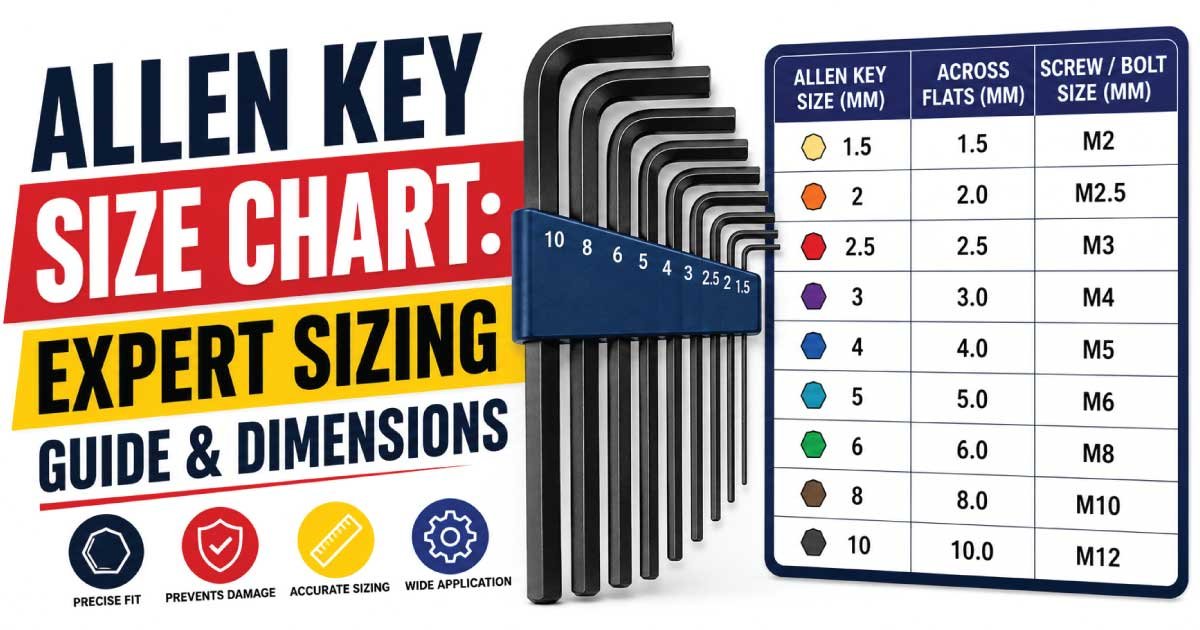
Allen keys, also known as hex keys or hex wrenches, are essential hand tools used to tighten and loosen hex socket screws and bolts.
They are widely used in furniture assembly, bicycles, motorcycles, automobiles, machinery, electronics, and industrial equipment. Choosing the correct Allen key size prevents damage to fasteners, improves torque transfer, and ensures safe installation.
This guide explains standard Allen key sizes, metric and SAE dimensions, types, materials, and applications.
What Is an Allen Key?
An Allen key is an L-shaped tool with a hexagonal cross-section designed to fit hex socket fasteners. The six-sided design provides excellent grip inside the screw head, allowing high torque with minimal slipping. Allen keys are available in metric and imperial (SAE) sizes to match different fastener standards.
Key features include:
- Six-sided hexagonal design
- Available in metric and SAE sizes
- Compact and lightweight
- High torque capability
- Suitable for recessed socket screws
- Available in short and long arm styles
Why Allen Key Size Matters
Using the correct Allen key size is critical for protecting both the tool and the fastener. A key that is too small may strip the socket, while one that is too large will not fit. Correct sizing improves fastening accuracy and extends tool life.
Benefits of using the correct size include:
- Prevents stripped screws
- Better torque transfer
- Safer fastening
- Reduced tool wear
- Easier screw removal
- Improved work efficiency
Metric Allen Key Size Chart
The following table lists the most common metric Allen key sizes used worldwide.
| Allen Key Size (mm) | Decimal (mm) | Common Applications |
|---|---|---|
| 0.7 mm | 0.70 | Precision electronics |
| 0.9 mm | 0.90 | Small instruments |
| 1.3 mm | 1.30 | Eyeglasses and electronics |
| 1.5 mm | 1.50 | Small machinery |
| 2 mm | 2.00 | Furniture assembly |
| 2.5 mm | 2.50 | Bicycles |
| 3 mm | 3.00 | Mechanical equipment |
| 4 mm | 4.00 | Automotive repairs |
| 5 mm | 5.00 | Industrial machinery |
| 6 mm | 6.00 | Heavy equipment |
| 8 mm | 8.00 | Structural assemblies |
| 10 mm | 10.00 | Industrial maintenance |
| 12 mm | 12.00 | Large machinery |
| 14 mm | 14.00 | Heavy-duty applications |
| 17 mm | 17.00 | Industrial equipment |
| 19 mm | 19.00 | Large mechanical systems |
SAE (Imperial) Allen Key Size Chart
Imperial or SAE Allen keys are commonly used in North America and on equipment manufactured using inch-based fasteners.
| SAE Size | Decimal (Inch) | Decimal (mm) |
|---|---|---|
| 0.028″ | 0.028 | 0.71 mm |
| 0.035″ | 0.035 | 0.89 mm |
| 1/16″ | 0.0625 | 1.59 mm |
| 5/64″ | 0.0781 | 1.98 mm |
| 3/32″ | 0.0938 | 2.38 mm |
| 7/64″ | 0.1094 | 2.78 mm |
| 1/8″ | 0.1250 | 3.18 mm |
| 9/64″ | 0.1406 | 3.57 mm |
| 5/32″ | 0.1563 | 3.97 mm |
| 3/16″ | 0.1875 | 4.76 mm |
| 7/32″ | 0.2188 | 5.56 mm |
| 1/4″ | 0.2500 | 6.35 mm |
| 5/16″ | 0.3125 | 7.94 mm |
| 3/8″ | 0.3750 | 9.53 mm |
Metric vs SAE Allen Keys
Metric and SAE Allen keys may appear similar, but they are manufactured to different measurement standards. Using the wrong system can damage the fastener or reduce gripping strength, especially in high-torque applications.
Metric Allen Keys
Metric Allen keys are measured in millimeters and are widely used in Europe, Asia, and most international manufacturing industries. They are commonly found on bicycles, machinery, automotive components, and imported equipment.
Advantages include:
- Precise metric sizing
- International standard
- Easy identification
- Widely available
SAE Allen Keys
SAE Allen keys use inch-based measurements and are common in the United States and older American-made machinery. They are frequently used in automotive repairs, industrial equipment, and construction tools.
Benefits include:
- Ideal for inch fasteners
- Common in North America
- Suitable for older equipment
- Available in complete sets
Types of Allen Keys
Allen keys are available in several designs to suit different working environments and fastening requirements.
1. Standard L-Shaped Allen Key
The traditional L-shaped Allen key is the most commonly used design. It offers one short arm for high torque and one long arm for improved reach, making it suitable for general maintenance and assembly work.
2. Ball-End Allen Key
Ball-end Allen keys feature a rounded tip that allows the tool to engage the fastener at an angle, making it easier to work in confined or hard-to-reach spaces. They are widely used in machinery maintenance and automotive repairs.
Advantages include:
- Angled operation
- Faster installation
- Better accessibility
- Improved productivity
3. T-Handle Allen Key
T-handle Allen keys provide a comfortable grip and greater leverage than standard L-shaped keys. They are commonly used in workshops where repetitive tightening or loosening is required.
4. Folding Allen Key Set
A folding Allen key set combines multiple sizes into one compact tool. The keys fold into the handle like a pocket knife, making them easy to carry and organize for field repairs and portable toolkits.
🔧 Read Detailed Size Guide 👉 Battery Wing Nut Sizes: Easy Selection Tips
Common Allen Key Materials
Material selection determines the durability, hardness, and corrosion resistance of an Allen key. High-quality tools are manufactured from hardened alloy steels to withstand repeated use without bending or wearing prematurely.
1. Chrome Vanadium Steel
Chrome vanadium steel is one of the most popular materials for Allen keys because it offers excellent strength, wear resistance, and long service life. It is commonly used in professional-grade tool sets.
2. S2 Tool Steel
S2 tool steel provides superior hardness and impact resistance compared to many standard steels. It is widely used in premium Allen key sets designed for industrial, automotive, and heavy-duty maintenance applications.
3. Chrome Molybdenum Steel
Chrome molybdenum steel combines high tensile strength with excellent toughness, making it suitable for heavy industrial work where tools experience repeated high-torque loads.
Common Applications of Allen Keys
Allen keys are used across numerous industries because hex socket fasteners provide secure, compact, and reliable fastening solutions. They are indispensable in both professional workshops and household toolkits.
Common applications include:
- Furniture assembly
- Bicycle maintenance
- Motorcycle repairs
- Automotive servicing
- Industrial machinery
- Electronics assembly
- Robotics
- HVAC equipment
- Construction
- Manufacturing plants
How to Choose the Correct Allen Key Size
Selecting the correct Allen key size is essential for preventing damage to both the tool and the fastener. A properly sized hex key fits tightly inside the socket, allowing maximum torque transfer while reducing the risk of slipping or rounding the screw head.
1. Match the Hex Socket Size
Always use an Allen key that fits snugly inside the hex socket. Never force a larger key into the fastener or use a smaller one that leaves excessive play, as both can permanently damage the screw.
Check the following:
- Metric or SAE standard
- Hex socket dimension
- Fastener manufacturer specifications
- Wear on the screw head
- Tool condition
2. Identify Metric or SAE Fasteners
Many fasteners look similar, but metric and SAE sizes are not interchangeable. Before selecting an Allen key, determine whether the fastener follows metric or imperial measurements to ensure a proper fit and avoid stripping.
Common standards include:
- Metric (mm)
- SAE (inch)
- DIN
- ISO
- ANSI
3. Consider the Required Torque
Large fasteners require greater tightening torque, making stronger Allen keys and longer handles more suitable. For heavy-duty applications, choose high-quality hardened steel tools that can withstand repeated high-torque use without twisting.
Consider:
- Bolt size
- Tightening torque
- Material hardness
- Working environment
4. Choose the Right Allen Key Style
Different jobs require different Allen key designs. Standard keys work well for general repairs, while ball-end and T-handle versions provide better accessibility and leverage in demanding applications.
Popular styles include:
- Standard L-shaped
- Ball-end
- T-handle
- Folding set
- Long-arm
- Short-arm
🔧 Read Detailed Size Guide 👉 Metric Bolt Sizes for Everyday Mechanical Use
Allen Bolt Size and Recommended Allen Key Chart
The following table shows common metric socket head cap screws and their matching Allen key sizes.
| Bolt Size | Recommended Allen Key |
|---|---|
| M2 | 1.5 mm |
| M2.5 | 2 mm |
| M3 | 2.5 mm |
| M4 | 3 mm |
| M5 | 4 mm |
| M6 | 5 mm |
| M8 | 6 mm |
| M10 | 8 mm |
| M12 | 10 mm |
| M14 | 12 mm |
| M16 | 14 mm |
| M20 | 17 mm |
Allen Key Material Comparison
Different materials offer varying levels of durability, hardness, and corrosion resistance. Selecting high-quality tools improves performance and extends service life.
| Material | Strength | Corrosion Resistance | Common Use |
|---|---|---|---|
| Chrome Vanadium | High | Good | General-purpose tools |
| S2 Tool Steel | Very High | Good | Professional mechanics |
| Chrome Molybdenum | Excellent | Moderate | Heavy-duty industrial work |
| Carbon Steel | Medium | Moderate | Household tool kits |
Advantages of Allen Keys
Allen keys remain one of the most widely used fastening tools because they are compact, inexpensive, and capable of transmitting significant torque. Their simple design makes them suitable for both professionals and DIY users.
Advantages include:
- Compact size
- Lightweight
- High torque capacity
- Easy storage
- Low manufacturing cost
- Wide availability
- Suitable for recessed fasteners
- Long service life
Limitations of Allen Keys
Although Allen keys are versatile tools, they also have limitations. Using poor-quality tools or incorrect sizes may reduce performance and damage fasteners.
Common limitations include:
- Limited reach in confined spaces
- Can strip worn fasteners
- Ball-end types handle less torque
- Easy to lose small sizes
- Requires correct size matching
How to Use an Allen Key Properly
Correct usage extends tool life and prevents damage to socket screws. Always ensure the tool is fully inserted into the fastener before applying force.
Basic Steps
- Identify the correct Allen key size.
- Insert the key fully into the socket.
- Keep the tool aligned with the screw.
- Apply steady pressure.
- Turn clockwise to tighten.
- Turn counterclockwise to loosen.
- Avoid excessive force.
- Replace worn tools when necessary.
Maintenance Tips for Allen Keys
Proper maintenance keeps Allen keys accurate and reliable while extending their lifespan. Clean tools after use and store them in an organized holder to prevent corrosion and loss.
Maintenance recommendations:
- Wipe tools after use.
- Remove dirt and grease.
- Store in a dry location.
- Replace bent keys.
- Avoid using damaged tips.
- Lightly oil steel tools.
- Keep complete sets organized.
Common Allen Key Applications
Allen keys are used in countless industries because hex socket fasteners provide strong, compact, and secure connections.
Major applications include:
- Furniture assembly
- Bicycle repair
- Motorcycle maintenance
- Automotive servicing
- Industrial machinery
- Robotics
- Aerospace components
- Electronics manufacturing
- Home appliances
- Construction equipment
🔧 Read Detailed Size Guide 👉 Machine Screw Threads and Sizes Explained
Common Mistakes When Using Allen Keys
Incorrect tool selection or improper technique can damage fasteners and reduce work efficiency. Following good practices helps avoid unnecessary repairs and replacement costs.
Avoid these mistakes:
- Using the wrong size
- Mixing metric and SAE tools
- Applying excessive force
- Using worn Allen keys
- Tilting the tool while turning
- Using Allen keys as pry bars
- Hammering the tool into damaged sockets
- Ignoring damaged fasteners
Allen Key vs Torx Key
Although both tools drive recessed fasteners, they differ in design and applications.
| Feature | Allen Key | Torx Key |
|---|---|---|
| Drive Shape | Hexagonal | Six-point star |
| Torque Capacity | High | Very High |
| Slip Resistance | Good | Excellent |
| Common Use | Machinery, furniture | Automotive, electronics |
| Availability | Very common | Common |
| Cost | Lower | Slightly higher |
Summary Allen keys Size Chart
Allen keys are indispensable tools for tightening and loosening hex socket fasteners across residential, commercial, and industrial applications. Choosing the correct size, material, and style improves torque transfer, protects fasteners from damage, and enhances overall work efficiency.
Whether you are assembling furniture, repairing a bicycle, maintaining industrial machinery, or servicing automotive components, using the appropriate Allen key ensures safer operation, reliable fastening, and longer tool life.
FAQs:
What is the most common Allen key size?
The most commonly used Allen key sizes are 2 mm, 2.5 mm, 3 mm, 4 mm, 5 mm, and 6 mm. These sizes are widely used for assembling furniture, repairing bicycles, servicing automotive components, and maintaining machinery because they fit many standard socket head screws found in everyday applications.
Can I use an SAE Allen key on a metric bolt?
No, using an SAE Allen key on a metric bolt is not recommended. Although some sizes seem similar, their dimensions differ slightly. Using the incorrect key can damage the socket, reduce grip, strip the fastener, and make future removal more difficult, especially under high tightening torque.
What material is best for Allen keys?
S2 tool steel and chrome vanadium steel are considered the best materials for Allen keys due to their excellent hardness, strength, and wear resistance. These materials withstand repeated high-torque applications, resist deformation, and provide a longer service life than lower-quality steel tools in demanding environments.
What is a ball-end Allen key used for?
A ball-end Allen key is designed to tighten or loosen socket head screws at an angle, typically up to 25 degrees. This makes it especially useful in tight or hard-to-reach spaces where a standard straight Allen key cannot be aligned directly with the fastener.
Why do Allen keys strip screws?
Allen keys usually strip screws when the wrong size tool is used, the key is worn, excessive force is applied, or the fastener is already damaged. Using the correct size, maintaining good tool condition, and applying steady pressure significantly reduce the risk of stripping the screw head.

Engineer Hassan is a Mechanical Engineer with 16+ years of hands-on experience in mechanical hardware, fasteners, and workshop tools. He focuses on size selection, thread identification, and measurement, helping users choose the correct components with accuracy and safety.