
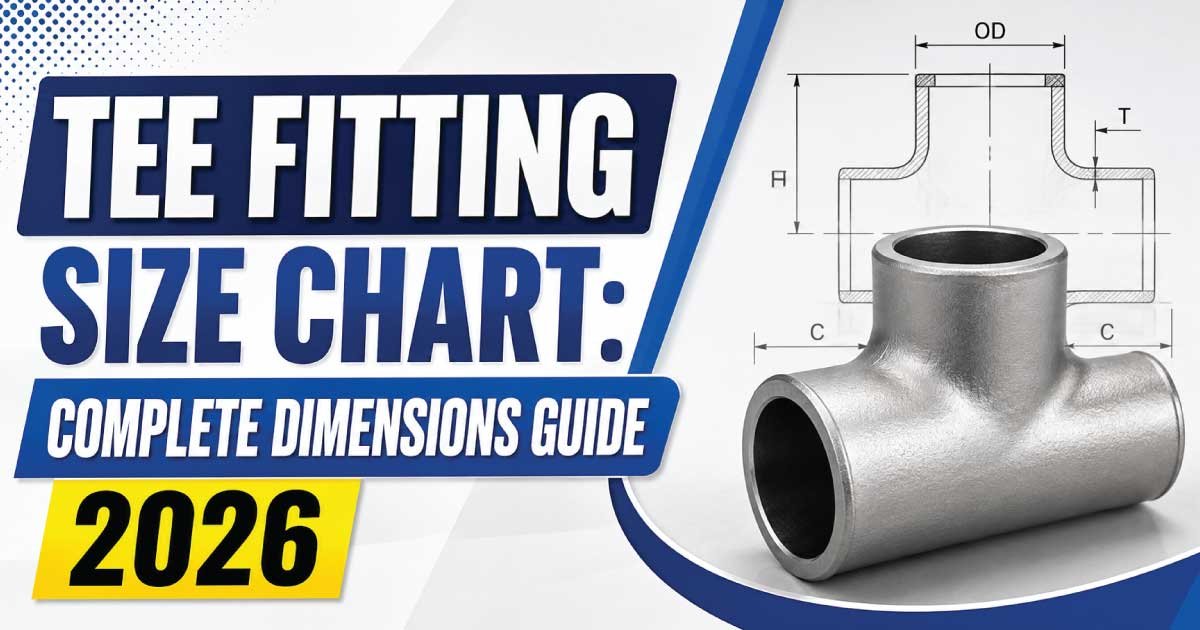
Tee fittings are one of the most commonly used pipe fittings in plumbing, industrial piping, HVAC, gas distribution, and chemical processing systems.
They allow a pipeline to branch into two directions while maintaining efficient fluid flow. Selecting the correct tee fitting size is essential for minimizing pressure loss, ensuring leak-free connections, and maintaining system efficiency.
This guide explains standard tee fitting sizes, dimensions, materials, applications, and tips for choosing the right fitting.
What Is a Tee Fitting?
A tee fitting is a T-shaped pipe connector with one inlet and two outlets, or vice versa. It joins three sections of pipe together, allowing fluid, gas, or steam to split into different directions or combine into a single line. Tee fittings are manufactured in various sizes, materials, and pressure ratings to suit residential, commercial, and industrial piping systems.
Common features include:
- Three pipe connections
- Available in equal and reducing designs
- Suitable for threaded, welded, or socket connections
- Used in both low- and high-pressure systems
- Offered in metal and plastic materials
Why Tee Fitting Size Matters
Choosing the proper tee fitting size directly affects flow efficiency, pressure balance, and overall system reliability. An incorrectly sized fitting can create unnecessary turbulence, pressure drops, and leakage, leading to higher maintenance costs and reduced system performance.
Proper sizing provides several benefits:
- Smooth fluid flow
- Reduced pressure loss
- Better system efficiency
- Easier installation
- Longer service life
- Improved safety
Tee Fitting Size Chart (Nominal Pipe Size)
The following table shows the most common tee fitting sizes used in plumbing and industrial piping.
| Nominal Size (Inch) | DN Size | Outside Diameter (Approx.) | Common Applications |
|---|---|---|---|
| 1/4″ | DN8 | 13.7 mm | Instrument tubing |
| 3/8″ | DN10 | 17.1 mm | Hydraulic systems |
| 1/2″ | DN15 | 21.3 mm | Residential plumbing |
| 3/4″ | DN20 | 26.7 mm | Water supply lines |
| 1″ | DN25 | 33.4 mm | Commercial piping |
| 1-1/4″ | DN32 | 42.2 mm | HVAC systems |
| 1-1/2″ | DN40 | 48.3 mm | Steam pipelines |
| 2″ | DN50 | 60.3 mm | Industrial plants |
| 2-1/2″ | DN65 | 73.0 mm | Chemical processing |
| 3″ | DN80 | 88.9 mm | Manufacturing plants |
| 4″ | DN100 | 114.3 mm | Municipal water systems |
| 6″ | DN150 | 168.3 mm | Large industrial pipelines |
| 8″ | DN200 | 219.1 mm | Oil and gas facilities |
| 10″ | DN250 | 273.0 mm | Processing industries |
| 12″ | DN300 | 323.9 mm | Main distribution pipelines |
Equal Tee vs Reducing Tee
Although both fittings perform similar functions, they differ in branch size and intended application.
1. Equal Tee
An equal tee has three openings of the same diameter. It is commonly used where all connected pipes require the same flow capacity. Equal tees are the standard choice for water supply systems, compressed air lines, and general industrial piping because they provide balanced flow distribution.
Advantages:
- Uniform pipe size
- Easy installation
- Better flow balance
- Lower inventory requirements
2. Reducing Tee
A reducing tee has one branch smaller than the main pipeline. It allows a larger pipe to connect with a smaller branch while maintaining efficient flow. These fittings are commonly used when supplying secondary equipment or branch lines from a larger pipeline.
Benefits include:
- Saves installation space
- Eliminates additional reducers
- Reduces fitting count
- Improves piping efficiency
Common Tee Fitting Materials
Material selection depends on pressure, temperature, corrosion resistance, and the type of fluid being transported.
1. Carbon Steel Tee
Carbon steel tees are widely used in oil, gas, steam, and industrial piping systems because of their excellent strength and affordability. They perform well under high-pressure conditions and are available in seamless and welded construction for various industrial applications.
2. Stainless Steel Tee
Stainless steel tees provide exceptional corrosion resistance, making them ideal for food processing, pharmaceuticals, chemical plants, and marine environments. They maintain strength at high temperatures while offering excellent durability and a long service life with minimal maintenance.
3. PVC Tee
PVC tees are commonly used in residential plumbing, irrigation, drainage, and swimming pool systems. They are lightweight, inexpensive, corrosion resistant, and easy to install using solvent cement, making them a popular choice for low-pressure water applications.
4. Copper Tee
Copper tees are primarily found in potable water systems and HVAC installations. Their natural corrosion resistance and excellent heat conductivity make them suitable for hot and cold water distribution, refrigeration, and heating applications.
5. Brass Tee
Brass tee fittings offer excellent resistance to corrosion and are commonly used in plumbing, compressed air systems, gas lines, and instrumentation. Their durability and machinability make them suitable for both residential and commercial installations.
Tee Fitting Connection Types
Different connection methods are available depending on system requirements and installation preferences.
Threaded Tee
Threaded tees feature internal or external pipe threads that allow quick assembly without welding. They are commonly used in smaller pipe sizes where easy maintenance and future disassembly are important considerations.
Applications:
- Water supply
- Compressed air
- Gas piping
- Residential plumbing
Socket Weld Tee
Socket weld tees are designed for smaller high-pressure pipelines. The pipe inserts into the fitting before welding, creating a strong and leak-resistant joint. They are frequently used in chemical plants, refineries, and steam distribution systems.
Butt Weld Tee
Butt weld tees are the preferred choice for medium and large industrial pipelines. The pipe ends are welded directly to the fitting, producing a continuous connection capable of handling high pressure, high temperatures, and demanding operating conditions.
Flanged Tee
Flanged tees include bolted flange connections, allowing quick removal for maintenance or inspection. They are commonly installed in large industrial systems where equipment servicing and periodic replacement are expected throughout the system’s operating life.
🔧 Read Detailed Size Guide 👉 Wood Screw Sizes for DIY and Construction Projects
Standard Tee Fitting Dimensions
Although dimensions vary according to manufacturing standards, tee fittings generally follow ASME and ANSI specifications to ensure compatibility with standard pipe sizes. Dimensions include center-to-end measurements, wall thickness, branch diameter, and pressure rating, all of which contribute to proper installation and reliable performance.
Common dimensional features include:
- Nominal pipe size (NPS)
- Diameter nominal (DN)
- Center-to-end dimension
- Wall thickness (Schedule)
- Branch diameter
- End connection type
Industries That Use Tee Fittings
Tee fittings are essential components in countless piping systems because they efficiently divide or combine fluid flow. Their versatility makes them suitable for residential plumbing as well as complex industrial installations operating under high pressure and temperature.
Major industries include:
- Water treatment plants
- Oil and gas
- Chemical processing
- Power generation
- HVAC systems
- Food processing
- Pharmaceutical manufacturing
- Marine engineering
- Fire protection systems
- Irrigation networks
How to Choose the Correct Tee Fitting Size
Selecting the correct tee fitting size ensures smooth fluid flow, minimizes pressure losses, and extends the life of the piping system. The correct fitting should match the pipeline dimensions, operating pressure, temperature, and fluid characteristics while complying with applicable piping standards.
1. Match the Pipe Diameter
The first step is selecting a tee that matches the outside diameter or nominal pipe size (NPS) of your piping system. Equal tees use the same diameter on all three openings, while reducing tees have a smaller branch connection for secondary pipelines.
Consider:
- Pipe outside diameter
- Nominal pipe size (NPS)
- DN size
- Connection compatibility
2. Check the Pipe Schedule
Pipe schedule determines the wall thickness of both the pipe and the fitting. Using the correct schedule ensures the fitting can safely withstand the system pressure while providing a proper welded or threaded connection.
Common schedules include:
- Schedule 10
- Schedule 20
- Schedule 40
- Schedule 80
- Schedule 160
- XXS (Double Extra Strong)
3. Determine the Operating Pressure
Pressure rating is one of the most important factors when selecting a tee fitting. Higher-pressure systems require thicker fittings manufactured from stronger materials to ensure safe operation under demanding conditions.
Consider:
- Maximum operating pressure
- Pressure fluctuations
- Hydraulic shock
- Safety factor
4. Consider the Fluid Type
Different fluids affect material selection differently. Corrosive chemicals, high-temperature steam, drinking water, and petroleum products each require specific fitting materials to maximize durability and safety.
Examples include:
- Water
- Steam
- Oil
- Natural gas
- Chemicals
- Compressed air
- Food-grade liquids
Pipe Schedule Size Chart
The pipe schedule determines wall thickness while the outside diameter remains constant for the same nominal size.
| Nominal Pipe Size | Schedule 40 Wall Thickness | Schedule 80 Wall Thickness |
|---|---|---|
| 1/2″ | 2.77 mm | 3.73 mm |
| 3/4″ | 2.87 mm | 3.91 mm |
| 1″ | 3.38 mm | 4.55 mm |
| 1-1/4″ | 3.56 mm | 4.85 mm |
| 1-1/2″ | 3.68 mm | 5.08 mm |
| 2″ | 3.91 mm | 5.54 mm |
| 3″ | 5.49 mm | 7.62 mm |
| 4″ | 6.02 mm | 8.56 mm |
Pressure Ratings for Tee Fittings
Pressure ratings vary depending on the material, wall thickness, manufacturing standard, and connection type. Selecting the correct pressure rating ensures safe and reliable system performance throughout the fitting’s service life.
| Pressure Class | Typical Applications |
|---|---|
| Class 150 | Water systems |
| Class 300 | Commercial piping |
| Class 600 | Steam service |
| Class 900 | High-pressure plants |
| Class 1500 | Refineries |
| Class 2500 | Power generation |
🔧 Read Detailed Size Guide 👉 Bearing Sizes for Machines: Choose Correctly
Common Tee Fitting Standards
Most manufacturers produce tee fittings according to international standards, ensuring compatibility between fittings, pipes, and flanges from different manufacturers. These standards also specify material requirements, dimensions, pressure ratings, and testing procedures.
Popular standards include:
- ASME B16.9
- ASME B16.11
- MSS SP-75
- ASTM A234
- ASTM A403
- ASTM A420
- DIN Standards
- ISO Standards
Advantages of Tee Fittings
Tee fittings remain one of the most popular pipe fittings because they simplify branch connections while maintaining reliable system performance. Their versatility allows them to be used across thousands of residential, commercial, and industrial applications.
Advantages include:
- Simple installation
- Reliable flow distribution
- Wide size availability
- Multiple material options
- Long service life
- Easy maintenance
- Cost-effective solution
- High pressure capability
Limitations of Tee Fittings
Although tee fittings are highly versatile, they also have limitations. Improper sizing or incorrect installation may create turbulence, pressure losses, and increased wear inside the piping system.
Common disadvantages include:
- Increased flow resistance
- Pressure drop at branch connections
- Possible turbulence
- Larger installation space
- Higher cost for specialty materials
Proper engineering and correct sizing significantly reduce these issues.
How to Install a Tee Fitting
Correct installation ensures leak-free operation and long-term reliability. Before installation, inspect the fitting for damage, verify compatibility with the piping system, and follow manufacturer recommendations for the chosen connection method.
Basic Installation Steps
- Measure the pipe accurately.
- Cut the pipe squarely.
- Remove burrs and clean the ends.
- Align the tee fitting correctly.
- Tighten threaded connections or complete the weld.
- Perform a pressure test.
- Inspect for leaks before commissioning.
Common Applications of Tee Fittings
Tee fittings are used wherever a pipeline needs to split, combine, or redirect fluid flow. Their availability in numerous sizes and materials makes them suitable for nearly every piping industry.
Common applications include:
- Residential plumbing
- Commercial buildings
- Fire sprinkler systems
- HVAC installations
- Oil and gas pipelines
- Chemical processing plants
- Water treatment facilities
- Power stations
- Marine piping
- Irrigation systems
Common Installation Mistakes
Incorrect installation can reduce system efficiency and shorten fitting life. Careful planning and adherence to installation standards help prevent costly failures and maintenance issues.
Avoid these mistakes:
- Selecting the wrong fitting size
- Mixing incompatible materials
- Using the wrong pipe schedule
- Over-tightening threaded joints
- Poor weld quality
- Incorrect branch alignment
- Ignoring pressure ratings
- Skipping pressure testing
Maintenance Tips for Tee Fittings
Although tee fittings have no moving parts, regular inspection helps identify corrosion, leaks, or mechanical damage before they become serious problems. Preventive maintenance increases system reliability and reduces downtime.
Recommended maintenance includes:
- Inspect joints regularly.
- Check for corrosion.
- Monitor vibration.
- Tighten loose connections.
- Replace damaged fittings.
- Clean external surfaces.
- Perform periodic pressure testing.
🔧 Read Detailed Size Guide 👉 Sheet Metal Screw Sizes for Secure Installations
Equal Tee vs Reducing Tee Comparison
| Feature | Equal Tee | Reducing Tee |
|---|---|---|
| Branch Size | Same as main pipe | Smaller than main pipe |
| Flow Distribution | Balanced | Reduced branch flow |
| Installation | Simple | Moderate |
| Cost | Lower | Slightly higher |
| Common Use | General piping | Branch connections |
| Availability | Very common | Common |
Quick Recap Fitting sizes
Choosing the correct tee fitting size is essential for building a safe, efficient, and durable piping system. Whether you’re installing residential plumbing, industrial process lines,
HVAC systems, or oil and gas pipelines, selecting the appropriate size, material, pressure rating, and connection type ensures reliable performance and minimizes maintenance.
By understanding standard tee fitting dimensions, schedules, and installation practices, you can confidently select the right fitting for virtually any application while improving system efficiency and extending service life.
FAQs:
What is the standard size of a tee fitting?
Standard tee fittings are available in sizes ranging from 1/8 inch to 48 inches or larger, depending on the piping application. Residential plumbing systems commonly use 1/2 inch to 2-inch fittings, while commercial and industrial pipelines require larger sizes to accommodate higher flow rates and operating pressures.
What is the difference between an equal tee and a reducing tee?
An equal tee has three openings of the same diameter, allowing equal-sized pipes to connect in all directions. A reducing tee features one smaller branch outlet connected to a larger main pipe, making it ideal for distributing flow from a main pipeline to a smaller branch line.
Which material is best for tee fittings?
The best material depends on the application. Stainless steel offers excellent corrosion resistance, carbon steel handles high-pressure systems, PVC is ideal for water distribution, copper is widely used in plumbing, and brass performs well in gas lines, compressed air systems, and general residential installations.
Are tee fittings available with threaded and welded connections?
Yes, tee fittings are available with threaded, socket weld, butt weld, flanged, compression, and push-fit connections. Each connection type is designed for specific piping systems, pressure ratings, and installation methods, allowing users to choose the most suitable option for their application and maintenance requirements.
How do I know which tee fitting size to buy?
Choose a tee fitting by matching the pipe diameter, pipe schedule, pressure rating, operating temperature, connection type, and fluid being transported. Selecting the correct size ensures proper compatibility, efficient flow, leak-free performance, and reliable long-term operation within the intended piping system.

Engineer Hassan is a Mechanical Engineer with 16+ years of hands-on experience in mechanical hardware, fasteners, and workshop tools. He focuses on size selection, thread identification, and measurement, helping users choose the correct components with accuracy and safety.