
A ratchet is one of the most essential hand tools used in automotive repair, industrial maintenance, construction, and mechanical assembly. While many users focus on socket sizes, choosing the correct ratchet size is equally important because it affects torque capacity, accessibility, efficiency, and overall safety during fastening or loosening operations.
This guide explains how to use a Ratchet Size Chart, understand standard drive sizes, select the correct ratchet for different jobs, and learn the engineering considerations behind ratchet selection.
Whether you are a DIY enthusiast or a professional mechanic, understanding ratchet sizing helps improve productivity while reducing tool wear and fastener damage.
Technical Overview of Ratchets
A ratchet is a reversible hand tool that allows continuous rotation of a fastener without removing the socket after each turn. Its internal gear mechanism enables movement in one direction while locking in the opposite direction, making it significantly faster than using a standard wrench.
Modern ratchets are designed to work with interchangeable sockets, extensions, and adapters. Their performance depends on several engineering characteristics, including:
- Drive size
- Gear tooth count
- Handle length
- Maximum torque capacity
- Material strength
- Ratcheting mechanism
- Surface finish
Although different manufacturers offer unique features, the drive size remains the primary specification when selecting a ratchet.
Standard Ratchet Size Chart
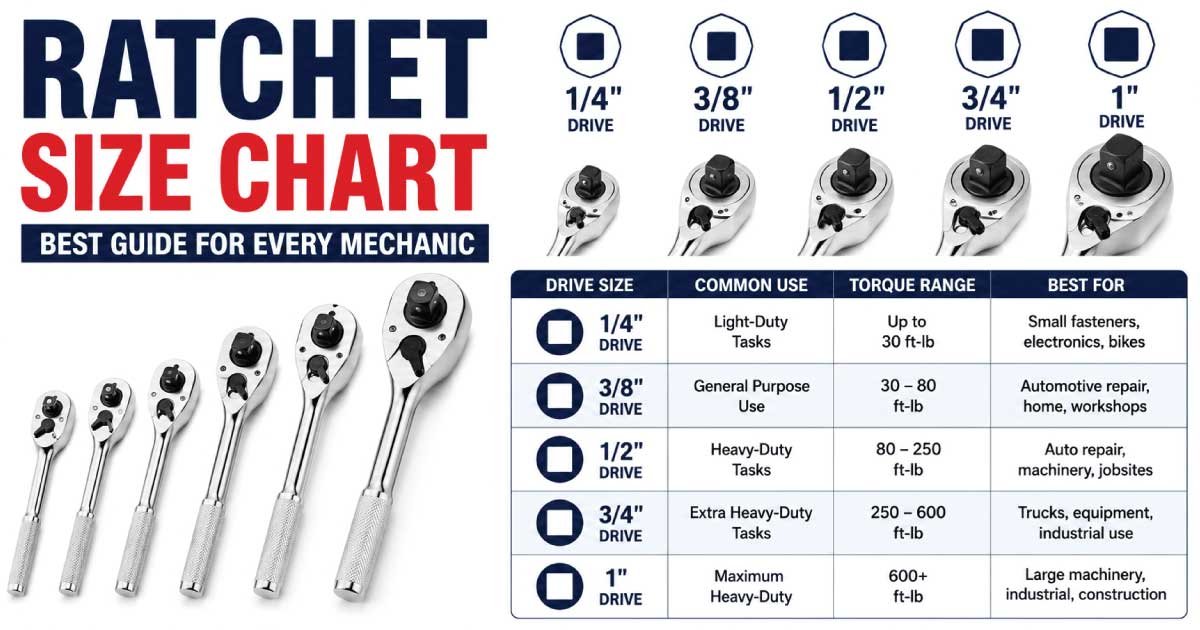
Ratchets are classified by the square drive size that connects to sockets. Larger drive sizes provide greater strength and torque capacity, while smaller drives offer improved access in confined spaces.
The following chart summarizes the most common ratchet drive sizes and their typical applications.
| Drive Size | Metric Equivalent | Typical Socket Range | Common Applications |
|---|---|---|---|
| 1/4 inch | 6.35 mm | 4–14 mm | Electronics, bicycles, motorcycles |
| 3/8 inch | 9.53 mm | 8–22 mm | Automotive maintenance, machinery |
| 1/2 inch | 12.7 mm | 10–36 mm | Vehicle repair, industrial equipment |
| 3/4 inch | 19.05 mm | 19–55 mm | Heavy machinery, commercial vehicles |
| 1 inch | 25.4 mm | 36 mm and above | Mining, construction, industrial plants |
This size chart serves as a general guide. Always verify the socket manufacturer’s compatibility before use, especially for high-torque applications.
Understand The Ratchet Drive Sizes
Drive size refers to the square male connector that fits into a matching square recess in the socket. This measurement determines which sockets, extensions, and accessories are compatible with the ratchet.
Selecting the appropriate drive size affects several aspects of tool performance, including:
- Maximum torque transmission
- Socket compatibility
- Tool durability
- User comfort
- Access to confined spaces
Using an undersized ratchet for heavy-duty work can overload the internal mechanism, while an oversized ratchet may be too bulky for precision tasks.
1/4-Inch Drive Ratchets
The 1/4-inch drive is the smallest standard ratchet size and is commonly used for light-duty fastening tasks. Its compact design allows easy access to tight spaces where larger tools cannot fit.
Typical applications include:
- Dashboard repairs
- Small engines
- Electronics
- HVAC equipment
- Interior automotive work
Because of its limited torque capacity, this drive size should not be used for stubborn or heavily tightened fasteners.
3/8-Inch Drive Ratchets
The 3/8-inch drive is often considered the most versatile ratchet size. It provides a balance between strength, accessibility, and ease of use, making it the preferred choice for general mechanical work.
Professionals frequently use this size for:
- Brake service
- Suspension repairs
- Engine maintenance
- General workshop tasks
- Industrial assembly
For many technicians, a quality 3/8-inch ratchet handles the majority of daily maintenance jobs.
1/2-Inch Drive Ratchets
The 1/2-inch drive is designed for higher torque applications. Its larger internal components provide increased durability when loosening tight bolts or tightening fasteners to specified torque values.
Common uses include:
- Wheel lug nuts
- Heavy suspension components
- Engine mounts
- Structural fasteners
- Agricultural equipment
Many torque wrenches also use a 1/2-inch drive because of its ability to safely transmit higher torque loads.
3/4-Inch and 1-Inch Drives
Large drive ratchets are intended for industrial environments where extremely high torque is required. These tools are commonly found in mining operations, heavy equipment maintenance, shipbuilding, and large manufacturing facilities.
Although heavier and less portable, they provide the strength necessary for oversized fasteners that smaller ratchets cannot safely handle.
Important Ratchet Specifications
Drive size alone does not determine a ratchet’s performance. Engineers and technicians also evaluate several additional specifications before selecting the appropriate tool.
Gear Tooth Count
The gear inside the ratchet determines how many degrees the handle must move before engaging the next tooth.
Common tooth counts include:
| Tooth Count | Swing Arc | Typical Applications |
|---|---|---|
| 24 Teeth | 15° | Heavy-duty work |
| 36 Teeth | 10° | General maintenance |
| 72 Teeth | 5° | Automotive repair |
| 90 Teeth | 4° | Tight spaces |
| 120 Teeth | 3° | Precision work |
Higher tooth counts provide smoother operation and require less handle movement, making them ideal for confined engine compartments.
Handle Length
Handle length directly influences leverage and torque output.
Typical lengths include:
| Ratchet Type | Handle Length |
|---|---|
| Stubby | 90–130 mm |
| Standard | 180–260 mm |
| Long Handle | 300–450 mm |
| Extra Long | 500 mm or more |
Longer handles generate more torque with less effort, while shorter handles improve maneuverability.
Head Design
Ratchets are available in several head configurations:
- Fixed head
- Flex head
- Swivel head
- Pear head
- Round head
Flex-head ratchets are particularly useful when working around engine components or structural obstructions because they allow the handle to pivot for better access.
Engineering Dimensions
Several engineering dimensions influence ratchet performance beyond the drive size. These dimensions determine how comfortably the tool fits into confined spaces and how effectively it transmits torque.
Important dimensions include:
- Overall length
- Head diameter
- Head thickness
- Drive square size
- Handle diameter
- Weight
Manufacturers often optimize these dimensions to balance strength with accessibility, particularly in professional-grade ratchets.
Typical Engineering Dimensions
| Drive Size | Head Diameter | Head Thickness | Approximate Weight |
|---|---|---|---|
| 1/4 inch | 25–30 mm | 12–18 mm | 150–300 g |
| 3/8 inch | 32–40 mm | 16–22 mm | 300–600 g |
| 1/2 inch | 40–50 mm | 20–28 mm | 600–1000 g |
| 3/4 inch | 55–70 mm | 30–40 mm | 1.5–3 kg |
Smaller head dimensions improve accessibility but may reduce internal gear strength.
How Engineers Choose Ratchet Size
Professional mechanics and maintenance engineers rarely choose a ratchet based solely on convenience. Instead, they evaluate several operating conditions to ensure the selected tool can safely transmit the required torque while remaining practical for the task.
The following factors are typically considered.
Required Torque
Torque is often the most important consideration.
General recommendations include:
| Drive Size | Typical Torque Range |
|---|---|
| 1/4 inch | Up to 40 Nm |
| 3/8 inch | 20–120 Nm |
| 1/2 inch | 70–300 Nm |
| 3/4 inch | 300–800 Nm |
| 1 inch | Above 800 Nm |
These values vary between manufacturers and should be treated as general guidance rather than absolute limits.
Workspace Accessibility
Many maintenance tasks occur in confined spaces where a large ratchet cannot rotate through a full swing. In these situations, engineers often prioritize compact head designs and higher gear tooth counts to minimize the required swing arc.
Fastener Size
Larger fasteners typically require higher tightening torque, making larger drive sizes more appropriate. Matching the ratchet to the fastener size helps prevent tool overload and improves work efficiency.
Engineering Materials
The materials used in ratchet construction directly affect durability, corrosion resistance, and service life. Professional-grade ratchets are manufactured from high-strength alloy steels that withstand repeated torque cycles without deforming.
Common Materials
| Material | Properties | Typical Use |
|---|---|---|
| Chrome Vanadium Steel (Cr-V) | High strength, wear resistance | General-purpose ratchets |
| Chrome Molybdenum Steel (Cr-Mo) | Excellent impact resistance | Heavy-duty ratchets |
| Alloy Steel | Balanced toughness and strength | Industrial tools |
| Hardened Steel | High surface hardness | Internal gears and pawls |
Chrome-plated finishes are commonly applied to improve corrosion resistance and simplify cleaning in workshop environments.
👉 For trusted dimensions and professional recommendations, visit our complete J-Bolt Size Chart, where every article includes an Expert Guide and Professional Guide for better decision-making.
Industry Standards
International standards ensure that ratchets and sockets from different manufacturers remain compatible while meeting established quality and safety requirements. Following recognized standards also helps engineers specify tools confidently for maintenance and industrial applications.
Some commonly referenced standards include:
| Standard | Purpose |
|---|---|
| ISO | International dimensions and quality requirements |
| ANSI | Tool performance and safety specifications |
| ASME | Mechanical tool standards in North America |
| DIN | German engineering standards for hand tools |
| JIS | Japanese industrial specifications |
| BS | British engineering standards |
Using tools manufactured to recognized standards helps ensure proper fit, reliable performance, and consistent quality across different brands and applications.
Engineering Formulas for Ratchets
Understanding the basic engineering formulas related to ratchets helps technicians apply the correct amount of force without damaging fasteners or tools. Although ratchets are manually operated, the same mechanical principles used in engineering design apply during everyday maintenance and assembly work.
Torque Formula
The most important formula associated with ratchets is the torque equation:
Torque (T) = Force (F) × Lever Arm Length (L)
Where:
- T = Torque (Nm)
- F = Applied force (N)
- L = Handle length (m)
This formula shows that increasing the handle length allows the same amount of force to produce greater torque. That is why long-handle ratchets are commonly used for stubborn bolts and heavy-duty mechanical work.
Sample Torque Calculation
Consider a mechanic applying 180 N of force to a ratchet with a 0.30 m handle.
Torque = 180 × 0.30
Torque = 54 Nm
If the same mechanic uses a 0.45 m handle while applying the same force:
Torque = 180 × 0.45
Torque = 81 Nm
This example demonstrates how a longer handle increases torque without requiring additional physical effort. However, always ensure the ratchet is rated for the expected torque to avoid damaging the internal mechanism.
Metric and Imperial Conversions
Since ratchets and sockets are available in both metric and imperial systems, understanding common conversions is helpful.
| Measurement | Equivalent |
|---|---|
| 1 inch | 25.4 mm |
| 1/4 inch | 6.35 mm |
| 3/8 inch | 9.53 mm |
| 1/2 inch | 12.7 mm |
| 3/4 inch | 19.05 mm |
| 1 ft-lb | 1.356 Nm |
| 1 Nm | 0.738 ft-lb |
Knowing these conversions helps when working with equipment designed to different international standards.
Measuring Ratchet Size Correctly
Selecting the correct ratchet begins with accurate measurement. Although drive sizes are standardized, other dimensions such as handle length and head size influence accessibility and performance.
Measure the Drive Square
The square drive is the primary measurement used to classify ratchets.
Use a vernier or digital caliper to measure the width of the square drive.
Common measurements include:
- 6.35 mm (1/4 inch)
- 9.53 mm (3/8 inch)
- 12.7 mm (1/2 inch)
- 19.05 mm (3/4 inch)
- 25.4 mm (1 inch)
Always measure across the flat surfaces rather than the diagonal corners for accurate results.
Measure Handle Length
Handle length is measured from the center of the drive square to the end of the handle.
Longer handles provide greater leverage, while shorter handles are easier to use in confined areas.
Check Head Clearance
Before beginning a repair, verify that the ratchet head has enough clearance around the fastener. Even if the correct drive size is selected, an oversized head may prevent the tool from fitting into tight spaces.
👉 Looking for more accurate dimensions? Explore our Self-Tapping Screw Size Chart collection for an Expert Guide and Professional Guide to selecting the correct mechanical component.
Installation and Operating Considerations
Proper use of a ratchet improves efficiency and reduces the likelihood of tool or fastener damage. Professional mechanics follow established practices to ensure reliable performance during installation and removal tasks.
Use the Correct Socket
The socket must match both the drive size and the fastener.
Using incorrect adapters or loose-fitting sockets can:
- Damage fastener corners.
- Increase slipping.
- Reduce torque transmission.
- Accelerate wear on the ratchet mechanism.
Always inspect sockets before use and replace cracked or worn components.
Apply Force Smoothly
Avoid sudden impacts or jerking motions when using a standard ratchet. Smooth, steady force allows the internal pawl and gear to engage properly and reduces unnecessary stress on the mechanism.
If a fastener is seized, switch to a breaker bar instead of applying excessive force to the ratchet.
Avoid Using Ratchets as Breaker Bars
A common workshop mistake is using a ratchet to loosen extremely tight bolts. Standard ratchets are designed for continuous turning rather than breaking loose heavily torqued fasteners.
For stubborn fasteners:
- Use a breaker bar first.
- Apply penetrating lubricant if necessary.
- Switch back to the ratchet after the fastener begins to rotate.
This approach significantly extends ratchet service life.
Inspection and Quality Checks
Routine inspection ensures that a ratchet remains safe and reliable throughout its service life. Preventive maintenance is especially important in industrial environments where tools are used daily under demanding conditions.
A quality inspection should include both visual and functional checks.
Visual Inspection
Examine the ratchet for:
- Cracks in the handle or head
- Rust or corrosion
- Worn chrome plating
- Bent drive square
- Loose screws or retaining clips
Any structural damage should be addressed immediately by replacing the tool.
Functional Inspection
Check that:
- The reversing lever operates smoothly.
- The ratcheting mechanism engages consistently.
- There is minimal backlash in the gear.
- The socket locks securely onto the drive square.
- The quick-release button functions correctly, if equipped.
Regular inspections reduce the risk of unexpected tool failure during critical maintenance operations.
Maintenance Best Practices
Proper maintenance significantly extends the lifespan of a ratchet and ensures smooth operation. Even premium ratchets require periodic cleaning and lubrication to maintain their performance.
Recommended maintenance practices include:
- Wipe the tool clean after each use.
- Remove dirt and metal debris from the gear mechanism.
- Apply light machine oil to moving parts.
- Store the ratchet in a dry toolbox or protective case.
- Avoid exposure to corrosive chemicals.
- Periodically inspect internal gears if the manufacturer recommends servicing.
Keeping the ratchet clean also helps prevent contamination from entering the gear mechanism, reducing wear over time.
👉 Before choosing your next part, check our latest Set Screw Size Chart for a complete Expert Guide with professional sizing recommendations and practical tips.
Common Ratchet Applications
Ratchets are used across numerous industries because they allow fast and controlled tightening of threaded fasteners. Selecting the correct drive size for each application improves efficiency and minimizes the risk of damaging tools or components.
Automotive Repair
Automotive technicians rely on ratchets for:
- Engine repairs
- Brake maintenance
- Suspension work
- Wheel assembly
- Transmission servicing
The 3/8-inch and 1/2-inch drive ratchets are the most commonly used sizes in automotive workshops due to their balance of strength and accessibility.
Industrial Maintenance
Factories and processing plants use ratchets for:
- Machine assembly
- Conveyor maintenance
- Pump servicing
- Equipment inspections
- Production line repairs
Heavy-duty ratchets with larger drive sizes are often required for industrial machinery where higher torque values are common.
Construction Equipment
Construction mechanics use ratchets when servicing:
- Excavators
- Bulldozers
- Cranes
- Loaders
- Agricultural machinery
These applications frequently require 3/4-inch or 1-inch drive ratchets because of the large fasteners used on heavy equipment.
Home and DIY Projects
For homeowners and hobbyists, a 1/4-inch or 3/8-inch drive ratchet is usually sufficient for assembling furniture, maintaining bicycles, repairing lawn equipment, and performing routine household maintenance.
Conclusion
Choosing the correct Ratchet Size is essential for safe, efficient, and accurate fastening operations. Understanding drive sizes, torque capacity, handle length, gear tooth count, and engineering specifications enables users to select the right ratchet for every application.
Whether working on automotive repairs, industrial machinery, construction equipment, or household projects, matching the ratchet to the fastener and operating conditions improves productivity while reducing tool wear and the risk of fastener damage.
Following recognized standards, performing routine inspections, and maintaining the ratchet properly will extend its service life and ensure dependable performance.
By applying the engineering principles and practical guidance covered in this complete guide, you can confidently choose the appropriate ratchet size and achieve reliable results in both professional and DIY environments.
FAQs:
Which ratchet size is the most versatile?
The 3/8-inch drive ratchet is widely considered the most versatile because it balances torque capacity, compact size, and compatibility with a broad range of socket sizes. It is suitable for most automotive repairs, general machinery maintenance, and household mechanical tasks. Many professionals consider it the best all-purpose ratchet for everyday use.
Can I use adapters between different drive sizes?
Yes, adapters allow different drive sizes to work together, such as using a 1/2-inch ratchet with a 3/8-inch socket. However, adapters should not be used to exceed the torque rating of the smaller drive. Excessive torque may damage the adapter, socket, or ratchet and reduce overall safety.
What is the advantage of a high-tooth-count ratchet?
A high-tooth-count ratchet requires a smaller swing arc to engage the next tooth, making it ideal for confined spaces. For example, a 90-tooth ratchet may require only about 4 degrees of movement, allowing efficient operation where larger handle movement is impossible.
How long does a quality ratchet last?
A high-quality ratchet made from chrome vanadium or chrome molybdenum steel can last for many years with proper care. Regular cleaning, lubrication, correct usage, and avoiding overload significantly extend its service life. Many professional mechanics use the same premium ratchets for decades with only routine maintenance.
Why does my ratchet skip under load?
A ratchet that skips while applying torque usually has worn gear teeth, a damaged pawl, weak springs, or contamination inside the mechanism. Continuing to use a skipping ratchet may damage fasteners or cause personal injury. Inspect, clean, repair if possible, or replace the ratchet if the internal components are excessively worn.
Should I use a ratchet instead of a torque wrench?
No. A ratchet is designed to tighten or loosen fasteners efficiently, while a torque wrench is specifically calibrated to apply a precise amount of torque. For applications where manufacturers specify tightening values, always use a torque wrench after snugging the fastener with a ratchet to ensure accuracy and prevent under- or over-tightening.

Engineer Hassan is a Mechanical Engineer with 16+ years of hands-on experience in mechanical hardware, fasteners, and workshop tools. He focuses on size selection, thread identification, and measurement, helping users choose the correct components with accuracy and safety.