
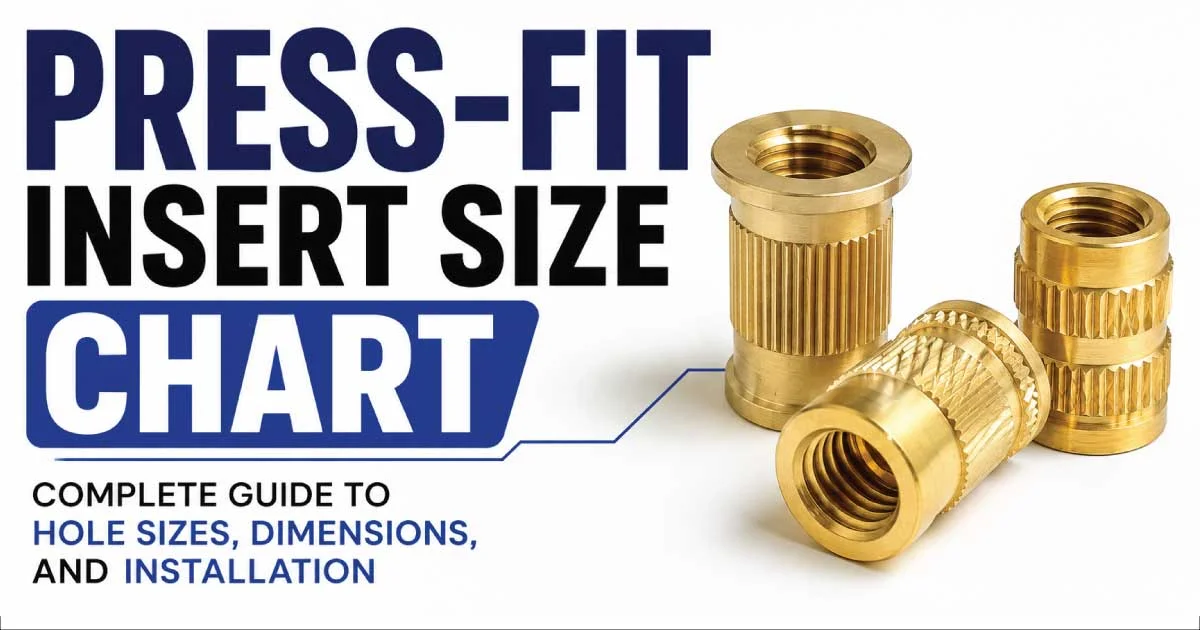
A press-fit insert size chart is a technical reference table that helps engineers, machinists, manufacturers, and designers select the correct hole diameter for threaded inserts. The chart ensures the insert fits securely without adhesives or additional fasteners, providing excellent holding strength, durability, and consistent assembly performance across different materials.
Why a Press-Fit Insert Sizes Matters
Selecting the wrong hole size can lead to loose inserts, cracked components, or poor thread engagement. A press-fit insert size chart eliminates guesswork by providing standardized dimensions that improve assembly accuracy, reduce manufacturing errors, and increase product reliability while minimizing costly rework and production downtime.
Key Benefits of Using a Press-Fit Insert Size Chart
- Ensures accurate insert installation
- Improves product durability
- Reduces manufacturing defects
- Prevents material damage
- Saves installation time
- Minimizes production costs
- Supports quality control
- Enhances thread strength
What Is a Press-Fit Insert?
A press-fit insert is a threaded metal insert designed to be pressed into a precisely sized hole without requiring heat, adhesives, or external threads. Once installed, the insert creates a strong, reusable internal thread capable of withstanding repeated assembly and disassembly in plastic, wood, or soft metal components.
How Press-Fit Inserts Work
Press-fit inserts rely on interference fit principles. Their outer surface contains knurls, grooves, or ridges that grip the surrounding material when pressed into a correctly sized hole. This mechanical locking action prevents rotation and pull-out while distributing loads evenly throughout the base material for maximum strength.
Press-Fit Insert Size Chart Example
The following example illustrates how a typical press-fit insert size chart may present dimensional information. Actual values vary by manufacturer, insert style, and material specifications, so always verify the latest technical documentation before machining production components.
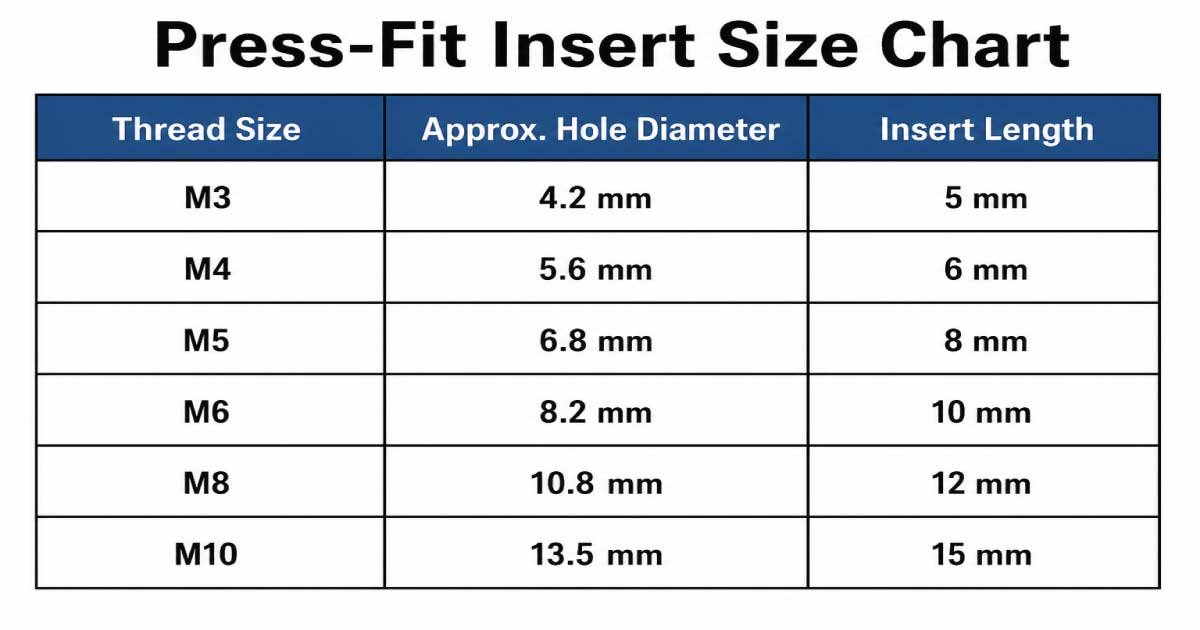
| Thread Size | Approx. Hole Diameter | Insert Length |
|---|---|---|
| M3 | 4.2 mm | 5 mm |
| M4 | 5.6 mm | 6 mm |
| M5 | 6.8 mm | 8 mm |
| M6 | 8.2 mm | 10 mm |
| M8 | 10.8 mm | 12 mm |
| M10 | 13.5 mm | 15 mm |
Press-Fit Insert Size Chart PDF
The Press-Fit Insert Size Chart helps you choose the correct insert based on thread size, hole diameter, and insert length. Using the proper dimensions ensures a secure fit, reliable performance, and long-lasting durability in metal, plastic, and composite materials. Refer to this chart for quick and accurate installation guidance.
📏 Expert Size Chart Resources 👉
Components Found in a Press-Fit Insert Size Chart
A standard press-fit insert size chart typically includes several important measurements that installers must understand before selecting an insert for production or repair work.
- Thread size
- Insert length
- Outside diameter
- Recommended hole diameter
- Installation depth
- Material compatibility
- Tolerance range
- Pull-out strength
Understanding Hole Diameter
Hole diameter is one of the most critical dimensions listed in a press-fit insert size chart. Even a slight variation can significantly affect insertion force and retention strength. Manufacturers specify recommended hole sizes based on extensive testing to ensure optimal interference fit without damaging the surrounding material.
Importance of Insert Outside Diameter
The outside diameter determines how tightly the insert fits inside the prepared hole. Larger outside diameters generally provide greater holding strength but require more installation force. Choosing the correct outside diameter according to the press-fit insert size chart ensures long-lasting performance without excessive stress on the host material.
Thread Size Explained
Thread size identifies the internal thread that will receive bolts, screws, or studs. Common thread standards include metric and imperial sizes. Matching the correct thread size with the intended fastener is essential for maintaining compatibility, preventing thread damage, and ensuring safe mechanical performance in assembled products.
Role of Insert Length
Insert length influences load distribution and thread engagement. Longer inserts typically provide better pull-out resistance and stronger fastening performance, while shorter inserts are suitable for limited material thickness. A press-fit insert size chart helps determine the proper insert length based on application requirements and available installation depth.
Material Compatibility in Press-Fit Applications
Different materials require different hole dimensions because each material responds differently during installation. Plastics, aluminum, brass, hardwood, composites, and engineered polymers all exhibit unique deformation characteristics. Press-fit insert size charts often include separate recommendations for various materials to maximize retention and prevent cracking or deformation.
Common Materials Used for Press-Fit Inserts
Manufacturers produce press-fit inserts using several metals depending on strength requirements, corrosion resistance, and environmental conditions.
- Brass
- Stainless steel
- Carbon steel
- Aluminum
- Bronze
- Zinc-plated steel
Standard Thread Sizes Available
Press-fit inserts are available in numerous thread sizes suitable for industrial, commercial, and consumer applications. Understanding these standard sizes simplifies component selection and ensures compatibility with existing hardware.
- M2
- M2.5
- M3
- M4
- M5
- M6
- M8
- M10
- #4-40
- #6-32
- #8-32
- 1/4-20
Metric vs Imperial Press-Fit Insert Charts
Most manufacturers provide separate charts for metric and imperial systems. Metric charts use millimeters for thread sizes and hole diameters, while imperial charts rely on inches. Using the correct measurement system prevents installation errors and ensures accurate machining for global manufacturing standards.
Factors That Affect Hole Size Selection
Several variables influence the recommended hole diameter beyond the insert dimensions alone. Understanding these factors improves installation consistency and overall fastening reliability in production environments.
- Base material hardness
- Manufacturing tolerance
- Operating temperature
- Surface finish
- Installation method
- Insert material
- Wall thickness
- Expected load conditions
Press-Fit Inserts for Plastic Components
Plastic components are among the most common applications for press-fit inserts because plastics often lack sufficient thread strength. Properly installed inserts reinforce threaded connections, allowing repeated assembly without stripping the surrounding material. The size chart provides optimized dimensions specifically designed for various plastic grades and engineering polymers.
Using Press-Fit Inserts in Metal Parts
Soft metals such as aluminum and magnesium frequently benefit from press-fit inserts. These inserts create stronger, wear-resistant threads that withstand repeated fastening cycles. Selecting dimensions from the appropriate press-fit insert size chart ensures sufficient interference while avoiding excessive installation force that could deform thin-walled components.
Applications Across Different Industries
Press-fit inserts are widely used because they provide durable threaded connections in lightweight materials across many industries. Their versatility makes them essential components in modern manufacturing and precision engineering.
- Automotive manufacturing
- Aerospace engineering
- Consumer electronics
- Medical equipment
- Industrial machinery
- Furniture production
- Electrical enclosures
- Robotics
- Telecommunications
- Renewable energy systems
Common Installation Methods
Although press-fit inserts are straightforward to install, using the proper installation technique ensures maximum retention and prevents damage. Manufacturers recommend controlled pressing rather than hammering to achieve uniform seating and reliable mechanical performance.
Also Read:

Engineer Hassan is a Mechanical Engineer with 16+ years of hands-on experience in mechanical hardware, fasteners, and workshop tools. He focuses on size selection, thread identification, and measurement, helping users choose the correct components with accuracy and safety.