
Ball valves are quarter-turn valves that use a hollow, perforated ball to control the flow of liquids and gases. When the valve handle is turned 90 degrees, the hole in the ball aligns with the pipeline to allow flow or rotates perpendicular to stop it.
Ball valves are widely used in plumbing, water treatment, oil and gas, HVAC systems, chemical processing, irrigation, and industrial applications because they provide reliable shut-off, low pressure loss, and long service life.
Choosing the correct ball valve size is essential for maintaining proper flow rates, minimizing pressure drop, and ensuring efficient system performance. This guide provides a standard ball valve size chart, explains how to measure ball valves, discusses common materials and types, and offers practical tips for selecting the right size.
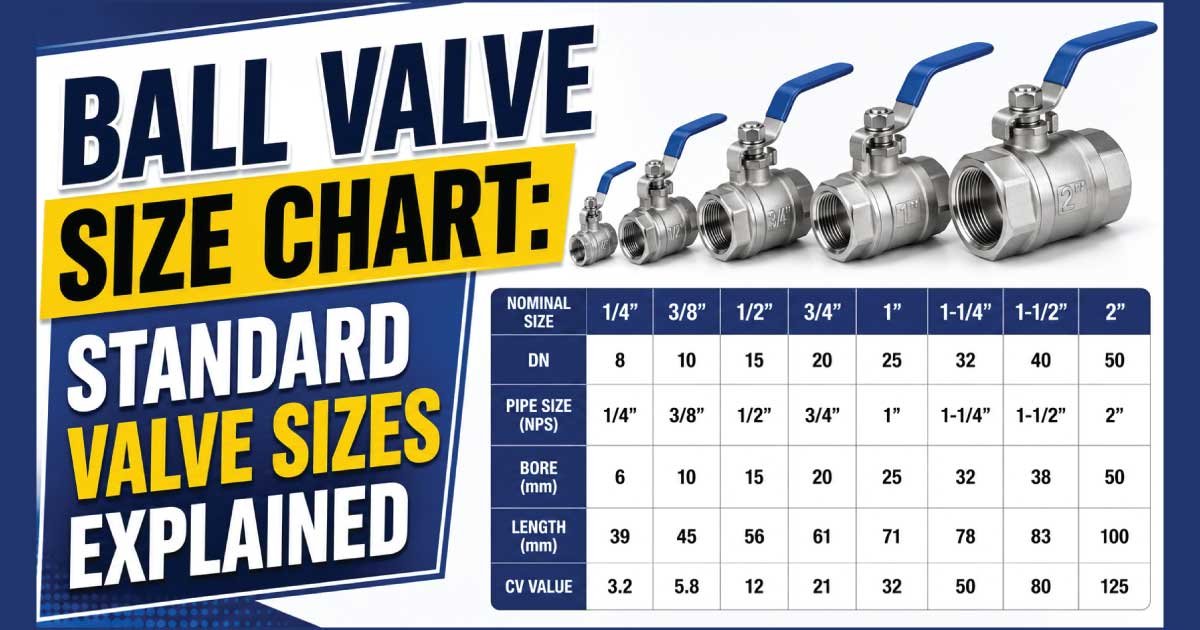
Standard Ball Valve Size Chart
The following chart lists common ball valve sizes and their typical dimensions.
| Nominal Valve Size | DN Size | Pipe Size (NPS) | Approx. Bore Diameter | Common Applications |
|---|---|---|---|---|
| 1/4″ | DN8 | 1/4″ | 8 mm | Air lines, laboratory equipment |
| 3/8″ | DN10 | 3/8″ | 10 mm | Water supply, compressed air |
| 1/2″ | DN15 | 1/2″ | 15 mm | Residential plumbing |
| 3/4″ | DN20 | 3/4″ | 20 mm | Irrigation systems |
| 1″ | DN25 | 1″ | 25 mm | Commercial water lines |
| 1-1/4″ | DN32 | 1-1/4″ | 32 mm | HVAC systems |
| 1-1/2″ | DN40 | 1-1/2″ | 40 mm | Industrial piping |
| 2″ | DN50 | 2″ | 50 mm | Process pipelines |
| 3″ | DN80 | 3″ | 80 mm | Water treatment plants |
| 4″ | DN100 | 4″ | 100 mm | Large industrial systems |
Metric Ball Valve Size Chart
| DN Size | Pipe Outside Diameter | Approx. Bore Diameter | Typical Applications |
|---|---|---|---|
| DN15 | 21.3 mm | 15 mm | Household plumbing |
| DN20 | 26.9 mm | 20 mm | Garden irrigation |
| DN25 | 33.7 mm | 25 mm | Water distribution |
| DN32 | 42.4 mm | 32 mm | Heating systems |
| DN40 | 48.3 mm | 40 mm | Industrial piping |
| DN50 | 60.3 mm | 50 mm | Process plants |
| DN65 | 76.1 mm | 65 mm | Chemical processing |
| DN80 | 88.9 mm | 80 mm | Municipal water systems |
| DN100 | 114.3 mm | 100 mm | High-capacity pipelines |
Why Ball Valve Size Matters
Selecting the correct ball valve size ensures efficient fluid flow and dependable shut-off performance. A valve that is too small can restrict flow and increase pressure loss, while an oversized valve may increase installation costs and reduce flow control accuracy.
Benefits of choosing the correct ball valve size include:
- Improved flow efficiency
- Reduced pressure drop
- Reliable shut-off performance
- Longer valve lifespan
- Lower maintenance costs
- Better energy efficiency
- Increased system reliability
How to Measure a Ball Valve
Accurate measurements help ensure the correct replacement or installation.
Follow these steps:
- Measure the pipe’s nominal size (NPS or DN).
- Measure the pipe outside diameter.
- Identify the valve connection type.
- Measure the valve body length.
- Determine the bore diameter.
- Check the thread or flange specifications.
- Verify the pressure rating.
Use a digital caliper and refer to the pipe specification for accurate sizing.
Also Read: Stud Bolt Size Chart: Complete Beginner’s Guide 2026
Common Types of Ball Valves
Different ball valve designs are available for various applications.
Full Port Ball Valve
A full port valve has a bore equal to the pipe diameter, allowing maximum flow with minimal pressure loss.
Reduced Port Ball Valve
The bore is smaller than the pipe diameter, making it more compact and economical while slightly reducing flow.
Three-Way Ball Valve
Used to divert or mix fluid between multiple pipelines.
Floating Ball Valve
The ball is supported by valve seats and is commonly used in low- and medium-pressure systems.
Trunnion Ball Valve
The ball is mechanically supported, making it suitable for large-diameter and high-pressure applications.
Common Materials Used for Ball Valves
Material selection depends on the operating environment and fluid.
Brass: Ideal for residential plumbing, water supply, and low-pressure systems.
Stainless Steel: Provides excellent corrosion resistance for chemical, marine, and food-processing applications.
Carbon Steel: Offers high strength for industrial and oil and gas systems.
PVC: Lightweight and corrosion-resistant, making it suitable for irrigation and water treatment.
Cast Iron: Commonly used in large water distribution and industrial piping systems.
Also Read: Punch Size Chart: Complete Guide 2026 + PDF
How to Choose the Right Ball Valve Size
Consider these factors before selecting a ball valve:
- Match the valve size to the pipe size.
- Calculate the required flow rate.
- Consider operating pressure.
- Verify the operating temperature.
- Choose the correct connection type.
- Select a material compatible with the fluid.
- Decide between full port and reduced port designs.
Proper valve sizing improves efficiency and reduces operating costs.
Common Applications of Ball Valves
Ball valves are widely used across many industries.
Typical applications include:
- Residential plumbing
- Water treatment plants
- HVAC systems
- Oil and gas pipelines
- Chemical processing
- Food and beverage manufacturing
- Irrigation systems
- Marine installations
- Fire protection systems
- Industrial process piping
Also Read: Gear Size Chart: Complete Guide 2026 with PDF
Installation Tips
Proper installation helps maximize valve performance.
- Verify the valve size before installation.
- Clean the pipeline thoroughly.
- Install the valve in the correct flow direction if specified.
- Use compatible thread sealant or gaskets.
- Avoid overtightening threaded connections.
- Ensure the handle has enough clearance to operate.
- Test the system for leaks after installation.
Correct installation extends the valve’s service life and improves sealing performance.
Common Mistakes to Avoid
Avoid these common ball valve installation errors:
- Installing the wrong valve size
- Using incompatible valve materials
- Ignoring pressure and temperature ratings
- Overtightening threaded fittings
- Failing to clean the pipeline
- Installing a damaged valve
- Neglecting routine inspections
These mistakes can reduce valve efficiency and increase the risk of leakage or premature failure.
Benefits of Properly Sized Ball Valves
Using the correct ball valve size provides several advantages.
- Reliable flow control
- Fast quarter-turn operation
- Minimal pressure loss
- Excellent sealing performance
- Reduced maintenance requirements
- Long service life
- Improved system efficiency
Proper valve sizing enhances both safety and operational performance.
Maintenance Tips
Routine maintenance helps maximize the lifespan of ball valves.
- Inspect the valve regularly for leaks.
- Operate the valve periodically to prevent sticking.
- Check seals and seats for wear.
- Clean the valve exterior.
- Replace worn seals when necessary.
- Inspect threaded or flanged connections.
- Include valves in scheduled system maintenance.
Regular maintenance helps prevent unexpected failures and keeps the valve operating smoothly.
Conclusion
Choosing the correct ball valve size is essential for achieving efficient flow control, reliable shut-off, and long-term system performance.
By accurately measuring the pipe size, selecting the appropriate valve type and material, and following proper installation practices, you can ensure dependable operation in residential, commercial, and industrial applications.
Whether used in plumbing, HVAC, irrigation, or process piping, the right ball valve size improves efficiency, minimizes pressure loss, and extends the life of your piping system. Always consult a ball valve size chart and manufacturer specifications before selecting a valve.

Engineer Hassan is a Mechanical Engineer with 16+ years of hands-on experience in mechanical hardware, fasteners, and workshop tools. He focuses on size selection, thread identification, and measurement, helping users choose the correct components with accuracy and safety.