
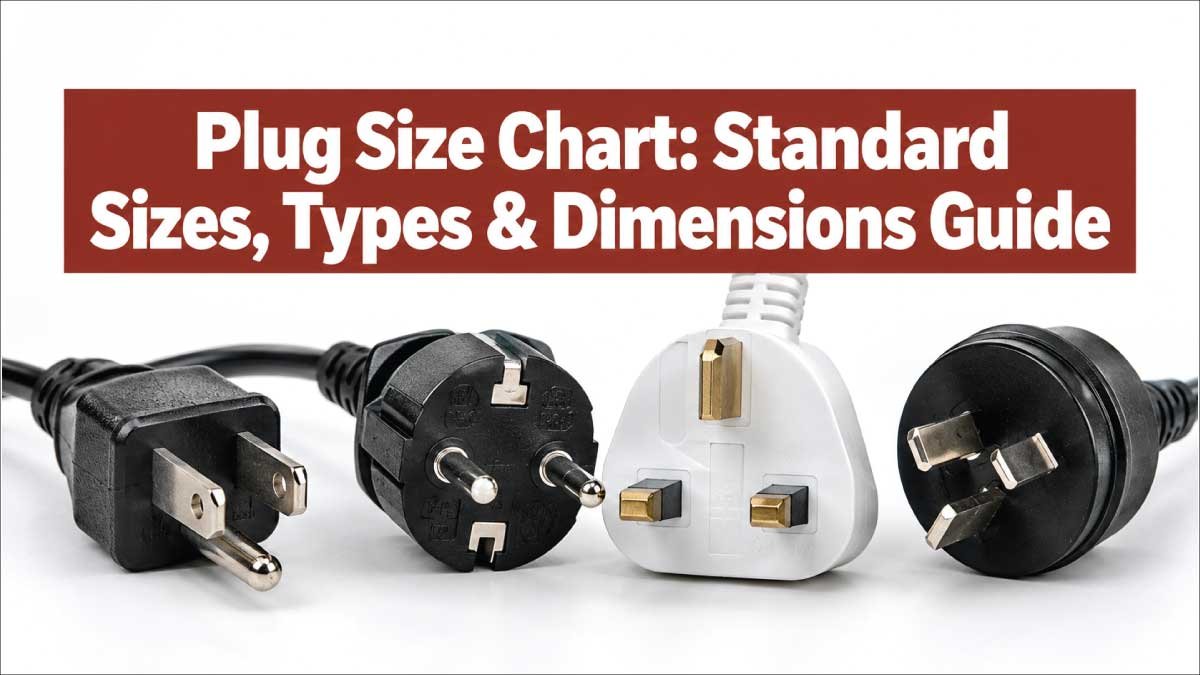
Choosing the correct electrical plug is more than matching the shape of the pins. Plug dimensions, pin arrangement, grounding, voltage, current rating, and regional standards all affect whether a plug is suitable for a device or electrical system.
A plug size chart helps compare common plug types and understand their physical characteristics. However, there is no single universal plug size. Different countries use different plug standards, and even plugs with similar-looking pins can have different electrical ratings or dimensions.
This guide explains common plug types, pin configurations, general dimensions, applications, grounding arrangements, and practical ways to identify and measure a plug. It also explains how to select a compatible plug without relying on appearance alone.
What Is a Plug Size?
An electrical plug is the connector attached to a power cord that inserts into a compatible socket or receptacle. Its physical size is determined by several features rather than one measurement.
When people search for plug dimensions or plug sizes, they may be referring to:
- Pin diameter
- Pin length
- Distance between pins
- Pin shape
- Plug body dimensions
- Grounding-pin arrangement
- Overall plug configuration
- Current rating
- Voltage rating
- Regional plug type
For example, a two-pin plug and a three-pin grounded plug may have similar overall dimensions but use completely different pin arrangements.
The most important point is that plug compatibility depends on the complete plug configuration, not simply on whether the plug appears to fit a socket.
Common Electrical Plug Types
Electrical plugs are commonly identified by lettered plug types. These designations describe physical configurations used in different regions.
The following chart provides a practical overview of widely encountered plug types.
| Plug Type | Typical Pin Configuration | Grounding | Common Regions |
|---|---|---|---|
| Type A | Two flat parallel pins | No separate ground | United States, Canada, Japan and others |
| Type B | Two flat pins + grounding pin | Yes | United States, Canada and others |
| Type C | Two round pins | No | Europe and many other regions |
| Type D | Three round pins | Yes | India and some other regions |
| Type E | Two round pins + socket grounding | Yes | France, Belgium and others |
| Type F | Two round pins + side grounding contacts | Yes | Germany and much of Europe |
| Type G | Three rectangular pins | Yes | United Kingdom and several other regions |
| Type I | Two angled flat pins + optional ground | Varies | Australia, New Zealand, China and others |
These are broad classifications. Exact construction, dimensions, ratings, and approved applications can vary by country and standard.
Type A Plug Size and Dimensions
Type A plugs use two flat parallel pins. They are commonly associated with electrical systems in North America and Japan.
The two pins provide line and neutral connections, while the plug itself does not have a separate grounding pin.
A Type A plug is generally compact and is commonly found on:
- Small electronic devices
- Chargers
- Lamps
- Radios
- Low-power appliances
- Small household equipment
The exact pin dimensions and spacing can vary depending on the applicable regional standard and whether the plug is intended for a particular voltage system.
Because Type A plugs do not provide a dedicated grounding connection, they should not automatically be substituted for a grounded plug when grounding is required.
Type B Plug Size and Dimensions
Type B plugs are similar to Type A plugs but add a third grounding pin.
The configuration consists of:
- Two flat current-carrying pins
- One grounding pin
- A molded or insulated plug body
The grounding pin is normally longer than the current-carrying pins so that grounding can be established before the power contacts engage when the plug is inserted.
Type B plugs are commonly used for grounded household and commercial equipment.
Typical applications include:
- Computers
- Kitchen appliances
- Power tools
- Office equipment
- Household appliances
- Electronic equipment with grounded enclosures
The grounding pin is an important safety feature and should not be removed simply to make a plug fit a different receptacle.
Type C Plug Size and Dimensions
Type C is one of the most widely recognized two-pin plug configurations. It generally uses two round pins and does not have a separate grounding pin.
Type C plugs are common across many European and international markets.
Their compact design makes them suitable for many low- and moderate-power appliances, including:
- Phone chargers
- Small electronics
- Lamps
- Audio equipment
- Small household appliances
A Type C plug can physically resemble other round-pin plugs, but similar appearance does not necessarily mean electrical compatibility.
When identifying a Type C plug, check the pin diameter, pin spacing, plug shape, and the receptacle configuration rather than relying only on the number of pins.
Type D Plug Size and Dimensions
Type D plugs use three round pins arranged in a triangular configuration.
The system includes:
- Two power pins
- One grounding pin
- A relatively substantial plug body
Type D is particularly associated with India and some other regions.
It is important to distinguish Type D from other three-pin systems because the pin arrangement and dimensions are different.
If replacing a Type D plug, match the replacement to the intended socket and electrical system rather than selecting another three-pin plug simply because it has the same number of contacts.
Type E and Type F Plug Dimensions
Type E and Type F plugs are common European configurations.
Type E
Type E uses two round pins and incorporates grounding through a grounding contact arrangement associated with the socket.
Type F
Type F, often called a Schuko-style plug, uses two round power pins with grounding contacts on the sides.
These plugs are designed for grounded electrical equipment and are commonly found on:
- Washing machines
- Refrigerators
- Kitchen appliances
- Power tools
- Computers
- Household equipment
Although Type E and Type F plugs can be compatible with certain hybrid receptacle systems, they should not be treated as identical in every application.
Type G Plug Size and Dimensions
Type G plugs use three rectangular pins arranged in a triangular pattern.
The configuration includes:
- Live pin
- Neutral pin
- Ground pin
Type G plugs are widely associated with the United Kingdom and are also used in several other countries.
They are generally larger than many two-pin European plugs because the design includes a substantial grounded configuration and safety features.
Type G plugs are commonly used for:
- Household appliances
- Computers
- Televisions
- Kitchen equipment
- Power tools
- Commercial equipment
Some Type G systems also incorporate a fuse within the plug, making the plug design different from many continental European configurations.
Type I Plug Size and Dimensions
Type I plugs commonly use two angled flat pins. Some versions also include a grounding pin.
They are associated with electrical systems in countries such as Australia and New Zealand, as well as other regions using related configurations.
The angled-pin arrangement makes Type I visually distinctive.
Common applications include:
- Household appliances
- Electronics
- Office equipment
- Lighting equipment
- Portable appliances
As with other plug types, exact dimensions and ratings should be matched to the applicable regional requirements.
Plug Size Chart by Pin Configuration
The following simplified chart can help identify a plug based on its physical arrangement.
| Configuration | Typical Plug Types | Pin Shape | Grounding Arrangement |
|---|---|---|---|
| 2-pin flat | Type A | Flat | None |
| 3-pin flat | Type B | Flat | Dedicated ground |
| 2-pin round | Type C | Round | None |
| 3-pin round | Type D | Round | Dedicated ground |
| 2-pin round + grounding | Type E/F | Round | Socket or side contacts |
| 3-pin rectangular | Type G | Rectangular | Dedicated ground |
| 2 angled flat pins | Type I | Flat | Varies |
This chart is useful for initial identification, but physical appearance alone is not enough to establish electrical compatibility.
Plug Dimensions That Matter
A plug does not have one universal dimension. Several measurements may be important when identifying or replacing one.
Pin Diameter
Round-pin plugs are commonly identified partly by pin diameter. A small difference in diameter can determine whether the plug properly matches its intended receptacle.
Measure the metal pin itself rather than the plastic insulation surrounding it.
Pin Length
Pin length affects how deeply the plug contacts the receptacle.
Some designs also intentionally use different pin lengths for safety functions, such as grounding or shutter operation.
Pin Spacing
Pin-to-pin spacing is another important dimension.
Measure from the appropriate reference points specified for the plug design. For round pins, this is often related to the center-to-center distance.
Pin Shape
Pins may be:
- Round
- Flat
- Rectangular
- Angled
- Partially insulated
Pin shape is often one of the quickest ways to distinguish plug families.
Plug Body Size
The plastic or rubber body surrounding the pins can vary considerably.
A larger plug body may provide additional strain relief, grounding arrangements, fusing, or mechanical protection.
Also Read:
Plug Size Chart: Important Dimensions to Check
| Dimension | What to Measure | Why It Matters |
|---|---|---|
| Pin diameter | Width of round pin | Helps identify compatible receptacle |
| Pin width | Width of flat pin | Identifies flat-pin configuration |
| Pin thickness | Thickness of flat pin | Affects physical compatibility |
| Pin length | Exposed or specified pin length | Affects insertion depth |
| Pin spacing | Distance between pin centers | Helps identify plug type |
| Ground pin | Shape, size and location | Determines grounding configuration |
| Body dimensions | Overall plug housing | Important for clearance and installation |
| Cord entry | Cable-entry size and style | Helps match cable and strain relief |
Exact dimensional requirements should always be verified against the applicable plug and socket specification.
How to Measure a Plug
Measuring an unknown plug can help identify its type before purchasing a replacement.
Step 1: Disconnect the Plug
Remove the plug from the electrical outlet before measuring it.
Never measure exposed electrical contacts while the plug is energized.
Step 2: Count the Pins
Determine whether the plug has:
- Two pins
- Three pins
- More specialized contacts
Then note whether the pins are flat, round, rectangular, or angled.
Step 3: Measure Pin Dimensions
For round pins, measure the diameter with a suitable measuring tool.
For flat pins, record:
- Width
- Thickness
- Length
A digital caliper can provide more precise measurements than a ruler.
Step 4: Measure Pin Spacing
Measure the distance between corresponding pin centers where appropriate.
This measurement is particularly useful when distinguishing similar round-pin plugs.
Step 5: Inspect Grounding Features
Look for:
- A third pin
- Side grounding contacts
- Grounding holes
- Metal grounding clips
- Other standardized grounding features
Step 6: Check the Plug Markings
Many plugs include electrical information on the body.
Look for markings showing:
- Voltage
- Current
- Certification information
- Manufacturer information
- Plug or model designation
These markings can provide more useful information than physical dimensions alone.
Also Read:
How to Choose the Correct Plug Size
Selecting a replacement plug requires more than matching the physical shape.
Check the Electrical Rating
The replacement plug must be appropriate for the voltage and current of the application.
A plug with an unsuitable rating may overheat or create a hazardous condition.
Match the Plug Type
Identify the regional or standardized plug configuration before purchasing a replacement.
For example, a three-pin plug does not automatically mean that any three-pin receptacle will accept it.
Consider Grounding
If the original equipment uses grounding, the replacement should preserve the intended grounding arrangement.
Do not remove a grounding connection simply because a two-pin plug is easier to install.
Match the Cable
The plug should be suitable for the cable type, conductor size, insulation, and intended application.
The cable entry and strain relief should securely hold the cord without damaging its insulation.
Consider the Application
A plug used with a small electronic device may have very different requirements from one used with a high-power appliance.
Consider:
- Load current
- Voltage
- Indoor or outdoor use
- Moisture exposure
- Mechanical stress
- Frequency of connection and disconnection
Also Read:
Plug Types vs. Plug Sizes
The terms plug type and plug size are sometimes used interchangeably, but they describe different things.
Plug type generally identifies the standardized physical configuration.
Plug size can refer to the physical dimensions of the plug or pins.
For example, two plugs may both have three pins but belong to different plug types because their pin shapes, spacing, grounding arrangements, or body configurations differ.
This distinction is important when searching for a replacement.
Instead of searching only for a “3-pin plug,” identify the complete configuration.
Plug vs. Socket vs. Receptacle
These terms are related but should not be confused.
A plug is normally attached to a flexible cord and contains contacts designed to enter a socket or receptacle.
A socket or receptacle is the receiving component into which the plug is inserted.
A connector is a broader term that can describe many types of electrical connection systems.
Understanding the difference helps when searching for compatible components. A plug and receptacle are designed as a mating pair, and their mechanical and electrical characteristics must correspond.
Why Plug Dimensions Vary by Country
Electrical plug systems developed under different national and regional standards.
As a result, countries can differ in:
- Voltage
- Frequency
- Pin shape
- Pin spacing
- Grounding method
- Plug dimensions
- Fuse requirements
- Socket design
- Safety features
This is why an appliance purchased in one country may require a suitable plug adapter, replacement plug, or compatible power supply when used elsewhere.
A simple physical adapter can change the mechanical connection, but it does not necessarily change the appliance’s voltage or frequency requirements.
Plug Adapter vs. Plug Converter
A plug adapter changes the physical plug configuration so that a device can connect to a different socket.
A voltage converter or transformer performs a different function: it changes electrical voltage.
These should not be confused.
If a device is not designed for the available supply voltage, changing the plug shape alone does not make it electrically compatible.
Before using an imported appliance, check its:
- Input voltage
- Frequency
- Current requirement
- Plug configuration
- Grounding requirements
Many modern power supplies are designed for multiple input voltages, but this must be confirmed from the equipment marking rather than assumed.
Common Plug Sizing Mistakes
Incorrect plug selection often results from focusing only on physical appearance.
Avoid these common mistakes:
Choosing by pin count alone: Two three-pin plugs may use completely different configurations.
Ignoring voltage: A physically compatible plug does not change the supply voltage.
Ignoring current rating: The plug must be suitable for the expected load.
Removing the ground pin: This can eliminate an important safety connection.
Assuming all round pins are interchangeable: Pin diameter and spacing can differ.
Ignoring cable size: The plug must be compatible with the attached cord.
Using damaged plugs: Cracked housings, loose pins, and damaged insulation should not be ignored.
Forcing a plug into a socket: A plug should fit its intended receptacle without excessive force.
Plug Size Selection Guide
For quick selection, use the following process.
| Step | What to Check | Purpose |
|---|---|---|
| 1 | Country or region | Identifies likely plug family |
| 2 | Number of pins | Narrows configuration |
| 3 | Pin shape | Distinguishes plug types |
| 4 | Pin dimensions | Confirms physical configuration |
| 5 | Grounding method | Confirms safety arrangement |
| 6 | Voltage rating | Confirms electrical suitability |
| 7 | Current rating | Confirms load capability |
| 8 | Cable compatibility | Ensures proper installation |
| 9 | Equipment requirements | Confirms complete compatibility |
This approach is more reliable than choosing a plug based solely on photographs.
Where Different Plug Types Are Used
Plug configurations are strongly associated with particular regions, although some countries use multiple systems.
| Plug Type | General Regional Association | Typical Uses |
|---|---|---|
| Type A | North America, Japan and others | Electronics, lamps, small appliances |
| Type B | North America and others | Grounded appliances and equipment |
| Type C | Europe and many international markets | Chargers, electronics, household devices |
| Type D | India and some regions | Household and commercial equipment |
| Type E | France, Belgium and others | Grounded household equipment |
| Type F | Germany and much of Europe | Appliances and general equipment |
| Type G | United Kingdom and others | Appliances, electronics, tools |
| Type I | Australia, New Zealand, China and others | Household and commercial equipment |
Regional association is only an identification aid. Always verify the specific electrical requirements of the installation.
Frequently Asked Questions About Plug Sizes
Are all 3-pin plugs the same size?
No. Three-pin plugs can have different pin shapes, spacing, dimensions, grounding arrangements, and electrical ratings. The number of pins alone does not identify a plug.
How do I know what size plug I need?
Identify the plug type, pin configuration, grounding method, voltage rating, current rating, and cable requirements. If replacing an existing plug, matching the original specification is usually the appropriate starting point.
Can I use a different plug if it fits the socket?
Physical fit alone does not establish safe compatibility. The plug must also be appropriate for the electrical rating, grounding arrangement, equipment, and applicable requirements.
What is the most common plug type?
There is no single plug type that is universal worldwide. Type A, Type C, Type G, Type I, and several other configurations are widely used in different regions.
What is the difference between a plug and an adapter?
A plug is the component that connects an appliance or cord to a receptacle. An adapter changes the physical connection between different plug and socket configurations.
Can I measure a plug with a ruler?
A ruler can provide basic measurements, but a caliper is generally more useful for measuring pin diameter, width, thickness, and spacing accurately.
Does a plug adapter change voltage?
Normally, no. A plug adapter changes the physical connection. It does not automatically convert electrical voltage or frequency.
Why does my plug have a third pin?
The third pin is commonly associated with grounding. It provides a path intended to help protect users and equipment under certain fault conditions.
Should I remove a grounding pin if the plug does not fit?
No. Removing a grounding feature can defeat the safety design of the electrical system. A properly compatible plug or approved connection method should be used instead.
Tips for Buying a Replacement Plug
Before purchasing a replacement, record the important information from the original plug and equipment.
Check:
- Plug type
- Number of pins
- Pin shape
- Pin dimensions
- Grounding configuration
- Voltage rating
- Current rating
- Cable size
- Equipment application
- Regional requirements
For permanently installed or high-power equipment, the replacement component should meet the requirements applicable to that installation. When exact specifications are critical, use the equipment manufacturer’s information and the relevant electrical standard rather than relying on a generic plug-size chart.
Final Takeaway
A plug size chart is useful for identifying common electrical plug configurations, comparing pin arrangements, and understanding the dimensions that matter when selecting a replacement. However, plug compatibility depends on more than physical size.
Always consider the plug type, pin shape, pin spacing, grounding arrangement, voltage, current rating, cable compatibility, and regional electrical requirements. Measuring an unknown plug can help identify it, but exact specifications should be confirmed before installation.
The safest approach is to match the replacement plug to the original equipment requirements and the intended receptacle rather than choosing solely by appearance or pin count.

Engineer Hassan is a Mechanical Engineer with 16+ years of hands-on experience in mechanical hardware, fasteners, and workshop tools. He focuses on size selection, thread identification, and measurement, helping users choose the correct components with accuracy and safety.