
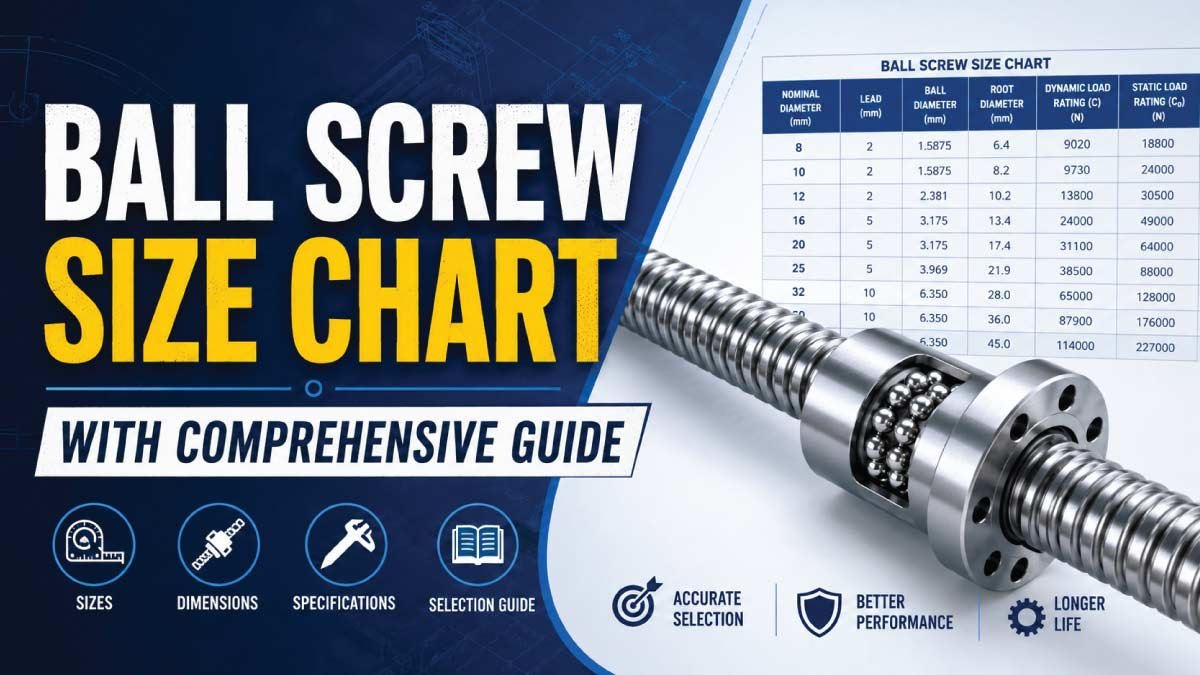
Ball screws are precision mechanical components used to convert rotary motion into linear motion with high efficiency and accuracy. They are widely used in CNC machines, robotics, automation systems, industrial machinery, aerospace equipment, and precision engineering applications.
Understanding a ball screw size chart helps engineers, machinists, and machine designers choose the correct ball screw for load capacity, speed, precision, and durability.
This detailed guide explains ball screw sizes, dimensions, lead, pitch, load ratings, types, materials, and applications in simple language.
What Is a Ball Screw?
A ball screw is a highly efficient mechanical component used to convert rotational motion into precise linear motion. It works using recirculating ball bearings that move between the screw shaft and nut, greatly reducing friction. This design allows smoother, more accurate, and more reliable movement compared to conventional systems used in machinery.
Unlike traditional lead screws, ball screws use rolling friction instead of sliding friction.
1. Main Advantages of Ball Screws
Ball screws are widely preferred in precision machinery because they offer excellent performance in motion control systems. Their design minimizes energy loss while improving accuracy and durability, making them suitable for CNC machines, automation systems, and industrial equipment where smooth and controlled linear movement is essential.
- High efficiency
- Precise positioning
- Low friction
- High load capacity
- Long service life
- Smooth operation
Main Parts of a Ball Screw and Their Functions
A ball screw is a precision mechanical device used to convert rotary motion into smooth linear motion with very high efficiency. It is commonly used in CNC machines, robotics, and automation systems where accuracy and smooth movement are essential. The system is made up of several important components that work together to reduce friction and improve performance.
1. Screw Shaft
The screw shaft is the main rotating element of the ball screw assembly. It is a long, hardened steel rod with precise helical grooves cut along its surface. These grooves guide the movement of the balls and ball nut. When the shaft rotates, it produces controlled linear motion, making it essential for accurate positioning in machines.
2. Ball Nut
The ball nut is a key moving component that travels along the screw shaft. It contains internal raceways and circulating steel balls that match the screw threads. As the shaft rotates, the ball nut moves linearly with minimal resistance. It plays a major role in providing smooth motion, high load capacity, and precise movement control.
3. Ball Bearings
Ball bearings are small, hardened steel spheres placed between the screw shaft and ball nut. Their main purpose is to replace sliding friction with rolling motion, which greatly increases efficiency. They reduce wear, heat generation, and energy loss while allowing the system to handle heavy loads smoothly and maintain high precision.
4. Return System
The return system is responsible for recirculating the balls inside the ball nut. After the balls travel through the load-carrying section, they are guided back to the starting point through internal return channels. This continuous circulation ensures uninterrupted motion, improves efficiency, and allows the ball screw to operate over long distances without performance loss.
5. End Caps
End caps are fitted at both ends of the ball nut to support and guide the ball circulation process. They help direct the balls into the return system and keep them contained within a closed loop. These caps also protect internal components and ensure stable and consistent performance during operation.
6. Threaded Raceways
Threaded raceways are the precision-ground helical grooves present on both the screw shaft and inside the ball nut. These grooves act as tracks for the ball bearings, allowing smooth rolling contact. The accuracy of these raceways directly affects the efficiency, load capacity, and positioning precision of the entire ball screw system.
Ball Screw Size Chart (Metric)
The following chart shows common metric ball screw sizes used in CNC machines, automation systems, and industrial motion control setups. Each size is selected based on load capacity, speed requirements, and precision needs. Smaller diameters are used for light-duty applications, while larger ones handle heavy industrial workloads efficiently.
| Ball Screw Size | Screw Diameter (mm) | Lead (mm) | Dynamic Load Capacity |
|---|---|---|---|
| 1204 | 12 mm | 4 mm | Light-duty |
| 1605 | 16 mm | 5 mm | Medium-duty |
| 1610 | 16 mm | 10 mm | High-speed applications |
| 2005 | 20 mm | 5 mm | CNC machinery |
| 2010 | 20 mm | 10 mm | Automation systems |
| 2505 | 25 mm | 5 mm | Medium-heavy loads |
| 2510 | 25 mm | 10 mm | Industrial equipment |
| 3205 | 32 mm | 5 mm | Heavy machinery |
| 3210 | 32 mm | 10 mm | High-load systems |
| 4005 | 40 mm | 5 mm | Large CNC machines |
| 4010 | 40 mm | 10 mm | Industrial automation |
| 5005 | 50 mm | 5 mm | Heavy-duty equipment |
Ball Screw Bearing Size Chart
Ball screw support bearings are critical components that help maintain alignment, rigidity, and accuracy during operation. They reduce vibration and ensure smooth rotation under load. Proper bearing selection improves system lifespan and performance, especially in high-precision CNC and automation systems where stability is essential.
| Ball Screw Diameter | Recommended Bearing Size |
|---|---|
| 12 mm | BK10 / BF10 |
| 16 mm | BK12 / BF12 |
| 20 mm | BK15 / BF15 |
| 25 mm | BK17 / BF17 |
| 32 mm | BK20 / BF20 |
| 40 mm | BK25 / BF25 |
| 50 mm | BK30 / BF30 |
Understanding Ball Screw Numbers
Ball screw model numbers are used to quickly describe the key specifications of a screw. These numbers usually represent the diameter and the lead of the screw, helping engineers and technicians choose the correct part for their machine. This simple coding system makes selection faster and reduces design mistakes in CNC and automation systems.
Ball screw model numbers usually indicate:
- Diameter
- Lead
Example:
1605
Breakdown
- 16 = Screw diameter (16 mm)
- 05 = Lead (5 mm)
Ball Screw Dimensions Explained
Understanding ball screw dimensions is very important when selecting the right component for a specific application. Each dimension directly affects performance, including speed, accuracy, load capacity, and rigidity. Choosing the correct size ensures smooth operation and longer machine life in CNC machines, robotics, and industrial automation systems.
1. Screw Diameter
The screw diameter is the outer thickness of the threaded shaft of the ball screw. It plays a major role in determining how much load the system can handle and how stable the motion will be during operation. A larger diameter provides better strength and reduces bending under heavy loads.
Larger diameters provide:
- Higher load capacity
- Better rigidity
- Reduced deflection
2. Lead
Lead is the linear distance the nut travels in one full rotation of the screw. It directly affects the speed and torque characteristics of the system. A smaller lead provides higher precision, while a larger lead allows faster movement but reduces mechanical advantage.
Example:
- 5 mm lead = nut moves 5 mm per revolution
Higher lead values provide:
- Faster movement
- Lower mechanical advantage
3. Pitch
Pitch is the distance between two adjacent thread peaks on the screw shaft. It is closely related to lead, but they are not always the same. In multi-start ball screws, lead can be greater than pitch due to multiple thread starts.
In many ball screws:
- Pitch and lead may differ depending on thread starts
4. Nut Length
Nut length refers to the total physical length of the ball nut assembly. It affects load distribution and system stability. A longer nut provides more contact area between balls and grooves, improving strength and reducing wear in heavy-duty applications.
Longer nuts usually:
- Support higher loads
- Improve rigidity
Also Read Our Latest Guide:
Types of Ball Screws
Different ball screw designs are developed to meet specific industrial needs. Each type offers unique performance characteristics such as accuracy, cost efficiency, speed, and load handling. Selecting the right type is important for achieving the best balance between precision, durability, and operational efficiency in CNC machines, automation systems, and other mechanical applications.
1. Ground Ball Screws
Ground ball screws are manufactured through precision grinding processes, which make them highly accurate and suitable for demanding engineering tasks. They are designed to deliver extremely tight tolerances and smooth motion, making them ideal for systems where positioning accuracy is critical.
Features
- Excellent positioning accuracy
- Low backlash
- Smooth operation
Applications
- CNC machines
- Precision automation
- Aerospace systems
2. Rolled Ball Screws
Rolled ball screws are produced using a rolling manufacturing process, which makes them more cost-effective compared to ground types. While slightly less precise, they still provide reliable performance for general-purpose industrial use where extreme accuracy is not required.
Advantages
- Lower cost
- Good performance
- Suitable for general applications
Applications
- Industrial machinery
- Automation equipment
3. Miniature Ball Screws
Miniature ball screws are compact and designed for small-scale, high-precision devices. Their small size allows them to be used in tight spaces while still delivering smooth and accurate linear motion. They are commonly used in delicate and sensitive equipment.
Applications
- Medical devices
- Robotics
- Electronics
4. High-Lead Ball Screws
High-lead ball screws are specifically designed for applications that require fast linear movement. Their larger lead values allow the nut to travel greater distances per rotation, making them ideal for systems where speed is more important than mechanical advantage or force.
Advantages
- Faster travel speed
- Improved productivity
Ball Screw Accuracy Grades
Ball screw accuracy grades define how precisely a ball screw can position a load during operation. These grades are extremely important in CNC machining and automation, where even small positioning errors can affect product quality. Higher grades offer better precision, smoother motion, and tighter tolerances, while lower grades are used for general industrial applications where extreme accuracy is not required.
| Grade | Accuracy Level |
|---|---|
| C0 | Ultra precision |
| C1 | Very high precision |
| C3 | Precision CNC |
| C5 | Standard industrial |
| C7 | General-purpose |
| C10 | Low precision |
Ball Screw Lead Chart
The ball screw lead chart shows how different lead sizes affect speed, precision, and overall performance. Lead determines how far the nut moves in one full revolution of the screw. Smaller leads provide higher accuracy and control, while larger leads increase speed but reduce mechanical advantage. This chart helps in selecting the right balance for specific machine requirements.
| Lead Size | Characteristics |
|---|---|
| 2 mm | High precision, slow speed |
| 5 mm | Balanced performance |
| 10 mm | High-speed movement |
| 20 mm | Very fast travel |
Also Read Our Latest Guide:
Ball Screw Materials and Load Types Explained
Ball screw performance depends heavily on the materials used in its construction and the type of load it is designed to handle. Proper material selection ensures strength, durability, and long service life, while understanding load types helps in choosing the right ball screw for different industrial applications.
1. Ball Screw Materials
Material selection plays a major role in determining the strength, wear resistance, and overall performance of a ball screw. Different materials are used depending on operating conditions, load requirements, and environmental exposure. High-quality materials help improve efficiency and extend service life in demanding mechanical systems.
2. Alloy Steel
Alloy steel is the most commonly used material for ball screws due to its excellent combination of strength and durability. It provides high resistance to wear and deformation under heavy loads. This material is suitable for most industrial applications where reliability, precision, and long operational life are required.
Advantages of Alloy Steel
Alloy steel offers high mechanical strength, allowing it to handle heavy loads without failure. It also provides strong wear resistance, reducing surface damage over time. In addition, it ensures long service life, making it a cost-effective and dependable choice for general-purpose ball screw systems.
3. Stainless Steel
Stainless steel is used in environments where corrosion resistance is important. It performs well in conditions exposed to moisture, chemicals, or cleaning processes. Although slightly lower in strength compared to alloy steel, it offers excellent protection against rust and contamination, making it ideal for sensitive industries.
Applications of Stainless Steel
Stainless steel ball screws are commonly used in medical equipment where hygiene is critical. They are also found in food processing machines to prevent contamination and in marine systems where exposure to water and salt can cause corrosion in standard materials.
4. Hardened Steel
Hardened steel is produced through heat treatment processes to increase its strength and durability. This material is designed to withstand extreme stress and heavy-duty working conditions. It offers improved surface hardness, reducing wear and extending the operational life of the ball screw in demanding environments.
Applications of Hardened Steel
Hardened steel ball screws are widely used in heavy-duty industrial machinery. They are suitable for applications involving high loads, continuous operation, and harsh working conditions, where maximum durability and resistance to wear are essential for reliable performance.
Ball Screw Load Types
Ball screws are designed to handle different types of mechanical loads depending on the application. Understanding these load types is essential for selecting the correct ball screw to ensure safety, efficiency, and long-term performance in machinery.
1. Dynamic Load
Dynamic load refers to the load applied to the ball screw while it is in motion. It represents the working condition where the screw is actively moving and performing tasks. This type of load is important for determining the operational life and efficiency of the system under continuous use.
2. Static Load
Static load is the maximum force a ball screw can withstand without permanent deformation when it is not moving. It defines the safety limit of the system in stationary conditions. Exceeding this load can cause damage to the screw or nut structure.
3. Axial Load
Axial load is the primary load direction in ball screw systems, acting parallel to the screw shaft. Ball screws are specifically designed to handle axial forces efficiently. This ensures smooth linear motion and accurate positioning in machines that require high precision and controlled movement.
Also Read Our Latest Guide:
Ball Screw Efficiency
Ball screws are highly efficient mechanical components because they use recirculating ball bearings that significantly reduce friction between the screw and nut. This rolling contact allows smooth motion with minimal energy loss, making them ideal for precision systems where performance and accuracy are important.
Typical efficiency:
- 85% to 95%
Compared to lead screws:
- Ball screws require less driving torque.
Ball Screw Applications
Ball screws are widely used in many industries because they provide precise, smooth, and efficient linear motion. Their ability to reduce friction and deliver accurate positioning makes them essential in advanced machinery, automation systems, and high-tech equipment where reliability and performance are critical.
1. CNC Machines
Ball screws play a vital role in CNC machines by enabling highly accurate and controlled movement of machine axes. They ensure that cutting tools follow precise paths, which is essential for producing high-quality components with tight tolerances in modern manufacturing environments.
Used for:
- Precise axis movement
- High-speed positioning
- Tool path accuracy
2. Robotics
In robotics, ball screws are commonly used in systems that require smooth and repeatable linear motion. They help robotic systems achieve accurate positioning and controlled movement, making them essential for industrial automation and advanced robotic designs.
Applications include:
- Linear actuators
- Robotic arms
- Automated systems
3. Aerospace Industry
The aerospace industry relies on ball screws for applications that demand extreme precision and reliability. They are used in systems where accuracy and safety are critical, helping control movement in various flight and mechanical assemblies.
Used in:
- Flight control systems
- Precision assemblies
4. Medical Equipment
Ball screws are widely used in medical devices due to their smooth operation and high precision. They ensure accurate movement in sensitive equipment, supporting reliable performance in healthcare and laboratory environments.
Applications include:
- Imaging systems
- Surgical devices
- Laboratory automation
5. Semiconductor Industry
In the semiconductor industry, ball screws are essential for ultra-precise positioning systems. They help maintain stability and accuracy during delicate manufacturing processes, where even the smallest vibration or error can affect product quality.
Ball screws provide:
- High precision
- Smooth motion
- Low vibration
Also Read Our Latest Guide:
How to Choose the Correct Ball Screw Size
Selecting the correct ball screw size is essential for achieving reliable performance, long service life, and accurate motion control. The right choice depends on factors such as load, speed, precision, space limitations, and working conditions. Proper selection ensures smooth operation and prevents premature wear or system failure.
1. Determine Load Requirements
Load capacity is one of the most important factors when choosing a ball screw. If the application involves heavy forces or continuous stress, a stronger and larger screw is required. Smaller systems can use compact designs, but industrial machines need higher strength for stability and durability.
Higher loads require:
- Larger diameters
- Stronger materials
2. Consider Travel Speed
Speed requirements directly affect the lead selection of a ball screw. High-speed systems need screws that can move the nut quickly per rotation, while precision systems prioritize control over speed. Choosing the right lead ensures efficient motion without sacrificing performance or stability.
High-speed applications may need:
- Larger lead values
- High-lead screws
3. Evaluate Accuracy Requirements
Accuracy plays a major role in CNC machines, robotics, and precision instruments. High-precision applications require tightly controlled motion with minimal error, which is achieved through better manufacturing processes and higher accuracy grades.
Precision machines require:
- Ground ball screws
- Higher accuracy grades
4. Check Mounting Space
Available space inside a machine often limits the type and size of ball screw that can be used. Compact systems need smaller components that can fit within tight assemblies while still providing reliable performance and smooth motion.
Compact systems may require:
- Miniature ball screws
- Smaller nut designs
5. Consider Operating Environment
The working environment affects material selection and protection requirements. Harsh conditions such as dust, moisture, or corrosive environments require special designs to prevent damage and ensure long-term performance.
Harsh environments may require:
- Stainless steel
- Protective covers
- Lubrication systems
Ball Screw Lubrication
Proper lubrication is essential for maintaining ball screw performance and extending its service life. It reduces friction, minimizes wear, and improves overall efficiency. Without proper lubrication, the system can lose accuracy and fail prematurely under continuous use.
Lubrication improves:
- Efficiency
- Service life
- Wear resistance
1. Grease Lubrication
Grease lubrication is the most commonly used method in industrial applications. It is easy to apply, cost-effective, and suitable for general-purpose machinery where maintenance intervals are moderate.
Most common for:
- General industrial use
2. Oil Lubrication
Oil lubrication is used in applications that require continuous operation and high-speed performance. It provides better cooling and consistent lubrication, making it ideal for demanding industrial environments where machines run for long periods.
Used in:
- High-speed systems
- Continuous operation
Common Ball Screw Problems
Ball screws are highly reliable components, but like any mechanical system, they can develop issues over time due to improper use, lack of maintenance, or unsuitable operating conditions. Understanding these common problems helps in early detection and prevents costly machine downtime.
1. Backlash
Backlash refers to the unwanted clearance or play between the screw and the nut. This can reduce positioning accuracy and affect machining precision, especially in CNC systems where tight control is required.
Solution
- Use preloaded ball nuts
2. Wear
Wear occurs when the ball screw components degrade over time, leading to reduced efficiency and accuracy. It is often the result of poor maintenance practices or harsh working environments that accelerate damage.
Caused by:
- Poor lubrication
- Contamination
- Overloading
3. Noise and Vibration
Unusual noise or vibration during operation often indicates mechanical issues within the ball screw system. These symptoms should not be ignored as they may lead to serious damage if left unaddressed.
May indicate:
- Misalignment
- Bearing damage
- Improper mounting
4. Overheating
Overheating in ball screws can reduce performance and shorten service life. It usually happens when the system is working under excessive load or without proper lubrication, causing increased friction and energy loss.
Usually caused by:
- Excessive speed
- Insufficient lubrication
Conclusion
A ball screw size chart is essential for selecting the correct linear motion component for CNC machines, robotics, automation systems, and industrial equipment. Understanding ball screw dimensions, lead, load capacity, and accuracy grades helps improve machine performance and reliability.
When selecting a ball screw, always consider:
- Screw diameter
- Lead value
- Load requirements
- Speed
- Accuracy grade
- Operating environment
Using the correct ball screw size and proper installation practices improves positioning accuracy, reduces wear, and ensures long-term operational efficiency.

Engineer Hassan is a Mechanical Engineer with 16+ years of hands-on experience in mechanical hardware, fasteners, and workshop tools. He focuses on size selection, thread identification, and measurement, helping users choose the correct components with accuracy and safety.