
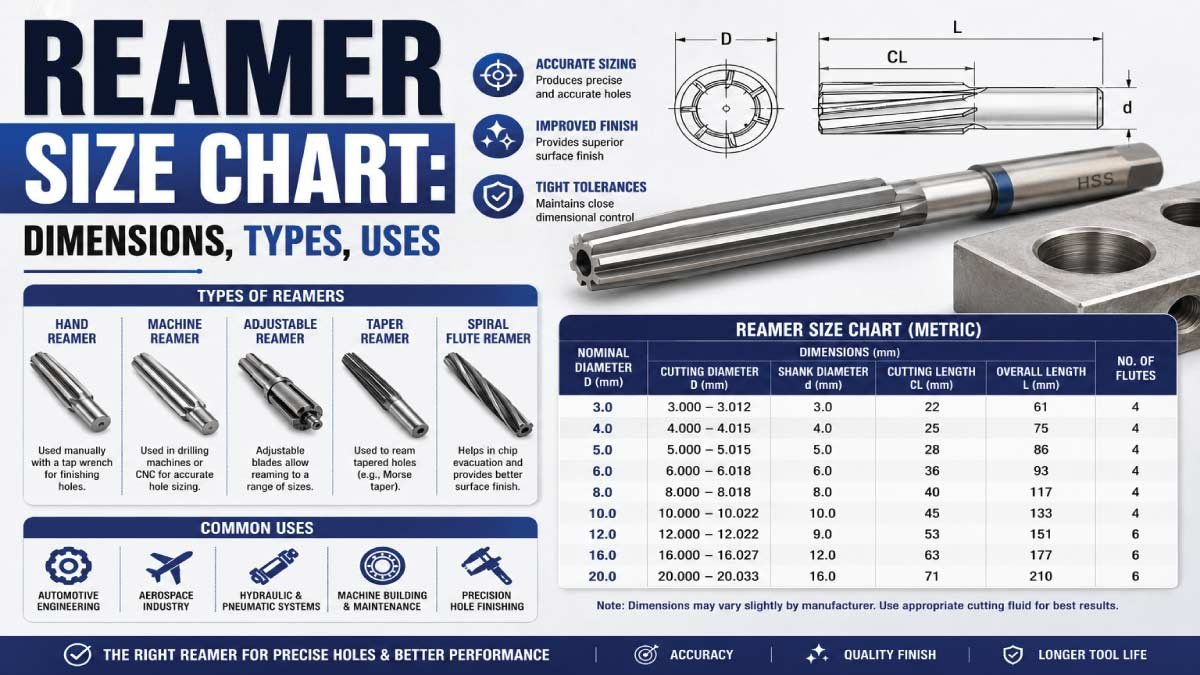
Reamers are precision cutting tools used to enlarge, smooth, and finish drilled holes with high accuracy. They are widely used in metalworking, machining, woodworking, automotive manufacturing, aerospace engineering, and industrial fabrication.
Using the correct reamer size chart is essential for achieving accurate hole dimensions, proper surface finish, and tight tolerances in machining operations.
This detailed guide explains reamer sizes, types, dimensions, tolerances, materials, and selection methods in simple language.
What Is a Reamer?
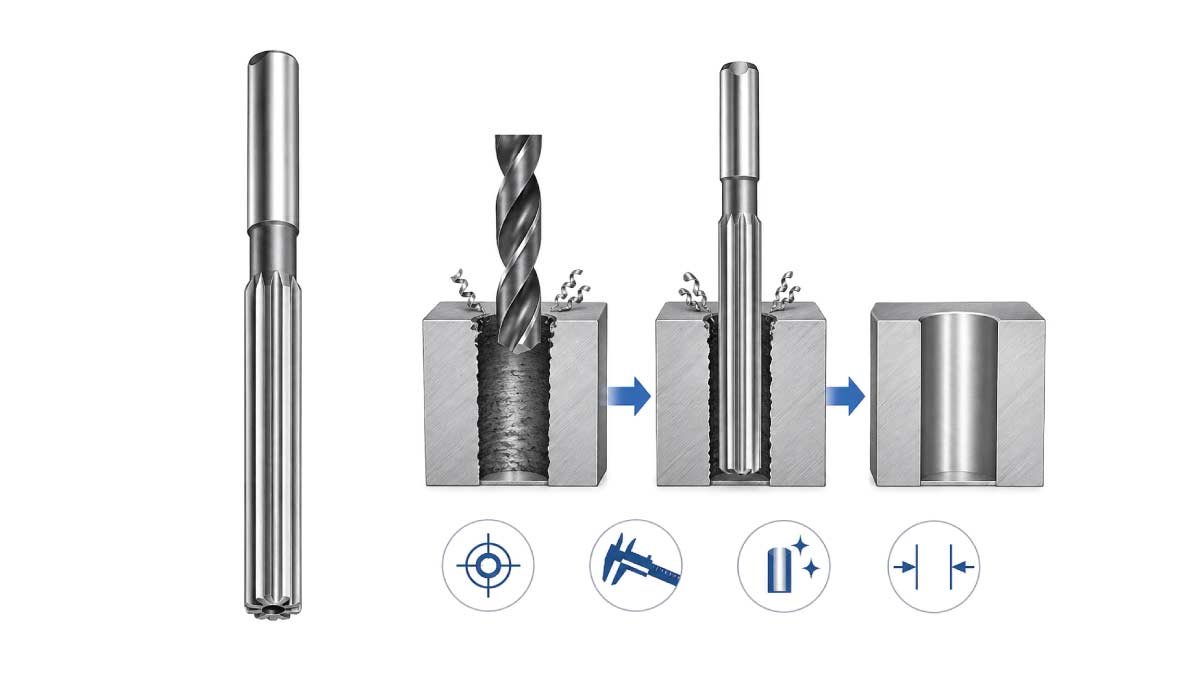
A reamer is a precision rotary cutting tool used to enlarge an already drilled hole slightly to achieve accurate dimensions and a smooth surface finish. It is commonly used in machining and manufacturing processes where tight tolerances and high-quality hole finishes are required. Reamers remove only a very small amount of material compared to drill bits.
Unlike drill bits, reamers remove only a small amount of material.
Main Functions of a Reamer
Reamers are essential tools in precision engineering because they improve hole quality after drilling. They help achieve exact sizing and smooth internal surfaces, making them suitable for components that require high accuracy and proper fitting.
- Improve hole accuracy
- Create smooth finishes
- Maintain tight tolerances
- Correct slightly undersized holes
- Prepare holes for pins, bearings, or bushings
How a Reamer Works
A reaming process is usually performed after drilling. First, a hole is drilled slightly smaller than the final required size. Then the reamer is inserted and rotated slowly to remove a thin layer of material, refining the hole to its final dimensions.
This process:
- Improves dimensional accuracy
- Reduces roughness
- Produces perfectly round holes
Standard Reamer Size Chart (Inch Sizes)
The following chart shows common straight shank chucking reamer sizes used in machining operations where inch-based measurements are required.
| Reamer Size | Decimal Equivalent | Recommended Drill Size |
|---|---|---|
| 1/16″ | 0.0625 | 1/32″ |
| 3/32″ | 0.0938 | 5/64″ |
| 1/8″ | 0.1250 | 7/64″ |
| 5/32″ | 0.1563 | 9/64″ |
| 3/16″ | 0.1875 | 11/64″ |
| 1/4″ | 0.2500 | 15/64″ |
| 5/16″ | 0.3125 | 19/64″ |
| 3/8″ | 0.3750 | 23/64″ |
| 7/16″ | 0.4375 | 27/64″ |
| 1/2″ | 0.5000 | 31/64″ |
| 5/8″ | 0.6250 | 39/64″ |
| 3/4″ | 0.7500 | 47/64″ |
| 7/8″ | 0.8750 | 55/64″ |
| 1″ | 1.0000 | 63/64″ |
Metric Reamer Size Chart
Metric reamers are widely used in CNC machining and global manufacturing industries where metric standards are followed. They ensure precise hole sizing for components in mechanical assemblies.
| Reamer Size (mm) | Recommended Drill Size (mm) |
|---|---|
| 3 mm | 2.8 mm |
| 4 mm | 3.8 mm |
| 5 mm | 4.8 mm |
| 6 mm | 5.8 mm |
| 8 mm | 7.8 mm |
| 10 mm | 9.8 mm |
| 12 mm | 11.8 mm |
| 14 mm | 13.8 mm |
| 16 mm | 15.8 mm |
| 18 mm | 17.8 mm |
| 20 mm | 19.8 mm |
| 25 mm | 24.8 mm |
Letter Reamer Size Chart
Letter-size reamers are commonly used in tool rooms and machine shops for precision fitting applications. They provide a standardized system for selecting hole sizes in engineering work.
| Letter Size | Decimal Equivalent |
|---|---|
| A | 0.2340 |
| B | 0.2380 |
| C | 0.2420 |
| D | 0.2460 |
| E | 0.2500 |
| F | 0.2570 |
| G | 0.2610 |
| H | 0.2660 |
| J | 0.2770 |
| K | 0.2810 |
| L | 0.2900 |
| M | 0.2950 |
| N | 0.3020 |
| P | 0.3230 |
| Q | 0.3320 |
| R | 0.3390 |
Number Reamer Size Chart
Number reamers are used for very small and precise holes in fine mechanical and electronic components. They are especially useful in applications requiring tight tolerances and smooth finishes in miniature parts.
| Number Size | Decimal Equivalent |
|---|---|
| #1 | 0.2280 |
| #2 | 0.2210 |
| #3 | 0.2130 |
| #4 | 0.2090 |
| #5 | 0.2055 |
| #6 | 0.2040 |
| #7 | 0.2010 |
| #8 | 0.1990 |
| #9 | 0.1960 |
| #10 | 0.1935 |
Standard Reamer Size Chart
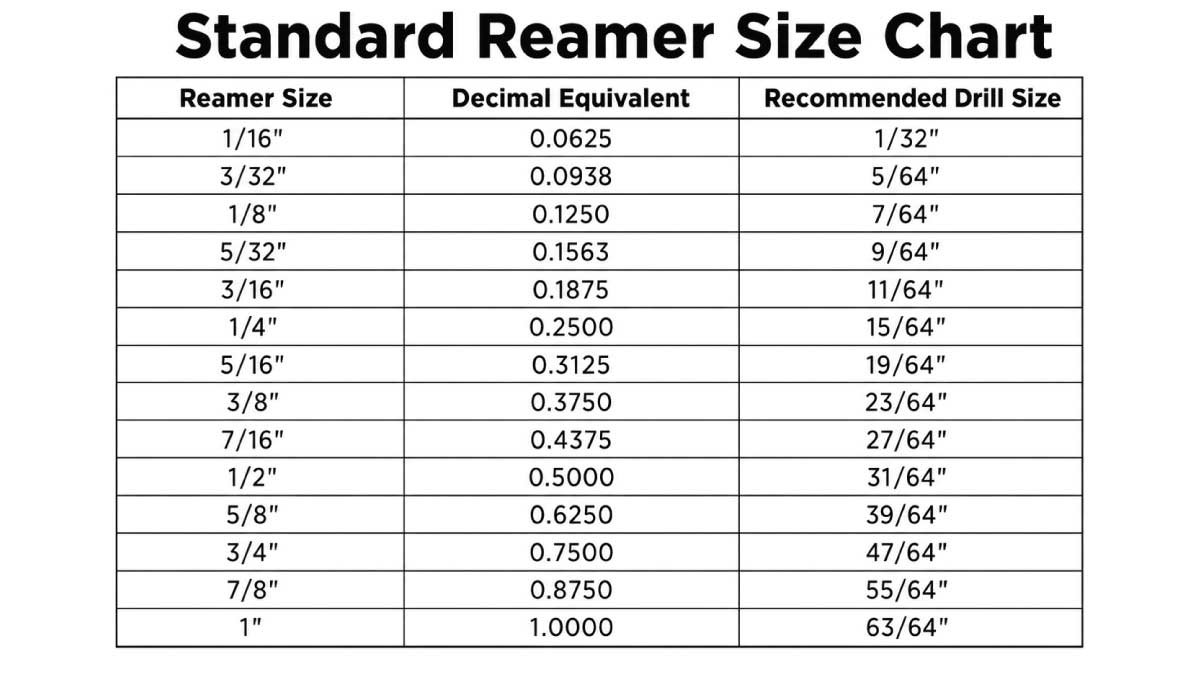
A Standard Reamer Size Chart PDF helps machinists, engineers, and workshop professionals quickly identify accurate number reamer dimensions and matching drill sizes. This guide covers standard number reamer sizes, decimal equivalents, and practical machining applications for precise hole finishing. Download the complete Standard Reamer Size Chart for easy reference in drilling, metalworking, and industrial projects.
Standard Reamer Size Chart Image
The Standard Reamer Size Chart Image provides a clear visual reference for common reamer sizes, decimal equivalents, and recommended drill sizes used in machining and metalworking. It helps engineers, machinists, and workshop professionals quickly select the correct reamer for accurate hole finishing. This easy-to-read chart image is ideal for industrial, mechanical, and CNC applications.
Types of Reamers
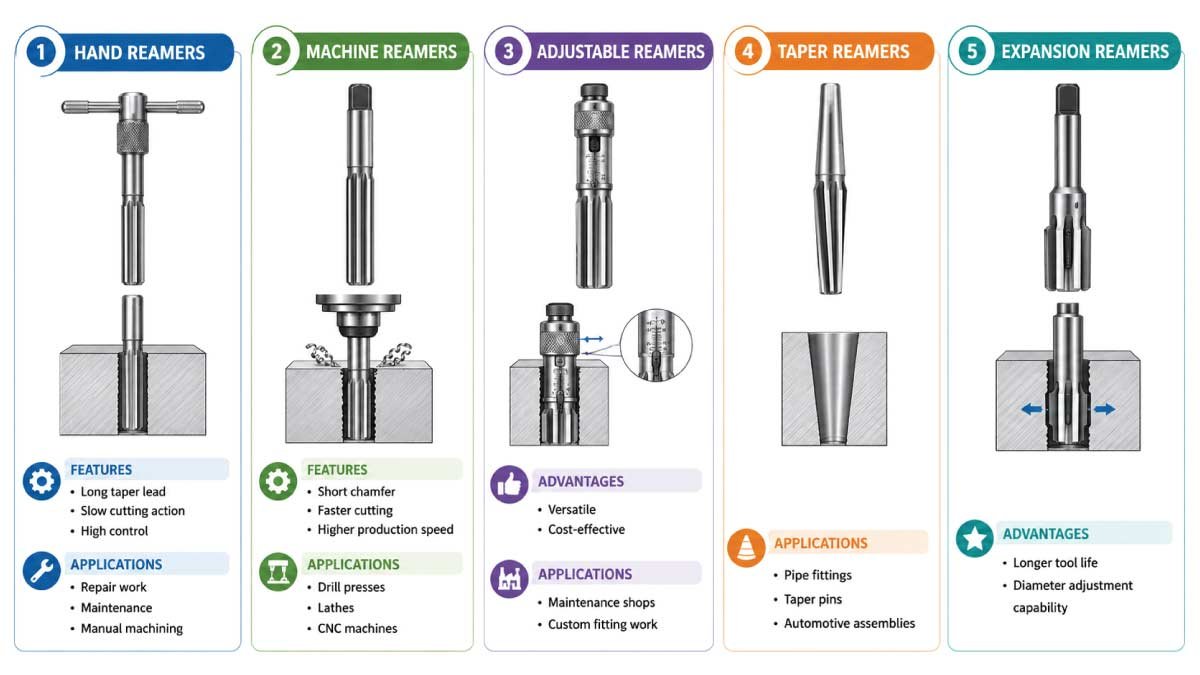
Reamers come in different designs to suit various machining needs and precision requirements. Each type is optimized for specific applications such as manual finishing, high-speed production, or specialized hole shaping. Choosing the right reamer type ensures better accuracy, surface finish, and tool efficiency in machining operations.
1. Hand Reamers
Hand reamers are operated manually using a wrench or tap handle. They are mainly used for finishing holes where high control and precision are required at a slow cutting speed. These reamers are ideal for small-scale work and repair tasks.
Features
- Long taper lead
- Slow cutting action
- High control
Applications
- Repair work
- Maintenance
- Manual machining
2. Machine Reamers
Machine reamers are designed for use in power-driven machines such as drill presses, lathes, and CNC machines. They provide faster cutting performance and are suitable for mass production environments where speed and consistency are important.
Features
- Short chamfer
- Faster cutting
- Higher production speed
Applications
- Drill presses
- Lathes
- CNC machines
3. Adjustable Reamers
Adjustable reamers allow slight changes in cutting diameter, making them flexible tools for different hole sizes. They are commonly used in maintenance and repair work where precise custom fitting is required without changing tools frequently.
Advantages
- Versatile
- Cost-effective
Applications
- Maintenance shops
- Custom fitting work
4. Taper Reamers
Taper reamers are specifically designed to create tapered holes with gradual diameter changes. They are essential in applications where parts must fit securely using a taper design, ensuring strong mechanical locking and alignment.
Applications
- Pipe fittings
- Taper pins
- Automotive assemblies
5. Expansion Reamers
Expansion reamers feature adjustable or expandable cutting blades that allow diameter adjustment over time. This design increases tool life and provides flexibility in achieving different hole sizes without replacing the tool frequently.
Advantages
- Longer tool life
- Diameter adjustment capability
Reamer Dimensions Explained
Understanding reamer dimensions is essential for selecting the correct tool for precise machining operations. Each dimension affects cutting performance, hole accuracy, and tool suitability for different materials and applications. Proper selection ensures high-quality finishes and tight dimensional control in engineering work.
1. Diameter
The diameter of a reamer determines the final size of the hole after machining. It is the most critical specification because it directly defines the finished hole dimension. Reamers are designed to produce highly accurate and consistent hole sizes.
Example:
- A 10 mm reamer creates a 10 mm finished hole
2. Flute Length
Flute length refers to the cutting section of the reamer where material removal takes place. It influences how deep a reamer can cut effectively. Longer flutes are used for deeper holes, while shorter flutes provide better rigidity for shallow or standard-depth applications. Longer flutes are suitable for deeper holes.
3. Overall Length
Overall length is the total measurement of the reamer from the cutting tip to the end of the shank. It determines how far the tool can reach into a machine setup and is important for accessibility in deep or restricted machining areas.
4. Shank Diameter
The shank diameter is the non-cutting portion of the reamer that is held by the machine spindle or chuck. It must match the tool holder properly to ensure stability, alignment, and safe operation during machining.
5. Reamer Tolerances
Reamers are specifically designed for high-precision finishing operations, where tight dimensional control is required. They are commonly used when drilled holes must meet strict engineering standards and accurate fits.
Typical tolerances include:
- H7
- H8
- H9
Example:
- A 10 mm H7 hole may allow only a few microns of variation
This level of precision ensures proper fitment of components such as shafts, pins, and bearings in mechanical assemblies.
Also Read:
Reamer Materials Explained
The material of a reamer plays a major role in its cutting performance, durability, and suitability for different machining conditions. Choosing the right material ensures better tool life, improved surface finish, and stable performance under heat, speed, and load conditions.
1. High-Speed Steel (HSS)
High-speed steel (HSS) reamers are the most commonly used type in general machining applications. They offer a good balance between cost, toughness, and cutting performance, making them suitable for workshops and standard manufacturing tasks.
Advantages
- Affordable
- Tough
- Suitable for general machining
2. Cobalt Reamers
Cobalt reamers are made with a cobalt alloy that improves heat resistance and hardness. They are designed for more demanding applications where higher cutting temperatures and tougher materials are involved, such as stainless steel and other hard metals.
Applications
- Stainless steel
- Hard metals
3. Carbide Reamers
Carbide reamers are high-performance cutting tools used in high-speed and mass production machining environments. They provide excellent wear resistance and maintain sharp cutting edges for long periods, ensuring consistent accuracy and superior surface finish.
Advantages
- Extremely hard
- Long tool life
- Excellent precision
Reamer Speed and Feed Chart
Correct cutting speed and feed rate are very important in reaming operations because they directly affect tool life, dimensional accuracy, and surface finish. Reaming is a finishing process, so speeds are generally slower than drilling to ensure smooth cutting and prevent tool wear or overheating.
| Material | Recommended Speed |
|---|---|
| Aluminum | High speed |
| Mild steel | Medium speed |
| Stainless steel | Low speed |
| Cast iron | Medium-low speed |
Reaming speeds are usually slower than drilling speeds.
Recommended Reaming Allowance
Reaming allowance refers to the small amount of material left after drilling, which the reamer removes to achieve final size and finish. Proper allowance is important because too little material can affect accuracy, while too much can overload and damage the reamer.
| Hole Size | Recommended Allowance |
|---|---|
| Small holes | 0.10 – 0.20 mm |
| Medium holes | 0.20 – 0.40 mm |
| Large holes | 0.30 – 0.50 mm |
Too much material removal can damage the reamer.
Also Read:
Common Applications of Reamers
Reamers are widely used across multiple industries where precise hole dimensions and smooth surface finishes are required. They are essential finishing tools in machining processes, helping ensure accurate fits for pins, shafts, bearings, and other mechanical components.
1. Automotive Industry
In the automotive industry, reamers are used to achieve precise hole sizes in engine and transmission components. They help ensure proper alignment and smooth operation of moving parts, which is critical for engine efficiency and durability.
Used for:
- Engine blocks
- Valve guides
- Bearing housings
2. Aerospace Industry
The aerospace industry relies heavily on reamers for high-precision machining. Components in aircraft and turbine systems require extremely tight tolerances, and reamers ensure accuracy and reliability in critical structural and mechanical assemblies.
Applications include:
- Precision assembly holes
- Aircraft structures
- Turbine components
3. Manufacturing Industry
In general manufacturing, reamers are used in CNC machining, tool production, and assembly lines. They ensure consistent hole quality and dimensional accuracy in mass production environments where precision is essential for part compatibility.
Used in:
- CNC machining
- Tool making
- Production lines
4. Construction Equipment
Heavy construction machinery uses reamed holes to ensure strong and precise fitting of mechanical components. Reamers help improve durability and alignment in parts that operate under high load and stress conditions.
Applications include:
- Bushings
- Pins
- Hydraulic components
How to Choose the Correct Reamer Size
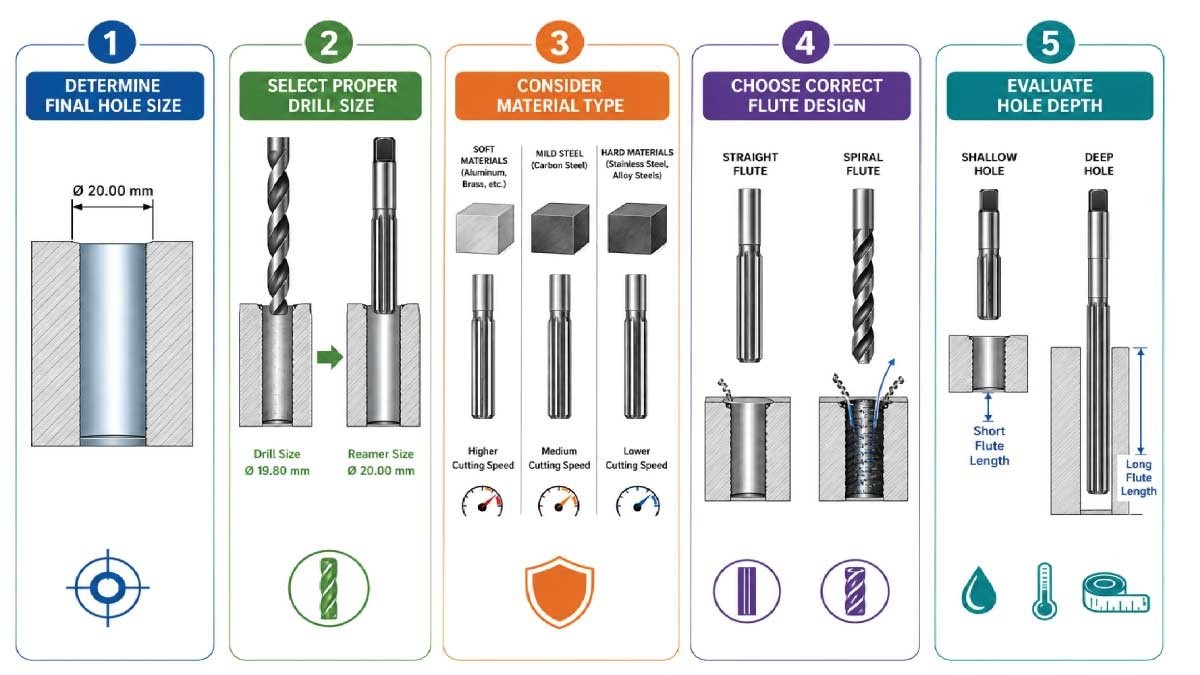
Choosing the correct reamer size is essential for achieving accurate hole dimensions, smooth surface finish, and proper fit in mechanical assemblies. A wrong selection can lead to oversized holes, poor alignment, or tool damage. Proper sizing depends on final diameter requirements, drill preparation, material type, flute design, and hole depth.
1. Determine Final Hole Size
The first step is to clearly define the final required hole diameter. The reamer size should closely match this finished dimension, as reaming is a finishing operation, not a rough cutting process. Selecting the correct size ensures precision, proper fit for mating parts, and consistent machining accuracy in production work.
2. Select Proper Drill Size
Before reaming, the drilled hole must be slightly smaller than the final reamer size. This allowance ensures the reamer removes only a small amount of material for finishing. If the drill hole is too large, the reamer cannot correct it properly. Accurate pre-drilling is essential for smooth operation and dimensional accuracy.
3. Consider Material Type
The material being machined plays a major role in selecting the correct reamer. Hard materials like stainless steel or alloy steels require stronger tools such as carbide or cobalt reamers. These materials also need lower cutting speeds to prevent tool wear and overheating, ensuring better performance and longer tool life.
4. Choose Correct Flute Design
Flute design affects chip removal and cutting efficiency during reaming. Straight flute reamers are commonly used for general-purpose applications and short holes. Spiral flute reamers are better for efficient chip evacuation, especially in softer or continuous materials. Selecting the right design improves surface finish and reduces clogging during operation.
5. Evaluate Hole Depth
Hole depth must also be considered when selecting a reamer. Deep holes require longer flute lengths to ensure proper cutting and chip removal. In such cases, effective lubrication is also important to reduce friction and prevent tool overheating. Proper depth matching helps maintain accuracy and avoids tool binding or breakage.
Also Read:
Reamer Lubrication
Proper lubrication is essential during reaming operations because it directly affects tool performance, surface quality, and overall machining efficiency. It helps reduce friction between the tool and workpiece, prevents overheating, and ensures smooth cutting action for achieving accurate and clean hole finishes.
Proper lubrication improves:
- Surface finish
- Tool life
- Chip evacuation
Common cutting fluids include:
- Soluble oil
- Synthetic coolant
- Cutting oil
Common Reaming Problems
Reaming is a precision machining process, but several issues can occur if tool condition, cutting parameters, or setup are not properly controlled. These problems affect hole accuracy, surface quality, and tool life. Understanding common reaming defects helps improve machining performance, reduce tool damage, and achieve smooth, accurate, and properly sized holes.
1. Oversized Holes
Oversized holes occur when the final reamed diameter becomes larger than required, reducing accuracy and fit quality. Common causes include excessive cutting speed, worn or damaged reamer edges, and poor tool alignment with the hole axis. These factors allow unwanted material removal, resulting in loose fits and poor assembly performance in mechanical parts.
2. Poor Surface Finish
A rough or poor surface finish after reaming reduces part quality and precision. This issue is usually caused by a dull reamer, incorrect feed rate, or insufficient lubrication during cutting. When friction increases, the cutting action becomes uneven, leaving marks and rough textures inside the hole that affect performance and durability.
3. Chatter Marks
Chatter marks appear as visible vibration patterns on the internal surface of the hole during reaming. They are mainly caused by machine vibration, weak tool holding, or unstable cutting conditions. The solution is to reduce cutting speed, improve rigidity of the setup, and ensure the reamer is properly supported to minimize oscillations.
4. Reamer Breakage
Reamer breakage is a serious issue that leads to tool failure and production loss. It is commonly caused by excessive material removal, improper alignment with the hole, or chip buildup during operation. When stress increases beyond tool capacity, the reamer can crack or snap, making correct setup and chip control essential for prevention.
Reamer Maintenance Tips
Proper maintenance of reamers is essential for maintaining cutting accuracy, improving surface finish, and extending tool life. A well-maintained reamer performs consistently, reduces machining errors, and prevents premature wear or breakage. Regular care also helps maintain precision in drilling and finishing operations over long-term industrial use.
1. Clean After Use
After each use, the reamer should be thoroughly cleaned to remove metal chips, cutting debris, and coolant residue. If left uncleaned, these particles can cause corrosion or affect cutting performance in future operations. Proper cleaning ensures the cutting edges remain sharp and the tool stays in good working condition for accurate reaming.
2. Store Properly
Reamers must be stored carefully to prevent damage to their cutting edges. They should not be placed loosely with other tools, as contact can cause dulling or chipping. Using protective cases or dedicated storage racks helps maintain tool alignment and sharpness. Proper storage also prevents rust and extends the overall tool lifespan.
3. Sharpen When Necessary
Over time, reamers become dull due to repeated use, which reduces cutting accuracy and surface quality. Regular inspection is important to identify wear early. When needed, reamers should be professionally sharpened to restore their cutting performance. A sharp reamer ensures smoother operation, better precision, and reduced machining errors.
4. Use Correct Speeds
Using appropriate cutting speeds is crucial for reamer maintenance and performance. Excessive speed generates heat, which can damage the cutting edges and reduce tool life. Proper speed selection helps maintain tool stability, prevents overheating, and ensures clean, accurate hole finishing. Correct operating conditions significantly improve both efficiency and durability.
Difference Between Drill Bits and Reamers
Drill bits and reamers are both used in hole-making processes, but they serve different purposes. Drill bits are used for creating initial holes, while reamers are used for finishing and improving accuracy. Understanding their differences helps in selecting the right tool for each stage of machining.
| Feature | Drill Bit | Reamer |
|---|---|---|
| Main Purpose | Create hole | Finish hole |
| Accuracy | Moderate | High |
| Surface Finish | Rougher | Smoother |
| Material Removal | Large | Small |
| Precision | Lower | Higher |
Conclusion
A reamer size chart is essential for achieving accurate and high-quality hole finishing in machining operations. Understanding reamer sizes, drill allowances, materials, and flute designs helps improve machining precision and tool performance.
When selecting a reamer, always consider:
- Final hole size
- Material type
- Hole depth
- Required tolerance
- Cutting speed
- Flute style
Using the correct reamer size and machining practices ensures better dimensional accuracy, smoother finishes, and longer tool life in industrial and manufacturing applications.

Engineer Hassan is a Mechanical Engineer with 16+ years of hands-on experience in mechanical hardware, fasteners, and workshop tools. He focuses on size selection, thread identification, and measurement, helping users choose the correct components with accuracy and safety.