
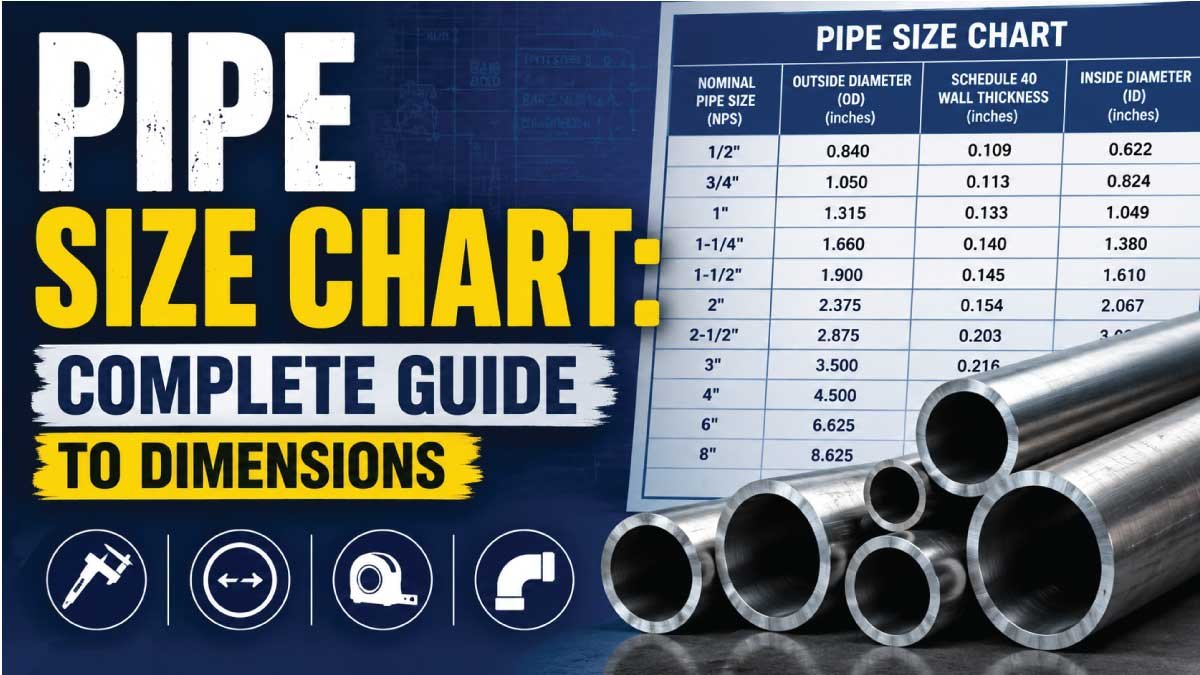
Pipes are essential components in plumbing, construction, oil and gas systems, irrigation, HVAC, and industrial machinery. Choosing the correct pipe size is important because the wrong size can reduce flow efficiency, create pressure problems, and increase installation costs.
This complete guide explains pipe sizes, schedules, dimensions, wall thickness, nominal pipe size (NPS), metric pipe sizing, and common applications. You will also find a detailed pipe size chart to help you select the right pipe for your project.
What Is Pipe Size?
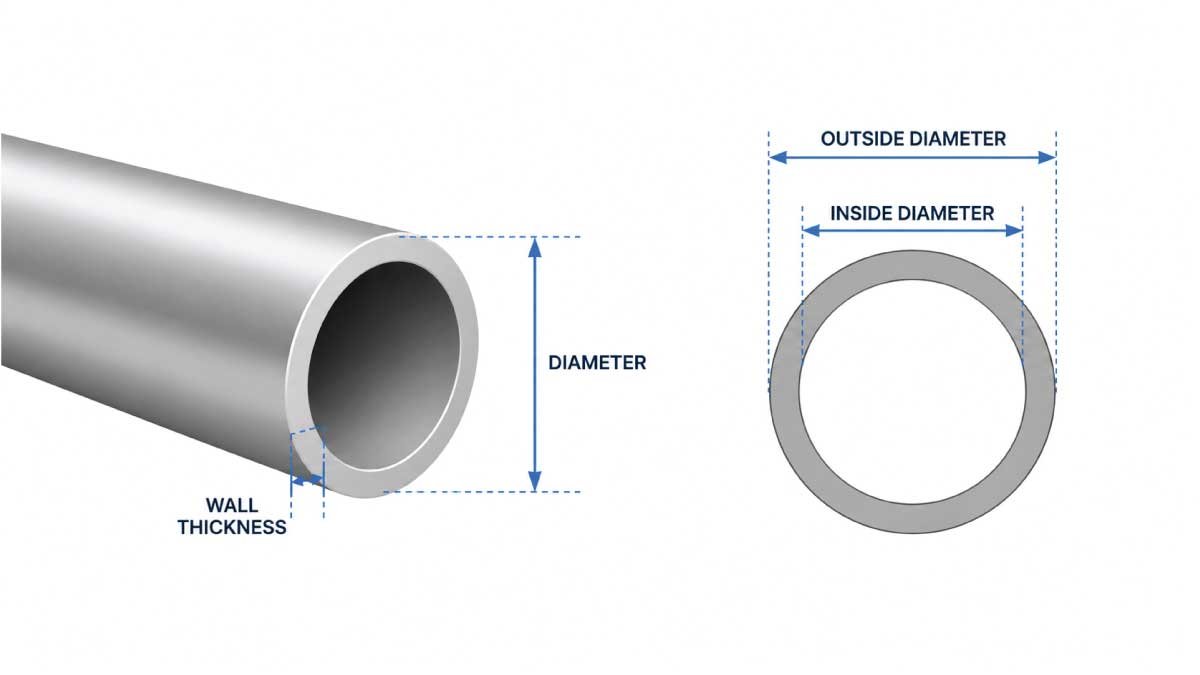
Pipe size refers to the diameter and wall thickness of a pipe. Pipe sizing systems help manufacturers, engineers, plumbers, and contractors maintain standard dimensions for compatibility.
Pipe size usually includes:
- Nominal Pipe Size (NPS)
- Outside Diameter (OD)
- Inside Diameter (ID)
- Wall Thickness
- Pipe Schedule
Understanding these measurements helps ensure proper flow capacity and fitting compatibility.
Standard Pipe Size Chart
Below is a common steel pipe size chart showing nominal size, outside diameter, and wall thickness for Schedule 40 pipe.
| Nominal Pipe Size | Outside Diameter (OD) | Wall Thickness | Inside Diameter |
|---|---|---|---|
| 1/8 inch | 0.405 inch | 0.068 inch | 0.269 inch |
| 1/4 inch | 0.540 inch | 0.088 inch | 0.364 inch |
| 3/8 inch | 0.675 inch | 0.091 inch | 0.493 inch |
| 1/2 inch | 0.840 inch | 0.109 inch | 0.622 inch |
| 3/4 inch | 1.050 inch | 0.113 inch | 0.824 inch |
| 1 inch | 1.315 inch | 0.133 inch | 1.049 inch |
| 1-1/4 inch | 1.660 inch | 0.140 inch | 1.380 inch |
| 1-1/2 inch | 1.900 inch | 0.145 inch | 1.610 inch |
| 2 inch | 2.375 inch | 0.154 inch | 2.067 inch |
| 3 inch | 3.500 inch | 0.216 inch | 3.068 inch |
| 4 inch | 4.500 inch | 0.237 inch | 4.026 inch |
| 6 inch | 6.625 inch | 0.280 inch | 6.065 inch |
| 8 inch | 8.625 inch | 0.322 inch | 7.981 inch |
Metric Pipe Size Chart
Metric pipe sizing is commonly used outside North America.
| Metric Size | Outside Diameter | Common Applications |
|---|---|---|
| 15 mm | 21.3 mm | Residential plumbing |
| 20 mm | 26.7 mm | Water supply |
| 25 mm | 33.4 mm | Irrigation systems |
| 32 mm | 42.2 mm | Industrial flow systems |
| 40 mm | 48.3 mm | Drainage systems |
| 50 mm | 60.3 mm | Commercial plumbing |
| 65 mm | 76.1 mm | HVAC systems |
| 80 mm | 88.9 mm | Fire protection |
| 100 mm | 114.3 mm | Industrial pipelines |
Pipe Schedule Chart
Pipe schedule determines pressure capacity and strength.
| Pipe Schedule | Wall Thickness | Typical Uses |
|---|---|---|
| Schedule 10 | Thin wall | Low-pressure systems |
| Schedule 20 | Medium-light wall | Drainage and ventilation |
| Schedule 40 | Standard wall | General plumbing |
| Schedule 80 | Heavy wall | High-pressure systems |
| Schedule 160 | Extra heavy wall | Industrial applications |
Standard Pipe Size Chart PDF
Explore More Posts:
Types of Pipes
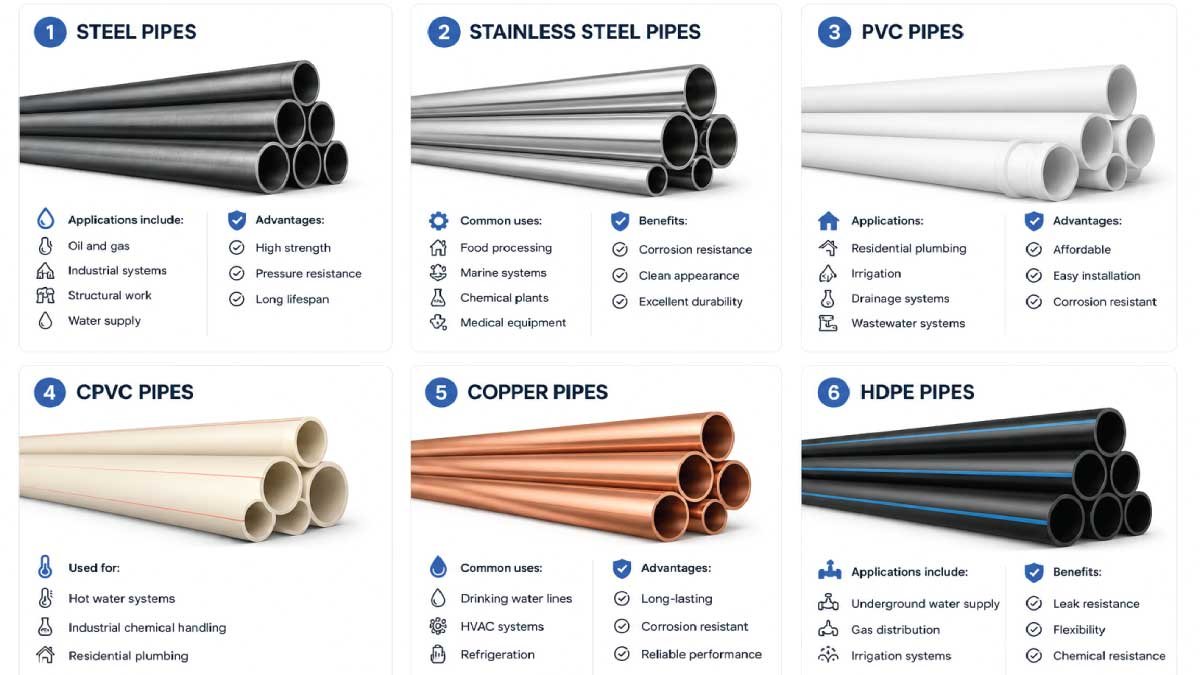
Different types of pipes are designed for specific applications based on pressure requirements, temperature conditions, durability, and environmental exposure. Each pipe material has unique properties that make it suitable for plumbing, industrial systems, or structural use. Selecting the right pipe type ensures safety, efficiency, and long-term reliability.
1. Steel Pipes
Steel pipes are known for their high strength and durability, making them suitable for heavy-duty applications. They can handle high pressure and mechanical stress, which makes them widely used in industrial and structural systems where reliability is critical.
Applications include:
- Oil and gas
- Industrial systems
- Structural work
- Water supply
Advantages:
- High strength
- Pressure resistance
- Long lifespan
2. Stainless Steel Pipes
Stainless steel pipes offer excellent resistance to rust and corrosion, making them ideal for environments where hygiene and durability are important. They are widely used in industries that require clean and long-lasting piping systems.
Common uses:
- Food processing
- Marine systems
- Chemical plants
- Medical equipment
Benefits:
- Corrosion resistance
- Clean appearance
- Excellent durability
3. PVC Pipes
PVC (Polyvinyl Chloride) pipes are lightweight plastic pipes commonly used in plumbing and drainage systems. They are easy to install and widely used in residential and commercial applications due to their cost-effectiveness.
Applications:
- Residential plumbing
- Irrigation
- Drainage systems
- Wastewater systems
Advantages:
- Affordable
- Easy installation
- Corrosion resistant
4. CPVC Pipes
CPVC (Chlorinated Polyvinyl Chloride) pipes are an upgraded version of PVC pipes designed to handle higher temperatures. They are suitable for both residential and industrial applications where hot water or chemical resistance is required.
Used for:
- Hot water systems
- Industrial chemical handling
- Residential plumbing
5. Copper Pipes
Copper pipes are widely used in plumbing systems due to their durability and reliability. They provide excellent performance in water supply and HVAC applications, making them a trusted choice for long-term installations.
Advantages:
- Long-lasting
- Corrosion resistant
- Reliable performance
Common uses:
- Drinking water lines
- HVAC systems
- Refrigeration
6. HDPE Pipes
HDPE (High-Density Polyethylene) pipes are flexible, strong, and highly resistant to chemicals. They are commonly used in underground and large-scale distribution systems where durability and leak resistance are important.
Applications include:
- Underground water supply
- Gas distribution
- Irrigation systems
Benefits:
- Leak resistance
- Flexibility
- Chemical resistance
Pipe Size Standards
Several international organizations define pipe sizing rules to ensure safety, compatibility, and uniform manufacturing across industries. These standards help engineers and manufacturers produce pipes that fit correctly, perform reliably, and meet required pressure and material specifications in mechanical, construction, and industrial systems worldwide.
1. ASME Standards
ASME standards are widely used in North America for designing and regulating piping systems in industrial applications. They define pressure ratings, dimensional requirements, and safety guidelines. ASME codes ensure that pipes can handle specific operating conditions safely in power plants, oil and gas systems, and mechanical engineering projects.
2. ASTM Standards
ASTM International standards focus on material quality, composition, and manufacturing processes of pipes. They ensure pipes meet specific strength, corrosion resistance, and durability requirements. ASTM specifications are essential for maintaining consistency in raw materials used in construction, plumbing, and industrial piping systems across different environments.
3. ANSI Standards
ANSI provides guidelines to ensure compatibility between pipes, fittings, and related components. These standards help maintain uniform sizing and connection systems across manufacturers. ANSI plays a key role in improving interchangeability, safety, and reliability in piping networks used in commercial, industrial, and mechanical installations.
4. ISO Standards
ISO develops globally recognized pipe standards used across many countries. ISO standards ensure consistency in pipe dimensions, materials, and performance requirements worldwide. They help international industries maintain compatibility and quality control, making it easier to design and install piping systems in global engineering and construction projects.
Explore More Posts:
How to Measure Pipe Size
Accurate pipe measurement is essential when selecting replacements or designing new systems. Proper measurement ensures correct fitting, safe operation, and efficient flow in plumbing, industrial, and mechanical applications. Even small errors in sizing can lead to leakage, poor performance, or system failure.
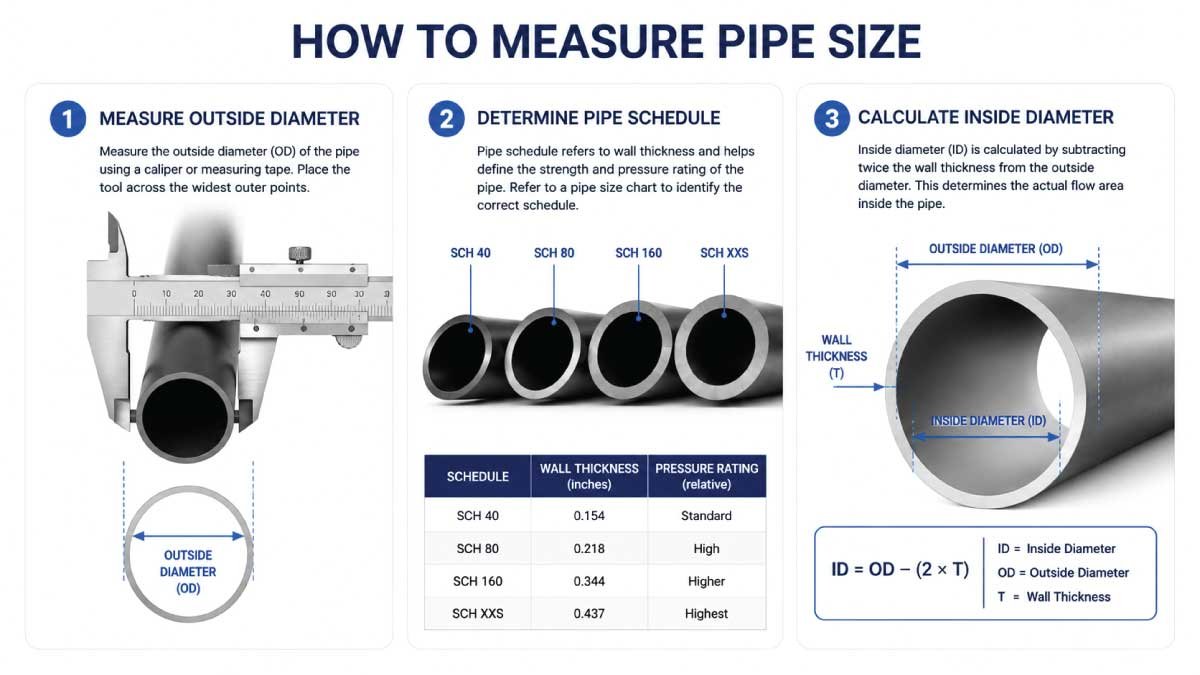
Step 1: Measure Outside Diameter
Measure the outside diameter (OD) of the pipe using a caliper or measuring tape. Place the tool across the widest outer points for accuracy. This measurement is crucial because pipe sizing systems often rely on OD rather than internal dimensions. Correct OD ensures proper fitting with connectors and system components.
Step 2: Determine Pipe Schedule
Pipe schedule refers to wall thickness and helps define the strength and pressure rating of the pipe. Heavier schedules mean thicker walls and higher durability. To identify the correct schedule, you may need to refer to a pipe size chart. This ensures the pipe can safely handle required pressure levels.
Step 3: Calculate Inside Diameter
Inside diameter (ID) is calculated by subtracting twice the wall thickness from the outside diameter. This measurement determines the actual flow area inside the pipe, which is important for fluid and gas transport efficiency.
Formula:
Inside Diameter = OD − (2 × Wall Thickness)
Accurate ID calculation ensures proper flow performance and system efficiency.
Pipe Pressure Ratings
Pipe pressure ratings define how much internal pressure a pipe can safely handle during operation. These ratings are critical for ensuring safety, performance, and long service life in fluid and gas transport systems. Proper selection depends on material strength, size, wall thickness, and working temperature.
Pipe pressure capacity depends on:
- Material
- Diameter
- Wall thickness
- Temperature
Higher schedules usually support higher pressure.
For example:
Schedule 80 pipe handles more pressure than Schedule 40.
Common Pipe Applications
Pipes are used in a wide range of industries for transporting fluids, gases, and supporting structural systems. Their application varies based on material type, pressure requirements, and environmental conditions.
1. Plumbing Systems
Plumbing systems in residential and commercial buildings rely on pipes for safe and efficient water distribution and waste removal. These systems are essential for daily water supply and sanitation.
Used for:
- Water supply
- Drainage
- Ventilation
2. Oil and Gas Industry
The oil and gas industry uses large-scale pipeline networks to transport energy resources over long distances. These pipelines must withstand high pressure and harsh environmental conditions.
Pipelines transport:
- Crude oil
- Natural gas
- Refined petroleum products
Steel pipes are commonly used due to high pressure.
3. HVAC Systems
HVAC systems use pipes to transfer heating and cooling media throughout buildings. These systems require reliable piping to maintain temperature control and energy efficiency.
HVAC pipes carry:
- Chilled water
- Refrigerants
- Hot water
Copper and steel pipes are common choices.
4. Agriculture and Irrigation
Agricultural systems depend on pipes for efficient water distribution across fields. These pipes help improve crop yield by ensuring consistent and controlled irrigation.
Advantages include:
- Low cost
- Easy installation
- Corrosion resistance
5. Construction Industry
In construction, pipes are used not only for fluid transport but also as structural elements. They provide strength and stability in buildings, bridges, and industrial frameworks.
Explore More Posts:
Pipe Fittings and Compatibility
Pipe fittings are essential components used to connect, redirect, or control the flow within piping systems. Proper fitting selection ensures a secure, leak-free, and efficient piping network.
Common fittings include:
- Elbows
- Tees
- Couplings
- Reducers
- Flanges
Correct sizing ensures leak-free connections.
Common Pipe Sizing Mistakes
Incorrect pipe sizing can lead to serious performance issues, safety risks, and increased maintenance costs in plumbing and industrial systems. Many problems occur due to wrong diameter selection, ignoring pressure requirements, or mixing incompatible standards. Understanding these mistakes helps ensure better system efficiency and long-term reliability.
1. Using the Wrong Diameter
One of the most common mistakes is selecting an incorrect pipe diameter. If the pipe is too small, it restricts flow, increases pressure loss, and reduces system efficiency. On the other hand, oversized pipes increase material costs and may reduce flow velocity, making the system less efficient overall.
2. Ignoring Pipe Schedule
Pipe schedule refers to wall thickness and pressure-handling capacity. Ignoring it can lead to serious failures, especially in high-pressure systems. Thin-wall pipes may crack, leak, or burst under stress. It is essential to always match the pipe schedule with the required operating pressure and application conditions for safe performance.
3. Mixing Standards
Different regions and industries use different pipe sizing standards, such as imperial and metric systems. Mixing these systems can result in poor fitting compatibility and installation errors. Always verify whether the project follows local or international standards before selecting pipes to ensure proper connection and system integrity.
Pipe Size Conversion Basics
Imperial and metric pipe sizing systems do not always match exactly, which often causes confusion during selection and installation. Understanding conversion basics helps ensure compatibility between different standards and prevents fitting or flow issues in piping systems.
For example:
NPS Size | Approximate Metric Equivalent
1/2 inch | 15 mm
3/4 inch | 20 mm
1 inch | 25 mm
1-1/4 inch | 32 mm
1-1/2 inch | 40 mm
2 inch | 50 mm
Pipe Thickness Explained
Pipe wall thickness plays a major role in determining overall performance, strength, and durability. It directly influences how much pressure a pipe can handle and how efficiently fluids can flow through it. Selecting the correct thickness ensures both safety and system efficiency.
Wall thickness affects:
- Strength
- Pressure handling
- Weight
- Flow capacity
Thicker walls provide more durability but reduce internal flow diameter.
Advantages of Proper Pipe Sizing
Proper pipe sizing plays a key role in ensuring that any piping system works efficiently, safely, and reliably over time. When pipes are correctly selected based on flow, pressure, and application needs, they help prevent operational issues and significantly improve system performance in both residential and industrial environments.
1. Improved Flow Efficiency
Correct pipe sizing ensures smooth and uninterrupted fluid movement throughout the system. When the diameter is properly selected, it reduces turbulence and prevents blockages. This leads to more stable performance, better flow control, and improved efficiency in water supply, gas distribution, and industrial fluid systems.
2. Reduced Pressure Loss
Proper pipe sizing helps minimize friction between the fluid and pipe walls. When the diameter is appropriate, pressure loss is reduced, allowing the system to maintain consistent pressure levels. This is especially important in long pipelines where even small pressure drops can affect overall performance and efficiency.
3. Longer System Life
Using correctly sized pipes reduces unnecessary stress on the system. It prevents issues like vibration, excessive wear, and material fatigue. As a result, the entire piping system lasts longer, requires fewer repairs, and performs more reliably over time, reducing long-term maintenance and replacement costs.
4. Better Safety
Proper pipe sizing improves overall system safety by reducing the risk of leaks, cracks, and bursts under pressure. When pipes are matched correctly with pressure requirements and schedules, they can handle operational loads safely. This ensures stable performance and protects both equipment and users from potential hazards.
Explore More Posts:
Pipe Maintenance Tips
Regular maintenance is necessary to ensure long-lasting performance and prevent unexpected failures in piping systems. Proper care improves efficiency and reduces repair costs over time.
1. Inspect Regularly
Routine inspections help identify early signs of damage before they become serious issues.
Check for:
- Corrosion
- Cracks
- Leaks
- Rust
2. Prevent Freezing
In cold environments, pipes can freeze and burst, causing major damage. Proper insulation helps protect piping systems during low temperatures.
3. Avoid Excessive Pressure
Overpressure can weaken pipes and fittings, increasing the risk of leaks or failure. Always operate within safe pressure limits.
4. Clean Pipes Periodically
Sediment and debris buildup can reduce flow efficiency over time. Regular cleaning helps maintain smooth operation and better performance.
Conclusion
Understanding pipe sizes is essential for plumbing, construction, HVAC, irrigation, and industrial systems. Correct pipe sizing improves efficiency, safety, durability, and overall system performance.
By learning about nominal pipe size, outside diameter, schedules, wall thickness, and material types, you can confidently choose the right pipe for your project. Using a reliable pipe size chart also helps prevent costly installation errors and compatibility problems.
FAQs:
What is the most common pipe schedule?
The most commonly used pipe schedule is Schedule 40, which is widely applied in plumbing, construction, and general industrial systems. It provides a good balance of strength, cost, and availability. Schedule 40 pipes are suitable for low to medium pressure applications and are commonly used in residential water supply and drainage systems.
How do I know my pipe size?
To determine pipe size, you need to measure the outside diameter (OD) of the pipe using a caliper or measuring tape. Once you have the OD, compare it with a standard pipe size chart to identify the nominal pipe size and schedule. This ensures accurate selection and proper fitting compatibility.
What does Schedule 80 mean?
Schedule 80 refers to pipes with thicker walls compared to Schedule 40. This increased wall thickness allows the pipe to handle higher pressure and more demanding industrial applications. Schedule 80 pipes are commonly used in chemical processing, high-pressure water systems, and heavy-duty industrial installations where strength and durability are essential.
Is pipe size measured by inside diameter?
Pipe size is not directly measured by inside diameter. Instead, it uses a nominal pipe size system, which does not exactly match either the inside or outside diameter. Actual dimensions vary depending on the pipe standard and schedule. Therefore, charts are always used to determine accurate pipe measurements.
Which pipe material is best for water supply?
Several materials are commonly used for water supply systems depending on the application. Copper, PVC, CPVC, and PEX are the most popular choices. Copper is durable and long-lasting, PVC is cost-effective, CPVC handles higher temperatures, and PEX is flexible and easy to install. Each material is selected based on system requirements.

Engineer Hassan is a Mechanical Engineer with 16+ years of hands-on experience in mechanical hardware, fasteners, and workshop tools. He focuses on size selection, thread identification, and measurement, helping users choose the correct components with accuracy and safety.