
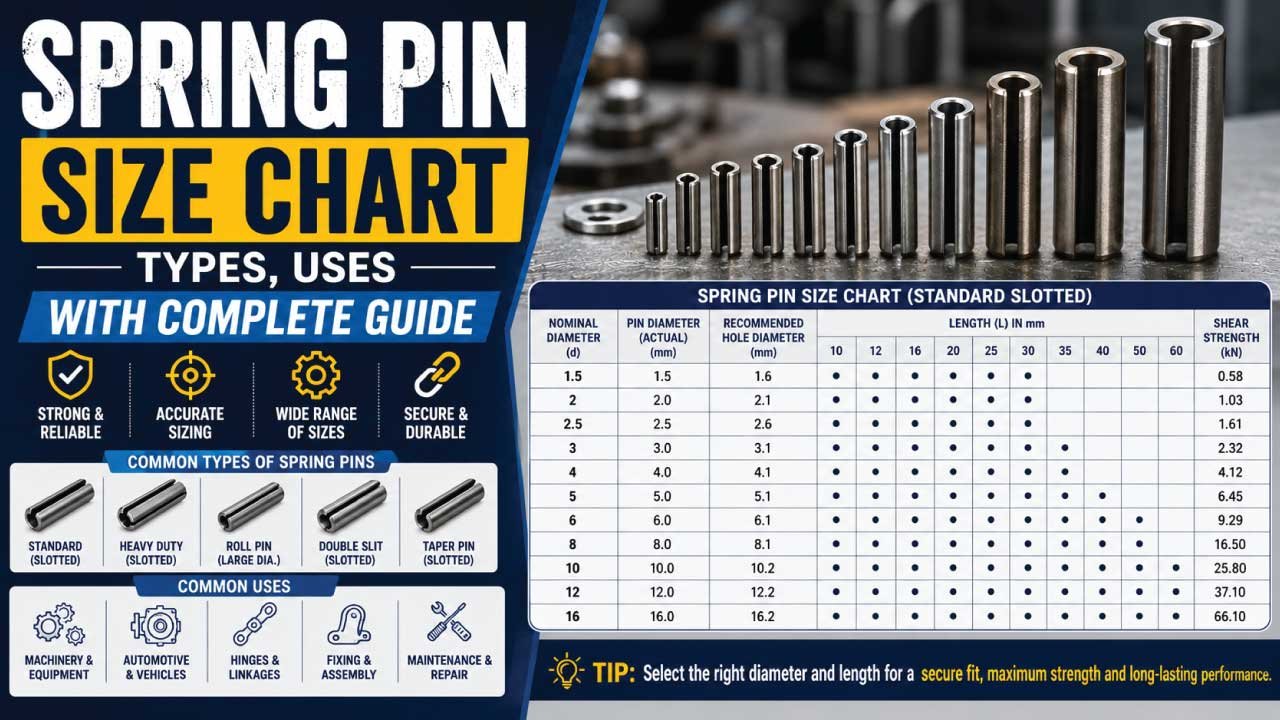
Spring pins are widely used fastening components in machinery, automotive systems, industrial equipment, construction tools, and mechanical assemblies. They provide a simple and reliable method of securing parts together while allowing easy installation and vibration resistance.
Choosing the correct spring pin size is important for maintaining proper alignment, preventing component movement, and ensuring long-term performance. In this complete spring pin size chart guide, you’ll learn about standard spring pin dimensions, types, materials, applications, installation methods, and how to select the right size for your project.
What Is a Spring Pin?
A spring pin, also known as a roll pin or tension pin, is a hollow cylindrical fastener made from spring steel or stainless steel. Unlike solid pins, spring pins have a longitudinal slot that allows the pin to compress during installation and expand after insertion.
This expansion creates friction between the pin and the hole, securely holding components together.
Spring pins are commonly used for:
- Shaft and gear alignment
- Machinery assembly
- Automotive components
- Agricultural equipment
- Power tools
- Industrial equipment
- Hinges and pivots
- Mechanical linkages
Their self-retaining design makes them one of the most popular fastening pins in engineering applications.
Standard Spring Pin Size Chart
The following chart shows common metric spring pin sizes.
| Pin Diameter | Hole Diameter | Length Range |
|---|---|---|
| 1 mm | 1 mm | 4–20 mm |
| 1.5 mm | 1.5 mm | 4–25 mm |
| 2 mm | 2 mm | 4–30 mm |
| 2.5 mm | 2.5 mm | 6–40 mm |
| 3 mm | 3 mm | 6–50 mm |
| 4 mm | 4 mm | 8–60 mm |
| 5 mm | 5 mm | 10–80 mm |
| 6 mm | 6 mm | 12–100 mm |
| 8 mm | 8 mm | 16–120 mm |
| 10 mm | 10 mm | 20–150 mm |
| 12 mm | 12 mm | 25–180 mm |
| 16 mm | 16 mm | 30–200 mm |
These dimensions may vary slightly depending on the manufacturer and industry standards.
Imperial Spring Pin Size Chart
Many industries still use inch-based spring pins.
| Pin Diameter | Decimal Size | Common Lengths |
|---|---|---|
| 1/16″ | 0.0625″ | 1/4″–1″ |
| 3/32″ | 0.0938″ | 1/4″–2″ |
| 1/8″ | 0.125″ | 1/4″–3″ |
| 5/32″ | 0.156″ | 1/2″–3″ |
| 3/16″ | 0.187″ | 1/2″–4″ |
| 1/4″ | 0.250″ | 1/2″–5″ |
| 5/16″ | 0.312″ | 3/4″–6″ |
| 3/8″ | 0.375″ | 1″–8″ |
| 1/2″ | 0.500″ | 1″–10″ |
How Spring Pin Sizes Are Measured
Understanding spring pin dimensions is essential for achieving a proper fit, secure fastening, and reliable performance in mechanical assemblies. Spring pins, also known as roll pins, rely on controlled compression to stay in place, so accurate sizing directly affects strength, vibration resistance, and long-term durability.
1. Pin Diameter
The pin diameter refers to the outside diameter of the spring pin in its free (uncompressed) state. This is one of the most important measurements because it determines the correct hole size required for installation. A properly matched diameter ensures the pin compresses correctly and maintains secure holding force.
This measurement determines the required hole size.
2. Pin Length
Pin length is measured from one end of the spring pin to the other end. It plays a key role in how well the pin distributes load across the joint. Longer pins generally offer better engagement with the material, resulting in improved stability and holding strength in assemblies.
Longer pins generally provide greater holding strength and support.
3. Wall Thickness
Wall thickness refers to the thickness of the material forming the spring pin body. This measurement influences how much force the pin can handle during compression and operation. It directly impacts performance under load and repeated stress conditions.
Wall thickness affects:
- Compression force
- Load capacity
- Durability
- Vibration resistance
4. Slot Width
The slot width is the opening in the spring pin that allows it to compress during installation. This feature is essential for the pin’s flexibility and retention ability. Different slot widths change how easily the pin compresses and how strongly it grips the hole once installed.
Different slot widths influence:
- Retention force
- Flexibility
Proper understanding of these measurements ensures correct selection and installation of spring pins, leading to stronger joints, improved reliability, and longer service life in mechanical systems.
Types of Spring Pins
Several spring pin designs are available to suit different mechanical, industrial, and structural applications. Each type is engineered with specific properties such as flexibility, strength, shock absorption, and installation force. Choosing the right type ensures proper fit, improved durability, and reliable performance under load and vibration.
1. Slotted Spring Pins
Slotted spring pins are the most commonly used type in general mechanical applications. They feature a single longitudinal slot that allows the pin to compress during installation and expand once placed in the hole. This makes them easy to install while still providing reliable holding strength.
Features:
- Single longitudinal slot
- Easy installation
- Excellent flexibility
Applications:
- General machinery
- Automotive systems
- Industrial equipment
2. Coiled Spring Pins
Coiled spring pins are manufactured from rolled steel strips formed into a spiral shape. This unique design provides uniform flexibility and excellent shock absorption, making them ideal for applications where vibration and dynamic loads are common.
Advantages:
- Uniform flexibility
- Better shock absorption
- Reduced hole stress
Applications:
- Heavy-duty machinery
- Aerospace components
- High-vibration environments
3. Heavy-Duty Spring Pins
Heavy-duty spring pins are designed for demanding applications where higher strength and durability are required. They feature thicker walls and improved load-bearing capacity, allowing them to perform well under extreme mechanical stress.
Features:
- Thicker walls
- Higher strength
- Increased load capacity
Applications:
- Construction equipment
- Mining machinery
- Industrial systems
4. Light-Duty Spring Pins
Light-duty spring pins are used in applications where loads are minimal and ease of installation is more important than high strength. They require lower insertion force and are commonly used in consumer products and small mechanical assemblies.
Advantages:
- Lower installation force
- Lightweight design
- Cost-effective
Applications:
- Consumer products
- Small mechanisms
- Electronics
Common Spring Pin Materials
Material selection plays a key role in determining the strength, flexibility, durability, and corrosion resistance of spring pins. Since these pins rely on repeated compression and expansion, the material must maintain elasticity while also resisting wear and environmental damage. Different materials are chosen based on operating conditions such as load, moisture exposure, and industrial environment.
1. Carbon Steel Spring Pins
Carbon steel is the most widely used material for spring pins due to its excellent balance of strength, elasticity, and cost-effectiveness. It performs well in general-purpose mechanical applications where extreme corrosion resistance is not required.
Advantages:
- High strength
- Affordable
- Excellent elasticity
Applications:
- Machinery
- Automotive components
- General industrial use
2. Stainless Steel Spring Pins
Stainless steel spring pins are known for their superior resistance to rust and corrosion. They are ideal for environments exposed to moisture, chemicals, or outdoor conditions, ensuring long-lasting performance with minimal maintenance.
Advantages:
- Rust resistant
- Weather resistant
- Long service life
Applications:
- Marine equipment
- Outdoor machinery
- Food processing equipment
3. Alloy Steel Spring Pins
Alloy steel spring pins are designed for high-performance and heavy-duty applications. By enhancing the base steel with alloying elements, these pins achieve superior strength and wear resistance, making them suitable for demanding industrial environments.
Advantages:
- Exceptional strength
- Improved wear resistance
- Long lifespan
Applications:
- Heavy machinery
- Industrial equipment
- Aerospace systems
4. Zinc-Plated Spring Pins
Zinc-plated spring pins are coated with a protective zinc layer that enhances corrosion resistance and extends service life. They provide a cost-effective solution for applications that require moderate protection against rust and environmental exposure.
Advantages:
- Corrosion protection
- Cost-effective
- Attractive finish
Applications:
- Construction hardware
- Equipment assembly
- Agricultural machinery
Spring Pin Length Selection Guide
Proper length selection is critical. A spring pin should generally extend through the entire assembly while providing adequate support.
Typical guidelines:
| Assembly Thickness | Recommended Pin Length |
|---|---|
| 5–10 mm | 10–15 mm |
| 10–20 mm | 20–30 mm |
| 20–40 mm | 30–50 mm |
| 40–60 mm | 50–80 mm |
| 60–100 mm | 80–120 mm |
Longer pins typically offer greater stability.
👉 Want to learn about cotter pins and choose the right one for your application? Our Cotter Pin Guide covers standard cotter pin sizes, key parts, common types, materials, and selection tips. Whether you’re working on automotive repairs, machinery, construction, or DIY projects, this guide helps ensure secure fastening and reliable performance. Read the full post to explore detailed size charts, cotter pin types, and expert advice for choosing the best option.
How to Choose the Correct Spring Pin Size
Selecting the correct spring pin size is essential for achieving strong, reliable, and long-lasting mechanical connections. Spring pins are used to align, secure, and retain components, so proper sizing ensures stability, prevents loosening, and maintains performance under load and vibration.
1. Determine Load Requirements
Start by evaluating the amount of force the joint will experience. Higher loads require larger diameter pins made from stronger materials to prevent deformation or failure. Choosing the correct strength level ensures the pin can safely handle operational stresses.
2. Measure Hole Size
Accurate hole measurement is critical for proper pin selection. The spring pin diameter must match the drilled or machined hole specification. A correct fit ensures secure holding force while allowing the pin’s flexibility to create proper tension within the assembly.
3. Consider Vibration Levels
In applications with constant vibration or shock, coiled spring pins are often preferred due to their flexibility and shock absorption. They distribute stress more evenly, reducing the risk of loosening or fatigue failure over time in dynamic environments.
4. Evaluate Environmental Conditions
Environmental exposure plays an important role in pin selection. In corrosive conditions such as moisture, chemicals, or outdoor use, stainless steel or coated spring pins are recommended. These materials help prevent rust and extend service life.
5. Check Assembly Thickness
The length of the spring pin must be suitable for the total thickness of the assembled components. Proper length ensures full engagement across all parts, providing secure alignment and preventing movement or disengagement during operation.
Common Uses of Spring Pins
Spring pins are widely used in many industries because they provide reliable fastening, alignment, and load distribution in mechanical assemblies. Their ability to absorb shock, resist vibration, and maintain secure positioning makes them essential in both light-duty and heavy-duty applications. They are commonly found in systems where precision, durability, and repeated movement are required.
1. Automotive Industry
In the automotive industry, spring pins are used in various moving and mechanical components that require precise alignment and strong retention under vibration and stress. They help maintain proper function in critical vehicle systems.
Applications include:
- Transmission components
- Gear assemblies
- Steering systems
- Brake mechanisms
2. Machinery Manufacturing
Spring pins play an important role in machinery manufacturing by securing components such as shafts, gears, and linkages. They help maintain alignment and ensure smooth mechanical operation in industrial equipment.
Used for:
- Shaft retention
- Gear positioning
- Mechanical linkages
- Equipment assembly
3. Agricultural Equipment
Agricultural machines operate under heavy loads and harsh environmental conditions. Spring pins are used to secure moving parts and maintain structural integrity in tractors, harvesters, and related equipment.
Applications include:
- Tractors
- Harvesters
- Implements
- Hydraulic systems
4. Aerospace Industry
In the aerospace industry, spring pins are used in precision-engineered systems where reliability, vibration resistance, and weight efficiency are critical. They support important aircraft mechanisms and control systems.
Used in:
- Aircraft mechanisms
- Control systems
- Structural assemblies
5. Construction Equipment
Spring pins are also widely used in construction machinery, where they help secure heavy components and withstand constant vibration, impact, and load stress in demanding working environments.
Applications include:
- Excavators
- Loaders
- Cranes
- Hydraulic equipment
These applications make spring pins a vital fastening solution across automotive, industrial, agricultural, aerospace, and construction sectors.
👉 Need the right chisel for your work? Our Chisel Sizes and Applications for Beginners guide explains standard chisel sizes, types, cutting edges, and common uses in woodworking, metalwork, and construction. Whether you’re a DIY learner or a professional, this guide helps you choose the perfect chisel for precise and safe work. Read the full post to explore size details, usage tips, and expert recommendations.
Advantages of Spring Pins
Spring pins offer several important benefits in mechanical assemblies, making them a popular choice for alignment, fastening, and load transfer applications. Their simple design, reliability, and cost efficiency make them suitable for a wide range of industrial and engineering uses.
1. Self-Retaining Design
Spring pins have a self-retaining structure that holds them firmly in place without requiring extra locking hardware. The spring tension creates constant outward force against the hole walls, ensuring a secure fit and reducing the need for additional fasteners or retainers.
2. Excellent Vibration Resistance
Due to their compressed and flexible design, spring pins maintain continuous pressure against the hole walls even under vibration. This helps prevent loosening in dynamic environments such as machinery, engines, and moving assemblies, ensuring long-term stability and reliability.
3. Easy Installation
Spring pins are simple to install and usually require only a hammer or basic installation tool. Their design allows quick insertion into pre-drilled holes without complex procedures, making them efficient for both manufacturing and maintenance applications.
4. Cost Effective
These pins provide a strong and dependable fastening solution at a relatively low cost. Their simple manufacturing process and wide availability make them an economical choice for many engineering and industrial applications without compromising performance.
5. Reliable Alignment
Spring pins are commonly used to align and position components accurately. They help maintain precise mechanical relationships between parts, ensuring proper assembly and smooth operation in systems that require exact positioning.
6. Shock Absorption
The flexible nature of spring pins allows them to absorb shock and impact loads effectively. This reduces stress on surrounding components, helping to prevent damage and extending the lifespan of the overall assembly in demanding conditions.
👉 Looking for the right roller bearing size? Our Roller Bearing Size Chart provides a complete guide with detailed dimensions, inner and outer diameters, widths, load capacities, and common applications. Whether you’re working with automotive systems, industrial machinery, or mechanical equipment, this guide simplifies bearing selection. Read the full post to access size charts, downloadable PDF resources, helpful images, and expert tips for choosing the correct roller bearing.
How to Remove a Spring Pin
Spring pins are designed to provide strong retention, but they can be safely removed when maintenance, repair, or replacement is required. Proper removal technique is important to avoid damaging the surrounding material, enlarging the hole, or deforming the pin during extraction.
1. Support the Workpiece Securely
Before starting, ensure the workpiece is firmly supported on a stable surface. Proper support prevents movement during removal and reduces the risk of damage or injury.
2. Select a Roll Pin Punch
Use a correctly sized roll pin punch designed specifically for spring pins. This tool helps apply even force and prevents slipping or damage to the pin and surrounding material.
3. Align the Punch with the Pin Center
Carefully position the punch at the center of the spring pin. Proper alignment ensures that force is applied evenly, allowing the pin to move straight out without bending or damaging the hole.
4. Drive the Pin Out Carefully
Gently tap the punch with a hammer to push the spring pin out of its hole. Apply controlled force to avoid damaging the pin bore or surrounding components.
5. Inspect the Hole Before Reinstallation
After removal, inspect the hole for wear, deformation, or debris. A clean and undamaged hole is essential for proper reinstallation and secure fastening of a new pin.
6. Replace Damaged Pins with New Components
Spring pins should never be reused after removal. If a pin is damaged, deformed, or worn, always replace it with a new one to ensure safety, reliability, and proper performance.
Following correct removal procedures helps maintain component integrity, extends equipment life, and ensures safe and effective maintenance practices.
ASME Standards
Common in North American industries. These standards ensure compatibility and consistent performance.
Spring Pin vs Dowel Pin
| Feature | Spring Pin | Dowel Pin |
|---|---|---|
| Design | Hollow | Solid |
| Installation | Compression Fit | Press Fit |
| Vibration Resistance | Excellent | Moderate |
| Cost | Lower | Higher |
| Shock Absorption | Better | Limited |
Spring pins are often preferred in applications involving vibration and movement.
Common Spring Pin Selection Mistakes
Choosing the correct spring pin is essential for ensuring secure fastening, proper alignment, and long-term durability. Many failures occur due to incorrect selection or improper installation rather than the pin itself. Avoiding these common mistakes helps improve performance, safety, and equipment reliability.
Avoid these common errors:
- Using incorrect hole sizes
- Choosing insufficient pin length
- Ignoring load requirements
- Selecting unsuitable materials
- Reusing damaged pins
- Improper installation techniques
- Failing to inspect assemblies
Proper sizing and correct installation significantly improve reliability and reduce the risk of mechanical failure in automotive, industrial, and machinery applications.
Maintenance and Inspection Tips
Regular maintenance and inspection of spring pins are important for ensuring continued performance and preventing unexpected breakdowns. Since spring pins operate under stress, vibration, and repeated movement, routine checks help identify early signs of wear or damage.
Check for:
- Corrosion
- Deformation
- Wear
- Cracks
- Looseness
Replacement Guidelines
Damaged or worn spring pins should be replaced immediately. Continuing to use compromised pins can lead to misalignment, reduced holding strength, and potential equipment failure.
Routine maintenance improves overall equipment reliability, extends service life, and ensures safe operation in mechanical systems and industrial applications.
Conclusion
Spring pins are reliable, cost-effective fastening components used in countless mechanical and industrial applications. Understanding spring pin sizes, materials, types, and installation requirements helps ensure strong and dependable assemblies.
By using the spring pin size charts and selection guidelines in this guide, you can choose the correct spring pin for machinery, automotive systems, industrial equipment, and construction projects while maximizing safety, durability, and performance.
👉 Confused about selecting the right retaining ring? Our Retaining Ring Sizes Explained with Uses guide provides a complete overview of standard retaining ring sizes, types (internal and external), groove dimensions, materials, and applications. Whether you’re working in automotive, machinery, or industrial assembly, this guide helps ensure secure and precise fastening. Read the full post to explore detailed size charts, usage examples, and expert selection tips.
FAQs:
What is the difference between a spring pin and a roll pin?
The terms spring pin and roll pin are often used interchangeably in engineering and manufacturing. Most roll pins are slotted spring pins that compress during installation and expand within the hole. This spring action creates a secure, vibration-resistant connection without requiring additional locking components.
How do I determine spring pin size?
To determine the correct spring pin size, measure the hole diameter and the thickness of the assembled components. The pin diameter should match the recommended hole size, while the length should provide adequate engagement. Following manufacturer specifications ensures proper retention and reliable performance.
Can spring pins be reused?
Reusing spring pins is generally not recommended because repeated installation and removal can reduce their spring tension and holding strength. A reused pin may not provide the same secure fit as a new one, increasing the risk of loosening, movement, or premature failure.
What material is best for outdoor use?
Stainless steel spring pins are usually the best choice for outdoor applications because they provide excellent resistance to rust, moisture, and corrosion. They are commonly used in marine environments, construction equipment, and outdoor machinery where long-term exposure to weather conditions is expected.
Are coiled spring pins stronger than slotted spring pins?
Coiled spring pins often distribute loads more evenly across their multiple layers, making them highly effective under vibration, shock, and repeated impact. While both types are reliable, coiled pins generally offer improved fatigue resistance and longer service life in demanding applications.
What industries commonly use spring pins?
Spring pins are widely used in automotive, aerospace, agricultural, construction, and industrial machinery applications. They help secure gears, pulleys, shafts, hinges, and mechanical assemblies. Their simple installation, low cost, and reliable holding power make them a popular fastening solution.
How are spring pins installed?
Spring pins are typically installed by aligning them with a properly sized hole and driving them into place using a hammer or pin installation tool. As the pin compresses, it creates tension against the hole walls, producing a secure fit that resists vibration and movement.

Engineer Hassan is a Mechanical Engineer with 16+ years of hands-on experience in mechanical hardware, fasteners, and workshop tools. He focuses on size selection, thread identification, and measurement, helping users choose the correct components with accuracy and safety.