
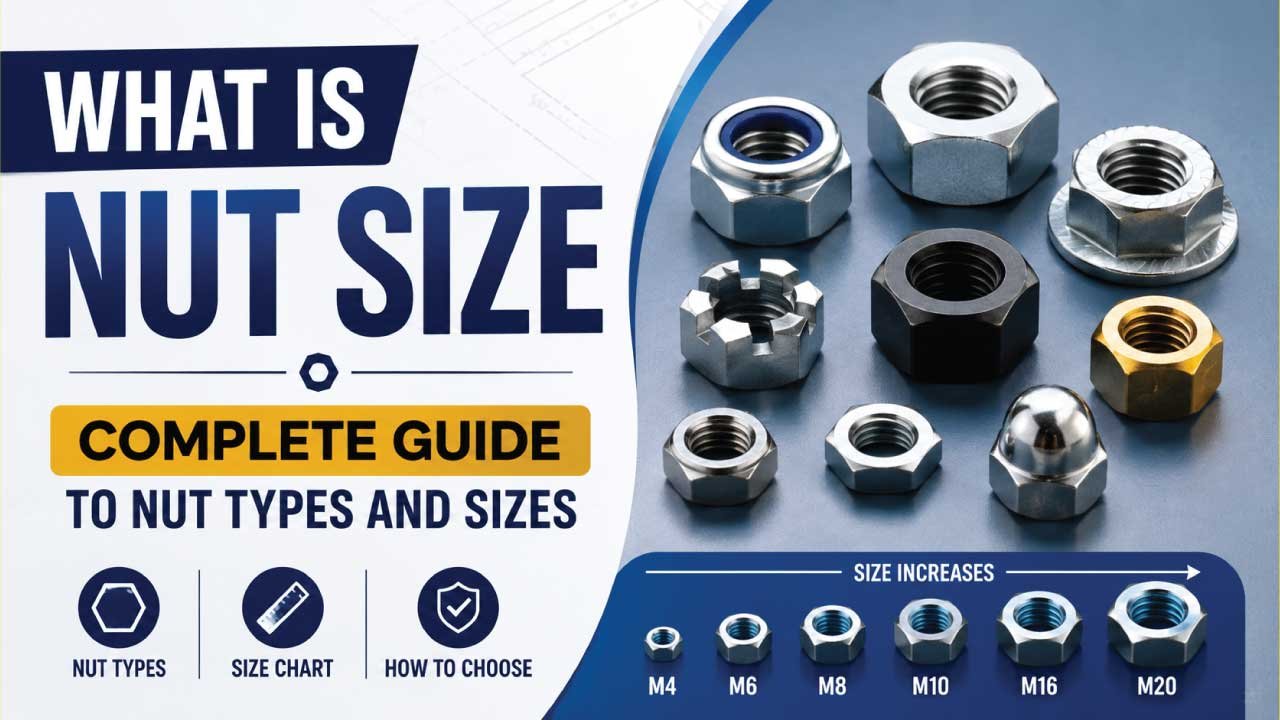
Nuts are among the most commonly used fasteners in construction, manufacturing, automotive repair, machinery assembly, and home improvement projects. They work together with bolts, screws, and threaded rods to create secure and removable connections between parts.
Choosing the correct nut size is essential for safety, strength, and compatibility. A nut that does not match the bolt thread can lead to loose connections, damaged threads, and equipment failure.
In this complete nut size chart guide, you’ll learn standard nut dimensions, metric and imperial nut sizes, common nut types, materials, applications, and how to choose the right nut for your project.
What Is a Nut?
A nut is a threaded fastener with an internal thread designed to mate with a bolt, screw, or threaded rod. When tightened, the nut creates clamping force that holds components together securely.
Nuts are widely used in:
- Construction projects
- Automotive assemblies
- Machinery manufacturing
- Furniture production
- Industrial equipment
- Agricultural machinery
- Home repairs
- Structural steel work
Metric Nut Size Chart
The following chart shows common metric hex nut sizes.
| Thread Size | Across Flats (AF) | Thickness | Common Bolt Size |
|---|---|---|---|
| M3 | 5.5 mm | 2.4 mm | M3 Bolt |
| M4 | 7 mm | 3.2 mm | M4 Bolt |
| M5 | 8 mm | 4 mm | M5 Bolt |
| M6 | 10 mm | 5 mm | M6 Bolt |
| M8 | 13 mm | 6.5 mm | M8 Bolt |
| M10 | 17 mm | 8 mm | M10 Bolt |
| M12 | 19 mm | 10 mm | M12 Bolt |
| M14 | 22 mm | 11 mm | M14 Bolt |
| M16 | 24 mm | 13 mm | M16 Bolt |
| M18 | 27 mm | 15 mm | M18 Bolt |
| M20 | 30 mm | 16 mm | M20 Bolt |
| M24 | 36 mm | 19 mm | M24 Bolt |
| M30 | 46 mm | 24 mm | M30 Bolt |
| M36 | 55 mm | 29 mm | M36 Bolt |
Imperial Nut Size Chart
In North America, nuts are often measured in inches.
| Nut Size | Thread Diameter | Wrench Size |
|---|---|---|
| #6 | 0.138″ | 1/4″ |
| #8 | 0.164″ | 11/32″ |
| #10 | 0.190″ | 3/8″ |
| 1/4″ | 0.250″ | 7/16″ |
| 5/16″ | 0.312″ | 1/2″ |
| 3/8″ | 0.375″ | 9/16″ |
| 7/16″ | 0.437″ | 5/8″ |
| 1/2″ | 0.500″ | 3/4″ |
| 5/8″ | 0.625″ | 15/16″ |
| 3/4″ | 0.750″ | 1-1/8″ |
| 1″ | 1.000″ | 1-1/2″ |
Understanding Nut Measurements
Nut sizes are identified using a few standard measurements that ensure proper compatibility with bolts, threaded rods, and fastening systems. Selecting the correct nut size is essential for achieving a secure fit, proper load distribution, and long-lasting joint strength. These measurements also help determine the correct tools required for installation, such as wrenches or sockets.
1. Thread Size
Thread size refers to the diameter of the bolt or threaded rod that the nut is designed to fit. It is the most important measurement because it ensures compatibility between the nut and the fastener. If the thread size does not match, the nut will not tighten properly or may damage the threads.
Examples:
- M6 nut fits M6 bolt
- M12 nut fits M12 bolt
- 1/2-inch nut fits 1/2-inch bolt
2. Across Flats (AF)
Across Flats (AF) is the distance measured between two opposite flat sides of a hexagonal nut. This measurement is used to determine the correct wrench or socket size needed for tightening or loosening the nut. Accurate AF measurement ensures proper tool selection and prevents slipping or damage during installation.
3. Nut Thickness
Nut thickness refers to the overall height of the nut from top to bottom. This dimension affects how much thread engagement is possible when the nut is tightened onto a bolt. Thicker nuts generally provide better strength and are used in heavy-duty applications where higher load resistance is required.
Standard Hex Nut Size Chart
Hex nuts are the most commonly used nuts worldwide.
| Nut Size | Width Across Flats | Thickness |
|---|---|---|
| M6 | 10 mm | 5 mm |
| M8 | 13 mm | 6.5 mm |
| M10 | 17 mm | 8 mm |
| M12 | 19 mm | 10 mm |
| M16 | 24 mm | 13 mm |
| M20 | 30 mm | 16 mm |
| M24 | 36 mm | 19 mm |
These nuts are used in general-purpose fastening applications.
Common Types of Nuts
Different applications require different nut designs because each type is engineered for specific strength, locking ability, installation method, and environmental conditions. Nuts are widely used in construction, automotive, machinery, furniture, and industrial equipment, where secure fastening and reliable performance are essential.
1. Hex Nuts
Hex nuts are the most commonly used and industry-standard type of nut. Their six-sided shape provides easy tool access and strong gripping points, making them suitable for a wide range of general-purpose fastening applications. They are reliable, widely available, and compatible with standard bolts and threaded rods.
Features:
- Six-sided design
- Easy wrench access
- Strong and reliable
Applications:
- Construction
- Machinery
- Automotive work
2. Lock Nuts
Lock nuts are specially designed to resist loosening caused by vibration, movement, or dynamic loads. They are essential in applications where joints are exposed to continuous stress or motion. Various designs, such as nylon insert and all-metal lock nuts, provide different levels of locking performance.
Common types include:
- Nylon insert lock nuts
- All-metal lock nuts
- Prevailing torque nuts
Applications:
- Vehicles
- Equipment
- Machinery
3. Wing Nuts
Wing nuts feature two extended “wings” that allow manual tightening without tools. They are designed for quick assembly and disassembly, making them ideal for temporary or frequently adjusted connections.
Advantages:
- Tool-free installation
- Quick adjustments
- Easy removal
Applications:
- Furniture
- Temporary fixtures
- DIY projects
4. Cap Nuts
Cap nuts have a closed, dome-shaped end that covers the exposed threads of a bolt. This improves safety by protecting users from sharp edges while also enhancing appearance in visible installations.
Advantages:
- Protect threads
- Improve appearance
- Increase safety
Applications:
- Decorative hardware
- Furniture
- Consumer products
5. Flange Nuts
Flange nuts include an integrated washer-like base that helps distribute load evenly across the surface. This reduces the need for a separate washer and improves grip, especially on softer materials.
Advantages:
- Better load distribution
- Reduced surface damage
- Improved grip
Applications:
- Automotive assembly
- Equipment manufacturing
6. Coupling Nuts
Coupling nuts are long, cylindrical nuts used to connect two threaded rods or bolts together. They are commonly used when extending length or joining structural components in construction and mechanical systems.
Applications:
- Construction
- Structural supports
- Mechanical assemblies
7. Castle Nuts
Castle nuts feature slotted ends that allow the insertion of a cotter pin for secure locking. This design prevents accidental loosening and is widely used in safety-critical applications.
Applications:
- Automotive wheel bearings
- Machinery shafts
- Safety-critical assemblies
8. Square Nuts
Square nuts have a four-sided shape that provides a larger surface contact area compared to hex nuts. This design helps distribute load more effectively and prevents loosening in heavy-duty applications.
Applications:
- Heavy-duty machinery
- Structural assemblies
- Industrial equipment
Nut Material Types
Material selection plays a major role in determining the strength, durability, corrosion resistance, and overall performance of a nut. Different working environments such as construction sites, marine applications, electrical systems, and heavy machinery require different materials to ensure safety and long service life. Choosing the correct material helps prevent failure, corrosion, and loosening under load.
1. Carbon Steel Nuts
Carbon steel nuts are the most commonly used type due to their high strength and cost-effectiveness. They are widely available and suitable for general-purpose fastening applications where extreme corrosion resistance is not required. These nuts perform well in controlled or indoor environments.
Advantages:
- Strong
- Affordable
- Widely available
Applications:
- Construction
- Manufacturing
- General repairs
2. Stainless Steel Nuts
Stainless steel nuts are highly resistant to rust, corrosion, and environmental damage. They are ideal for use in harsh or moisture-rich environments where long-term durability is important. Their clean and polished appearance also makes them suitable for visible installations.
Advantages:
- Rust resistant
- Durable
- Attractive finish
Applications:
- Marine environments
- Outdoor projects
- Food processing equipment
3. Alloy Steel Nuts
Alloy steel nuts are designed for high-strength and heavy-duty applications. By combining steel with additional alloying elements, these nuts offer superior mechanical performance and can withstand high stress, pressure, and load conditions.
Advantages:
- Superior strength
- Heavy-load capability
- High durability
Applications:
- Structural steel
- Heavy machinery
- Industrial equipment
4. Brass Nuts
Brass nuts are known for their corrosion resistance and attractive appearance. They are softer than steel but perform well in environments where moderate strength and good visual finish are required. Brass also offers good resistance to wear in low-stress applications.
Applications:
- Plumbing systems
- Decorative hardware
- Electrical equipment
5. Nylon Nuts
Nylon nuts are made from strong plastic materials and are primarily used where electrical insulation or lightweight fastening is required. They are resistant to corrosion and do not conduct electricity, making them suitable for sensitive applications.
Applications:
- Electronics
- Light-duty assemblies
- Specialty equipment
👉 Need the right gear size for your mechanical project? Our Gear Size Chart provides a complete guide to gear dimensions, module sizes, pitch diameters, tooth counts, gear ratios, and common applications. Whether you’re working in automotive, industrial machinery, robotics, or engineering design, this guide simplifies gear selection. Read the full post to explore detailed size charts, a downloadable PDF, and expert tips for choosing the correct gear.
Nut Strength Grades
Nuts are manufactured in different strength grades to ensure they can safely handle specific load requirements. These grades define the mechanical strength, hardness, and performance capability of the nut under tension and stress. Using the correct strength grade is essential for maintaining safety, especially in structural, automotive, and heavy machinery applications.
Common Metric Grades Include:
- Grade 5
- Grade 8
- Grade 10
- Grade 12
Each grade represents an increase in strength and load-bearing capacity, making higher-grade nuts suitable for more demanding applications.
Higher Grades Provide:
- Greater tensile strength
- Better load resistance
- Improved durability
Higher-grade nuts are designed for environments where joints are exposed to heavy stress, vibration, or dynamic loading. Lower grades, on the other hand, are suitable for light to medium-duty applications.
Important Safety Note
Always match the nut grade to the bolt grade to ensure proper compatibility and safe performance. Using mismatched grades can lead to thread failure, loosening, or complete joint breakdown under load.
How to Measure a Nut
Correctly measuring a nut is important for identifying the right replacement and ensuring proper fit with bolts or threaded rods. Accurate measurements help avoid loosening, stripping, or mismatched threading, which can lead to mechanical failure or unsafe connections in assemblies and structures.
1. Measure Thread Diameter
Use a caliper to measure the internal thread diameter of the nut. This measurement corresponds to the bolt size the nut is designed to fit. Accurate thread diameter measurement ensures compatibility with the matching bolt or stud for a secure fastening.
2. Measure Across Flats
Measure the distance between two opposite flat sides of the nut using a caliper or ruler. This is known as the “across flats” dimension and is commonly used to determine the correct wrench or spanner size required for tightening or loosening the nut.
3. Measure Thickness
Measure the height or thickness of the nut from top to bottom. Nut thickness affects its strength and load distribution capability. Thicker nuts generally provide stronger engagement and better resistance against loosening under heavy loads or vibration.
4. Determine Thread Pitch
Thread pitch refers to the distance between threads and is essential for proper compatibility. It ensures that the nut matches the bolt threading system. Common metric examples include:
- M10 × 1.5
- M12 × 1.75
- M16 × 2.0
Matching the correct thread pitch prevents cross-threading and ensures a secure, stable connection.
How to Choose the Correct Nut Size
Choosing the correct nut size is essential for creating a secure and reliable fastening system. The wrong nut can lead to loosening, thread damage, or even mechanical failure. Proper selection depends on bolt compatibility, load conditions, environment, and safety standards.
1. Match Bolt Size
The most important step is ensuring the nut matches the bolt diameter and thread pitch. Even a small mismatch can cause poor engagement or cross-threading. Always verify both the size (e.g., M10, M12) and thread pitch to ensure a proper and secure fit.
2. Consider Load Requirements
Different applications require different strength levels. Heavy-duty or structural loads need high-strength nuts that can withstand stress without deforming. Selecting the correct grade ensures the nut maintains clamping force and prevents loosening under pressure or vibration.
3. Evaluate Environmental Conditions
Environmental exposure plays a major role in nut selection. In corrosive environments such as outdoor, marine, or chemical settings, stainless steel or coated nuts are preferred. These materials help resist rust and extend service life in harsh conditions.
4. Check Strength Ratings
Always verify the strength grade of the nut before use. Higher-grade nuts are designed for higher loads and improved durability. Matching the nut’s strength rating with the bolt and application ensures balanced performance and reduces the risk of failure.
5. Verify Industry Standards
Ensure the nuts you select are manufactured according to recognized industry standards. Standard-compliant nuts guarantee consistent dimensions, material quality, and load performance. This improves safety and ensures compatibility across different tools and fastening systems.
👉 Looking for the correct stud bolt size for your project? Our Stud Bolt Size Chart provides a complete beginner’s guide covering standard stud bolt dimensions, thread sizes, lengths, materials, and common applications. Whether you’re working with flanges, piping systems, construction, or industrial equipment, this guide helps you select the right stud bolt with confidence. Read the full post to explore detailed size charts, installation tips, and expert recommendations.
Common Nut Standards
Nut manufacturing is governed by international standards that define dimensions, tolerances, materials, and mechanical properties. These standards ensure that nuts are interchangeable, safe to use, and compatible with bolts and threaded systems across different industries and countries.
1. ISO 4032
ISO 4032 is a widely used international standard for standard metric hex nuts. It specifies dimensions, thread sizes, and mechanical requirements for general-purpose fastening. These nuts are commonly used in machinery, construction, and industrial applications where reliable and consistent performance is required.
2. DIN 934
DIN 934 is a well-known European standard for hex nuts. It defines the shape, dimensions, and thread specifications used in a wide range of mechanical and structural applications. DIN 934 nuts are commonly used in engineering and manufacturing industries due to their compatibility and standardization.
3. ASTM Standards
ASTM standards focus on material composition, mechanical strength, and performance testing of nuts. These standards ensure that nuts can withstand specific loads, stress levels, and environmental conditions. ASTM-compliant nuts are widely used in heavy-duty and safety-critical applications in various industries.
4. ASME Standards
ASME standards are commonly used in North America for nuts and other fastening components. They provide guidelines for design, manufacturing, and safety requirements. ASME-compliant nuts are frequently used in engineering systems, industrial equipment, and structural assemblies where reliability is essential.
These standards ensure compatibility, interchangeability, and reliability across different fastening systems worldwide, helping maintain safety and performance in various applications.
Common Uses of Nuts
Nuts are essential fastening components used in almost every mechanical and structural system. They work together with bolts or threaded rods to create secure, adjustable, and removable joints. Because of their strength, reliability, and versatility, nuts are widely used across industrial, commercial, and domestic applications.
1. Construction Industry
In construction, nuts are used to assemble and secure large structural components. They play a key role in ensuring the stability and strength of buildings, bridges, and steel frameworks. Heavy-duty nuts are often required to handle high loads and environmental stress.
Used for:
- Structural steel
- Building frames
- Bridges
2. Automotive Industry
The automotive industry relies heavily on nuts for assembling critical vehicle components. They are used in systems that require strong, vibration-resistant fastening to ensure safety and performance during vehicle operation.
Applications include:
- Suspension systems
- Engines
- Chassis assemblies
3. Manufacturing Industry
In manufacturing environments, nuts are used to assemble machines, production lines, and industrial systems. They provide secure fastening while also allowing easy maintenance and replacement of components when needed.
Used in:
- Production equipment
- Machine assemblies
- Industrial systems
4. Agricultural Equipment
Agricultural machinery operates in tough outdoor conditions, requiring strong and durable fasteners. Nuts are used to keep tractors, harvesters, and other farming equipment securely assembled under heavy workloads and vibrations.
Applications include:
- Tractors
- Harvesters
- Farm machinery
5. Home Improvement Projects
Nuts are also commonly used in household repairs and DIY projects. They are ideal for assembling furniture, installing shelving systems, and performing general maintenance tasks where secure fastening is required.
Used for:
- Furniture assembly
- Shelving systems
- General repairs
👉 Need accurate flange dimensions for your piping system? Our Flange Size Chart provides a complete guide to standard flange sizes, pressure classes, bolt hole patterns, dimensions, and flange types. Whether you’re working in oil and gas, plumbing, manufacturing, or industrial piping, this guide helps you choose the right flange with confidence. Read the full post to explore detailed size charts, specifications, and expert flange selection tips.
Nut Installation Tips
Proper installation of nuts is essential for achieving strong, secure, and long-lasting connections. Even high-quality nuts can fail if installed incorrectly. Following correct practices improves safety, prevents loosening, and ensures reliable performance under load and vibration.
1. Use Correct Torque
Applying the correct torque is crucial for safe installation. Over-tightening can damage threads or cause bolt failure, while under-tightening may lead to loosening during operation. Always use a torque wrench and follow manufacturer specifications to achieve proper clamping force.
2. Inspect Threads
Before installation, carefully inspect both the nut and bolt threads. Damaged, dirty, or worn threads can reduce holding strength and lead to improper engagement. Clean and replace any components with visible thread damage to ensure a secure and stable connection.
3. Use Washers When Needed
Washers help distribute the load evenly across the surface and prevent damage to connected materials. They also reduce friction during tightening and help maintain consistent pressure. Using washers is especially important in high-load or precision applications.
4. Apply Thread Locking Compounds
Thread locking compounds are used to prevent nuts from loosening due to vibration or movement. These compounds increase resistance between threads and improve joint stability. They are commonly used in automotive, machinery, and structural applications where vibration is present.
5. Replace Damaged Nuts
Never reuse nuts that are severely worn, stripped, or deformed. Damaged nuts can compromise the strength and safety of the entire assembly. Replacing them ensures reliable fastening and helps prevent unexpected failures during operation.
Advantages of Using Properly Sized Nuts
Using correctly sized nuts is essential for ensuring safe, stable, and long-lasting fastening connections. Proper sizing allows the nut to match the bolt accurately, which improves overall performance in mechanical, structural, and industrial applications. When the correct nut is selected, the joint becomes more reliable under load, vibration, and environmental stress.
Advantages:
- Improved safety
- Better load distribution
- Increased joint strength
- Reduced loosening
- Longer service life
- Easier maintenance
- Greater reliability
These benefits make proper nut selection essential in every fastening application, from simple household repairs to heavy industrial assembly work.
Common Nut Selection Mistakes
Selecting the wrong nut can weaken the entire fastening system and lead to mechanical failure, safety risks, and increased maintenance costs. Many issues occur due to incorrect sizing, mismatched standards, or improper usage. Avoiding these common mistakes ensures stronger and more dependable joints.
1. Using Mismatched Thread Sizes
Using a nut that does not match the bolt thread size can cause improper engagement, stripping, or complete failure of the connection. Always ensure both components are compatible.
2. Ignoring Thread Pitch
Thread pitch must match between the nut and bolt for proper tightening. Ignoring pitch differences can lead to cross-threading and weak fastening.
3. Mixing Metric and Imperial Fasteners
Mixing measurement systems (metric and imperial) results in poor fit and unsafe connections. These systems are not interchangeable and should always be used consistently.
4. Using Incorrect Strength Grades
Using a nut with a lower strength grade than required can result in deformation or breakage under load. Proper grade matching ensures safe performance in demanding applications.
5. Selecting Unsuitable Materials
Choosing the wrong material can lead to corrosion, wear, or failure in specific environments such as outdoor, marine, or chemical exposure conditions.
6. Over-tightening Fasteners
Excessive tightening can damage threads, deform nuts, or weaken the joint. Proper torque specifications should always be followed.
7. Reusing Damaged Nuts
Reusing worn, stripped, or deformed nuts reduces reliability and increases the risk of failure. Damaged fasteners should always be replaced.
Proper nut selection and correct installation significantly reduce failure risks, improve performance, and lower long-term maintenance costs across all applications.
Conclusion
Understanding nut sizes, dimensions, materials, and strength grades is essential for creating safe and reliable fastened connections. Whether you’re working on machinery, vehicles, construction projects, or home repairs, choosing the correct nut size ensures proper fit, strength, and durability.
By using the nut size charts above and matching nuts with compatible bolts, thread pitches, and materials, you can achieve secure fastening and long-lasting performance in any application.
Frequently Asked Questions
How do I identify a nut size?
To identify a nut size, measure the thread diameter, thread pitch, and the distance across the flats of the nut. These measurements help determine whether the nut is metric or imperial and ensure compatibility with the correct bolt or threaded fastener.
Can metric nuts fit imperial bolts?
No, metric and imperial threads use different dimensions and thread pitches, making them generally incompatible. Attempting to force a metric nut onto an imperial bolt can damage the threads and create an unsafe connection that may fail under load.
What wrench size fits an M10 nut?
An M10 standard hex nut typically requires a 17 mm wrench or socket. However, dimensions can vary depending on the nut style, standard, or manufacturer, so it is always a good idea to verify the specifications before installation.
What is the most common nut type?
The hex nut is the most commonly used nut across construction, automotive, manufacturing, and maintenance industries. Its six-sided shape allows easy tightening with standard tools and provides reliable fastening for a wide range of applications.
Why are lock nuts used?
Lock nuts are designed to resist loosening caused by vibration, movement, and repeated stress. They are commonly used in machinery, vehicles, and equipment where maintaining a secure connection is critical for safety and long-term performance.
What materials are nuts made from?
Nuts are manufactured from various materials, including carbon steel, stainless steel, brass, bronze, and nylon. The choice depends on strength requirements, corrosion resistance, environmental conditions, and the specific application where the fastener will be used.
Can a damaged nut be reused?
A nut with worn, stripped, cracked, or damaged threads should not be reused. Damaged nuts may fail to achieve proper clamping force and can compromise the integrity of the connection, leading to equipment damage or safety hazards.
What is the difference between coarse and fine threads?
Coarse threads have fewer threads per inch and are easier to install, making them suitable for general-purpose applications. Fine threads provide greater holding power, improved adjustment precision, and better resistance to vibration in demanding environments.
How do I choose the right nut for a bolt?
Select a nut that matches the bolt’s thread diameter, thread pitch, and standard. Consider factors such as load requirements, corrosion resistance, temperature exposure, and whether vibration resistance is needed to ensure a safe and reliable fastening solution.

Engineer Hassan is a Mechanical Engineer with 16+ years of hands-on experience in mechanical hardware, fasteners, and workshop tools. He focuses on size selection, thread identification, and measurement, helping users choose the correct components with accuracy and safety.