
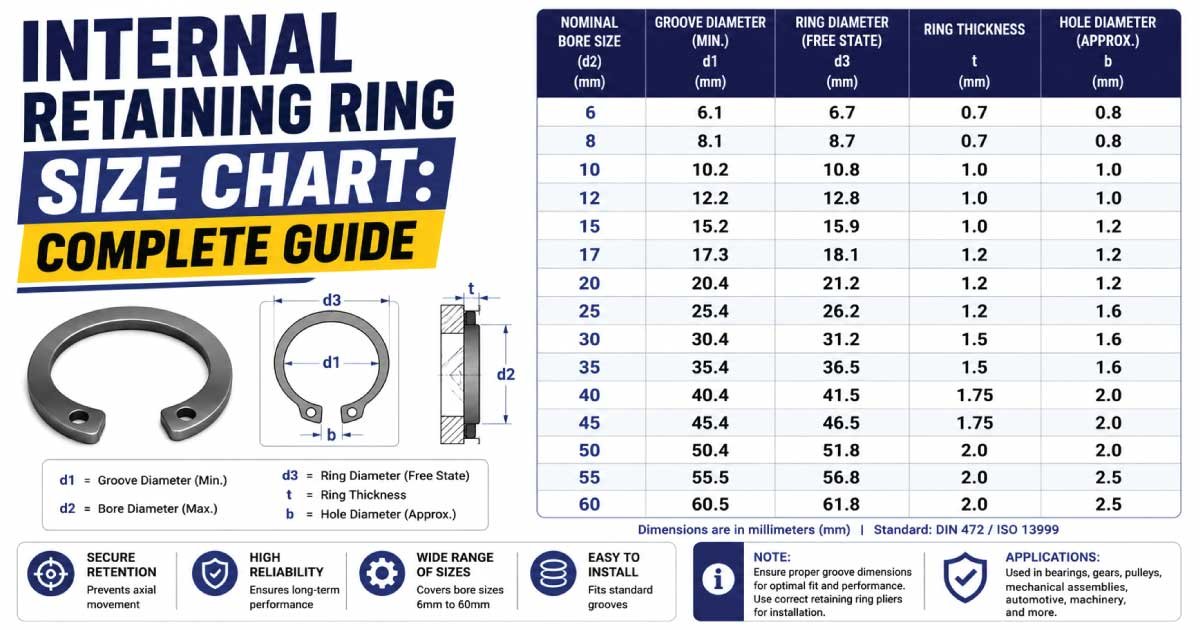
Internal retaining rings are precision-engineered retaining components used to secure parts inside a bore or housing. They fit into a machined groove within a hole and prevent axial movement of bearings, shafts, gears, and other rotating components.
Internal retaining rings are widely used in automotive systems, industrial machinery, gearboxes, pumps, motors, and mechanical assemblies.
Choosing the correct internal retaining ring size ensures proper fit, reliable holding force, and long-term equipment performance.
What Is an Internal Retaining Ring?
An internal retaining ring, also known as an internal snap ring or circlip, is a circular spring-steel fastener installed inside a bore. The ring expands outward against the groove walls to hold components securely in position.
Unlike external retaining rings that fit around shafts, internal retaining rings are designed specifically for installation inside holes or housings.
Key features include:
- Circular spring design
- Installed inside a bore groove
- Prevents axial movement
- Easy installation and removal
- High resistance to vibration
- Available in metric and imperial sizes
Why Internal Retaining Ring Size Matters
Selecting the correct retaining ring size is essential for maintaining proper fit and preventing component failure. An incorrect ring may not seat correctly in the groove, resulting in loosening, deformation, or unexpected movement.
Benefits of correct sizing include:
- Secure component retention
- Proper groove engagement
- Improved safety
- Reduced maintenance
- Longer service life
- Reliable mechanical performance
Internal Retaining Ring Size Chart (Metric)
The following chart shows common metric internal retaining ring sizes used in mechanical applications.
| Bore Diameter | Ring Size | Groove Diameter | Common Applications |
|---|---|---|---|
| 10 mm | 10 mm | 10.8 mm | Small mechanisms |
| 12 mm | 12 mm | 12.8 mm | Bearings and gears |
| 15 mm | 15 mm | 15.9 mm | Machinery parts |
| 20 mm | 20 mm | 21.0 mm | Motors and pumps |
| 25 mm | 25 mm | 26.2 mm | Industrial equipment |
| 30 mm | 30 mm | 31.3 mm | Gear assemblies |
| 40 mm | 40 mm | 41.3 mm | Heavy machinery |
| 50 mm | 50 mm | 51.8 mm | Large assemblies |
| 60 mm | 60 mm | 61.8 mm | Industrial applications |
Internal Retaining Ring Size Chart (Imperial)
Imperial internal retaining rings are commonly used in automotive, industrial, and older machinery applications.
| Bore Diameter | Ring Size | Typical Applications |
|---|---|---|
| 1/4″ | Small | Precision assemblies |
| 3/8″ | Small machinery | |
| 1/2″ | Bearings and shafts | |
| 3/4″ | Mechanical equipment | |
| 1″ | Industrial machinery | |
| 1-1/4″ | Heavy assemblies | |
| 1-1/2″ | Large equipment | |
| 2″ | Heavy-duty applications |
Main Parts of an Internal Retaining Ring
Understanding retaining ring dimensions helps in selecting the correct component for a specific application.
1. Ring Diameter
The diameter determines the size of the bore where the retaining ring will be installed. Proper diameter ensures the ring fits securely inside the groove.
2. Groove Diameter
The groove diameter is the machined diameter inside the bore where the retaining ring sits. Correct groove dimensions are necessary for proper engagement and load capacity.
3. Ring Thickness
The thickness determines the strength and load capacity of the retaining ring. Thicker rings generally provide greater resistance against axial forces.
4. Lug or Ear Design
Many internal retaining rings include small lugs with holes that allow installation and removal using retaining ring pliers.
Common Types of Internal Retaining Rings
Internal retaining rings are available in different designs to suit various mechanical requirements.
1. Standard Internal Retaining Ring
Standard internal retaining rings are the most common type used in general machinery and equipment. They provide reliable axial retention for bearings, shafts, and rotating components.
Advantages include:
- Simple design
- Easy installation
- Low cost
- Wide availability
2. Heavy Duty Internal Retaining Ring
Heavy-duty retaining rings are manufactured with increased thickness and strength for applications involving higher axial loads and impact forces.
Common uses include:
- Construction machinery
- Industrial gearboxes
- Heavy equipment
3. Spiral Internal Retaining Ring
Spiral retaining rings are manufactured from coiled wire and provide continuous support around the groove. They are commonly used where smooth operation and uniform load distribution are required.
4. Axial Internal Retaining Ring
Axial retaining rings are designed specifically to resist forces parallel to the shaft axis. They are widely used in rotating equipment and precision assemblies.
Common Internal Retaining Ring Materials
Material selection affects strength, flexibility, corrosion resistance, and service life.
1. Carbon Steel
Carbon steel is the most common material for internal retaining rings. It provides good strength and flexibility for general industrial applications.
Advantages include:
- Affordable
- High strength
- Easy availability
- Suitable for general machinery
2. Stainless Steel
Stainless steel retaining rings are used where corrosion resistance is required. They are suitable for outdoor equipment, marine systems, and chemical environments.
Benefits include:
- Excellent corrosion resistance
- Long service life
- Low maintenance
- Suitable for harsh environments
3. Spring Steel
Spring steel provides excellent elasticity and fatigue resistance. It is commonly used for high-performance retaining rings requiring repeated loading cycles.
Internal Retaining Ring Standards
Internal retaining rings are manufactured according to international standards to maintain consistent dimensions and performance.
Common standards include:
- DIN 472
- ANSI B27.7
- ASME standards
- ISO retaining ring standards
These standards define:
- Ring dimensions
- Groove specifications
- Material requirements
- Load ratings
- Manufacturing tolerances
Common Applications of Internal Retaining Rings
Internal retaining rings are widely used in mechanical systems where components must be securely positioned inside housings or bores.
Major applications include:
- Bearings
- Gearboxes
- Electric motors
- Pumps
- Automotive transmissions
- Hydraulic systems
- Power tools
- Agricultural machinery
- Industrial equipment
- Robotics
How Internal Retaining Rings Work
An internal retaining ring works by expanding outward into a machined groove inside a bore. When installed correctly, the ring creates a mechanical stop that prevents components from moving axially.
Working process:
- Ring is compressed using retaining ring pliers.
- Ring is inserted into the bore.
- Ring expands into the groove.
- Component rests against the retaining ring.
- Axial movement is prevented.
Factors Affecting Internal Retaining Ring Performance
Several factors influence the effectiveness and service life of an internal retaining ring.
Important factors include:
- Correct ring size
- Groove accuracy
- Material quality
- Installation method
- Operating temperature
- Load conditions
- Vibration levels
📊 View Standard Size Guide 👉 How to Measure Nut Size: Complete Step-by-Step Guide
How to Choose the Correct Internal Retaining Ring Size
Selecting the correct internal retaining ring size is essential for maintaining proper component positioning and preventing mechanical failure. The ring must match the bore diameter, groove dimensions, axial load requirements, and operating conditions. A properly selected retaining ring provides secure retention while allowing easy installation and maintenance.
1. Measure the Bore Diameter
The bore diameter is the primary measurement required when selecting an internal retaining ring. The ring must fit inside the housing bore and expand correctly into the groove.
Important measurements include:
- Bore diameter
- Groove diameter
- Groove width
- Ring thickness
- Component dimensions
2. Check Groove Dimensions
The retaining ring depends on the groove for proper support. Incorrect groove depth or width can reduce the ring’s holding capacity and cause premature failure.
Check the following:
- Groove diameter
- Groove width
- Groove depth
- Edge condition
- Surface finish
3. Match the Load Requirements
Different applications require different retaining ring strengths. Heavy machinery and high-speed rotating systems require stronger rings than lightweight assemblies.
Consider:
- Axial load
- Shock loads
- Vibration levels
- Rotation speed
- Operating environment
4. Select the Correct Material
The operating environment determines the best retaining ring material. Applications exposed to moisture or chemicals may require stainless steel, while high-load applications often use hardened spring steel.
Common material choices:
- Carbon steel
- Stainless steel
- Spring steel
- Alloy steel
Internal Retaining Ring Groove Dimension Chart
Correct groove dimensions are essential for achieving maximum retaining force and preventing ring failure.
| Ring Size | Groove Width | Groove Depth | Bore Diameter |
|---|---|---|---|
| 10 mm | 1.0 mm | 0.6 mm | 10 mm |
| 15 mm | 1.2 mm | 0.7 mm | 15 mm |
| 20 mm | 1.5 mm | 0.9 mm | 20 mm |
| 25 mm | 1.75 mm | 1.0 mm | 25 mm |
| 30 mm | 2.0 mm | 1.2 mm | 30 mm |
| 40 mm | 2.5 mm | 1.5 mm | 40 mm |
| 50 mm | 3.0 mm | 1.8 mm | 50 mm |
| 60 mm | 3.5 mm | 2.2 mm | 60 mm |
Internal Retaining Ring Load Capacity Chart
Load capacity depends on ring material, groove design, installation quality, and application conditions. The following values provide general guidance.
| Ring Diameter | Light Load | Medium Load | Heavy Load |
|---|---|---|---|
| 10 mm | 100–300 N | 300–500 N | 500–800 N |
| 20 mm | 500–1000 N | 1000–2000 N | 2000–3000 N |
| 30 mm | 1000–2500 N | 2500–4000 N | 4000–6000 N |
| 40 mm | 2000–4000 N | 4000–7000 N | 7000–10000 N |
| 50 mm | 3000–6000 N | 6000–10000 N | 10000–15000 N |
Internal Retaining Ring Material Comparison
Different materials provide different levels of strength, flexibility, and corrosion resistance.
| Material | Strength | Corrosion Resistance | Typical Applications |
|---|---|---|---|
| Carbon Steel | High | Moderate | General machinery |
| Spring Steel | Very High | Moderate | High-cycle applications |
| Stainless Steel | High | Excellent | Marine and outdoor equipment |
| Alloy Steel | Excellent | Moderate | Heavy-duty machinery |
Advantages of Internal Retaining Rings
Internal retaining rings provide an efficient and economical method for securing components inside housings and bores. Their compact design makes them suitable for applications where space is limited.
Advantages include:
- Simple installation
- Compact design
- High axial load resistance
- Easy removal and replacement
- Cost-effective fastening solution
- Reliable vibration resistance
- No threading required
- Suitable for rotating components
Limitations of Internal Retaining Rings
Although internal retaining rings are widely used, they require accurate machining and proper installation to perform effectively.
Common limitations include:
- Require precision grooves
- Limited load capacity compared with bolts
- Incorrect installation may cause failure
- Can deform if overloaded
- Need special pliers for installation
- Not suitable for all environments
📊 View Standard Size Guide 👉 How to Measure Washer Size: Complete Guide
How to Install an Internal Retaining Ring
Proper installation prevents damage to the ring and ensures secure component retention.
Basic Installation Steps
- Clean the bore and groove area.
- Inspect the groove for damage.
- Select the correct retaining ring size.
- Compress the ring using retaining ring pliers.
- Insert the ring into the bore.
- Release the pliers carefully.
- Ensure the ring is fully seated inside the groove.
- Inspect the final installation.
Tools Used for Internal Retaining Ring Installation
Using the correct tools prevents bending, overstretching, or damaging the retaining ring.
Common tools include:
- Internal snap ring pliers
- Precision retaining ring pliers
- Circlip installation tools
- Inspection gauges
- Measuring calipers
Maintenance Tips for Internal Retaining Rings
Regular inspection helps prevent unexpected failures in mechanical assemblies.
Maintenance recommendations:
- Inspect rings for cracks
- Check groove condition
- Replace damaged rings
- Monitor corrosion
- Avoid overstretching during removal
- Verify proper seating
- Follow equipment maintenance schedules
Common Installation Mistakes
Incorrect installation can reduce the holding strength of an internal retaining ring and may lead to component movement.
Avoid these mistakes:
- Using incorrect ring size
- Installing into damaged grooves
- Over-expanding the ring
- Using improper tools
- Ignoring groove dimensions
- Reusing worn retaining rings
- Installing without inspection
- Selecting incorrect material
Internal Retaining Ring vs External Retaining Ring
Both retaining rings prevent axial movement, but they are designed for different installation locations.
| Feature | Internal Retaining Ring | External Retaining Ring |
|---|---|---|
| Installation Location | Inside bore | Around shaft |
| Load Direction | Outward force | Inward force |
| Common Use | Bearings and housings | Shafts and rotating parts |
| Groove Location | Internal groove | External groove |
| Installation Tool | Internal pliers | External pliers |
Internal Retaining Ring vs Circlip
Internal retaining rings and circlips are often used interchangeably, but their designs may vary depending on standards and applications.
| Feature | Internal Retaining Ring | Circlip |
|---|---|---|
| Design | Engineered retaining ring | General snap ring |
| Precision | High | Medium |
| Applications | Industrial machinery | General mechanical assemblies |
| Material | Spring steel | Various steels |
| Load Capacity | Application dependent | Application dependent |
Industries That Use Internal Retaining Rings
Internal retaining rings are essential components across many industries where secure mechanical retention is required.
Major industries include:
- Automotive manufacturing
- Aerospace engineering
- Industrial machinery
- Robotics
- Agricultural equipment
- Power tools
- Hydraulic systems
- Medical equipment
- Manufacturing equipment
- Electrical motors
Final Recommendations
Internal retaining rings are essential mechanical components that provide secure axial retention in a wide range of applications.
Selecting the correct size, groove dimensions, material, and load capacity ensures reliable performance and prevents component movement.
From automotive transmissions and industrial machinery to pumps, motors, and precision equipment, properly installed internal retaining rings offer a simple, durable, and cost-effective solution for maintaining mechanical stability and extending equipment life.
📊 View Standard Size Guide 👉 Bevel Gear Size Chart: Ultimate Guide to Gear Sizes
FAQs:
What is an internal retaining ring used for?
An internal retaining ring is used to secure components inside a bore or housing by fitting into a machined internal groove. It prevents the axial movement of bearings, gears, bushings, shafts, and other mechanical parts, ensuring proper alignment and reliable operation in automotive, industrial, and machinery applications.
How do I measure an internal retaining ring?
Measure the bore diameter, ring thickness, groove width, and groove depth using precision measuring tools such as calipers or micrometers. Comparing these measurements with a standard retaining ring size chart ensures the ring fits correctly, provides adequate holding strength, and functions reliably in the intended assembly.
Can internal retaining rings be reused?
Internal retaining rings can sometimes be reused if they remain free from cracks, corrosion, permanent deformation, or excessive wear. However, for high-load or safety-critical applications, replacing the retaining ring is recommended to ensure reliable retention, maintain proper performance, and reduce the risk of mechanical failure.
What tool is used to install internal retaining rings?
Internal retaining rings are installed using internal snap ring pliers, which compress the ring so it can be inserted into the bore groove. Using the correct installation tool helps prevent ring damage, ensures accurate positioning, and improves both installation safety and long-term fastening reliability.
What material is best for internal retaining rings?
Spring steel is the most common material for internal retaining rings because it provides excellent elasticity, strength, and fatigue resistance. Stainless steel is preferred for corrosive or moisture-prone environments, offering superior rust resistance and long-lasting performance in marine, food processing, and outdoor industrial applications.

Engineer Hassan is a Mechanical Engineer with 16+ years of hands-on experience in mechanical hardware, fasteners, and workshop tools. He focuses on size selection, thread identification, and measurement, helping users choose the correct components with accuracy and safety.