
Self-tapping screws are among the most commonly used fasteners in construction, manufacturing, automotive work, and DIY projects. Unlike standard screws, these fasteners can create their own threads as they are driven into a material, eliminating the need for pre-threaded holes in many applications.
Understanding a Self-Tapping Screw Size Chart is essential for selecting the correct screw size, ensuring strong fastening, and preventing material damage. In this complete guide, you will learn about self-tapping screw sizes, types, dimensions, applications, and how to choose the right screw for your project.
What Is a Self-Tapping Screw?
A self-tapping screw is a threaded fastener designed to cut or form its own mating threads when driven into materials such as metal, plastic, wood, or fiberglass.
The main advantage of self-tapping screws is that they reduce installation time and eliminate the need for separate threading operations in many applications.
Common industries that use self-tapping screws include:
- Construction
- Automotive manufacturing
- HVAC systems
- Electronics
- Furniture assembly
- Metal fabrication
How Self-Tapping Screws Work
When the screw is driven into a pilot hole or directly into certain materials, the sharp threads cut into the material and create matching threads.
The screw then locks securely into place.
The process involves:
- Penetrating the material
- Cutting or forming threads
- Creating a secure fastening connection
- Providing resistance against loosening
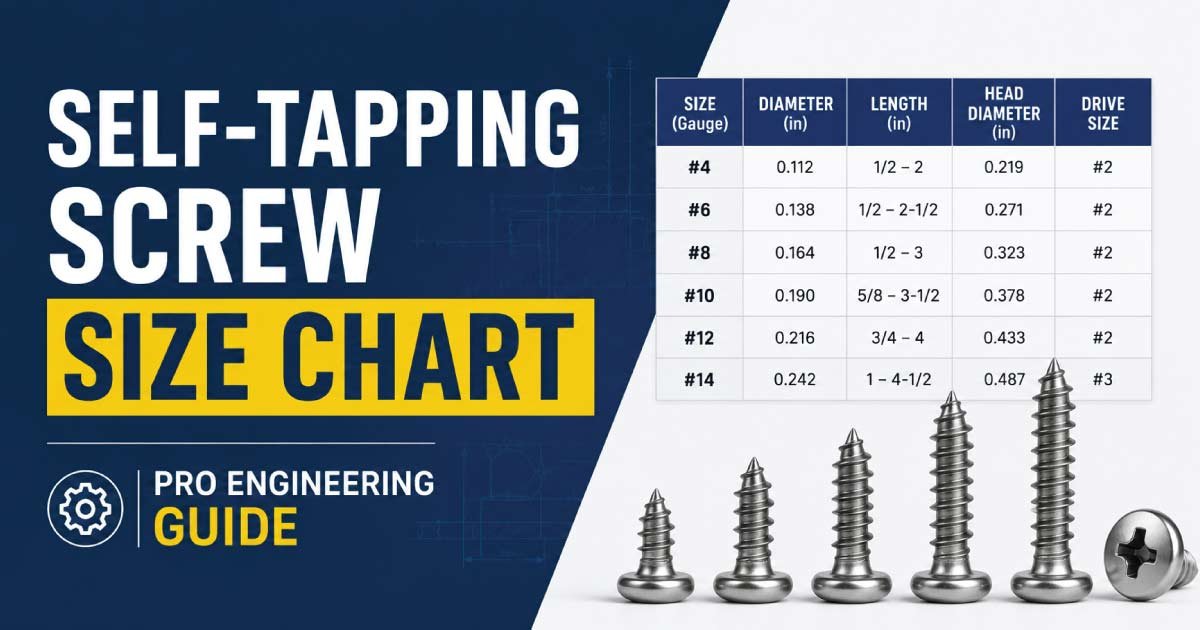
Self-Tapping Screw Size Chart
The following chart shows common self-tapping screw sizes and their approximate dimensions.
| Screw Size | Major Diameter (Inches) | Major Diameter (mm) |
|---|---|---|
| #2 | 0.086 | 2.18 |
| #4 | 0.112 | 2.84 |
| #6 | 0.138 | 3.51 |
| #8 | 0.164 | 4.17 |
| #10 | 0.190 | 4.83 |
| #12 | 0.216 | 5.49 |
| #14 | 0.242 | 6.15 |
| #16 | 0.268 | 6.81 |
| #18 | 0.294 | 7.47 |
| #20 | 0.320 | 8.13 |
These sizes are commonly found in a standard Self-Tapping Screw Size Chart and are widely used across different industries.
Common Self-Tapping Screw Lengths
Self-tapping screws are available in various lengths depending on the application.
| Length (Inches) | Length (mm) |
|---|---|
| 1/4″ | 6.35 mm |
| 3/8″ | 9.52 mm |
| 1/2″ | 12.7 mm |
| 5/8″ | 15.9 mm |
| 3/4″ | 19.05 mm |
| 1″ | 25.4 mm |
| 1-1/4″ | 31.75 mm |
| 1-1/2″ | 38.1 mm |
| 2″ | 50.8 mm |
| 3″ | 76.2 mm |
Selecting the correct length is just as important as choosing the proper diameter.
Types of Self-Tapping Screws
Different applications require different self-tapping screw designs. These fasteners are engineered to cut, form, or drill their own threads depending on the material. Choosing the correct type improves grip strength, installation speed, and overall durability in metal, plastic, and construction applications.
1. Thread-Cutting Self-Tapping Screws
These screws remove material as they are installed, forming precise internal threads inside the base material. They are ideal for harder materials where accurate and clean threading is required. Their cutting action reduces installation stress and ensures a strong, reliable mechanical joint for long-term use.
Features:
- Sharp cutting edges
- Precise threads
- Excellent for metal applications
Common uses:
- Sheet metal
- Aluminum
- Plastic components
2. Thread-Forming Self-Tapping Screws
These screws displace material instead of cutting it, forming threads by pushing the material aside. This creates a tighter and stronger connection, especially in softer materials. They are widely used where vibration resistance and long-term fastening strength are more important than easy removal.
Advantages:
- Stronger threads
- Reduced material removal
- Better vibration resistance
Common applications:
- Plastic assemblies
- Soft metals
- Electrical housings
3. Sheet Metal Self-Tapping Screws
These screws are designed specifically for thin metal sheets where strong holding power is required. Their sharp points and aggressive threads allow quick penetration and secure fastening. They are commonly used in fabrication and assembly work involving lightweight metal structures where stability is essential.
Features include:
- Sharp points
- Aggressive threads
- High holding power
4. Self-Drilling Screws
These screws are often confused with standard self-tapping screws, but they include a built-in drill point. They can drill, tap, and fasten in a single step without needing a pilot hole. This makes them highly efficient for fast and heavy-duty construction work.
These screws include:
- Built-in drill point
- Thread-cutting capability
- No separate pilot hole required
They are widely used in roofing and steel construction.
Understand The Self-Tapping Screw Dimensions
A Self-Tapping Screw Size Chart typically includes several key measurements that help determine the correct screw for different materials and applications. These dimensions directly affect strength, fit, performance, and overall reliability of the fastening system.
1. Major Diameter
The major diameter is the largest diameter of the screw thread, measured across the outer edges. It is one of the most important sizing factors because it defines how well the screw fits into a hole and how much load it can handle during operation.
This measurement determines:
- Hole size
- Strength
- Load capacity
A larger major diameter provides higher strength and better holding power, especially in heavy-duty applications where stability is essential.
2. Minor Diameter
The minor diameter is measured at the root of the screw threads, where the core of the screw is narrowest. This dimension plays an important role in determining thread engagement and resistance against pull-out forces.
This dimension affects:
- Thread engagement
- Pull-out resistance
- Core strength of the screw
A stronger core improves durability and helps the screw withstand higher mechanical loads without failure.
3. Thread Pitch
Thread pitch refers to the distance between two adjacent threads on the screw. It controls how smoothly or quickly the screw advances into the material during installation and directly impacts performance.
Thread pitch impacts:
- Installation speed
- Holding strength
- Material compatibility
Fine pitch threads offer better grip in softer materials, while coarse pitch threads allow faster installation in harder materials.
4. Length
The length of a self-tapping screw is measured from the underside of the head to the tip in most screw types. For countersunk screws, it is measured from the top of the head to the tip to ensure accurate sizing.
This dimension determines how deeply the screw penetrates into the material and how securely it holds components together.
Self-Tapping Screw Head Types
Different head styles serve different purposes in fastening applications. The head type affects torque handling, installation method, load distribution, and final appearance. Choosing the correct head style improves performance, especially in construction, machinery, and sheet metal work.
1. Pan Head
Pan head screws have a rounded top with a flat bearing surface underneath. This design provides good contact with the material and makes them suitable for general-purpose fastening where a neat but raised head is acceptable.
Features:
- Rounded top
- Flat bearing surface
- General-purpose design
2. Flat Head
Flat head screws are designed to sit flush with the surface after installation. They are commonly used where a smooth and clean finish is required, especially in visible applications or where protruding heads are not allowed.
Features:
- Countersinks into material
- Flush finish
- Attractive appearance
3. Hex Head
Hex head screws are designed for high torque applications and are typically installed using a wrench or socket tool. They provide strong grip and are widely used in heavy-duty construction and mechanical assemblies.
Advantages:
- High torque capacity
- Easy installation
- Popular in construction
4. Truss Head
Truss head screws have an extra-wide head that spreads load over a larger surface area. This makes them ideal for thin or soft materials where preventing pull-through is important.
Features:
- Extra-wide head
- Improved load distribution
- Ideal for thin materials
Self-Tapping Screw Drive Types
The drive type of a self-tapping screw determines the tool required for installation and directly affects torque transfer, ease of use, and stripping resistance. Choosing the right drive style improves efficiency and reduces damage during fastening.
1. Phillips
Phillips drive screws are one of the most commonly used types. They are designed to allow controlled slipping (cam-out) when too much torque is applied, which helps prevent over-tightening in general applications.
Common features:
- Cross-shaped slot
- Widely available
- Easy to use
2. Slotted
Slotted drives are the oldest and simplest screw drive type. They use a single straight groove and are typically used in light-duty or low-torque applications.
Common features:
- Single straight slot
- Simple design
- Easy to manufacture
3. Torx
Torx drives have a star-shaped design that provides excellent torque transfer and reduces cam-out significantly. This makes them ideal for high-performance and precision applications where reliability is important.
Common features:
- Star-shaped pattern
- High torque capacity
- Reduced cam-out
4. Square Drive
Square drive screws offer strong grip between the tool and screw, reducing slipping during installation. They are widely used in woodworking and construction applications where stability is important.
Common features:
- Square-shaped recess
- Good torque transfer
- Less slipping
5. Hex Drive
Hex drive screws use a six-sided internal or external shape, allowing high torque application. They are commonly used in heavy-duty mechanical and structural applications.
Common features:
- Six-sided design
- High torque capacity
- Strong tool engagement
6. Pozidriv
Pozidriv is an improved version of the Phillips drive, offering better grip and reduced cam-out. It is commonly used in Europe and in applications requiring more precise torque control.
Common features:
- Enhanced cross design
- Better grip than Phillips
- Reduced slipping
Torx drives are becoming increasingly popular due to their excellent torque transfer and reduced cam-out, making them ideal for modern high-performance fastening applications.
Materials Used for Self-Tapping Screws
The material of a self-tapping screw plays a major role in determining its strength, durability, and resistance to corrosion. Different environments and applications require different materials to ensure long-lasting and reliable fastening performance.
1. Carbon Steel
Carbon steel is one of the most commonly used materials for self-tapping screws due to its high strength and cost-effectiveness. It performs well in general applications and is often treated with coatings to improve resistance against rust and environmental damage.
Benefits:
- Strong
- Affordable
- Widely available
Carbon steel screws are often zinc-coated to provide extra protection against corrosion, making them suitable for indoor and moderately exposed environments.
2. Stainless Steel
Stainless steel screws are highly valued for their excellent resistance to corrosion and rust. They are widely used in environments where moisture, chemicals, or outdoor exposure is common. This makes them ideal for long-term installations.
Advantages:
- Excellent corrosion resistance
- Suitable for outdoor use
- Long service life
They are commonly used in marine, construction, and exterior applications where durability is essential.
3. Hardened Steel
Hardened steel screws are designed for high-strength applications where extra durability is required. They undergo heat treatment to improve hardness, making them suitable for fastening into tougher or denser materials.
Features:
- High strength
- Increased durability
- Suitable for hard materials
These screws are commonly used in industrial and heavy-duty mechanical applications.
4. Brass
Brass screws are used where appearance and corrosion resistance are important. They have a golden finish and are often chosen for decorative purposes as well as electrical and light-duty applications.
Common use:
- Decorative applications
- Electrical fittings
- Corrosion-resistant environments
Brass provides a good balance of aesthetics and functional corrosion resistance, especially in indoor or low-stress environments.
How to Read a Self-Tapping Screw Size Chart
Reading a size chart becomes simple when you understand the key dimensions and follow a step-by-step approach. Each step ensures you select the correct screw for strength, fit, and material compatibility in different applications.
Step 1: Identify the Screw Diameter
Start by identifying the screw diameter, which determines the overall thickness and strength of the fastener. It is usually represented in gauge numbers or inches in size charts.
Example:
- #8 screw = 0.164 inches
A correct diameter ensures proper fit and prevents loosening or material damage.
Step 2: Determine the Required Length
Next, select the correct screw length based on how deep the screw must penetrate into the material. Length is critical for achieving secure fastening without over-penetration.
Example:
- 1-inch length
Choosing the right length improves grip strength and overall joint stability.
Step 3: Select the Thread Type
Choose the appropriate thread type depending on the material you are working with. Different threads are designed for cutting, forming, or drilling into specific surfaces.
Thread selection affects:
- Grip strength
- Installation ease
- Material compatibility
Step 4: Choose the Appropriate Head Style
Select the head type based on the application and required finish. Head styles affect torque handling and surface appearance after installation.
Common options include:
- Pan head
- Flat head
- Hex head
- Truss head
Each head type serves a different structural and visual purpose.
Step 5: Verify Material Compatibility
Finally, ensure the screw material matches the working environment. This step is important for preventing corrosion, wear, and premature failure.
Material choice affects:
- Strength
- Corrosion resistance
- Service life
Following these steps helps ensure proper fastener selection and long-term performance.
How to Choose the Correct Self-Tapping Screw Size
Choosing the correct self-tapping screw size is essential for strength, durability, and safe assembly. The right choice depends on material thickness, load conditions, environment, vibration exposure, and installation method. Each factor directly affects performance and reliability in real applications.
1. Material Thickness
Material thickness is one of the most important factors in screw selection. The screw must be long enough to fully engage the material and form strong threads without passing too far beyond the surface. Thin sheets require shorter screws, while thicker materials need longer screws for proper holding strength and stability during use.
2. Load Requirements
Load requirements determine the diameter and strength of the screw. Light applications such as plastic or thin metal need smaller screws, while heavy structural loads require thicker and high-strength screws. A properly selected screw prevents bending, loosening, or failure when subjected to static pressure or dynamic forces over time.
3. Environmental Conditions
Environmental conditions greatly influence screw material choice. Outdoor or humid environments require corrosion-resistant options like stainless steel or coated screws to prevent rust and degradation. Indoor dry environments can use standard steel screws. Choosing the right material ensures long service life and maintains fastening strength under changing weather conditions.
4. Vibration Exposure
Vibration can loosen improperly selected screws over time, especially in machinery, vehicles, or moving equipment. To prevent this, deeper thread engagement and stronger fastening designs are required. Screws designed for vibration resistance maintain grip better and reduce the risk of loosening, improving safety and long-term mechanical stability in operation.
5. Installation Method
Installation method affects screw performance and ease of use. Power tools require screws designed for higher torque and compatible drive types such as Phillips, Torx, or hex. Proper matching reduces stripping, speeds up installation, and ensures smooth fastening. Choosing the right drive type improves efficiency and prevents damage during assembly.
Pilot Hole Sizes for Self-Tapping Screws
Many self-tapping screws require pilot holes.
General pilot hole guidelines:
| Screw Size | Typical Pilot Hole |
|---|---|
| #4 | 3/32″ |
| #6 | 7/64″ |
| #8 | 1/8″ |
| #10 | 9/64″ |
| #12 | 5/32″ |
Always verify manufacturer recommendations before drilling.
Applications of Self-Tapping Screws
Self-tapping screws are widely used across many industries because they can create their own threads without pre-tapping. This makes installation faster, more efficient, and highly reliable in both light-duty and heavy-duty applications.
1. Construction
In the construction industry, self-tapping screws are essential for fast and strong fastening in metal and structural applications. They help reduce installation time while ensuring durable joints in demanding environments.
Applications include:
- Metal framing
- Roofing systems
- HVAC installation
2. Automotive Industry
Self-tapping screws are commonly used in vehicles where quick assembly and strong holding power are required. They are ideal for both structural and interior components that need vibration resistance and durability.
Used for:
- Interior panels
- Trim components
- Electrical brackets
3. Electronics
In electronics manufacturing, these screws are used for assembling delicate but precise components. They provide secure fastening without damaging sensitive materials or housings.
Common uses:
- Device enclosures
- Control panels
- Electrical boxes
4. Furniture Manufacturing
Self-tapping screws are widely used in furniture production for quick assembly and strong joints. They help in creating durable furniture structures while maintaining clean and precise fitting.
Used for:
- Cabinet assembly
- Metal furniture
- Adjustable fixtures
5. Home Improvement
For DIY and home improvement projects, self-tapping screws are a practical choice due to their ease of use and versatility. They are commonly used in both indoor and outdoor repair and installation tasks.
DIY enthusiasts use them for:
- Repairs
- Shelving
- Outdoor projects
Common Installation Mistakes
Correct installation of self-tapping screws is just as important as choosing the right size. Even a high-quality screw can fail if installed incorrectly. Understanding common mistakes helps improve joint strength, durability, and overall performance in different applications.
1. Using the Wrong Size
Using the wrong screw size is a frequent installation error. If the screw is too small, it will not hold properly and may loosen under load. If it is too large, it can crack the material or strip threads. Proper sizing ensures a strong, secure, and long-lasting joint.
2. Excessive Tightening
Overtightening is another common mistake that can seriously damage threads. When too much force is applied, the screw may strip the material or lose its holding ability. It can also weaken the joint structure. Tightening should be controlled to ensure a firm grip without damaging the internal threads.
3. Wrong Pilot Hole Size
A correctly sized pilot hole is essential for proper screw engagement. If the hole is too large, the threads will not grip securely, leading to weak fastening. If it is too small, it can cause cracking or difficulty in installation. Proper pilot hole sizing ensures maximum thread contact and stability.
4. Using the Wrong Material
Choosing the wrong screw material can lead to early failure, especially in harsh environments. For example, carbon steel screws may rust quickly in moisture or outdoor conditions. In such cases, stainless steel or coated screws are better options. Selecting the right material ensures durability, corrosion resistance, and long-term performance.
Self-Tapping Screw vs Self-Drilling Screw
Many people confuse these fasteners.
| Feature | Self-Tapping Screw | Self-Drilling Screw |
|---|---|---|
| Creates Threads | Yes | Yes |
| Built-in Drill Point | No | Yes |
| Pilot Hole Needed | Often | Usually No |
| Metal Applications | Excellent | Excellent |
| Installation Speed | Fast | Very Fast |
Understanding this distinction helps ensure proper fastener selection.
Maintenance and Inspection
Regular maintenance and inspection of self-tapping screws is essential to ensure safety, reliability, and long service life. Over time, environmental exposure, vibration, and load stress can reduce performance, so routine checks help prevent failure in critical applications.
1. Check for Corrosion
Corrosion is one of the most common issues, especially in outdoor or humid environments. It weakens the screw material and reduces holding strength, which can lead to structural instability if not addressed early.
Look for:
- Rust formation
- Surface discoloration
- Pitting or material degradation
2. Check for Loose Fasteners
Loose screws can occur due to vibration, thermal expansion, or improper installation. This can reduce joint strength and may lead to component movement or failure in mechanical systems.
Inspect for:
- Movement in joints
- Reduced grip strength
- Gaps between connected parts
3. Check for Damaged Threads
Threads are critical for holding strength, and any damage can significantly affect performance. Stripped or worn threads reduce engagement and may cause the screw to fail under load.
Look for:
- Stripped threads
- Deformed thread shape
- Poor engagement during tightening
4. Check Head Wear
Head wear occurs when the screw head becomes rounded or damaged due to repeated tightening or incorrect tools. This can make removal or tightening difficult and reduce torque efficiency.
Inspect for:
- Rounded edges
- Tool slip marks
- Deformation of head shape
5. Replacement Recommendation
Any damaged or weakened screws should be replaced immediately to maintain structural integrity and prevent system failure. Regular replacement ensures consistent performance and long-term safety in all applications.
Conclusion
A Self-Tapping Screw Size Chart is an essential reference for selecting the correct screw diameter, length, and thread design. Whether you’re working with sheet metal, plastic, wood, or construction materials, choosing the right self-tapping screw ensures secure fastening, improved durability, and reliable performance.
By understanding screw dimensions, pilot hole requirements, materials, and applications, you can confidently select the best self-tapping screw for any project. Proper sizing and installation not only improve safety but also maximize the lifespan of the finished assembly.
Also Read: 👉 J-Bolt Size Chart: Types, Sizes & Uses, Complete Guide is a must-read guide for engineers, mechanics, and DIY users. Learn accurate sizing, applications, types, and selection tips. This post helps you choose the right J-bolt for strong fastening, safety, and durability. Read the full article for detailed expert insights now today.

Engineer Hassan is a Mechanical Engineer with 16+ years of hands-on experience in mechanical hardware, fasteners, and workshop tools. He focuses on size selection, thread identification, and measurement, helping users choose the correct components with accuracy and safety.