
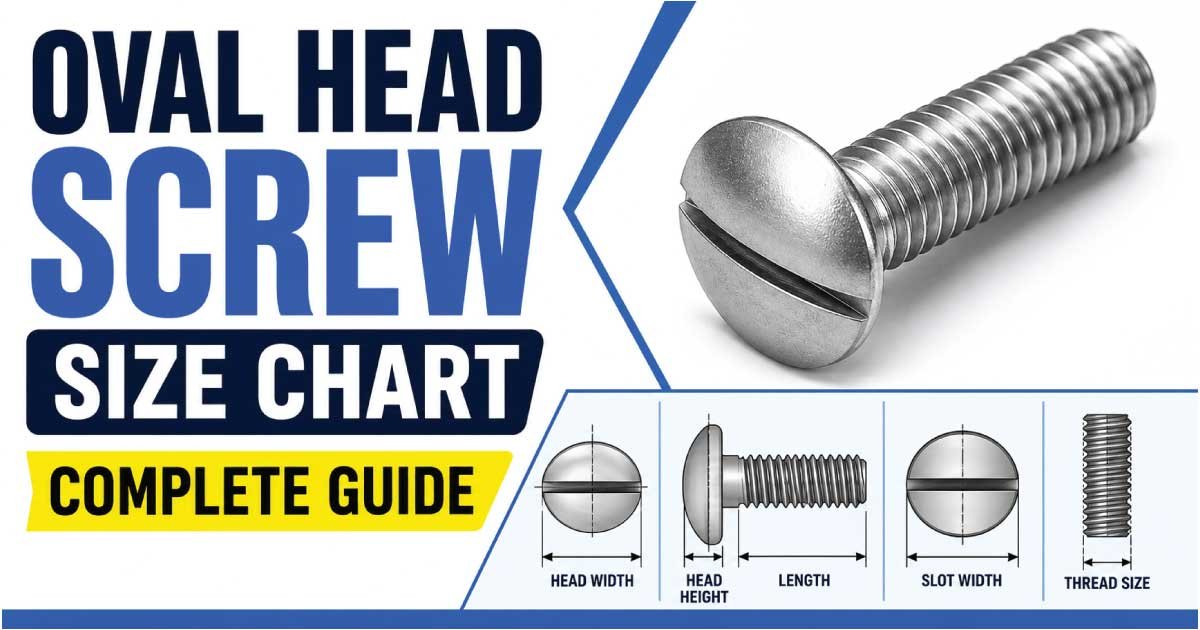
Oval head screws are widely used when a fastener needs a partially countersunk head with a rounded, finished top. They provide a cleaner appearance than many raised-head fasteners while still offering a visible decorative head profile.
Also known as oval countersunk screws or raised countersunk head screws, these fasteners are commonly used in woodworking, furniture, electrical equipment, sheet metal, cabinetry, marine applications, and general construction.
Selecting the correct oval head screw size requires more than choosing the screw diameter. You should also consider screw length, thread type, head diameter, head height, countersink angle, drive type, material, and finish.
This complete oval head screw size chart and guide explains common metric and imperial sizes, how oval head screws are measured, common dimensions, thread types, drive styles, materials, applications, installation methods, and how to choose the correct screw for your project.
What Is an Oval Head Screw?
An oval head screw is a screw with a countersunk underside and rounded, domed upper surface. When installed correctly, the tapered portion of the head sits inside a countersunk hole while the rounded top remains slightly above the material surface.
This creates a smooth and finished appearance.
Oval head screws are commonly used for:
- Furniture
- Woodworking
- Cabinets
- Door hardware
- Electrical equipment
- Metal brackets
- Decorative hardware
- Marine applications
- General construction
- DIY projects
The combination of a countersunk underside and rounded top makes oval head screws particularly useful when both appearance and secure fastening are important.
Understanding Oval Head Screw Dimensions
Several measurements are important when selecting an oval head screw.
Screw Diameter
The nominal diameter refers to the diameter of the threaded portion.
Common metric sizes include:
- M3
- M4
- M5
- M6
- M8
- M10
Common imperial sizes include:
- #4
- #6
- #8
- #10
- #12
- 1/4 inch
The available sizes depend on the screw type and manufacturer.
Screw Length
For a countersunk or oval head screw, length is generally measured from the top of the head to the tip.
This differs from pan head screws, where length is normally measured from the underside of the head.
This distinction is important when comparing screw sizes.
Head Diameter
Head diameter is the maximum width across the oval-shaped head.
It determines the visible head size and affects the bearing area around the countersunk hole.
Head Height
Head height is the distance from the bottom of the countersunk portion to the highest point of the rounded head.
Thread Pitch
Metric machine screws are commonly specified by thread pitch.
For example:
M5 × 0.8
means a 5 mm nominal diameter and 0.8 mm thread pitch.
Imperial screws are usually identified by threads per inch (TPI).
Metric Oval Head Screw Size Chart
The following chart provides common metric oval head screw thread sizes.
| Screw Size | Nominal Diameter | Common Coarse Pitch | Typical Application |
|---|---|---|---|
| M3 | 3 mm | 0.50 mm | Electronics and small hardware |
| M4 | 4 mm | 0.70 mm | General fastening |
| M5 | 5 mm | 0.80 mm | Equipment and brackets |
| M6 | 6 mm | 1.00 mm | Machinery and hardware |
| M8 | 8 mm | 1.25 mm | Heavy general fastening |
| M10 | 10 mm | 1.50 mm | Larger mechanical assemblies |
| M12 | 12 mm | 1.75 mm | Heavy-duty applications |
These values represent common coarse metric thread specifications. Exact head dimensions and available lengths depend on the screw standard and manufacturer.
Imperial Oval Head Screw Size Chart
Imperial oval head screws are commonly specified by numbered screw size and thread count.
| Screw Size | Approx. Major Diameter | Common Coarse Thread | Typical Application |
|---|---|---|---|
| #4 | 0.112 in | 40 TPI | Small hardware |
| #6 | 0.138 in | 32 TPI | General fastening |
| #8 | 0.164 in | 32 TPI | Woodworking and equipment |
| #10 | 0.190 in | 24 TPI | Machinery and construction |
| #12 | 0.216 in | 24 TPI | Heavy general fastening |
| 1/4 in | 0.250 in | 20 TPI | Hardware and machinery |
| 5/16 in | 0.313 in | 18 TPI | Heavy-duty assemblies |
| 3/8 in | 0.375 in | 16 TPI | Larger mechanical applications |
Fine-thread versions may also be available for some imperial sizes.
How to Read an Oval Head Screw Size
Oval head screw specifications commonly include diameter and length.
For example:
M5 × 30 mm
means:
- M = metric thread
- 5 = 5 mm nominal diameter
- 30 mm = screw length
If the thread pitch is specified:
M5 × 0.8 × 30 mm
means:
- 5 mm nominal diameter
- 0.8 mm thread pitch
- 30 mm overall screw length
An imperial designation such as:
#10-24 × 1 in
means:
- #10 nominal screw size
- 24 threads per inch
- 1-inch screw length
Always check whether the manufacturer’s length specification is measured from the top of the head, as is typical for countersunk-style screws.
How to Measure an Oval Head Screw
If you need to replace an existing oval head screw, accurate measurement is important.
Step 1: Measure the Screw Diameter
Use a caliper to measure the outside diameter of the threaded section.
Compare it with a metric or imperial screw chart.
Step 2: Measure the Overall Length
For an oval countersunk screw, measure from the top of the head to the tip.
Do not measure only the threaded portion.
Step 3: Measure the Head Diameter
Measure across the widest part of the oval head.
Step 4: Measure the Head Height
Measure from the underside of the head to the highest point of the rounded top.
Step 5: Determine Thread Pitch
Use a thread pitch gauge to determine the metric pitch or imperial TPI.
Step 6: Identify the Drive
Check whether the screw uses:
- Phillips
- Slotted
- Pozidriv
- Torx
- Hex socket
- Combination drive
Oval Head Screw Length Measurement
Length measurement is particularly important with oval head screws because they are countersunk.
Unlike a pan head screw, where length is generally measured below the head, an oval head screw is normally measured from the top of the head to the tip.
For example, if you purchase a 1-inch oval head screw, the stated 1-inch dimension normally represents the complete screw length including the countersunk head.
This allows the screw to sit flush or nearly flush with the surface after installation.
Always verify the manufacturer’s measurement convention when exact dimensions are required.
Oval Head Screw vs Flat Head Screw
Oval and flat head screws are both countersunk fasteners, but their head profiles are different.
| Feature | Oval Head Screw | Flat Head Screw |
|---|---|---|
| Top profile | Rounded | Flat |
| Underside | Countersunk | Countersunk |
| Surface appearance | Raised rounded top | Flush |
| Head visibility | Visible | Minimal |
| Common use | Decorative and finished applications | Flush fastening |
| Countersinking | Required | Required |
An oval head screw is a good choice when you want the fastener to sit neatly in a countersunk hole while retaining a rounded decorative appearance.
Discover More: Lag Bolt Size Chart, Types, Uses With Complete Guide
Oval Head Screw vs Pan Head Screw
These two screws have noticeably different head designs.
Oval Head Screw
An oval head screw has a tapered underside that fits into a countersunk hole.
The top remains rounded and slightly raised.
Pan Head Screw
A pan head screw has a rounded head with a relatively flat underside and normally sits completely above the surface.
Therefore:
- Use an oval head screw for countersunk installation.
- Use a pan head screw when a raised head without countersinking is acceptable.
Oval Head Screw Drive Types
Oval head screws are available with several drive styles.
Phillips Oval Head Screw
Phillips drives are common in general-purpose applications and are available in many screw sizes.
The driver size should match the screw recess.
Slotted Oval Head Screw
Slotted screws have a simple straight-line drive.
They are commonly used in traditional hardware and decorative applications.
Pozidriv Oval Head Screw
Pozidriv screws provide a different recess geometry from Phillips screws.
Using the correct Pozidriv driver helps reduce damage to the drive recess.
Torx Oval Head Screw
Torx screws have a six-lobed star-shaped recess and provide good driver engagement.
They are commonly used where higher installation torque or improved resistance to cam-out is desirable.
Oval Head Machine Screws
Oval head machine screws use machine threads designed to engage with:
- Nuts
- Tapped holes
- Threaded inserts
- Metal components
- Machinery assemblies
They are commonly used in:
- Electrical panels
- Machinery
- Metal enclosures
- Hardware assemblies
- Equipment
- Automotive components
When selecting an oval head machine screw, match the diameter, pitch, length, material, and drive to the mating component.
Oval Head Wood Screws
Oval head wood screws are designed specifically for fastening wood and wood-based materials.
They commonly have a tapered thread designed to grip timber.
Applications include:
- Furniture
- Cabinets
- Trim
- Decorative hardware
- Woodworking
- Doors
- Wooden fixtures
A pilot hole may be recommended depending on the wood species, screw diameter, and screw design.
Oval Head Self-Tapping Screws
Self-tapping oval head screws are designed to create or form their own mating thread in suitable materials.
They can be used with:
- Sheet metal
- Plastic
- Thin metal panels
- Electrical enclosures
- Automotive components
The correct screw should be selected based on material thickness and hardness.
Oval Head Screw Countersink
Because oval head screws have a countersunk underside, the receiving hole generally needs to be prepared with a suitable countersink.
The countersink allows the tapered portion of the screw head to sit inside the material.
A properly prepared countersink should:
- Match the screw head angle
- Provide sufficient head seating
- Avoid excessive material removal
- Keep the screw aligned
- Prevent the head from sitting unevenly
The exact countersink angle depends on the screw standard.
Oval Head Screw Countersink Angle
Countersink angles can vary depending on the fastener standard and market.
Common countersunk screw designs may use angles such as:
- 82°
- 90°
- 100°
These angles should not be mixed without checking compatibility.
For example, an 82° screw should be installed in a countersink designed for the appropriate head geometry.
The countersink angle and head dimensions should match the screw manufacturer’s specifications.
Oval Head Screw Materials
Oval head screws are manufactured from many different materials.
Steel
Steel provides good strength and is widely used in general mechanical and construction applications.
Stainless Steel
Stainless steel provides improved corrosion resistance and is commonly used in:
- Outdoor applications
- Marine hardware
- Kitchens
- Moist environments
- Decorative hardware
- Electrical installations
Brass
Brass oval head screws are popular in decorative hardware and applications where appearance and corrosion resistance are important.
They are commonly found in:
- Furniture
- Cabinet hardware
- Decorative fittings
- Marine applications
- Electrical components
Zinc-Plated Steel
Zinc plating provides additional corrosion protection and is widely used for general-purpose fasteners.
Oval Head Screw Finishes
The finish can affect both appearance and corrosion resistance.
Common finishes include:
- Plain steel
- Zinc plated
- Black oxide
- Nickel plated
- Chrome plated
- Stainless steel
- Brass finishes
Choose a finish based on the environment and desired appearance.
Outdoor or humid applications may require greater corrosion resistance than dry indoor environments.
Discover More: Tapered Bearing Size Chart: Sizes, Types, Selections
How to Choose the Correct Oval Head Screw Size
Selecting the right screw requires several measurements.
1. Determine the Screw Diameter
Identify the required nominal diameter based on the existing hole or application.
2. Select the Screw Length
Measure the combined material thickness and required thread engagement.
Remember that oval head screw length is generally measured from the top of the head to the tip.
3. Match the Thread
For machine screws, match the exact thread diameter and pitch.
4. Check the Head Diameter
Make sure the head fits the available surface area and countersink.
5. Select the Countersink Angle
The receiving countersink must match the screw head geometry.
6. Choose the Drive
Select Phillips, Torx, slotted, Pozidriv, or another appropriate drive.
7. Select the Material
Choose steel, stainless steel, brass, or another suitable material according to the environment.
8. Consider the Finish
Select an appropriate coating or finish for corrosion resistance and appearance.
Oval Head Screw Applications
Oval head screws are used across many industries and projects.
Common applications include:
- Cabinet making
- Furniture
- Door hardware
- Electrical equipment
- Metal enclosures
- Marine hardware
- Woodworking
- Decorative fixtures
- Automotive components
- Machinery
- General repairs
- DIY projects
Their rounded visible head makes them particularly useful where appearance is important.
Common Oval Head Screw Sizes
Some of the most frequently encountered sizes include:
Metric:
- M3
- M4
- M5
- M6
- M8
- M10
Imperial:
- #4
- #6
- #8
- #10
- #12
- 1/4 inch
- 5/16 inch
- 3/8 inch
Available lengths can range from short miniature screws to substantially longer fasteners depending on the screw type and manufacturer.
Discover More: Thrust Bearing Size Chart: Sizes Types, Applications
Common Oval Head Screw Mistakes
Using the Wrong Length
A screw that is too long can protrude through the material or interfere with components behind it.
Using the Wrong Countersink
An incorrect countersink angle can prevent the head from seating correctly.
Mixing Metric and Imperial Threads
Similar-looking metric and imperial screws are not interchangeable.
Choosing the Wrong Head Diameter
A head that is too large may interfere with surrounding components, while a head that is too small may not provide the desired bearing area.
Using the Wrong Driver
A mismatched driver can damage the screw recess.
Over-Tightening
Excessive torque can damage the screw, material, or threaded hole.
Oval Head Screw Size Chart Quick Reference
| Size | Nominal Diameter | Common Pitch / TPI | Typical Application |
|---|---|---|---|
| M3 | 3 mm | 0.50 mm | Electronics and small hardware |
| M4 | 4 mm | 0.70 mm | General fastening |
| M5 | 5 mm | 0.80 mm | Equipment and brackets |
| M6 | 6 mm | 1.00 mm | Machinery and hardware |
| M8 | 8 mm | 1.25 mm | Heavy general fastening |
| M10 | 10 mm | 1.50 mm | Larger assemblies |
| #4 | 0.112 in | 40 TPI | Small hardware |
| #6 | 0.138 in | 32 TPI | General fastening |
| #8 | 0.164 in | 32 TPI | Woodworking and equipment |
| #10 | 0.190 in | 24 TPI | Machinery |
| #12 | 0.216 in | 24 TPI | Heavy fastening |
| 1/4 in | 0.250 in | 20 TPI | Hardware and machinery |
| 5/16 in | 0.313 in | 18 TPI | Heavy-duty fastening |
| 3/8 in | 0.375 in | 16 TPI | Large assemblies |
These are common thread-size references. Exact head diameter, head height, countersink geometry, and available lengths vary by screw standard and manufacturer.
Frequently Asked Questions About Oval Head Screw Sizes
What is an oval head screw?
An oval head screw has a countersunk underside and rounded upper head. The tapered underside allows the screw to sit in a countersunk hole, while the rounded top remains slightly visible above the surface. These screws are popular for furniture, woodworking, hardware, electrical equipment, and decorative applications.
What are the common oval head screw sizes?
Common metric oval head screw sizes include M3, M4, M5, M6, M8, and M10. Common imperial sizes include #4, #6, #8, #10, #12, 1/4 inch, 5/16 inch, and 3/8 inch. The required size depends on the application and material.
How are oval head screws measured?
Oval head screws are measured by diameter, overall length, thread pitch, head diameter, and head height. Because they are countersunk, length is generally measured from the top of the head to the tip. A caliper and thread pitch gauge can help identify an existing screw.
Is an oval head screw the same as a flat head screw?
No. Both are countersunk screws, but an oval head screw has a rounded raised top, while a flat head screw has a flat top designed to sit flush with the surface. Oval head screws are often selected when a finished or decorative appearance is desired.
Does an oval head screw need a countersunk hole?
Yes, an oval head screw normally requires a countersunk hole so the tapered underside can seat correctly. The countersink angle and diameter should match the screw head geometry. Using an incorrect countersink can leave the screw sitting too high, too low, or unevenly.
How is oval head screw length measured?
For a typical oval countersunk screw, length is measured from the top of the head to the tip. This differs from pan head screws, whose length is normally measured from the underside of the head to the tip.
Are oval head screws suitable for wood?
Yes. Oval head wood screws are commonly used in furniture, cabinets, woodworking, doors, trim, and decorative hardware. Choose a wood screw with a suitable thread profile and length, and use a pilot hole when recommended for the material and screw size.
What is the difference between an oval head and pan head screw?
An oval head screw has a countersunk underside and rounded top, while a pan head screw has a rounded head with a relatively flat underside. Oval head screws normally require countersinking, whereas pan head screws are designed to sit on top of the material.
Final Thoughts
An oval head screw size chart makes it easier to identify common screw diameters, thread pitches, and standard sizes, but selecting the correct fastener requires more than matching the diameter.
The most important specifications include screw diameter, length, thread pitch, head diameter, head height, countersink angle, drive type, material, and finish.
Common metric sizes include M3, M4, M5, M6, M8, and M10, while common imperial sizes include #4, #6, #8, #10, #12, 1/4 inch, 5/16 inch, and 3/8 inch.
When replacing an existing oval head screw, measure the complete fastener rather than relying only on its appearance. Confirm the diameter, length, thread, head dimensions, drive type, and countersink geometry.
The main advantage of an oval head screw is its combination of secure countersunk installation and attractive rounded head appearance. When the correct size, material, and thread type are selected, these screws provide a practical fastening solution for mechanical, woodworking, furniture, electrical, marine, and decorative applications.

Engineer Hassan is a Mechanical Engineer with 16+ years of hands-on experience in mechanical hardware, fasteners, and workshop tools. He focuses on size selection, thread identification, and measurement, helping users choose the correct components with accuracy and safety.