
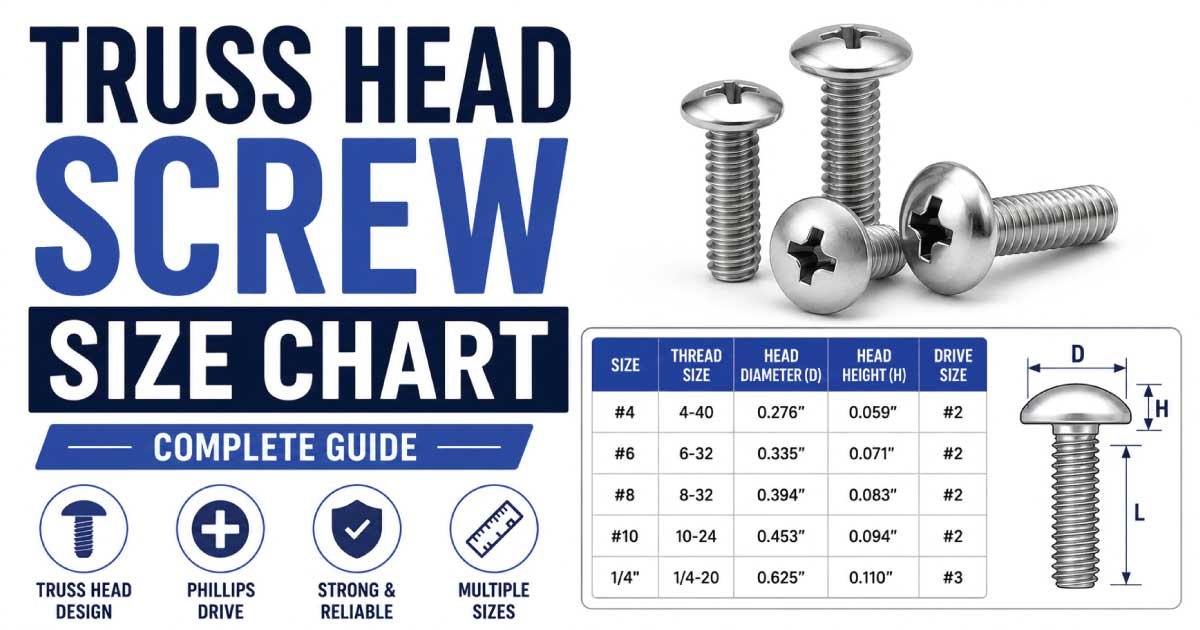
Truss head screws are widely used fasteners designed with a large, low-profile head that provides a broad bearing surface over the material. Their wide head makes them especially useful for fastening thin sheet metal, panels, brackets, plastic components, electrical equipment, and other materials where a larger contact area is beneficial.
Choosing the correct truss head screw size involves more than selecting the screw diameter. Important specifications include screw length, thread diameter, thread pitch, head diameter, head height, drive type, material, finish, and the type of material being fastened.
This complete truss head screw size chart and guide explains common metric and imperial sizes, truss head dimensions, how to measure these screws, thread types, drive styles, materials, applications, installation methods, and how to select the right fastener.
What Is a Truss Head Screw?
A truss head screw is a fastener with a wide, low-profile head and a relatively large bearing surface.
The wide head distributes clamping pressure over a larger area than many conventional screw heads. This makes truss head screws particularly useful for thin materials that could otherwise deform under a smaller screw head.
Common applications include:
- Sheet metal
- Electrical panels
- HVAC equipment
- Automotive components
- Machinery
- Plastic components
- Metal enclosures
- Roofing and fabrication
- Furniture
- Brackets
- General repairs
Truss head screws are available with different thread designs, drive types, materials, and finishes.
Understanding Truss Head Screw Dimensions
Several dimensions determine the complete size of a truss head screw.
Screw Diameter
The nominal diameter refers to the diameter of the threaded portion.
Common metric sizes include:
- M3
- M4
- M5
- M6
- M8
- M10
Common imperial sizes include:
- #4
- #6
- #8
- #10
- #12
- 1/4 inch
Screw Length
For a truss head screw, length is generally measured from the underside of the head to the tip.
For example:
M5 × 20 mm
means a 5 mm nominal diameter and 20 mm screw length.
The head height is normally not included in the stated screw length.
Head Diameter
Truss head screws have a relatively large head diameter.
This broad head provides increased bearing area and helps distribute clamping force.
Head Height
Head height is measured from the underside of the head to the highest point of the head.
Truss heads are generally designed to remain relatively low compared with some other wide-head fasteners.
Thread Pitch
Metric screws are commonly identified by thread pitch.
For example:
M6 × 1.0
means a nominal diameter of 6 mm and a 1.0 mm thread pitch.
Imperial screws are generally identified by threads per inch.
Metric Truss Head Screw Size Chart
The following chart provides common metric truss head screw sizes and typical coarse thread pitches.
| Screw Size | Nominal Diameter | Common Coarse Pitch | Typical Application |
|---|---|---|---|
| M3 | 3 mm | 0.50 mm | Electronics and light panels |
| M4 | 4 mm | 0.70 mm | Sheet metal and equipment |
| M5 | 5 mm | 0.80 mm | General fastening |
| M6 | 6 mm | 1.00 mm | Machinery and brackets |
| M8 | 8 mm | 1.25 mm | Heavy general fastening |
| M10 | 10 mm | 1.50 mm | Larger mechanical assemblies |
| M12 | 12 mm | 1.75 mm | Heavy-duty applications |
Exact head diameter and head height can vary according to the applicable screw standard, head style, and manufacturer.
Imperial Truss Head Screw Size Chart
Imperial truss head screws are commonly identified by numbered screw size and thread count.
| Screw Size | Approx. Major Diameter | Common Thread | Typical Application |
|---|---|---|---|
| #4 | 0.112 in | 40 TPI | Small components |
| #6 | 0.138 in | 32 TPI | Light fastening |
| #8 | 0.164 in | 32 TPI | Panels and equipment |
| #10 | 0.190 in | 24 TPI | Machinery and fabrication |
| #12 | 0.216 in | 24 TPI | Heavy general fastening |
| 1/4 in | 0.250 in | 20 TPI | Machinery and brackets |
| 5/16 in | 0.313 in | 18 TPI | Heavy assemblies |
| 3/8 in | 0.375 in | 16 TPI | Larger mechanical applications |
Fine-thread versions are also available for certain imperial sizes.
How to Read a Truss Head Screw Size
A truss head screw is commonly specified using its diameter and length.
For example:
M5 × 20 mm
means:
- M = metric thread
- 5 = 5 mm nominal diameter
- 20 mm = screw length
A more detailed specification could be:
M5 × 0.8 × 20 mm
where:
- 5 mm = nominal diameter
- 0.8 mm = thread pitch
- 20 mm = screw length
An imperial example is:
#10-24 × 1 in
which identifies:
- #10 screw size
- 24 threads per inch
- 1-inch screw length
The complete product description may also specify the drive, material, coating, and thread type.
How to Measure a Truss Head Screw
If you need to replace an existing truss head screw, measure several dimensions.
Step 1: Measure Thread Diameter
Use a caliper to measure the outside diameter of the threaded section.
Compare the measurement against metric and imperial sizes.
Step 2: Measure Screw Length
Measure from the underside of the head to the tip.
Do not normally include the head height.
Step 3: Measure Head Diameter
Measure across the widest portion of the truss head.
This is particularly important because the head is intentionally wider than many standard screw heads.
Step 4: Measure Head Height
Measure from the underside of the head to the highest point.
Step 5: Identify Thread Pitch
Use a thread pitch gauge to determine the metric pitch or imperial threads per inch.
Step 6: Identify the Drive
Check whether the screw has:
- Phillips
- Torx
- Slotted
- Hex
- Combination
- Another specialized drive
Discover More: File Tool Size Chart: Types and Uses With Full Guide
Why Do Truss Head Screws Have a Wide Head?
The main advantage of the truss head design is its large bearing surface.
A wider head can distribute the clamping force over a larger area.
This can be useful when fastening:
- Thin sheet metal
- Plastic panels
- Electrical enclosures
- Thin brackets
- Lightweight materials
- Overlapping panels
The larger head can help reduce the tendency of the fastener to pull through thin material.
However, the appropriate screw should always be selected according to the material and manufacturer’s recommendations.
Truss Head Screw vs Pan Head Screw
Truss head and pan head screws can look similar, but their head proportions are different.
| Feature | Truss Head Screw | Pan Head Screw |
|---|---|---|
| Head width | Very broad | Moderate |
| Head profile | Low and broad | Rounded / domed |
| Bearing area | Large | Moderate |
| Common use | Thin materials and panels | General fastening |
| Pull-through resistance | Generally improved by larger head | Lower than wide-head designs |
| Countersinking | Normally not required | Normally not required |
Choose a truss head screw when a large bearing surface and low-profile wide head are useful.
Truss Head Screw vs Flat Head Screw
Flat head screws have a countersunk head designed to sit flush with the surface.
Truss head screws have a wide head that remains above the surface.
| Feature | Truss Head | Flat Head |
|---|---|---|
| Head profile | Wide and low | Flat |
| Head position | Above surface | Flush |
| Countersinking | Normally not required | Required |
| Bearing surface | Large | Depends on head design |
| Common application | Panels and sheet metal | Flush installations |
The two designs solve different fastening problems.
Truss Head Screw vs Button Head Screw
Button head screws have a rounded, relatively low-profile head, while truss head screws generally have a larger head diameter.
Truss heads are particularly useful when greater surface coverage is required.
Button heads are often chosen where a compact rounded appearance is more important than maximum head diameter.
Types of Truss Head Screws
Truss head screws are available in several configurations.
Truss Head Machine Screws
Machine-thread truss screws are designed to engage with:
- Threaded holes
- Nuts
- Threaded inserts
- Captive nuts
They are widely used in machinery, electrical equipment, metal enclosures, and industrial assemblies.
Truss Head Self-Tapping Screws
Self-tapping truss screws are designed to form or cut their own mating thread.
They are commonly used in:
- Sheet metal
- Thin steel
- Aluminum
- Plastic
- Electrical enclosures
- Automotive panels
Truss Head Sheet Metal Screws
These screws are designed for fastening sheet materials and often feature sharp or specialized threads.
Truss Head Wood Screws
Some wide-head screws are designed for wood applications and use wood-specific thread profiles.
Discover More: Adjustable Wrench Size Chart: Types, Uses With Full Guide
Truss Head Screw Drive Types
The drive type determines the tool required for installation.
Phillips Truss Head Screw
Phillips drives are widely available and commonly used for general-purpose fastening.
Torx Truss Head Screw
Torx drives use a six-lobed recess and provide good engagement between the tool and fastener.
They are popular in automotive, machinery, and manufacturing applications.
Slotted Truss Head Screw
Slotted drives have a simple straight recess and are used in traditional hardware and some general-purpose applications.
Combination Drive
Combination-head screws can accommodate more than one type of driver.
This can be useful in general-purpose assembly and maintenance.
Truss Head Screw Materials
The screw material affects strength, durability, and corrosion resistance.
Carbon Steel
Carbon steel truss head screws provide good mechanical strength and are commonly used for general fastening.
A protective coating may be applied to improve corrosion resistance.
Stainless Steel
Stainless steel provides improved resistance to corrosion.
Stainless steel truss head screws are commonly used in:
- Outdoor equipment
- Marine environments
- Moist areas
- Food-related equipment
- Electrical installations
- General corrosion-resistant applications
Zinc-Plated Steel
Zinc plating provides a protective coating against corrosion and is widely used for general-purpose fasteners.
Black Oxide Steel
Black oxide finishes are commonly used where a dark appearance and suitable corrosion protection are desired.
Truss Head Screw Thread Types
The thread design should match the material and application.
Machine Threads
Machine threads are designed to engage with a matching nut or threaded hole.
Self-Tapping Threads
Self-tapping threads create or form a mating thread during installation.
Coarse Threads
Coarse threads have a larger thread pitch and are commonly used for general-purpose fastening.
Fine Threads
Fine threads provide more threads over the same length and are used for specific mechanical applications.
Truss Head Screw Length Guide
Choosing the correct screw length is essential for achieving adequate thread engagement.
Consider:
- Material thickness
- Number of layers being joined
- Thread engagement
- Washer thickness
- Nut thickness
- Clearance behind the material
- Type of screw
For a screw passing through a thin panel into a threaded component, the screw must be long enough to provide adequate engagement without bottoming out.
For self-tapping applications, the screw should provide enough thread engagement without unnecessarily penetrating components behind the panel.
How to Choose the Correct Truss Head Screw Size
Selecting the correct screw requires several considerations.
1. Determine the Diameter
Identify the required screw diameter from the existing fastener or application.
2. Choose the Length
Measure the material thickness and determine how much thread engagement is required.
3. Match the Thread
For machine screws, match the exact thread diameter and pitch.
4. Check Head Diameter
Make sure the large truss head will fit the available space.
5. Select the Drive
Choose Phillips, Torx, slotted, or another appropriate drive.
6. Choose the Material
Select steel, stainless steel, or another material according to the environment.
7. Select the Finish
Choose a suitable protective coating for the application.
8. Consider Material Thickness
For thin materials, the broad truss head can help distribute the clamping load.
Discover More: Threaded Rod Size Chart, Types, Uses: Complete Guide
Truss Head Screw Applications
Truss head screws are used in many industries.
Common applications include:
- Sheet metal
- Electrical panels
- HVAC systems
- Automotive components
- Machinery
- Metal enclosures
- Computer equipment
- Plastic assemblies
- Furniture
- Brackets
- Appliance manufacturing
- General fabrication
They are particularly useful when a wide head and relatively low profile are preferred.
Truss Head Screws for Sheet Metal
Sheet metal is one of the most common applications for wide-head screws.
Thin sheet materials can be susceptible to deformation or pull-through when fastened with a small-head screw.
A truss head provides greater surface coverage.
When choosing a truss head screw for sheet metal, consider:
- Sheet thickness
- Metal type
- Screw diameter
- Thread design
- Screw length
- Head diameter
- Corrosion environment
- Required clamping force
For self-tapping screws, the pilot-hole requirements should follow the manufacturer’s recommendations.
Truss Head Screws for Electrical Panels
Truss head screws are commonly used in electrical enclosures and panels because their broad head can provide useful clamping coverage.
They may be used for:
- Panel covers
- Brackets
- Mounting components
- Cable-management hardware
- Electrical enclosures
- Equipment assemblies
The material and finish should be selected according to the operating environment.
Truss Head Screw Installation
Correct installation helps prevent damage to both the fastener and the workpiece.
Use the Correct Driver
Choose a driver that exactly matches the drive recess.
Keep the Driver Aligned
Hold the driver straight with the screw to reduce recess damage.
Tighten Gradually
Avoid excessive force, especially when fastening thin sheet material.
Avoid Over-Tightening
Excessive torque can:
- Strip the drive
- Damage threads
- Deform thin material
- Pull the screw through the panel
- Damage plastic components
Use the manufacturer’s torque specification when one is provided.
Common Truss Head Screw Sizing Mistakes
Choosing Only by Diameter
A screw’s diameter does not determine its complete size.
Length, pitch, head dimensions, and drive type are also important.
Using an Oversized Head
The wide head needs enough clearance around the installation area.
Using the Wrong Length
A screw that is too long may interfere with components behind the panel.
Mixing Thread Standards
Metric and imperial screws should not be mixed.
Using the Wrong Driver
A mismatched driver can damage the recess.
Over-Tightening Thin Material
Too much torque can deform thin sheet metal or cause pull-through.
Truss Head Screw Size Chart Quick Reference
| Size | Nominal Diameter | Common Pitch / TPI | Typical Application |
|---|---|---|---|
| M3 | 3 mm | 0.50 mm | Electronics and panels |
| M4 | 4 mm | 0.70 mm | Sheet metal |
| M5 | 5 mm | 0.80 mm | Equipment |
| M6 | 6 mm | 1.00 mm | Machinery |
| M8 | 8 mm | 1.25 mm | Heavy fastening |
| M10 | 10 mm | 1.50 mm | Larger assemblies |
| #4 | 0.112 in | 40 TPI | Small components |
| #6 | 0.138 in | 32 TPI | Light fastening |
| #8 | 0.164 in | 32 TPI | Panels and equipment |
| #10 | 0.190 in | 24 TPI | Machinery |
| #12 | 0.216 in | 24 TPI | Heavy fastening |
| 1/4 in | 0.250 in | 20 TPI | Machinery and brackets |
| 5/16 in | 0.313 in | 18 TPI | Heavy assemblies |
| 3/8 in | 0.375 in | 16 TPI | Large applications |
This is a thread-size reference, not a universal dimensional standard. Exact truss head diameter, head height, drive dimensions, and available lengths depend on the relevant fastener standard and manufacturer.
Frequently Asked Questions About Truss Head Screw Sizes
What is a truss head screw?
A truss head screw is a fastener with a wide, low-profile head that provides a large bearing surface. It is commonly used for sheet metal, electrical panels, machinery, plastic components, brackets, and thin materials where a larger head can distribute clamping pressure.
What are the common truss head screw sizes?
Common metric truss head screw sizes include M3, M4, M5, M6, M8, and M10. Common imperial sizes include #4, #6, #8, #10, #12, 1/4 inch, 5/16 inch, and 3/8 inch. The correct size depends on the application.
How are truss head screws measured?
Truss head screws are generally measured by thread diameter, screw length, thread pitch, head diameter, and head height. Screw length is normally measured from the underside of the head to the tip. A caliper and thread gauge can help identify an existing screw.
Why are truss head screws wider than pan head screws?
The wider head provides a larger bearing surface, which can help distribute clamping pressure over a larger area. This makes truss head screws particularly useful for thin sheet metal, panels, plastic components, and other materials where a small screw head could pull through or deform the surface.
Do truss head screws require countersinking?
Normally, no. Truss head screws are designed to sit above the surface and provide a broad bearing area. They are different from flat or oval countersunk screws, which require a tapered recess for the head.
Are truss head screws good for sheet metal?
Yes. Truss head screws are commonly used with sheet metal and thin panels because their wide head distributes clamping pressure over a larger area. The appropriate thread type, diameter, length, and material should be selected according to the sheet thickness and application.
What is the difference between a truss head and pan head screw?
The primary difference is the head geometry. A truss head has a wider and generally lower-profile head, providing greater bearing coverage. A pan head is usually narrower with a more conventional rounded profile. Truss heads are especially useful for thin materials and panels.
What screwdriver is used for a truss head screw?
The required screwdriver depends on the drive. Phillips truss head screws use Phillips drivers, Torx screws use Torx drivers, and slotted versions use flat-blade drivers. Always use the correct driver size to reduce the risk of damaging the screw recess.
Final Thoughts
A truss head screw size chart provides a useful starting point for identifying common screw diameters, thread pitches, and applications. However, choosing the correct truss head screw requires more than matching the diameter.
The key specifications include screw diameter, length, thread pitch, head diameter, head height, drive type, material, and finish.
Common metric sizes include M3, M4, M5, M6, M8, and M10, while common imperial sizes include #4, #6, #8, #10, #12, 1/4 inch, 5/16 inch, and 3/8 inch.
The defining advantage of a truss head screw is its large bearing surface and relatively low head profile. This makes it particularly useful for sheet metal, electrical panels, thin materials, machinery, automotive components, and equipment assemblies.
When replacing an existing screw, measure the complete fastener and verify the diameter, length, thread pitch, head dimensions, drive type, material, and finish. For specialized or safety-critical applications, always follow the manufacturer’s specifications and recommended installation requirements.

Engineer Hassan is a Mechanical Engineer with 16+ years of hands-on experience in mechanical hardware, fasteners, and workshop tools. He focuses on size selection, thread identification, and measurement, helping users choose the correct components with accuracy and safety.