
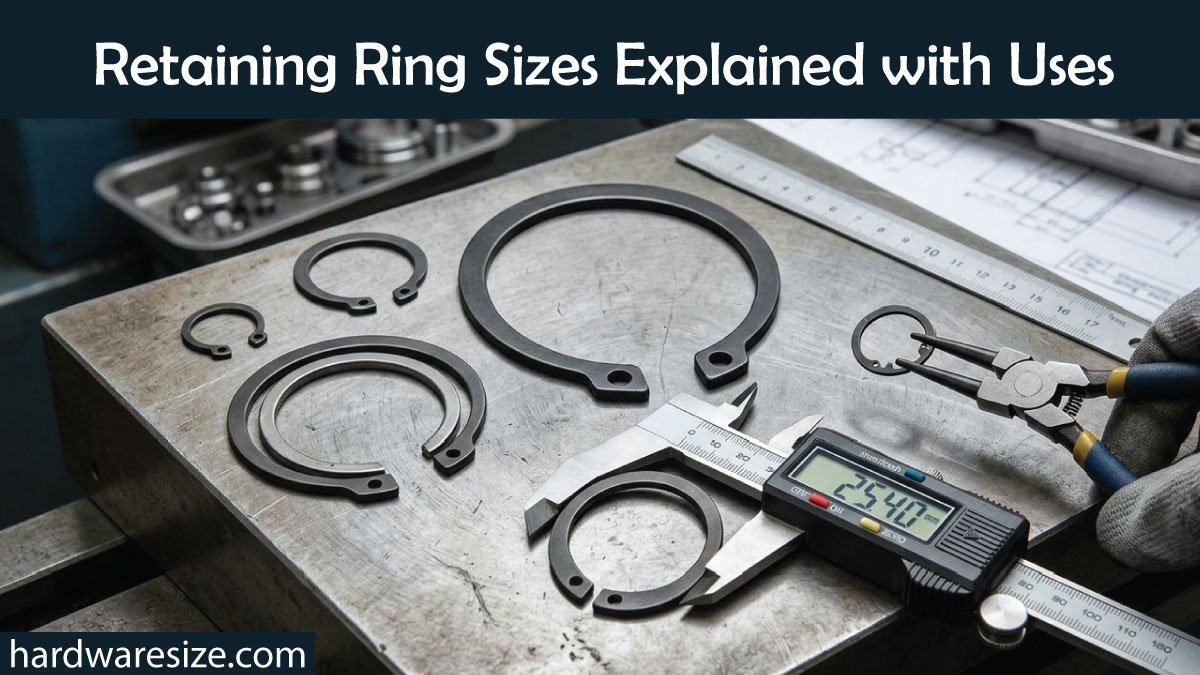
Retaining rings may look small, but they play a powerful role in mechanical assemblies. Whether you are working in automotive repair, machinery design, or DIY engineering projects, understanding retaining ring sizes is essential for safety, reliability, and performance.
In this complete guide, you will learn everything about retaining ring sizes, types, measurement methods, and uses—explained in a simple, practical way.
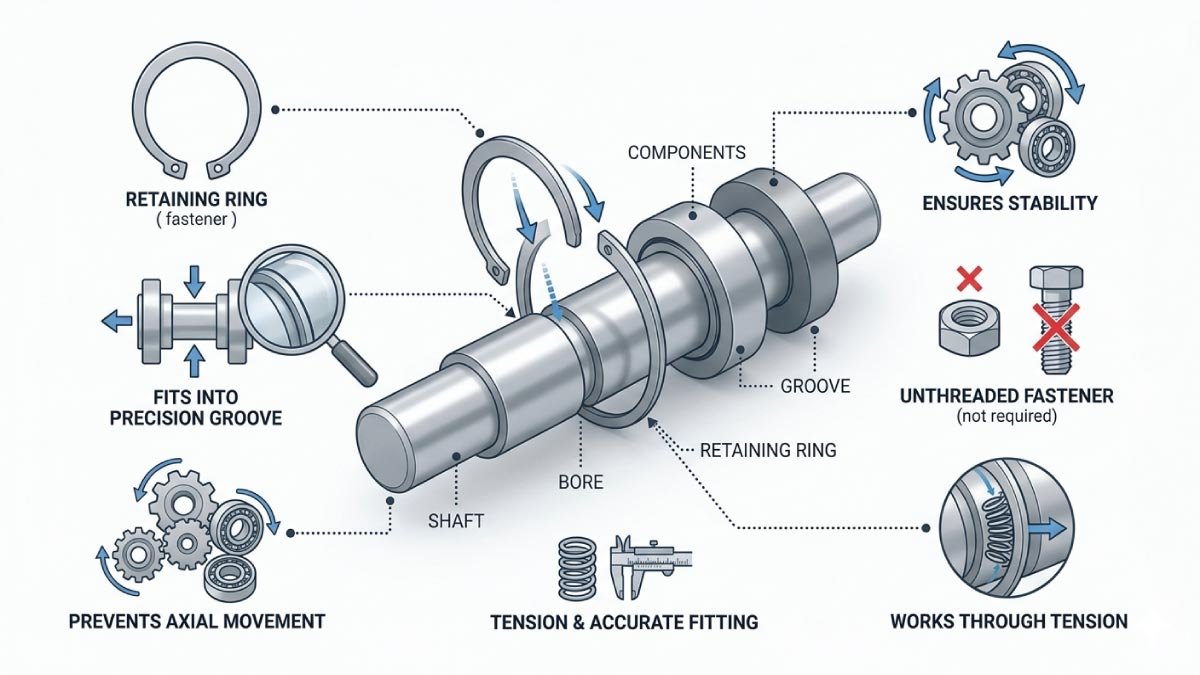
Types of Retaining Rings
Before understand the retaining ring sizes, it’s important to know the different types available because each type is designed for specific applications and load conditions. The size, shape, and installation method vary depending on where and how the ring will be used in a mechanical assembly.
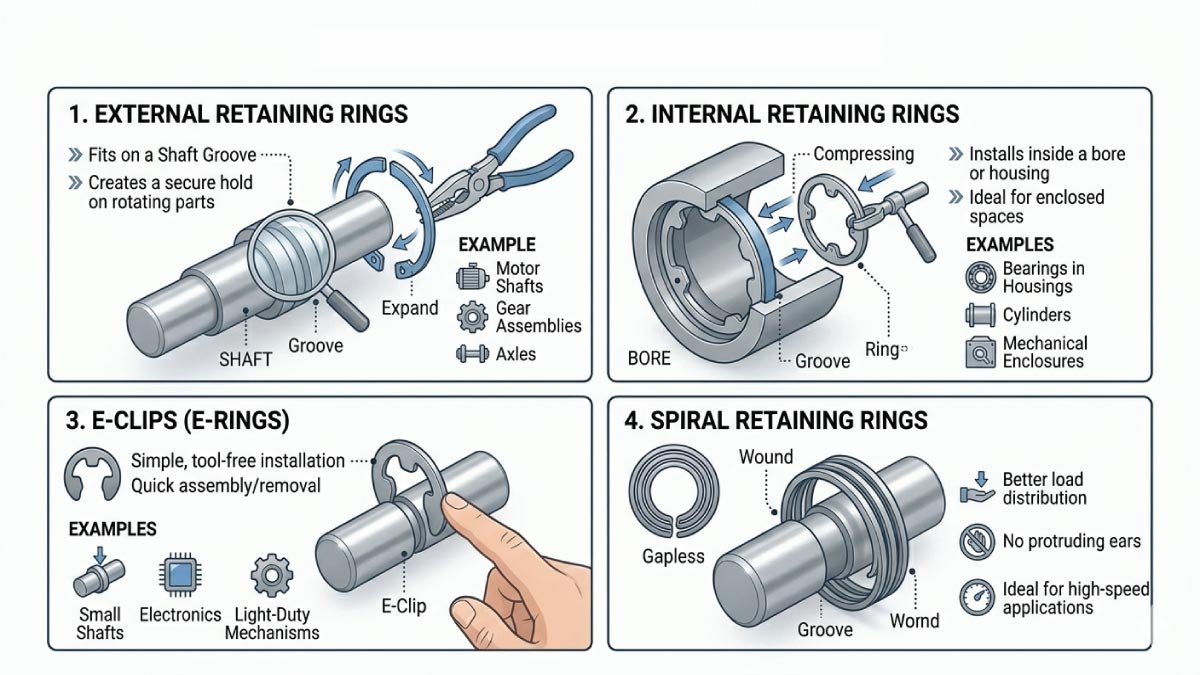
1. External Retaining Rings
External retaining rings are designed to fit into grooves on the outside of a shaft. They expand slightly during installation and then snap into place, creating a secure hold. These rings are commonly used where components need to be retained on rotating shafts without slipping.
Common Uses:
- Motor shafts
- Gear assemblies
- Axles
2. Internal Retaining Rings
Internal retaining rings are installed inside a bore or housing. They compress during installation and expand into a groove inside the bore to hold components in place. These rings are ideal for securing parts within enclosed spaces where external fastening is not possible.
Common Uses:
- Bearings inside housings
- Cylinders
- Mechanical enclosures
3. E-Clips (E-Rings)
E-clips, also known as E-rings, are shaped like the letter “E” and are designed for quick and easy installation without special tools. They snap onto a shaft groove and provide a simple solution for light-duty applications where frequent assembly or removal may be required.
Common Uses:
- Small shafts
- Electronics
- Light-duty mechanisms
4. Spiral Retaining Rings
Spiral retaining rings are flat, coiled rings that fit into grooves without gaps or lugs. Their continuous design provides uniform strength and better load distribution. They are commonly used in high-performance applications where smooth rotation and minimal protrusion are important.
Advantages:
- Better load distribution
- No protruding ears
- Ideal for high-speed applications
Key Dimensions of Retaining Rings
Understanding retaining ring dimensions is essential for selecting the right component for your application. Each dimension directly affects how securely the ring fits and performs under load. Knowing these measurements helps prevent failures, ensures proper assembly, and improves the overall reliability and safety of mechanical systems.
1. Nominal Diameter
The nominal diameter refers to the shaft or bore size that the retaining ring is specifically designed to fit. It is the primary reference dimension when selecting a ring. Choosing the correct nominal diameter ensures a proper fit, preventing looseness or excessive stress during installation and operation.
2. Groove Diameter
Groove diameter is the measurement of the groove where the retaining ring is installed. It must match the ring’s design specifications to ensure a secure seating. An incorrect groove diameter can lead to improper fit, reduced holding strength, or even ring failure under load conditions.
3. Ring Thickness
Ring thickness plays a critical role in determining the strength and load-bearing capacity of the retaining ring. Thicker rings can handle higher loads and provide better resistance to deformation. However, they also require properly sized grooves to fit correctly without causing installation difficulties or damage.
4. Free Diameter
The free diameter is the natural diameter of the retaining ring before it is installed onto a shaft or into a bore. This dimension is important because it indicates how much the ring must expand or compress during installation, directly affecting its holding force and retention capability.
5. Lug Width (for pliers)
Lug width refers to the distance between the holes or lugs used for installation with pliers. This dimension ensures compatibility with installation tools. Proper lug width allows easy handling, accurate placement, and safe installation without damaging the retaining ring or surrounding components.
Retaining Ring Size Chart (General Overview)
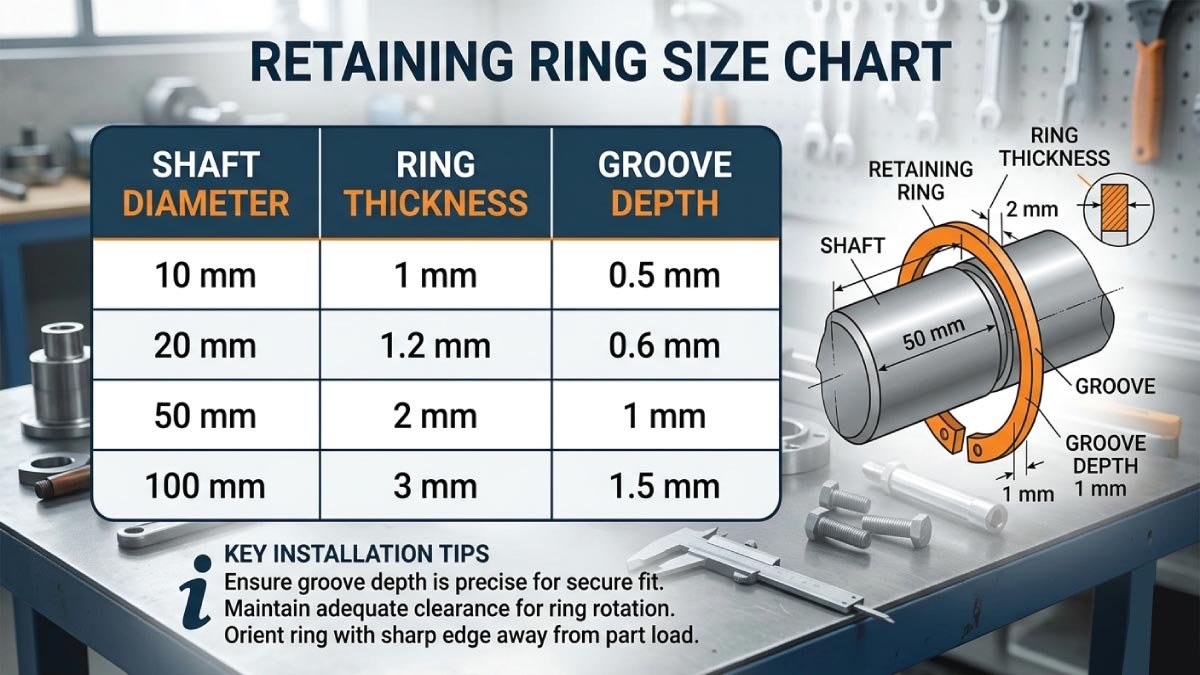
A retaining ring size chart provides a quick reference to match shaft diameter with the correct ring thickness and groove depth. These values help ensure proper fitting, strength, and performance in mechanical assemblies. While general charts are useful for understanding, exact dimensions may vary depending on design standards and load requirements.
| Shaft Diameter | Ring Thickness | Groove Depth |
|---|---|---|
| 10 mm | 1 mm | 0.5 mm |
| 20 mm | 1.2 mm | 0.6 mm |
| 50 mm | 2 mm | 1 mm |
| 100 mm | 3 mm | 1.5 mm |
How to Measure Retaining Ring Size
Accurate measurement of a retaining ring is essential to ensure proper fit, safety, and performance in any mechanical setup. Even a small error can lead to loose fitting or component failure. By following a systematic approach and using precise tools, you can confidently select the correct retaining ring size.
1. Measure Shaft or Bore Diameter
Start by measuring the shaft (for external rings) or bore (for internal rings) diameter using a vernier caliper. Ensure the tool is properly aligned and readings are taken at multiple points for accuracy. This measurement serves as the base size for selecting the correct retaining ring.
2. Check Groove Dimensions
Next, carefully measure the groove where the retaining ring will sit. Focus on both the groove width and depth, as these determine how well the ring fits and holds in place. Incorrect groove dimensions can cause improper seating or reduced load capacity.
3. Determine Ring Thickness
Measure or select the ring thickness based on the groove size. The thickness should match the groove width to ensure a snug fit without excessive play. A mismatch can lead to instability, deformation, or difficulty during installation.
4. Identify Ring Type
Determine whether you are using an internal or external retaining ring. Internal rings fit inside bores, while external rings fit onto shafts. This distinction is important because it directly affects how measurements are taken and how the ring behaves during installation.
5. Verify Standard Size
Finally, compare your measurements with standard retaining ring size charts. These charts help you match your dimensions with commercially available sizes. Verifying against standards ensures compatibility, saves time, and reduces the risk of selecting the wrong component.
Tools Required for Measurement
Using the right tools is essential for accurately measuring retaining rings and their corresponding grooves. Precision instruments help eliminate guesswork, reduce errors, and ensure a perfect fit. Proper tools not only improve measurement accuracy but also make the installation process smoother and more reliable.
1- Vernier Caliper
A vernier caliper is one of the most commonly used tools for measuring shaft diameter, bore size, and groove dimensions. It provides high accuracy and can measure internal, external, and depth dimensions. This makes it an essential tool for selecting the correct retaining ring size.
2- Micrometer
A micrometer is used for extremely precise measurement of small dimensions, especially ring thickness. It offers greater accuracy than a vernier caliper and is ideal when tight tolerances are required. This tool ensures the retaining ring thickness matches the groove perfectly.
3- Groove Gauge
A groove gauge is specifically designed to measure groove width and depth. It helps ensure that the retaining ring will sit properly in its designated groove. Accurate groove measurement is critical for maintaining the ring’s holding strength and preventing dislodging during operation.
4- Retaining Ring Pliers
Retaining ring pliers are used for installing and removing retaining rings safely and efficiently. They are designed to fit into the ring’s lugs, allowing controlled expansion or compression. Using proper pliers prevents damage to the ring and ensures correct placement during installation.
Using proper tools improves accuracy, saves time, and significantly reduces the chances of measurement and installation errors in mechanical applications.
Materials Used in Retaining Rings
The material of a retaining ring plays a major role in its strength, flexibility, and overall performance. Different working environments require different materials to ensure durability and reliability. For example, high-load applications need stronger metals, while corrosive environments require rust-resistant options. Proper material selection also influences size stability under stress.
Common Materials:
- Carbon steel (strong and durable)
- Stainless steel (corrosion-resistant)
- Spring steel (flexible and resilient)
Coatings:
- Zinc plating
- Phosphate coating
- Black oxide
These materials affect strength, flexibility, and lifespan.
Applications of Retaining Rings
Retaining rings are widely used across multiple industries because they provide a simple, cost-effective, and reliable method of holding components in place. Their ability to secure parts without complex fasteners makes them essential in both light and heavy-duty mechanical systems.
1. Automotive Industry
In the automotive sector, retaining rings play a crucial role in securing gears, shafts, and bearings. They are commonly used in transmission systems where precise alignment and strong holding force are required. Their reliability helps improve vehicle performance and reduces the risk of mechanical failure during operation.
2. Machinery and Equipment
Retaining rings are extensively used in industrial machinery such as conveyor systems, pumps, and compressors. They help maintain the position of rotating and moving parts, ensuring smooth operation. Their durability and ease of installation make them ideal for high-load and continuous working environments.
3. Aerospace Applications
In aerospace engineering, retaining rings are valued for their lightweight and high-strength properties. They are used in precision assemblies where safety and accuracy are critical. Their ability to withstand vibration and extreme conditions makes them suitable for aircraft and spacecraft components.
4. Electronics and Small Devices
Retaining rings are also used in compact electronic devices and small mechanical assemblies. They help secure delicate internal components such as switches, circuit mechanisms, and miniature shafts. Their small size and precision design make them ideal for tight and intricate spaces.
5. Construction Equipment
In construction machinery, retaining rings are used for heavy-duty applications such as hydraulic systems and shaft retention. They help secure moving parts under high stress and vibration. Their strength and reliability ensure stable performance in demanding construction environments.
Advantages of Using Retaining Rings
Retaining rings provide a simple yet highly effective solution for securing components in mechanical assemblies. Compared to traditional fasteners like bolts or screws, they offer faster installation and require less space. Their design eliminates the need for threading, making them ideal for compact systems and high-speed applications where efficiency is important.
Key Benefits:
- Quick installation and removal
- Lightweight design
- Cost-effective solution
- No threading required
- Space-saving design
They are ideal for applications where simplicity and efficiency are important.
👉 Complete Guide to Stud Bolt Sizes and Applications helps you understand different stud bolt sizes, dimensions, and industrial uses. Learn how to select the right stud bolt for strength, safety, and performance. Read the full guide to improve accuracy, avoid errors, and ensure reliable fastening in every engineering project.
Common Mistakes When Choosing Retaining Ring Sizes
Selecting the wrong retaining ring size can lead to mechanical failure, poor fitting, or reduced performance. Many issues occur when users ignore groove specifications or assume one size fits all. Careful attention to measurements and material selection is essential to avoid operational problems and ensure long-term reliability in assemblies.
Mistakes to Watch:
- Using incorrect diameter
- Ignoring groove dimensions
- Choosing wrong material
- Overloading the ring
- Poor installation technique
Always double-check specifications before installation.
Retaining Ring Installation Tips
Proper installation is crucial for ensuring retaining rings perform effectively under load. Using the correct tools and following proper steps helps prevent deformation or improper seating in the groove. A well-installed retaining ring improves durability, safety, and system efficiency in both light and heavy-duty applications.
Best Practices:
- Use correct pliers for installation
- Avoid over-expanding the ring
- Ensure proper groove seating
- Inspect for damage before use
- Follow manufacturer guidelines
Incorrect installation can weaken the ring and cause failure.
Retaining Ring Removal Tips
Safe removal of retaining rings is just as important as proper installation. Using the right tools and techniques helps prevent damage to the ring and surrounding components. Careful handling ensures safety and allows proper replacement without affecting the mechanical assembly’s integrity or performance.
Safe Removal Steps:
- Use proper pliers
- Apply steady force
- Avoid bending the ring
- Wear safety glasses
- Replace damaged rings
Never reuse a deformed retaining ring.
👉 U Bolt Dimensions and Selection Guide for Your Project explains different U-bolt sizes, dimensions, and proper selection methods for strong and secure fittings. Learn how to choose the right U-bolt for load, pipe size, and application. Read the full guide to ensure safety, accuracy, and reliable performance in every project.
Retaining Rings vs Other Fasteners
Let’s compare retaining rings with traditional fasteners.
| Feature | Retaining Rings | Bolts/Nuts |
|---|---|---|
| Installation | Fast | Slower |
| Weight | Light | Heavy |
| Space Required | Minimal | More |
| Reusability | Limited | High |
| Cost | Low | Moderate |
Retaining rings are better for compact and high-speed applications.
Maintenance and Inspection
Regular maintenance and inspection of retaining rings are essential to ensure safe and reliable performance in mechanical systems. Over time, rings can wear out, lose tension, or become damaged due to load stress and environmental conditions. Routine checks help detect early signs of failure and prevent unexpected breakdowns in machinery.
Maintenance Tips:
- Check for wear and deformation
- Inspect groove condition
- Replace worn rings immediately
- Avoid corrosion exposure
Proper maintenance increases lifespan and safety.
Trends in Retaining Ring Design
Retaining ring technology is continuously evolving with advancements in engineering and manufacturing. Modern industries demand higher precision, durability, and efficiency, leading to improved designs and materials. These innovations aim to enhance performance in extreme conditions while reducing failure risks in critical mechanical applications.
Innovations:
- Advanced materials for higher strength
- Precision manufacturing
- Improved corrosion resistance
- Custom-designed rings
These trends make retaining rings more reliable and efficient.
Final Thoughts
Understanding retaining ring sizes is essential for anyone working with mechanical assemblies. From selecting the correct diameter to ensuring proper installation, every detail matters.
By focusing on accurate measurements, choosing the right type, and following best practices, you can ensure strong, reliable, and long-lasting performance in your projects.
Retaining rings may be small, but their impact on safety and functionality is massive. Mastering their sizing and usage is a valuable skill in engineering and technical work.
👉 Cotter Pin Size Chart for Secure Connections helps you understand different cotter pin sizes, dimensions, and applications for safe mechanical locking. Learn how to choose the right size for strong and reliable fastening. Read the full guide to improve accuracy, prevent failure, and ensure secure connections in every project.
FAQs:
What is a retaining ring and what is its purpose?
A retaining ring is a small circular fastener used to secure components onto a shaft or inside a bore. Its main purpose is to hold parts in place, prevent movement, and ensure proper alignment in mechanical assemblies such as motors, gear systems, and automotive components.
What are the common types of retaining rings?
The most common types include internal retaining rings, external retaining rings, and E-clips. Internal rings fit inside a bore, external rings fit onto a shaft, and E-clips are used for quick installation. Each type is designed for specific mechanical applications and load conditions.
How are retaining ring sizes measured?
Retaining ring sizes are measured based on shaft diameter or bore diameter, depending on the type. Thickness and groove dimensions are also important. Accurate measurement ensures a secure fit, prevents slippage, and maintains the safety and efficiency of mechanical assemblies.
What materials are retaining rings made from?
Retaining rings are commonly made from carbon steel, stainless steel, and beryllium copper. Carbon steel offers strength, stainless steel provides corrosion resistance, and beryllium copper is used for electrical applications. The material choice depends on load requirements and environmental conditions.
Where are retaining rings commonly used?
Retaining rings are widely used in automotive systems, machinery, aerospace equipment, and household appliances. They help secure bearings, gears, and rotating parts in place, ensuring smooth operation and preventing parts from slipping or becoming misaligned during use.
How do I choose the correct retaining ring size?
To choose the correct size, measure the shaft or bore accurately and match it with the ring specifications. Also consider groove depth and load requirements. Using the correct size ensures secure fitting, prevents mechanical failure, and improves overall system performance.
What are the benefits of using retaining rings?
Retaining rings provide a simple, cost-effective way to secure components without welding or complex fasteners. They save space, allow easy assembly and disassembly, and improve mechanical reliability. Their durability and precision make them essential in many engineering and industrial applications.

Engineer Hassan is a Mechanical Engineer with 16+ years of hands-on experience in mechanical hardware, fasteners, and workshop tools. He focuses on size selection, thread identification, and measurement, helping users choose the correct components with accuracy and safety.