
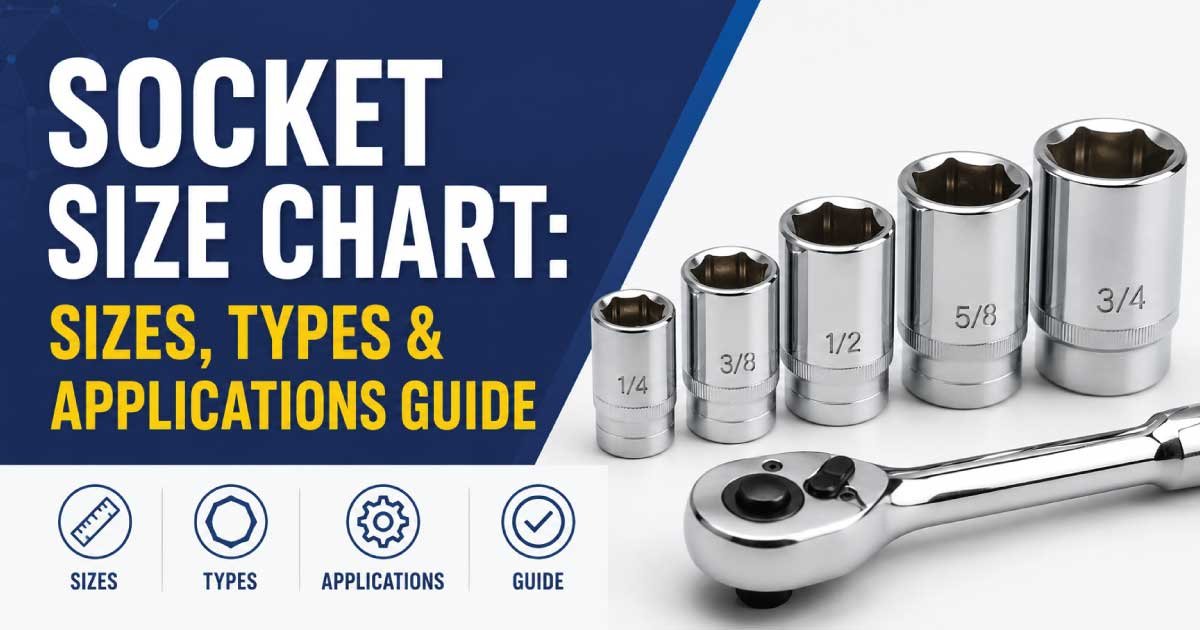
Sockets are among the most essential tools used in automotive repair, construction, machinery maintenance, and home improvement projects. Whether you’re tightening a bolt on a vehicle or assembling industrial equipment, choosing the correct socket size ensures efficiency, safety, and prevents damage to fasteners.
This complete guide explains socket sizes, socket size charts, drive sizes, measurement systems, and practical tips for selecting the right socket for any job.
What Is a Socket?
A socket is a cylindrical tool attachment designed to fit over a nut or bolt head. It connects to a ratchet, breaker bar, torque wrench, or power tool to loosen or tighten fasteners.
Sockets provide better grip and greater torque than traditional wrenches, making them ideal for working in confined spaces and handling stubborn fasteners.
Common Uses of Sockets
- Automotive repairs
- Engine maintenance
- Bicycle repairs
- Industrial machinery
- Construction projects
- Home maintenance tasks
- Mechanical assembly work
Because fasteners come in many dimensions, sockets are manufactured in a wide range of sizes.
Socket Size Chart (Metric)
Metric sockets are measured in millimeters (mm) and are commonly used on modern vehicles, machinery, and imported equipment.
| Socket Size (mm) | Common Applications |
|---|---|
| 4 mm | Electronics and small equipment |
| 5 mm | Small machinery |
| 6 mm | Light-duty fasteners |
| 7 mm | Hose clamps and automotive parts |
| 8 mm | Engine covers and brackets |
| 9 mm | Specialized applications |
| 10 mm | Automotive repairs |
| 11 mm | General maintenance |
| 12 mm | Vehicle components |
| 13 mm | Suspension and brackets |
| 14 mm | Automotive assemblies |
| 15 mm | Mechanical equipment |
| 16 mm | Machinery maintenance |
| 17 mm | Lug nuts and suspension parts |
| 18 mm | Automotive repair |
| 19 mm | Wheel nuts and heavy-duty equipment |
| 21 mm | Lug nuts |
| 22 mm | Industrial machinery |
| 24 mm | Heavy mechanical work |
| 27 mm | Large equipment |
| 30 mm | Industrial applications |
| 32 mm | Heavy machinery |
| 36 mm | Industrial maintenance |
Socket Size Chart (SAE)
SAE sockets are measured in inches and are widely used on older American vehicles and equipment.
| SAE Size | Decimal Equivalent |
|---|---|
| 1/4″ | 0.250″ |
| 5/16″ | 0.313″ |
| 3/8″ | 0.375″ |
| 7/16″ | 0.438″ |
| 1/2″ | 0.500″ |
| 9/16″ | 0.563″ |
| 5/8″ | 0.625″ |
| 11/16″ | 0.688″ |
| 3/4″ | 0.750″ |
| 13/16″ | 0.813″ |
| 7/8″ | 0.875″ |
| 15/16″ | 0.938″ |
| 1″ | 1.000″ |
| 1-1/16″ | 1.063″ |
| 1-1/8″ | 1.125″ |
| 1-1/4″ | 1.250″ |
Metric to SAE Socket Conversion Chart
Sometimes a metric socket can substitute for an SAE socket and vice versa.
| Metric (mm) | SAE Equivalent |
|---|---|
| 8 mm | 5/16″ |
| 10 mm | 3/8″ |
| 11 mm | 7/16″ |
| 13 mm | 1/2″ |
| 14 mm | 9/16″ |
| 16 mm | 5/8″ |
| 17 mm | 11/16″ |
| 19 mm | 3/4″ |
| 21 mm | 13/16″ |
| 22 mm | 7/8″ |
| 24 mm | 15/16″ |
| 27 mm | 1-1/16″ |
| 30 mm | 1-3/16″ |
| 32 mm | 1-1/4″ |
Always use the exact size whenever possible because substitutions can damage fasteners.
Understand The Socket Drive Sizes
The drive size refers to the square opening on the socket that connects to a ratchet, breaker bar, torque wrench, or other drive tools. Selecting the correct drive size is important because it affects the amount of torque that can be safely applied. Smaller drive sizes are ideal for precision work and tight spaces, while larger drive sizes are designed for heavy-duty fastening tasks that require greater strength and durability.
1. 1/4-Inch Drive Sockets
The 1/4-inch drive is the smallest and most commonly used drive size for light-duty applications. These sockets are compact, lightweight, and easy to use in confined spaces where larger tools cannot fit. They are ideal for tasks requiring precision rather than high torque, making them popular among technicians, hobbyists, and homeowners.
Best For
- Electronics
- Small fasteners
- Light-duty repairs
- Interior vehicle work
Typical Socket Range
- 4 mm to 14 mm
- 5/32″ to 9/16″
2. 3/8-Inch Drive Sockets
The 3/8-inch drive is considered the most versatile socket drive size available. It provides an excellent balance between strength and accessibility, making it suitable for a wide range of repair and maintenance tasks. Many professional mechanics and DIY enthusiasts rely on this drive size because it can handle both small and medium-sized fasteners effectively.
Best For
- Automotive repairs
- General maintenance
- DIY projects
Typical Socket Range
- 6 mm to 24 mm
- 1/4″ to 1″
Most homeowners and mechanics use 3/8-inch drive sets regularly because they offer enough torque for most common fastening jobs while remaining easy to maneuver in tight working areas.
3. 1/2-Inch Drive Sockets
The 1/2-inch drive is designed for applications that require significantly higher torque. These sockets are stronger and more durable than smaller drive sizes, making them ideal for loosening stubborn fasteners and tightening critical components. They are commonly found in automotive workshops, industrial facilities, and heavy equipment maintenance environments.
Best For
- Lug nuts
- Suspension components
- Heavy machinery
Typical Socket Range
- 10 mm to 36 mm
- 3/8″ to 1-1/2″
4. 3/4-Inch Drive Sockets
The 3/4-inch drive is primarily used in commercial, industrial, and fleet maintenance operations. It is built to withstand very high torque loads and is commonly paired with large ratchets, breaker bars, and torque multipliers. These sockets are suitable for servicing large equipment where standard automotive tools are insufficient.
Best For
- Large trucks
- Construction equipment
- Industrial machinery
Typical Socket Range
- 19 mm to 80 mm
5. 1-Inch Drive Sockets
The 1-inch drive is the largest commonly available socket drive size and is intended for extremely demanding applications. These sockets are engineered for maximum strength and durability, allowing technicians to work on oversized fasteners found in mining, heavy construction, marine, and industrial equipment. Specialized tools are typically required to operate these sockets safely.
Best For
- Mining equipment
- Heavy industrial equipment
- Large mechanical assemblies
Typical Socket Range
- 36 mm and larger
Types of Sockets
Not all sockets are designed the same. Different tasks require different socket styles to ensure proper fit, efficiency, and safety. Choosing the correct type of socket helps improve access to fasteners, reduces the risk of tool damage, and makes repair or maintenance work easier. Understanding the most common socket types allows users to select the right tool for every application.
1. Standard Sockets
Standard sockets have a shorter profile and are among the most commonly used socket types. Their compact design makes them ideal for working in areas with limited clearance. They are suitable for everyday maintenance tasks and provide excellent control when tightening or loosening standard fasteners in automotive, household, and industrial applications.
Advantages
- Better access in tight spaces
- Lightweight
- Ideal for general repairs
Common Uses
- Household repairs
- Automotive maintenance
- Machinery servicing
2. Deep Sockets
Deep sockets are longer than standard sockets and are specifically designed to reach fasteners located on extended studs or recessed surfaces. Their additional depth allows them to fit over protruding bolts that standard sockets cannot accommodate. They are widely used in automotive, industrial, and mechanical repair environments where extra reach is required.
Advantages
- Reach recessed fasteners
- Fit over long bolts
Common Uses
- Automotive engine work
- Suspension repairs
- Industrial equipment
3. Impact Sockets
Impact sockets are specially designed for use with impact wrenches and other high-torque power tools. They are manufactured from high-strength materials and feature thicker walls to withstand repeated shock loads. These sockets provide greater durability and safety when working on stubborn fasteners that require substantial force for removal or installation.
Features
- Thicker walls
- High-strength steel construction
- Better shock resistance
Common Uses
- Tire changes
- Heavy-duty repairs
- Construction equipment
Important: Never use regular sockets with high-powered impact tools, as they may crack, shatter, or fail under heavy impact forces.
4. Spark Plug Sockets
Spark plug sockets are specifically designed for installing and removing spark plugs without damaging them. They typically include a rubber insert or magnetic feature that securely holds the spark plug during removal and installation. Their deep profile allows easy access to spark plugs located deep inside engine cylinder heads.
Features
- Rubber insert
- Deep profile
- Secure grip
Common Uses
- Vehicle engine maintenance
- Motorcycle repairs
5. Hex Bit Sockets
Hex bit sockets combine the functionality of a socket and an Allen key into a single tool. They are designed to drive hexagonal socket-head fasteners efficiently while allowing use with ratchets and torque wrenches. These sockets are commonly used in mechanical assembly, maintenance work, and applications requiring precise torque control.
Common Uses
- Furniture assembly
- Bicycle maintenance
- Machinery repair
👉 Adjustable Wrench Size Chart helps you understand types, uses, and proper selection for every job. Read full post to learn measurements, tips, and expert guidance for choosing the right adjustable wrench for home, workshop, and professional mechanical applications. Make selection easy and accurate every time. Read now today guide.
How to Measure Socket Size
If the size marking on a socket has become worn, faded, or unreadable, you can still identify the correct size using simple measuring methods. Accurate measurement helps ensure proper tool selection, prevents fastener damage, and improves safety during repairs. The two most common methods involve measuring either the socket opening or the fastener itself.
Method 1: Measure the Opening
This method involves measuring the inside diameter of the socket opening using a caliper. It is one of the most accurate ways to determine socket size when markings are no longer visible. After obtaining the measurement, compare it with a socket size chart to identify the corresponding metric or SAE socket size.
Steps
- Open the caliper jaws.
- Place them inside the socket opening.
- Read the measurement.
- Compare it with a socket size chart.
Method 2: Measure the Fastener
Another reliable approach is to measure the nut or bolt head that the socket fits. Since sockets are designed to match the width of the fastener across its flats, the measured dimension will usually indicate the correct socket size. This method is especially useful when the socket is unavailable or when selecting a replacement tool.
Tools Needed
- Digital caliper
- Vernier caliper
- Precision ruler
The measured dimension usually corresponds to the required socket size. For the most accurate results, use a digital or vernier caliper rather than a standard ruler, as even small measurement errors can lead to choosing the wrong socket size.
Most Common Socket Sizes
Certain socket sizes are used far more frequently than others because they fit many of the fasteners found in vehicles, machinery, appliances, and household equipment. Keeping these commonly used sizes readily available can save time during repairs and maintenance. Both metric and SAE systems have a handful of socket sizes that are considered essential in most tool collections.
Common Metric Sizes
Metric sockets are widely used throughout the world and are standard on most modern vehicles and equipment. These sizes are commonly found in automotive repairs, mechanical maintenance, manufacturing, and general household projects. A complete metric socket set typically includes these frequently used sizes because they cover a large percentage of everyday fastening tasks.
- 8 mm
- 10 mm
- 12 mm
- 13 mm
- 14 mm
- 17 mm
- 19 mm
Among mechanics, the 10 mm socket is famously known as the most frequently used socket size. It is found on countless automotive components and small mechanical assemblies, which has also earned it a reputation for being one of the easiest tools to misplace in a workshop.
Common SAE Sizes
SAE (Society of Automotive Engineers) sockets are measured in inches and remain common in many older vehicles, agricultural equipment, and American-manufactured machinery. Although metric fasteners have become more prevalent, SAE sockets are still essential for servicing legacy equipment and certain industrial applications.
- 3/8″
- 7/16″
- 1/2″
- 9/16″
- 5/8″
- 3/4″
These sizes are commonly encountered when working on older American-made vehicles, tractors, industrial machinery, and equipment that uses inch-based fasteners. For maximum versatility, many technicians keep both metric and SAE socket sets available to handle a wide variety of repair and maintenance tasks.
👉 File Tool Size Chart explains different file tool types, their uses, and how to choose the right one for accurate and efficient work. Read the full guide to understand sizes, applications, and expert tips that make your selection easier for both workshop and professional tasks. Don’t miss the complete details.
Choose the Right Socket Size
Selecting the correct socket size improves efficiency, ensures proper torque transfer, and helps prevent damage to both the fastener and the tool. Using the wrong socket can lead to stripped bolt heads, damaged equipment, and unnecessary safety risks. By considering fastener size, torque requirements, and tool compatibility, you can choose the most suitable socket for the job.
1. Match the Fastener Exactly
Always use a socket that fits the fastener snugly with little to no movement. A properly fitted socket provides better grip and allows force to be applied evenly across the fastener. Taking a few moments to verify the fit can prevent costly repairs and make the task much easier.
A loose socket can:
- Round off bolt heads
- Slip during operation
- Cause injuries
2. Consider Torque Requirements
Different jobs require different levels of torque, and the socket drive size should match the force needed for the application. Smaller drive sizes are suitable for light-duty work, while larger drives are designed to handle greater torque loads without damaging the tool or fastener.
For example:
- Small electronics: 1/4-inch drive
- Vehicle repairs: 3/8-inch drive
- Lug nuts: 1/2-inch drive
Choosing the appropriate drive size helps improve control, reduces tool wear, and ensures safe operation during fastening and loosening tasks.
3. Use Impact Sockets for Power Tools
Impact wrenches and other power tools generate powerful rotational forces and repeated shock loads. Standard hand-tool sockets are not designed to withstand these forces and may fail during use. Impact sockets are specifically engineered with stronger materials and thicker walls to handle high-impact applications safely.
Using standard sockets with impact tools can cause:
- Socket cracking
- Tool damage
- Safety hazards
4. Choose Metric or SAE Correctly
Before selecting a socket, determine whether the fastener uses metric or SAE dimensions. While some sizes may appear similar, using the wrong standard can result in a poor fit and increase the risk of damaging the fastener. Keeping both metric and SAE socket sets available ensures you are prepared for a wider range of projects.
- Many modern vehicles use metric fasteners.
- Older American equipment often uses SAE sizes.
Verify the fastener standard before selecting a socket. This simple step improves accuracy, protects fasteners from wear, and helps ensure a safe and efficient repair process.
Common Socket Size Mistakes
Even experienced technicians occasionally make mistakes when selecting or using sockets. These errors can damage fasteners, reduce tool life, and create unnecessary safety risks. Understanding the most common socket-related mistakes helps ensure safer, more efficient work and improves the overall quality of repairs and maintenance tasks.
1. Using the Wrong Measurement System
One of the most common mistakes is confusing metric and SAE socket sizes. Although some sizes may appear similar, they are not identical and often provide a poor fit. Using the wrong measurement system can lead to slipping, fastener damage, and difficulty applying proper torque.
- Mixing metric and SAE sockets often results in poor fitment.
- Always verify the fastener specification first.
2. Using Worn Sockets
Sockets experience wear over time, especially when used frequently in demanding environments. A worn or damaged socket may no longer grip the fastener correctly, increasing the risk of slippage and rounded bolt heads. Regular inspection of your socket set helps maintain safety and performance.
Replace sockets showing:
- Cracks
- Rounded corners
- Excessive wear
Using damaged sockets can also increase the likelihood of tool failure during high-torque applications.
3. Ignoring Drive Size
Many users focus only on the socket opening size and forget to check the drive size. Even if the socket fits the fastener perfectly, it may not connect to the available ratchet or torque wrench. Ensuring drive compatibility saves time and prevents frustration during repairs.
Always confirm compatibility between:
- Socket
- Ratchet
- Extension
- Torque wrench
Matching all components correctly ensures efficient torque transfer and safe operation.
4. Using Standard Sockets with Impact Tools
This is one of the most common and potentially dangerous mistakes. Standard sockets are designed for manual tools and are not engineered to withstand the repeated shock loads produced by impact wrenches. Using them with power tools can lead to premature failure and workplace injuries.
Impact tools require impact-rated sockets for safety and durability.
Using standard sockets with impact tools can result in:
- Socket cracking
- Flying metal fragments
- Reduced tool life
- Increased safety hazards
For any high-torque power-tool application, always use sockets specifically rated for impact use to ensure maximum safety and performance.
👉 Bolt Cutter Size Chart explains different cutter sizes, types, uses, and how to choose the right one for wire, chain, and metal cutting tasks. Read the full guide to understand capacity, strength, and selection tips that help you pick the perfect tool for safety and efficiency in every job.
Benefits of Using the Correct Socket Size
Using the proper socket size is essential for safe, efficient, and accurate mechanical work. When the socket fits the fastener correctly, it improves overall performance, reduces damage, and ensures that tools operate at their best. Whether in automotive repair, machinery maintenance, or household tasks, correct socket selection plays a key role in achieving professional results.
Improved Safety
Using the correct socket size significantly reduces the risk of accidents during work. A properly fitted socket grips the fastener securely, preventing sudden slips that can cause hand injuries or loss of control over tools. It also helps maintain stability when applying force, especially in high-torque applications.
Better Fastener Protection
A correct socket size ensures full contact with the fastener head, distributing force evenly across all edges. This prevents damage such as rounding, stripping, or deformation of bolts and nuts. Protecting fasteners not only makes removal easier but also reduces the need for costly replacements.
Increased Efficiency
When the socket fits correctly, tasks become faster and smoother. There is no need to repeatedly adjust or reposition tools, which saves time during repairs or assembly work. Proper fit also reduces frustration and allows users to complete jobs with greater confidence and precision.
Longer Tool Life
Using the right socket size reduces unnecessary stress on both the socket and the fastener. This minimizes wear and tear on tools, extending their usable life. Proper engagement also prevents cracking, deformation, or premature failure of sockets under load.
Accurate Torque Application
Correct socket sizing ensures that torque is applied evenly and accurately to the fastener. This is especially important in automotive and industrial applications where over-tightening or under-tightening can lead to mechanical failure or safety hazards.
Final Thoughts
Understanding socket sizes is essential for anyone working with tools, vehicles, machinery, or home repairs. A reliable socket size chart helps you quickly identify the correct metric or SAE socket, select the appropriate drive size, and complete jobs safely and efficiently. Whether you’re a professional mechanic or a DIY enthusiast, keeping a complete socket size reference nearby can save time, prevent fastener damage, and improve overall work quality.

Engineer Hassan is a Mechanical Engineer with 16+ years of hands-on experience in mechanical hardware, fasteners, and workshop tools. He focuses on size selection, thread identification, and measurement, helping users choose the correct components with accuracy and safety.