
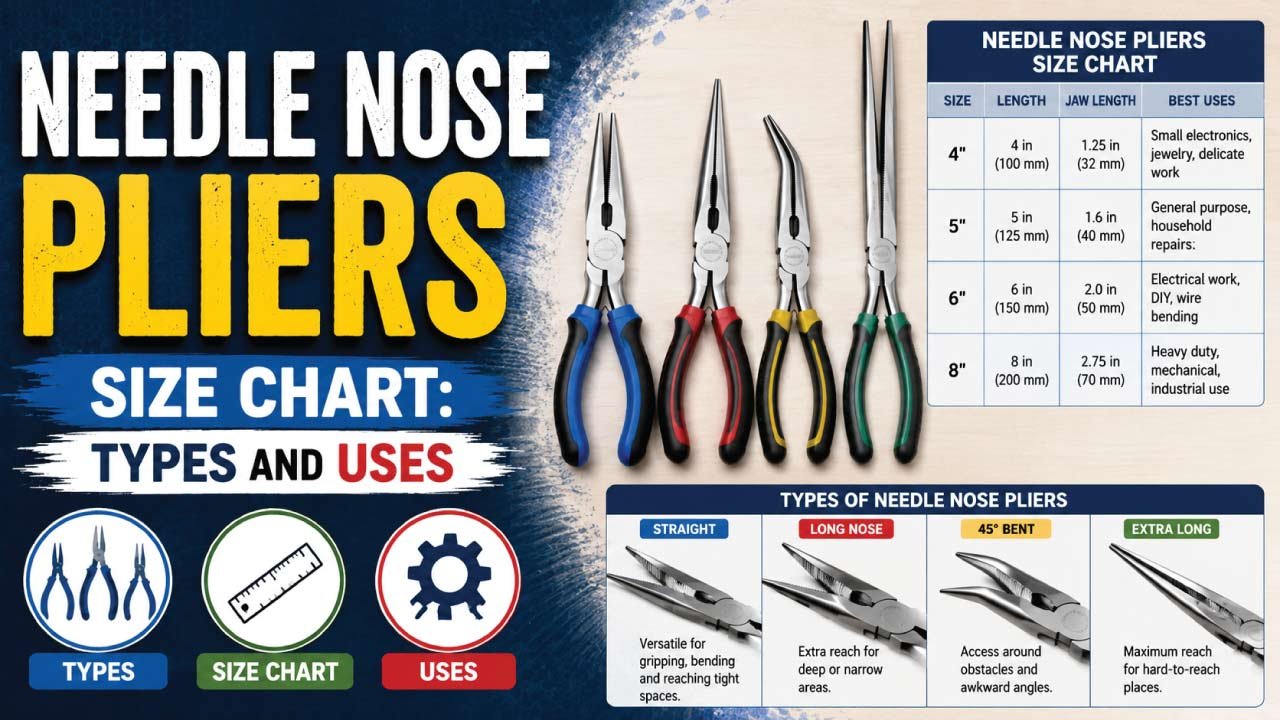
Needle nose pliers are one of the most useful hand tools for electricians, mechanics, jewelers, DIY workers, and technicians. Their long, narrow jaws make them perfect for gripping small objects, bending wires, reaching tight spaces, and handling delicate materials. Choosing the correct needle nose pliers size is important because the wrong size can reduce control, damage materials, or make work difficult.
In this complete guide, you will learn about needle nose pliers sizes, common measurements, types, materials, practical uses, and how to choose the right size for different tasks.
What Are Needle Nose Pliers?
Needle nose pliers are hand tools with long, pointed jaws designed for precision work. Unlike standard pliers, their slim jaws allow users to access narrow or hard-to-reach areas.
These pliers are commonly used in:
- Electrical work
- Jewelry making
- Automotive repair
- Electronics
- Fishing
- Craft projects
- Mechanical repair
- Wire bending and cutting
Some needle nose pliers also include built-in wire cutters near the pivot point.
Standard Needle Nose Pliers Sizes
Needle nose pliers are usually measured by their total length from the handle end to the jaw tip.
| Pliers Size | Length (mm) | Common Uses |
|---|---|---|
| 4 inch | 100 mm | Jewelry and electronics |
| 5 inch | 125 mm | Small precision work |
| 6 inch | 150 mm | General household tasks |
| 7 inch | 175 mm | Electrical and automotive work |
| 8 inch | 200 mm | Heavy-duty gripping |
| 9 inch | 225 mm | Industrial applications |
| 11 inch | 280 mm | Deep reach tasks |
Small Needle Nose Pliers Sizes
Small needle nose pliers come in compact sizes designed for precision work where control and accuracy are more important than strength. These tools are widely used in detailed tasks such as crafting, electronics, and jewelry making, where delicate handling is required without damaging small components or fine wires.
4-Inch Needle Nose Pliers
Small 4-inch pliers are mainly used for delicate work. Their compact size makes them ideal for precision tasks where space is limited and accuracy is essential.
Best for:
- Jewelry making
- Bead work
- Small electronics
- Crafting
- Precision wire bending
Advantages:
- Lightweight
- Excellent control
- Easy to handle
Limitations:
- Not suitable for heavy gripping
- Limited cutting strength
5-Inch Needle Nose Pliers
These are slightly larger and offer better gripping strength while still maintaining precision. They are a great upgrade from 4-inch pliers and are commonly used in light technical and hobby-related tasks requiring a balance of control and durability.
Common applications:
- Circuit board repair
- Hobby projects
- Light electrical tasks
- Small hardware handling
Medium Needle Nose Pliers Sizes
Medium-sized needle nose pliers are the most commonly used range because they provide a perfect balance between strength, reach, and precision. They are suitable for both household and professional tasks, making them versatile tools for electricians, mechanics, and DIY users.
6-Inch Needle Nose Pliers
The 6-inch size is one of the most popular options because it balances control and strength. It is widely used for everyday repair and installation tasks in both home and professional environments.
Common uses:
- Household repairs
- Electrical wiring
- DIY projects
- Light automotive tasks
Benefits:
- Comfortable grip
- Good jaw reach
- Versatile for many tasks
7-Inch Needle Nose Pliers
7-inch pliers are commonly used by electricians and mechanics. Their increased length provides better leverage, making them more effective for gripping, pulling, and bending wires or small components in tighter working conditions.
Best applications:
- Pulling wires
- Bending electrical cables
- Automotive repair
- Fastener handling
Advantages:
- Strong gripping force
- Better leverage
- Suitable for daily professional use
Large Needle Nose Pliers Sizes
Large needle nose pliers are designed for heavy-duty tasks where extra reach and stronger gripping power are required. These tools are commonly used in industrial environments, mechanical workshops, and maintenance jobs involving larger or harder-to-reach components.
8-Inch Needle Nose Pliers
These pliers provide stronger gripping power and longer reach. They are ideal for demanding tasks where standard pliers may not offer enough access or strength for safe and efficient handling.
Used for:
- Industrial maintenance
- Heavy wire handling
- Mechanical repair
- Deep access work
Features:
- Increased leverage
- Longer jaw reach
- Better durability
9-Inch and 11-Inch Needle Nose Pliers
Large needle nose pliers are mainly used in industrial and heavy-duty environments. Their extended length allows users to work in deeper or confined spaces while maintaining strong gripping ability for larger components and tough materials.
Common uses:
- Machinery repair
- Large cable work
- Tight industrial spaces
- Heavy gripping applications
Benefits:
- Maximum reach
- Strong grip strength
- Suitable for demanding tasks
Limitations:
- Less precision
- Heavier weight
Needle Nose Pliers Jaw Types
Needle nose pliers come in different jaw designs, each created for specific working conditions. The shape and angle of the jaws determine accessibility, precision, and suitability for electrical, mechanical, or industrial tasks.
1. Straight Jaw Needle Nose Pliers
These are the most common type. Their straight design provides direct control, making them ideal for general gripping and bending tasks where visibility and accuracy are important.
Used for:
- General gripping
- Wire bending
- Electrical work
Advantages:
- Better visibility
- Simple handling
2. Bent Nose Pliers
Bent nose pliers have angled jaws for accessing difficult positions. They are especially useful in tight or obstructed areas where straight pliers cannot reach effectively.
Best for:
- Automotive repair
- Electronics
- Tight corners
Benefits:
- Improved access
- Better working angles
3. Long Reach Needle Nose Pliers
These pliers have extra-long jaws. They are designed for deep or narrow spaces where standard pliers cannot reach, especially in mechanical or industrial environments.
Common applications:
- Deep engine work
- Industrial machinery
- Narrow spaces
Advantages:
- Extended reach
- Improved access
Needle Nose Pliers Materials
The performance, durability, and lifespan of needle nose pliers depend heavily on the material used in their construction. Different steels offer different levels of strength, corrosion resistance, and affordability.
1. Carbon Steel
Common in affordable pliers. It provides good strength and durability, making it suitable for general use, especially in basic household and DIY tasks.
Benefits:
- Strong
- Durable
- Cost-effective
Limitations:
- Can rust if not coated
2. Chrome Vanadium Steel
Popular in professional tools. It offers a strong balance of durability and corrosion resistance, making it suitable for heavy and repeated use in workshops and industrial environments.
Advantages:
- Corrosion resistant
- High strength
- Long-lasting
3. Stainless Steel
Best for wet environments. It is highly resistant to rust and corrosion, making it ideal for marine, outdoor, and moisture-prone working conditions.
Used in:
- Fishing
- Marine work
- Outdoor repair
Benefits:
- Rust resistant
- Durable
Needle Nose Pliers Handle Types
Handle design plays an important role in comfort, safety, and control during use. Different handle types are designed for general, professional, or electrical applications.
1. Standard Plastic Handles
Suitable for general use. These handles provide basic comfort and are commonly found in entry-level tools used for light-duty tasks.
Advantages:
- Comfortable
- Affordable
2. Rubber Grip Handles
Provide better comfort and control. They are preferred for extended use because they reduce hand strain and improve handling precision during long working sessions.
Best for:
- Long working hours
- Professional use
Benefits:
- Reduced hand fatigue
- Improved grip
3. Insulated Handles
Used for electrical work. These handles are designed to protect users from electric shock and are essential for electricians working near live wires.
Important feature:
- Protection against electric shock
Always verify voltage ratings before electrical use.
👆 Punch Size Chart: Complete Guide + PDF is a valuable expert guide for understanding punch sizes, types, and industrial applications in metalworking and fabrication. Read the full post to select the correct punch tool, improve accuracy, and complete marking or cutting tasks efficiently with professional-level precision and confidence.
Needle Nose Pliers with Cutter
Many needle nose pliers include built-in cutting edges.
These are useful for:
- Cutting wires
- Trimming cables
- Electrical repair
Common cutting capacities:
| Material | Typical Capacity |
|---|---|
| Copper wire | Small to medium |
| Aluminum wire | Medium |
| Steel wire | Light-duty only |
Needle Nose Pliers Uses
Needle nose pliers are highly versatile tools used across multiple industries due to their precision tips and ability to reach tight spaces. They are especially useful in electrical, mechanical, crafting, and repair work where accuracy, control, and access to small or confined areas are required for safe and effective handling.
1. Electrical Work
Electricians use needle nose pliers for a variety of precise wiring tasks where safety and accuracy are essential. Their slim jaws allow access to tight electrical boxes and help manipulate small wires without damaging insulation or connections.
Electricians use needle nose pliers for:
- Pulling wires
- Bending terminals
- Working inside electrical boxes
2. Jewelry Making
Jewelry workers rely on needle nose pliers for delicate and detailed craftsmanship. These tools allow precise control when working with thin wires, beads, and small decorative elements that require careful shaping and alignment without causing damage or distortion.
Jewelry workers need small precision pliers for:
- Shaping wire
- Holding beads
- Creating loops
3. Automotive Repair
Mechanics use needle nose pliers in automotive repair tasks where access is limited and components are small or hard to reach. Their long, narrow jaws help in removing parts and handling delicate fasteners inside tight engine compartments.
Mechanics use them to:
- Remove clips
- Access tight engine spaces
- Handle small fasteners
4. Electronics Repair
Needle nose pliers are essential in electronics repair because they allow precise handling of small components on circuit boards. Technicians use them for detailed adjustments, ensuring accuracy without damaging sensitive electronic parts or connections.
Used for:
- Circuit board work
- Small component handling
- Precision adjustments
5. Fishing Applications
Fishing needle nose pliers are widely used by anglers for handling hooks and fishing lines safely and efficiently. They make hook removal easier and help with cutting and crimping tasks during fishing activities, especially in outdoor environments.
Fishing needle nose pliers help with:
- Hook removal
- Line cutting
- Crimping
Stainless steel versions are preferred for saltwater use because they resist rust and corrosion, ensuring long-lasting performance in harsh marine conditions.
👆 Reamer Size Chart: Complete Guide with PDF is a complete expert guide to understanding reamer sizes, machining tolerances, and precision hole finishing techniques. Read the full post to choose the correct reamer, improve dimensional accuracy, and achieve smooth professional results in metalworking, engineering, and workshop projects with confidence.
Needle Nose Pliers Size Comparison
| Size | Precision | Grip Strength | Best Use |
| 4 inch | Excellent | Low | Jewelry |
| 5 inch | Very Good | Low-Medium | Electronics |
| 6 inch | Good | Medium | DIY tasks |
| 7 inch | Medium | High | Electrical work |
| 8 inch | Moderate | Very High | Industrial repair |
| 9–11 inch | Lower | Maximum | Heavy-duty tasks |
Common Problems When Using the Wrong Size
Using the incorrect size of needle nose pliers can significantly affect performance, safety, and accuracy. When the tool is too small or too large for the task, it reduces efficiency and may even damage both the tool and the workpiece. Choosing the right size is important for smooth and controlled operation.
1. Too Small
When pliers are too small for the job, they lack the strength and reach needed to perform effectively. This often leads to poor control and unnecessary strain on the tool, especially during tougher tasks.
Problems:
- Weak gripping
- Tool damage
- Poor leverage
2. Too Large
Oversized pliers can be difficult to control in detailed or confined workspaces. While they offer more power, they reduce accuracy and may cause hand fatigue during precision tasks.
Problems:
- Reduced precision
- Difficulty in tight spaces
- Hand fatigue
Maintenance Tips for Needle Nose Pliers
Proper maintenance is essential for keeping needle nose pliers in good working condition. Regular care improves durability, ensures smooth operation, and helps prevent rust, wear, and performance issues over time.
1. Keep the Jaws Clean
Dirty jaws can reduce grip efficiency and damage small components during use. Keeping them clean ensures accurate performance and longer tool life.
Remove:
- Dirt
- Oil
- Metal particles
2. Lubricate the Pivot Point
The pivot point is the most important moving part of the pliers. Regular lubrication ensures smooth opening and closing while preventing stiffness and corrosion buildup.
Apply light oil regularly to:
- Reduce friction
- Prevent rust
- Improve movement
3. Avoid Overloading
Needle nose pliers are precision tools and should not be used for heavy-duty force tasks. Overloading can damage the jaws and reduce tool lifespan significantly.
Do not use needle nose pliers for:
- Heavy hammering
- Large bolt turning
- Thick steel cutting
4. Store in a Dry Area
Moisture exposure can lead to rust and corrosion, reducing both performance and durability. Proper storage helps maintain tool quality for long-term use.
Best storage methods:
- Toolbox
- Dry cabinet
- Hanging tool rack
👆 Feeler Gauge Sizes and Their Practical Uses is a complete expert guide to understanding feeler gauge sizes, thickness measurements, and accurate gap-checking applications in automotive and mechanical work. Read the full post to learn proper usage, improve precision, and choose the right gauge for professional maintenance and adjustment tasks.
Needle Nose Pliers Safety Tips
Using needle nose pliers safely is essential to avoid injuries and ensure precise work. Following basic safety practices protects both the user and the tool during electrical, mechanical, and crafting tasks.
1. Wear Safety Glasses
Safety glasses protect your eyes from small flying particles that may occur during cutting, bending, or pulling wire-related tasks. This is especially important in electrical and mechanical work.
Protect eyes from:
- Flying wire pieces
- Metal fragments
2. Use Insulated Pliers for Electrical Work
For any electrical task, insulated pliers are essential. They provide protection against electric shock and should always be used when working near live circuits. Never use standard pliers on live electrical circuits.
3. Inspect the Tool Before Use
Before starting any task, checking the condition of the pliers ensures safe and effective operation. Damaged tools can slip, break, or cause accidents during use.
Check for:
- Loose handles
- Cracked jaws
- Rust damage
Needle Nose Pliers vs Regular Pliers
| Feature | Needle Nose Pliers | Regular Pliers |
|---|---|---|
| Jaw Shape | Long and narrow | Wide and flat |
| Precision | High | Medium |
| Tight Space Access | Excellent | Limited |
| Heavy Gripping | Moderate | Strong |
| Electronics Use | Excellent | Poor |
Best Industries Using Needle Nose Pliers
Needle nose pliers are widely used across multiple industries because of their precision tips and ability to work in tight or hard-to-reach spaces. Their versatility makes them a standard hand tool for professionals who deal with wiring, small components, and detailed assembly or repair work.
Common Industries
Needle nose pliers are used in many professional fields where accuracy and control are essential. These industries rely on them for handling wires, small parts, and delicate adjustments during installation, maintenance, and production tasks.
- Construction
- Electrical
- Automotive
- Jewelry
- Electronics
- Manufacturing
- Mechanical maintenance
Advantages of Needle Nose Pliers
Needle nose pliers offer several important benefits that make them highly useful for both professionals and DIY users. Their design allows users to perform precise tasks efficiently, especially in situations where larger tools cannot reach or provide the needed control.
Key benefits include:
- Excellent precision
- Tight space access
- Easy wire bending
- Multi-purpose use
- Lightweight handling
Disadvantages of Needle Nose Pliers
Although needle nose pliers are very useful, they also have some limitations. They are not designed for heavy-duty force or large materials, which means improper use can damage the tool or reduce its effectiveness over time.
Some limitations include:
- Limited heavy-duty strength
- Can bend under excessive force
- Not ideal for large materials
Conclusion
Needle nose pliers are essential tools for precision gripping, wire handling, and working in narrow spaces. Choosing the correct size improves safety, comfort, and work accuracy. Small sizes work best for delicate tasks, medium sizes are ideal for general repairs, and large sizes provide stronger gripping power for industrial applications.
Whether you are an electrician, mechanic, jeweler, or DIY enthusiast, understanding needle nose pliers sizes and features helps you select the right tool for every project.
👆 Micrometer Screw Gauge Reading Guide for Beginners is a must-read expert guide for learning accurate micrometer screw gauge reading, measurement techniques, and precision tool usage. Read the full post to understand scales, avoid measurement errors, and master high-accuracy dimension checking for engineering, machining, and workshop applications with confidence.

Engineer Hassan is a Mechanical Engineer with 16+ years of hands-on experience in mechanical hardware, fasteners, and workshop tools. He focuses on size selection, thread identification, and measurement, helping users choose the correct components with accuracy and safety.