
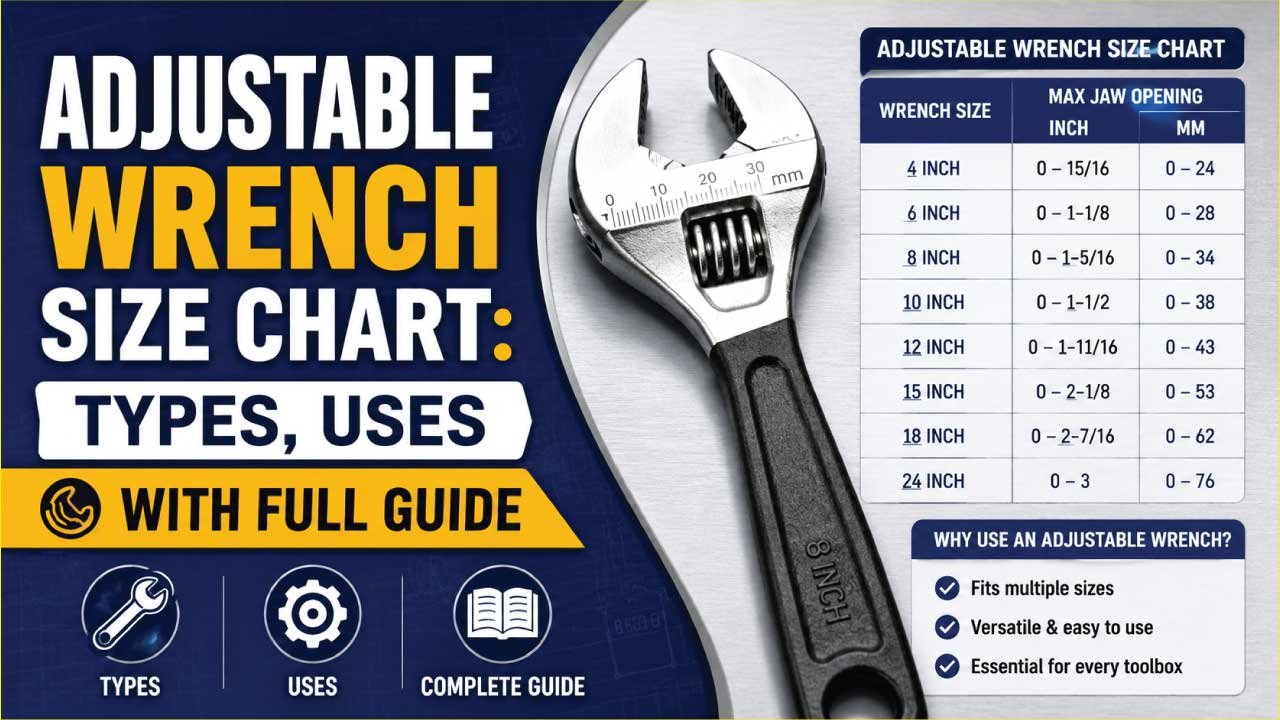
An adjustable wrench is one of the most versatile hand tools found in workshops, garages, construction sites, and home toolboxes. Unlike fixed-size wrenches, an adjustable wrench can fit multiple nut and bolt sizes by adjusting its movable jaw. This flexibility makes it a popular tool for mechanics, plumbers, electricians, maintenance technicians, and DIY users.
Choosing the correct adjustable wrench size improves grip, reduces damage to fasteners, and makes work safer and more efficient. In this complete adjustable wrench size chart guide, you’ll learn about standard adjustable wrench sizes, jaw capacities, types, uses, materials, and tips for selecting the right wrench.
What Is an Adjustable Wrench?
An adjustable wrench is a hand tool with one fixed jaw and one movable jaw. A worm screw mechanism allows the movable jaw to open or close, enabling the wrench to fit different fastener sizes.
Adjustable wrenches are commonly used for:
- Tightening nuts and bolts
- Plumbing repairs
- Automotive maintenance
- Mechanical assembly
- Equipment servicing
- Construction projects
- Home improvement tasks
Because one tool can handle many fastener sizes, adjustable wrenches reduce the need to carry a full set of fixed wrenches.
Adjustable Wrench Size Chart
The size of an adjustable wrench is measured by its overall length.
| Wrench Length | Length (mm) | Maximum Jaw Opening |
|---|---|---|
| 4 Inch | 100 mm | 13 mm |
| 6 Inch | 150 mm | 20 mm |
| 8 Inch | 200 mm | 25 mm |
| 10 Inch | 250 mm | 30 mm |
| 12 Inch | 300 mm | 35 mm |
| 15 Inch | 375 mm | 45 mm |
| 18 Inch | 450 mm | 55 mm |
| 24 Inch | 600 mm | 65 mm |
| 30 Inch | 750 mm | 75 mm |
| 36 Inch | 900 mm | 90 mm |
Actual jaw capacity may vary slightly by manufacturer.
Adjustable Wrench Jaw Capacity Chart
Jaw opening is often more important than wrench length.
| Jaw Opening | Common Fastener Sizes |
|---|---|
| 13 mm | Small machine screws and nuts |
| 20 mm | Household plumbing fittings |
| 25 mm | Automotive fasteners |
| 30 mm | Mechanical equipment |
| 35 mm | Industrial hardware |
| 45 mm | Pipe fittings and machinery |
| 55 mm+ | Heavy-duty industrial applications |
Parts of an Adjustable Wrench
Understanding the main components of an adjustable wrench helps users operate it safely and efficiently. Each part plays an important role in gripping, adjusting, and turning different sizes of nuts and bolts, making this tool highly versatile in mechanical, plumbing, and maintenance work.
1. Fixed Jaw
The fixed jaw is the stationary part of the wrench that provides a stable grip on one side of the fastener. It works together with the movable jaw to hold nuts or bolts firmly. Its rigid structure ensures strength and stability during tightening or loosening operations.
2. Movable Jaw
The movable jaw slides in and out to adjust the opening size of the wrench. This flexibility allows the tool to fit different fastener sizes. It is designed to work smoothly with the worm screw, providing a secure and adjustable grip on various nuts and bolts.
3. Worm Screw
The worm screw is the adjustment mechanism that controls the position of the movable jaw. By turning the screw, users can precisely increase or decrease the jaw opening. This component ensures accurate adjustment and helps maintain a tight and secure fit on fasteners.
4. Handle
The handle provides grip and leverage during use. It allows users to apply the necessary force to tighten or loosen fasteners effectively. A well-designed handle improves comfort, control, and safety, especially during heavy-duty or repetitive tasks.
5. Head
The head contains both the jaws and the adjustment mechanism. It is the functional working end of the wrench where all gripping and adjustment actions take place. A strong, well-machined head ensures durability and reliable performance under load.
Types of Adjustable Wrenches
Adjustable wrenches come in different designs to suit various mechanical, plumbing, electrical, and industrial applications. Each type is engineered with specific features such as jaw capacity, handle design, insulation, and accessibility. Selecting the right type improves efficiency, safety, and control during fastening or loosening operations.
1. Standard Adjustable Wrench
The standard adjustable wrench is the most commonly used type in workshops and households. It features a straight handle and a movable jaw that can be adjusted to fit different fastener sizes. Its simple and versatile design makes it suitable for general-purpose use.
Features:
- Straight handle
- Adjustable jaw
- General-purpose design
Applications:
- Mechanical work
- Home repairs
- Maintenance
2. Wide Jaw Adjustable Wrench
Wide jaw adjustable wrenches are designed with a larger opening capacity, allowing them to fit bigger nuts and bolts. This makes them more versatile when working with various fastener sizes, especially in plumbing and industrial environments.
Advantages:
- Handles larger fasteners
- Increased versatility
Applications:
- Plumbing
- Industrial work
3. Slim Jaw Adjustable Wrench
Slim jaw adjustable wrenches are specially designed for working in tight or confined spaces. Their narrow head allows better access to hard-to-reach fasteners, making them highly useful in automotive and equipment maintenance tasks.
Advantages:
- Improved access
- Lightweight design
Applications:
- Automotive repairs
- Equipment maintenance
4. Insulated Adjustable Wrench
Insulated adjustable wrenches are designed with protective insulated handles to provide safety when working near electrical systems. They help reduce the risk of electric shock and are commonly used in professional electrical maintenance work.
Applications:
- Electrical work
- Utility maintenance
5. Pipe Adjustable Wrench
Pipe adjustable wrenches are specifically designed for plumbing applications. They provide a strong grip on pipes, fittings, and valves, making them essential tools for installation and maintenance of plumbing systems.
Applications:
- Pipe fittings
- Valves
- Plumbing systems
Adjustable Wrench Materials
The material used in an adjustable wrench plays a major role in determining its strength, durability, wear resistance, and overall performance. High-quality materials ensure the wrench can withstand repeated stress, high torque, and long-term use in mechanical, plumbing, and industrial environments. Different materials are selected based on whether the tool is intended for light-duty, general-purpose, or heavy-duty applications.
1. Chrome Vanadium Steel
Chrome vanadium steel is the most commonly used material for adjustable wrenches. It offers an excellent balance of strength, toughness, and wear resistance, making it suitable for a wide range of professional and general-use applications. This material also provides a long service life under regular working conditions.
Advantages:
- High strength
- Good wear resistance
- Long service life
2. Chrome Molybdenum Steel
Chrome molybdenum steel is used in heavy-duty adjustable wrenches that are designed for demanding industrial applications. It offers superior toughness and durability, allowing the tool to withstand higher torque and harsh working conditions without deformation or failure.
Advantages:
- Superior toughness
- Increased durability
Applications:
- Industrial maintenance
- Heavy machinery
3. Carbon Steel
Carbon steel is a more budget-friendly material commonly used in adjustable wrenches intended for light-duty or occasional use. While it may not offer the same level of durability as alloy steels, it still provides adequate strength for basic household and general repair tasks.
Advantages:
- Affordable
- Strong enough for general use
Applications:
- Light-duty work
Adjustable Wrench Size Selection Guide
Choosing the correct adjustable wrench size is important for ensuring safe operation, proper grip, and efficient torque application. The right size depends on the type of fastener, working environment, and level of force required. Smaller wrenches are better for precision work, while larger ones provide higher leverage for heavy-duty applications.
1. Small Fasteners
Small fasteners require compact wrenches that offer better control in tight or delicate spaces. These sizes are commonly used for electronics, small appliances, and light mechanical tasks where precision is more important than high torque.
Recommended sizes:
- 4-inch
- 6-inch
2. General Household Repairs
For everyday maintenance and repair work, medium-sized adjustable wrenches provide a good balance between strength and usability. They are versatile tools suitable for most home and light workshop tasks.
Recommended sizes:
- 8-inch
- 10-inch
3. Plumbing Work
Plumbing applications often require more torque and a stronger grip to handle pipes, fittings, and valves. Medium to larger wrench sizes are preferred to ensure proper tightening and loosening without damaging components.
Recommended sizes:
- 10-inch
- 12-inch
4. Industrial Maintenance
Industrial environments involve heavier machinery and larger fasteners, requiring longer wrenches for increased leverage. These sizes are designed for demanding mechanical and maintenance tasks.
Recommended sizes:
- 15-inch
- 18-inch
5. Heavy Equipment Repair
Heavy equipment repair requires the largest adjustable wrenches available. These tools provide maximum torque and are used for large industrial fasteners in construction, mining, and heavy machinery applications.
Recommended sizes:
- 24-inch and larger
Selecting the proper adjustable wrench size improves safety, reduces effort, and ensures more efficient and reliable performance across all types of mechanical and industrial work.
🔧 Want to choose the right hacksaw for cutting metal, plastic, or other materials? This guide covers the Hacksaw Size Chart, Blade Sizes, different Types, and their practical Uses. Learn how blade length, tooth count, and frame style affect cutting performance. Read the full post for complete sizing details and expert selection tips.
Common Uses of Adjustable Wrenches
Adjustable wrenches are versatile hand tools used in a wide range of industries because they can fit multiple fastener sizes with a single tool. Their adjustable jaw design makes them ideal for tightening and loosening nuts and bolts in automotive, plumbing, construction, and general maintenance work. This flexibility reduces the need for multiple fixed-size wrenches.
1. Automotive Industry
In the automotive industry, adjustable wrenches are commonly used for repairing and maintaining vehicle components. They are especially useful in situations where fastener sizes vary and quick adjustments are required during repair work.
Applications include:
- Battery terminals
- Brake components
- Engine repairs
2. Plumbing Industry
Plumbers rely heavily on adjustable wrenches for working with pipes, valves, and fittings of different sizes. The tool’s adjustable jaw makes it ideal for gripping round and irregular shapes commonly found in plumbing systems.
Used for:
- Pipe fittings
- Water valves
- Faucet installation
3. Construction Industry
In construction work, adjustable wrenches are used for assembling structural components, tightening fasteners, and performing maintenance on building equipment. Their durability and flexibility make them suitable for on-site applications.
Applications include:
- Structural fasteners
- Equipment assembly
- Building maintenance
4. Manufacturing Industry
Manufacturing environments use adjustable wrenches for machine maintenance, installation, and repair tasks. They are useful in production lines where different fastener sizes are frequently encountered.
Used for:
- Machine maintenance
- Equipment installation
- Production line repairs
5. Home Improvement
Adjustable wrenches are also widely used in household and DIY projects. They are ideal for furniture assembly, appliance repairs, and general home maintenance tasks where convenience and versatility are important.
Applications include:
- Furniture assembly
- Appliance repair
- DIY projects
How to Use an Adjustable Wrench Correctly
Using an adjustable wrench properly is important for preventing damage to fasteners, improving efficiency, and ensuring user safety. Correct technique also helps extend the life of both the tool and the hardware being worked on.
1. Adjust Jaw Tightly
Before using the wrench, adjust the movable jaw so it fits snugly against the fastener. A tight fit reduces slipping and prevents rounding off the edges of nuts and bolts. Proper adjustment ensures better grip and more controlled force application during tightening or loosening.
2. Pull Instead of Push
Whenever possible, apply force by pulling the wrench rather than pushing it. Pulling provides better control, reduces the chance of sudden slips, and lowers the risk of hand injury. This technique is especially important when working in tight or awkward positions.
3. Position Correctly
Always position the wrench so that force is applied toward the fixed jaw. This helps maintain a secure grip on the fastener and reduces movement in the adjustable jaw. Correct positioning improves stability and ensures safer and more efficient operation.
4. Use Correct Size
Select an adjustable wrench that is appropriate for the size of the fastener. Using a wrench that is too small can lead to slippage and damage. A properly sized tool provides better leverage, control, and overall performance during use.
5. Avoid Excessive Force
Do not apply excessive force with an adjustable wrench, as it is not designed for high-torque applications. If a fastener is too tight, use a larger wrench or a specialized tool instead. This helps prevent tool damage, fastener stripping, and potential injury.
🔩 Wondering how a ratchet works and which one you need? This guide explains What Is a Ratchet, including common Sizes, Types, Uses, and Materials. Learn how different ratchets are used in automotive, mechanical, and DIY tasks, and discover the key factors to consider when choosing the right tool. Read the full post for complete details and practical tips.
Advantages of Adjustable Wrenches
Adjustable wrenches are highly practical tools because they can fit multiple fastener sizes using a single tool. Their flexible jaw design eliminates the need for carrying a full set of fixed-size wrenches, making them efficient for both professional technicians and DIY users. They are widely used in automotive, plumbing, construction, and maintenance work due to their convenience and adaptability.
Advantages:
- One tool fits many fastener sizes
- Reduces toolbox weight
- Cost-effective
- Easy to carry
- Quick adjustment
- Versatile applications
- Suitable for professionals and DIY users
These advantages make adjustable wrenches essential tools in many industries where efficiency, portability, and flexibility are important.
Common Adjustable Wrench Mistakes
Despite their usefulness, incorrect usage of adjustable wrenches can lead to damaged fasteners, tool wear, or safety risks. Many issues occur due to improper adjustment, poor grip, or using the wrong size for the job. Avoiding these mistakes ensures better performance and longer tool life.
1. Using Incorrect Jaw Tightness
Failing to properly adjust the jaw can cause slipping, rounding of fasteners, or reduced torque efficiency. The wrench should always fit snugly around the fastener before applying force.
2. Applying Force in the Wrong Direction
Pulling the wrench in the wrong direction or using uneven pressure can damage both the tool and the fastener. Proper alignment ensures safer and more effective operation.
3. Using the Wrong Size Wrench
Using a small wrench for large fasteners increases the risk of slipping and injury. Always select a size that matches the load and fastener dimensions.
4. Wearing or Damaged Jaws
Worn-out jaws reduce grip strength and can cause slippage. Regular inspection and replacement are necessary for safe operation.
5. Over-tightening Fasteners
Excessive force can damage threads, deform bolts, or weaken connections. Proper torque control should always be maintained.
6. Using Adjustable Wrenches as a Hammer
Using the wrench for unintended tasks can damage the tool and reduce its effectiveness. It should only be used for tightening and loosening fasteners.
7. Not Maintaining the Adjustment Mechanism
A dirty or stiff adjustment screw can affect performance. Regular cleaning and light lubrication help ensure smooth operation.
Proper usage and maintenance significantly improve safety, accuracy, and the lifespan of adjustable wrenches across all applications.
Adjustable Wrench vs Combination Wrench
| Feature | Adjustable Wrench | Combination Wrench |
|---|---|---|
| Size Flexibility | High | Fixed |
| Precision Fit | Moderate | Excellent |
| Portability | Excellent | Requires multiple sizes |
| Fastener Protection | Good | Better |
| Versatility | High | Limited |
Both tools have important roles in maintenance and repair work.
Adjustable Wrench Maintenance Tips
Proper maintenance of an adjustable wrench ensures smooth operation, longer service life, and safe usage. Regular care helps maintain jaw alignment, prevents rust, and keeps the adjustment mechanism working efficiently for accurate fastening tasks.
1. Keep Clean
After each use, clean the wrench to remove dirt, grease, and metal debris. Built-up residue can affect jaw movement and reduce gripping performance. A clean tool works more smoothly and provides better control during tightening and loosening tasks.
2. Lubricate Worm Screw
The worm screw is a key moving part that controls jaw adjustment. Periodic lubrication keeps it turning smoothly and prevents stiffness or jamming. Applying light machine oil helps maintain precise adjustment and improves overall tool functionality.
3. Prevent Rust
Always store the adjustable wrench in a dry environment to avoid rust formation. Moisture can weaken metal parts and reduce tool durability. In humid conditions, applying a light protective oil coating can help protect the surface from corrosion.
4. Inspect Jaws
Regularly check the jaws for wear, damage, or misalignment. Worn jaws can slip during use and damage fasteners. If the tool no longer grips securely, it should be replaced to ensure safety and maintain proper performance.
5. Avoid Misuse
Do not use an adjustable wrench as a hammer, pry bar, or striking tool. Misuse can damage the jaws, bend the handle, and reduce accuracy. Using the tool only for its intended purpose helps preserve strength and extends its working life.
Conclusion
Understanding adjustable wrench sizes, jaw capacities, materials, and applications helps users select the right tool for every job. Whether you’re performing plumbing repairs, automotive maintenance, construction work, or general household projects, choosing the correct adjustable wrench size improves efficiency, protects fasteners, and enhances safety.
By using the adjustable wrench size charts and selection tips above, you can confidently choose the best wrench for your needs and achieve professional-quality results.
🔧 Choosing the correct pipe wrench is essential for safe and efficient pipe work. This Pipe Wrench Size Chart guide explains common Types, practical Uses, and how to select the right size for plumbing, maintenance, and industrial applications. Learn about jaw capacity, handle length, and key features. Read the full guide for complete sizing information and expert recommendations.
Frequently Asked Questions
What is the most common adjustable wrench size?
The 8-inch adjustable wrench is one of the most popular and widely used sizes for home repairs, plumbing work, automotive maintenance, and general workshop tasks. It offers a good balance between portability and jaw capacity, making it suitable for tightening or loosening a variety of nuts and bolts.
How is adjustable wrench size measured?
Adjustable wrench size is measured by the overall length of the tool from one end to the other. Common lengths include 4, 6, 8, 10, 12, and 15 inches. Longer wrenches typically provide greater leverage and can handle larger fasteners than shorter models.
What size adjustable wrench should I buy?
For most homeowners and DIY users, an 8-inch or 10-inch adjustable wrench is an excellent choice. These sizes can handle a wide range of everyday tasks without being too bulky. Professionals may keep multiple sizes available to accommodate different fastener dimensions and work requirements.
Can adjustable wrenches replace socket sets?
Adjustable wrenches can perform many fastening tasks, but they do not completely replace socket sets. Sockets provide a more secure grip, reduce the risk of rounding fasteners, and allow faster operation in confined spaces. Adjustable wrenches are best used when versatility is needed.
What material is best for adjustable wrenches?
Chrome vanadium steel is widely regarded as the best material for adjustable wrenches because it provides excellent strength, toughness, and corrosion resistance. Many high-quality wrenches also feature protective chrome plating, which improves durability and helps prevent rust during long-term use.
How do I maintain an adjustable wrench?
Regular maintenance helps extend the life of an adjustable wrench. Keep the tool clean, lubricate the adjustment screw periodically, and store it in a dry location. Inspect the jaws for wear or damage, as excessive wear can reduce gripping performance and accuracy during use.

Engineer Hassan is a Mechanical Engineer with 16+ years of hands-on experience in mechanical hardware, fasteners, and workshop tools. He focuses on size selection, thread identification, and measurement, helping users choose the correct components with accuracy and safety.