
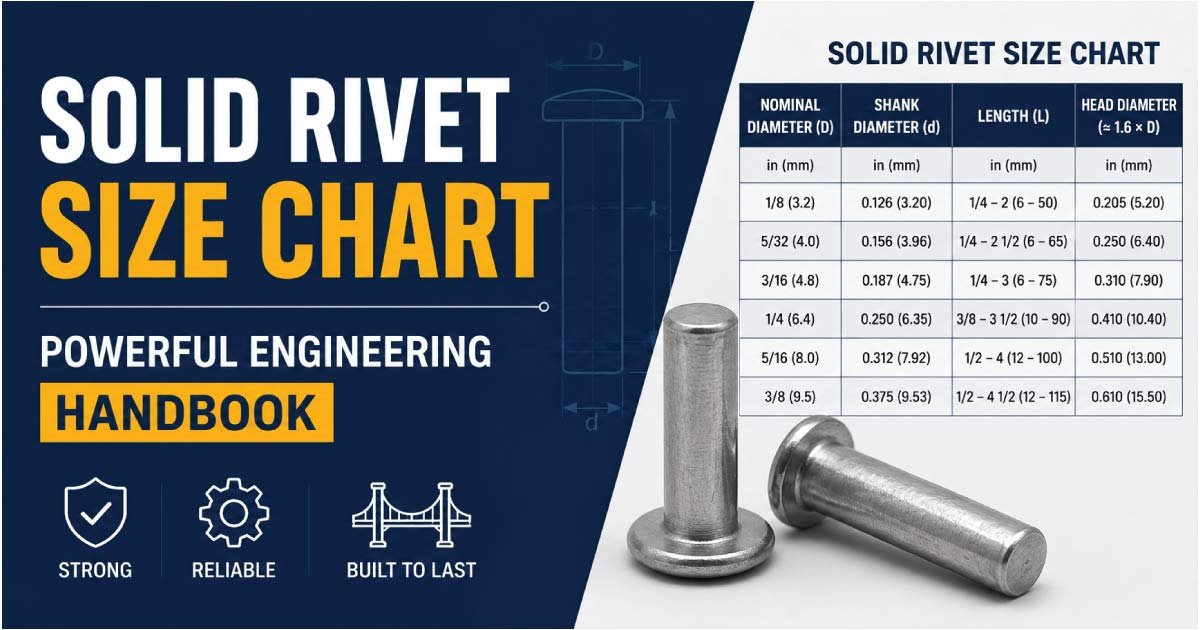
Solid rivets are among the oldest and strongest permanent fasteners used in engineering, construction, aerospace, shipbuilding, and heavy manufacturing. Unlike blind rivets, solid rivets consist of a single solid metal piece and require access to both sides of the workpiece during installation.
Understanding a Solid Rivet Size Chart is essential for selecting the correct rivet diameter, length, and material to ensure a strong, long-lasting joint. This guide explains solid rivet sizes, dimensions, types, materials, applications, and installation methods.
What Is a Solid Rivet?
A solid rivet is a permanent mechanical fastener made from a single piece of metal with a pre-formed head on one end. It is one of the strongest and most reliable fastening methods used in structural and industrial applications where long-term durability is required.
During installation, the rivet is inserted into a prepared hole, and the tail end is deformed to form a second head. This process permanently locks the materials together, creating a strong and vibration-resistant joint.
How Does a Solid Rivet Work?
The working principle of a solid rivet involves plastic deformation of the rivet shank to create a secure mechanical lock between materials.
- Drilling or aligning holes in the materials
- Inserting the rivet through the hole
- Supporting the manufactured head with a bucking bar
- Deforming the tail end using a rivet hammer or riveting tool
- Forming a shop head
As the tail is deformed, the rivet expands inside the hole, producing a tight and permanent connection between the joined materials.
Solid Rivet Size Chart
The Solid Rivet Size Chart shows common rivet diameters along with their inch and metric equivalents used in different engineering applications.
| Rivet Diameter | Diameter (Inches) | Diameter (mm) |
|---|---|---|
| 3/32″ | 0.094″ | 2.4 mm |
| 1/8″ | 0.125″ | 3.2 mm |
| 5/32″ | 0.156″ | 4.0 mm |
| 3/16″ | 0.188″ | 4.8 mm |
| 7/32″ | 0.219″ | 5.6 mm |
| 1/4″ | 0.250″ | 6.4 mm |
| 5/16″ | 0.313″ | 7.9 mm |
| 3/8″ | 0.375″ | 9.5 mm |
| 1/2″ | 0.500″ | 12.7 mm |
These diameters are widely used across automotive, aerospace, construction, and heavy machinery applications.
Solid Rivet Length Chart
Rivet length must be selected based on material thickness and the amount of material needed to form the shop head properly. Correct length selection ensures strong and secure fastening.
| Length (Inches) | Length (mm) |
|---|---|
| 1/4″ | 6.35 mm |
| 3/8″ | 9.53 mm |
| 1/2″ | 12.7 mm |
| 5/8″ | 15.88 mm |
| 3/4″ | 19.05 mm |
| 1″ | 25.4 mm |
| 1-1/4″ | 31.75 mm |
| 1-1/2″ | 38.1 mm |
| 2″ | 50.8 mm |
Longer rivets are required when joining thicker materials or when additional deformation is needed for proper joint formation.
How to Determine Solid Rivet Length
A commonly used engineering rule helps estimate the correct rivet length based on material thickness and rivet diameter.
Rivet Length = Material Thickness + 1.5 × Rivet Diameter
Example:
Material thickness = 0.250″
Rivet diameter = 0.125″
Calculation:
0.250 + (1.5 × 0.125) = 0.4375″
So, a 7/16″ rivet would typically be selected for this application.
Types of Solid Rivets
Solid rivets come in different head styles to suit various structural, aesthetic, and load-bearing requirements. Each type is designed to perform efficiently under specific conditions, ensuring strong, durable, and reliable permanent joints in engineering and manufacturing applications.
1. Round Head Rivet
Round head rivets are the most commonly used type of solid rivet due to their high strength and simple, reliable design. They provide excellent holding power and are widely used in heavy-duty applications where durability and structural integrity are essential.
Features:
- High strength
- Excellent durability
- General-purpose design
Applications:
- Structural assemblies
- Heavy machinery
- Construction
2. Universal Head Rivet
Universal head rivets offer a balance between strength and a slightly streamlined head profile. They are widely accepted in aerospace and transportation industries due to their dependable performance and standardized design.
Features:
- Combination of strength and streamlined shape
- Aerospace standard
Applications:
- Aircraft manufacturing
- Transportation equipment
3. Flat Head Rivet
Flat head rivets are designed with a larger bearing surface, allowing better load distribution across softer or thinner materials. This reduces the risk of material damage and improves joint stability under stress.
Features:
- Large bearing surface
- Improved load distribution
Applications:
- Thin materials
- Soft materials
4. Countersunk Rivet
Countersunk rivets are designed to sit flush with the material surface after installation. This creates a smooth and aerodynamic finish, making them ideal for applications where surface appearance and reduced drag are important.
Features:
- Flush finish
- Smooth surface
Applications:
- Aircraft skins
- Automotive panels
- Decorative assemblies
Solid Rivet Materials
Solid rivet materials play a crucial role in determining the strength, durability, corrosion resistance, and weight of the final assembly. Choosing the right material ensures optimal performance in different environmental and structural conditions.
1. Aluminum Rivets
Aluminum solid rivets are widely used because of their lightweight nature and good corrosion resistance. They are easy to install and ideal for applications where reducing overall weight is important without compromising basic fastening performance.
Advantages:
- Lightweight
- Corrosion resistant
- Easy installation
Applications:
- Aerospace
- Electronics
- Sheet metal work
2. Steel Rivets
Steel rivets are known for their high strength and durability, making them suitable for heavy-duty structural applications. They are cost-effective and perform well under high mechanical stress and load conditions.
Benefits:
- High strength
- Durable
- Cost-effective
Applications:
- Structural steel
- Machinery
- Construction
3. Stainless Steel Rivets
Stainless steel rivets offer excellent resistance to corrosion and harsh environmental conditions. They provide long service life and are commonly used in outdoor and moisture-prone applications.
Advantages:
- Excellent corrosion resistance
- Long service life
- Outdoor suitability
Applications:
- Marine equipment
- Food processing machinery
- Outdoor structures
4. Copper Rivets
Copper rivets are valued for their corrosion resistance, electrical conductivity, and attractive appearance. They are often used in specialized applications where both functionality and aesthetics are important.
Benefits:
- Corrosion resistance
- Attractive appearance
- Electrical conductivity
Applications:
- Decorative work
- Electrical equipment
Solid Rivet Head Dimensions
Solid rivet head dimensions vary depending on the rivet diameter and application requirements. The head size is designed to ensure proper load distribution, strength, and stability in the joint. Larger diameters generally come with larger head sizes to maintain balance and structural integrity.
| Rivet Diameter | Head Diameter | Head Height |
|---|---|---|
| 1/8″ | 0.219″ | 0.063″ |
| 3/16″ | 0.328″ | 0.094″ |
| 1/4″ | 0.438″ | 0.125″ |
| 5/16″ | 0.547″ | 0.156″ |
These dimensions may vary slightly depending on manufacturing standards and industry specifications.
How to Read a Solid Rivet Size
Understanding rivet size notation is important for selecting the correct fastener for a specific application. Rivet sizes are typically shown using diameter and length values.
1. Imperial Size Example
A typical rivet designation may appear as:
1/8″ × 1/2″
Meaning:
- Diameter = 1/8 inch
- Length = 1/2 inch
2. Metric Size Example
A metric rivet size may appear as:
4 mm × 12 mm
Meaning:
- Diameter = 4 mm
- Length = 12 mm
In both cases, the first number always represents the rivet diameter, while the second number represents the rivet length used for proper grip and installation.
How to Choose the Correct Solid Rivet Size
Selecting the correct solid rivet size is essential for achieving strong, permanent, and reliable joints. Solid rivets are widely used in structural applications, and proper selection depends on material thickness, load conditions, environmental exposure, and required strength. Choosing correctly ensures safety, durability, and long-term performance of the assembly.
1. Material Thickness
Material thickness is a key factor when selecting a solid rivet. The rivet must be long enough to form a proper shop head after installation. If it is too short, it cannot form correctly; if too long, it may bend or deform. Correct sizing ensures tight clamping and strong mechanical fastening.
2. Load Requirements
The load applied to a joint directly affects rivet diameter selection. High-load applications require thicker rivets to withstand shear and tensile forces without failure. Light-duty connections can use smaller diameters. Proper load matching ensures the joint remains stable, vibration-resistant, and safe under continuous or heavy mechanical stress conditions.
3. Material Type
The type of material being joined influences rivet head style and size. Soft materials such as aluminum or plastic may require larger heads to distribute pressure evenly and prevent damage. Hard materials can use standard heads. Correct selection helps improve load distribution, prevents deformation, and ensures a stronger and more durable joint.
4. Environmental Conditions
Environmental exposure plays an important role in rivet selection. In corrosive environments such as marine or outdoor applications, stainless steel or aluminum rivets are preferred. These materials resist rust and degradation, ensuring long-term performance. Proper material choice helps maintain joint integrity, reduces maintenance needs, and extends the service life of the structure.
5. Strength Requirements
Different applications demand different levels of strength, making material selection critical. Structural and heavy-duty applications typically require steel or alloy rivets due to their high strength and durability. These rivets can handle extreme loads and stresses, ensuring safe and reliable performance in demanding industrial, construction, and engineering environments.
Advantages of Solid Rivets
Solid rivets are widely preferred in engineering applications because they provide extremely strong and long-lasting joints. Their simple design and reliable performance make them suitable for demanding structural environments.
Key benefits include:
- Exceptional strength
- Permanent fastening
- Excellent vibration resistance
- Long service life
- High shear strength
- Reliable performance
- Minimal maintenance
These advantages make solid rivets a preferred solution for critical applications where safety and durability are essential.
Common Installation Mistakes
Proper installation of solid rivets is critical for achieving strong, durable, and safe permanent joints. Even small errors in sizing or technique can reduce load capacity, weaken the structure, and shorten service life. Understanding these common mistakes helps ensure correct installation and reliable long-term performance in engineering applications.
1. Incorrect Rivet Length
Choosing the wrong rivet length is a common mistake that directly affects shop head formation and joint strength. If the rivet is too short, it cannot form a proper head, resulting in a weak connection. If it is too long, it may buckle or create an uneven head, reducing stability and fastening reliability.
2. Wrong Hole Size
Incorrect hole sizing significantly impacts rivet performance and joint integrity. Oversized holes reduce friction between materials, leading to loose connections and reduced strength. Poorly drilled or inconsistent holes can also cause improper seating of the rivet. Maintaining accurate hole diameter ensures tight fitment, proper deformation, and maximum holding strength of the joint.
3. Poor Rivet Alignment
Misalignment during installation can cause uneven load distribution across the joint. When rivets are not properly aligned, stress concentrates on specific points, weakening the overall assembly. This can lead to deformation, loosening, or early failure under load. Proper alignment ensures balanced force distribution and long-term structural stability.
4. Using the Wrong Material
Selecting incompatible rivet and base materials can lead to galvanic corrosion, especially in moisture-prone environments. This chemical reaction gradually weakens the joint, causing rust and reduced strength over time. Choosing compatible or corrosion-resistant materials ensures durability, prevents deterioration, and extends the overall service life of the assembly.
Solid Rivet vs Blind Rivet
| Feature | Solid Rivet | Blind Rivet |
|---|---|---|
| Installation Access | Both sides required | One side required |
| Strength | Very high | Moderate to high |
| Installation Speed | Slower | Faster |
| Cost | Lower rivet cost | Higher rivet cost |
| Common Applications | Aerospace, structural | General assembly |
Solid rivets provide maximum strength and durability, while blind rivets offer faster and easier installation, especially in restricted-access applications.
Conclusion
A Solid Rivet Size Chart is an essential reference for selecting the correct rivet diameter and length for structural, aerospace, industrial, and manufacturing applications. Choosing the proper Rivet size ensures maximum joint strength, durability, and long-term performance.
By understanding rivet dimensions, materials, head styles, and installation requirements, you can confidently select the best solid rivet for any project and create secure, permanent fastening connections that withstand demanding conditions.
👉 Lag Bolt Size Chart, Types, Uses With Complete Guide helps you understand lag bolt sizes, thread dimensions, head types, and load-bearing applications. Learn how to choose the correct lag bolt for wood construction, decking, heavy-duty fastening, and structural projects. Read the full guide for detailed size charts, installation tips, common types, and practical uses.

Engineer Hassan is a Mechanical Engineer with 16+ years of hands-on experience in mechanical hardware, fasteners, and workshop tools. He focuses on size selection, thread identification, and measurement, helping users choose the correct components with accuracy and safety.