
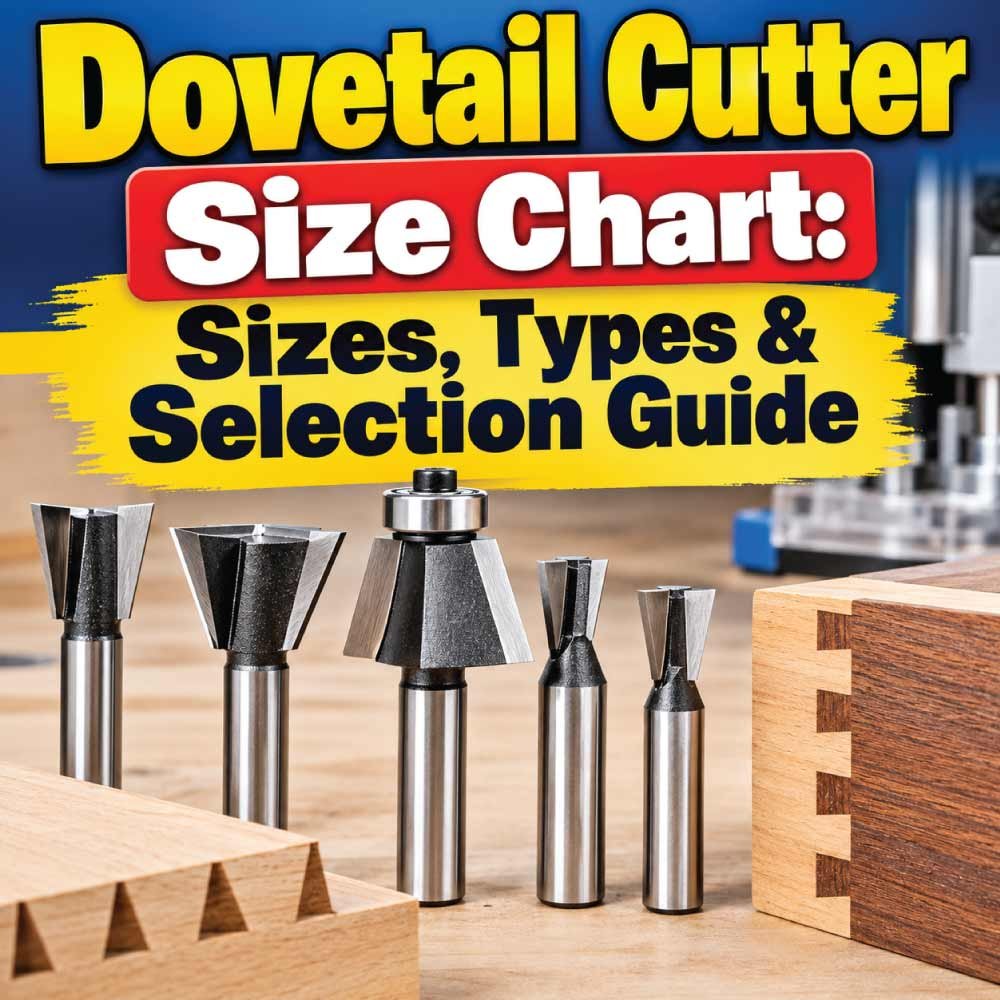
Choosing the correct dovetail cutter is essential when machining angled slots, dovetail slides, T-slots, tool-holding features, and precision mating surfaces. The cutter must match the dovetail angle, slot width, required depth, workpiece material, machine setup, and available clearance.
A dovetail cutter size chart makes it easier to compare common cutter diameters, included angles, cutting widths, shank sizes, and typical applications. However, unlike simple drill or bolt sizing, dovetail cutters do not follow one universal dimensional system. Exact dimensions can vary significantly between manufacturers and cutter designs.
This guide explains the main dovetail cutter sizes, common cutter types, important dimensions, angle selection, measuring methods, and practical selection considerations. The charts provide useful reference ranges rather than replacing the manufacturer’s exact specification.
What Is a Dovetail Cutter?
A dovetail cutter is an angled milling cutter designed to produce dovetail-shaped grooves, slots, shoulders, and mating surfaces. Its cutting teeth are positioned around an angled body, allowing the tool to machine the sloping sides characteristic of a dovetail profile.
Dovetail cutters are commonly used on:
- Milling machines
- CNC machining centers
- Manual knee mills
- Toolroom milling machines
- Specialty production equipment
The cutter’s most important characteristics include included angle, outside diameter, cutting width, depth capability, shank diameter, and tooth configuration.
Unlike an ordinary end mill, a dovetail cutter is generally used to create a specific angled geometry. This makes selecting the correct angle and diameter particularly important.
How a Dovetail Cutter Works
A typical machining operation begins by creating a straight slot or preliminary cavity with another milling tool. The dovetail cutter then enters the slot and cuts the angled walls.
This approach reduces the amount of material the angled cutter must remove and can improve tool life and surface finish.
The cutter can also be used to machine an existing slot to a specific dovetail profile, provided the cutter dimensions and machine setup allow adequate access.
Dovetail Cutter Size Chart
There is no single universal dovetail cutter size chart because manufacturers offer different combinations of diameter, angle, cutting width, shank size, and tooth geometry.
The following reference chart shows common nominal size ranges encountered in general-purpose milling. Always verify the exact dimensions before ordering or programming a tool.
| Nominal Cutter Diameter | Approx. Metric Equivalent | Common Included Angles | Typical Use |
|---|---|---|---|
| 1/4 in | 6.35 mm | 45°, 60° | Small slots and light work |
| 3/8 in | 9.53 mm | 45°, 60° | Small to medium components |
| 1/2 in | 12.70 mm | 45°, 60° | General-purpose milling |
| 5/8 in | 15.88 mm | 45°, 60° | Medium dovetail features |
| 3/4 in | 19.05 mm | 45°, 60° | Larger slots and slides |
| 7/8 in | 22.23 mm | 45°, 60° | Medium-heavy machining |
| 1 in | 25.40 mm | 45°, 60° | Larger dovetail profiles |
| 1-1/4 in | 31.75 mm | 45°, 60° | Large workpieces |
| 1-1/2 in | 38.10 mm | 45°, 60° | Large dovetail machining |
These are nominal cutter diameters, not guaranteed dimensions for every tool. A 1/2-inch dovetail cutter from one manufacturer may have a different cutting width, neck diameter, overall length, or maximum depth than another 1/2-inch cutter.
Key Dovetail Cutter Dimensions
Understanding the dimensions on a cutter drawing is more useful than relying on diameter alone. Several measurements determine whether the cutter will actually produce the required feature.
Outside Diameter
The outside diameter is the largest diameter across the cutting portion of the tool.
A larger diameter can provide a broader cutting profile, but it also requires more clearance. The diameter should therefore be considered together with the required slot width and depth.
Included Angle
The included angle describes the angle between the two sloping sides of the dovetail profile.
Common configurations include 45°, 60°, and other application-specific angles. A cutter must match the intended profile angle unless the geometry is deliberately being produced differently.
Cutting Width
Cutting width describes the usable width of the cutting section. Depending on the cutter design, this dimension may be specified differently by the manufacturer.
It is important when determining whether the cutter can reach the required depth and create the intended profile.
Shank Diameter
The shank is the portion held by the milling machine’s collet, chuck, or tool holder.
Common shank dimensions include both imperial and metric sizes. The shank must match the tool-holding system and provide adequate rigidity.
Overall Length
Overall length affects tool reach and machine clearance. A longer cutter can reach deeper features, but excessive stick-out can increase deflection and vibration.
For rigid machining, use the shortest practical tool projection.
Neck Diameter and Relief
Some dovetail cutters have a reduced neck behind the cutting section. This creates clearance between the tool and the upper portion of a workpiece.
Neck dimensions can become especially important when machining deep dovetails or enclosed profiles.
Common Dovetail Cutter Types
Dovetail cutters are available in several configurations. The correct type depends on the machine, material, profile, and production requirements.
Solid Carbide Dovetail Cutters
Solid carbide cutters provide high rigidity and wear resistance and are frequently used for CNC machining and harder materials.
They can perform well at appropriate cutting speeds, but carbide is comparatively brittle. Machine rigidity, workholding, and proper cutting conditions are important.
Typical applications include:
- Precision CNC work
- Hardened or abrasive materials within the tool’s capability
- High-production machining
- Small-diameter tooling
High-Speed Steel Dovetail Cutters
HSS dovetail cutters are widely used in general-purpose milling. They offer good toughness and are often forgiving in manual machining applications.
HSS tooling can be particularly practical when cutting conditions are variable or when a machine does not have the rigidity required for aggressive carbide machining.
Indexable Dovetail Cutters
Indexable designs use replaceable cutting inserts instead of a permanently ground cutting edge.
Their advantages can include:
- Replaceable inserts
- Reduced tool replacement time
- Suitable configurations for production work
- Potentially economical edge replacement
Exact insert geometry and cutter availability vary by tooling system.
Single-Angle Dovetail Cutters
Single-angle cutters are designed around a specific included angle and are useful when machining a known dovetail profile.
They are often selected for specialized components where the required geometry is already established.
Double-Angle Dovetail Cutters
Double-angle cutters are commonly associated with milling applications requiring two angled surfaces. The exact geometry depends on the manufacturer’s design.
Always check the cutter drawing because the terminology used for single-angle and double-angle tools can differ between suppliers.
Dovetail Cutter Angle Chart
The angle is one of the most important specifications when selecting a cutter. A diameter that fits the application is not useful if its angle does not match the required dovetail geometry.
| Included Angle | Typical Profile Characteristic | Potential Application |
|---|---|---|
| 30° | Narrower included angle | Specialized dovetail profiles |
| 45° | Moderate angular profile | General angled slots and slides |
| 60° | Wider included angle | Common dovetail-style features |
| 75° | Broad angled profile | Specialized machining |
| 90° | Very wide included angle | Specific angled-slot applications |
These angles are examples of configurations that may be available; they are not a universal standard size list. The required angle should always come from the engineering drawing, mating component, or existing feature.
How to Choose the Right Dovetail Cutter Size
Selecting a dovetail cutter should begin with the finished feature rather than the cutter itself.
1. Identify the Required Angle
First determine the angle of the dovetail.
If the drawing specifies a 60° included angle, select a cutter designed for that geometry. Do not assume that a cutter labeled with an angle uses the same angle convention as every other manufacturer.
Check whether the specification refers to:
- Included angle
- Angle per side
- Profile angle
- Cutter angle
This distinction can prevent major machining errors.
2. Determine the Required Width
Measure or calculate the finished width of the dovetail feature.
The cutter diameter and cutting width must provide enough material clearance to form the intended profile.
For an existing slot, also check the entry width at the top of the feature. A cutter may have the correct angle but still be too large to enter the available opening.
3. Check Required Depth
Depth determines how far the cutter must travel into the workpiece.
Check:
- Finished dovetail depth
- Cutter cutting height
- Neck clearance
- Shank clearance
- Machine travel
A cutter that can create the correct angle at shallow depth may not have enough clearance for a deep dovetail.
4. Match the Shank to the Tool Holder
Confirm that the shank fits the machine’s collet, chuck, or tool holder.
A properly sized cutting diameter does not compensate for an incompatible shank.
5. Consider Workpiece Material
Tool material and geometry should suit the workpiece.
For example:
- Aluminum: sharp, suitable geometry can help control built-up edge.
- Mild steel: HSS or carbide may be appropriate depending on machine and production requirements.
- Stainless steel: rigidity and heat control become particularly important.
- Tool steel: cutter grade and cutting conditions require careful consideration.
- Plastics: sharp cutting edges and appropriate chip clearance can reduce melting or deformation.
The manufacturer’s recommended cutting data should be used for the specific tool and material.
Dovetail Cutter Size vs. Dovetail Slot Size
One of the most common misunderstandings is assuming that the cutter diameter directly equals the finished dovetail width.
It does not.
The finished feature depends on several variables:
- Cutter outside diameter
- Included angle
- Cutter thickness or cutting width
- Starting slot dimensions
- Machining depth
- Workpiece geometry
- Cutter position
For this reason, a 1/2-inch cutter does not simply produce a 1/2-inch dovetail.
The tool’s geometry and its vertical and horizontal position determine the final profile.
Why the Pre-Cut Slot Matters
When machining a deep dovetail, removing most of the material with a conventional end mill can significantly reduce the load on the dovetail cutter.
The preliminary slot is generally made narrower than the final feature so the angled cutter removes only the remaining material.
The exact dimensions should be calculated from the desired profile and cutter geometry rather than guessed.
How to Measure a Dovetail Cutter
Accurate tool measurement is useful when the cutter marking is missing, unreadable, or incomplete.
Measure the Outside Diameter
Use a suitable micrometer or caliper to measure across the widest cutting portion.
For precision work, a micrometer is generally preferable when its range and geometry allow reliable contact.
Measure the Shank
Measure the cylindrical shank separately from the cutting body.
Record the value in the same unit system used by the machine setup or tooling documentation.
Determine the Angle
The angle can be checked using appropriate inspection equipment, an optical comparator, or a suitable angle-measuring method.
Do not estimate the angle visually when the profile is dimensionally critical.
Measure the Cutting Width
Measure the axial width of the cutting section according to the manufacturer’s dimension convention.
Because cutter drawings can define this measurement differently, compare your measurement with the manufacturer’s diagram whenever possible.
Also Read:
How to Use a Dovetail Cutter Safely
Dovetail cutters have relatively thin cutting sections compared with many conventional milling cutters. Incorrect engagement can result in chatter, edge damage, poor finish, or tool breakage.
Before machining:
- Secure the workpiece firmly.
- Confirm the cutter is correctly seated.
- Minimize tool overhang.
- Verify spindle direction.
- Use appropriate cutting fluid or coolant where required.
- Confirm the cutter clears clamps and fixtures.
- Start with conservative cutting conditions when tool data is uncertain.
Avoid forcing the cutter into a full-width cut when a staged machining approach is possible.
Use a Pilot or Preliminary Slot
For many dovetail operations, first create a straight slot using an end mill or similar tool.
This removes the central material before the angled cutter creates the final sides.
This technique can reduce cutting load and make the operation more predictable.
Take Controlled Passes
Rather than removing excessive material in one pass, use controlled depth increments appropriate to the machine, cutter, and material.
The correct step-over and depth of cut depend on the tool manufacturer’s recommendations.
Common Dovetail Cutter Applications
Dovetail cutters are used wherever angled mechanical surfaces or grooves are required.
Common applications include:
- Machine-tool slides
- Guideways
- Fixture components
- Jigs
- Tooling plates
- Mold components
- Mechanical locking features
- Tapered mounting surfaces
- Specialized slots
- Machine adjustments
- Replacement mechanical components
Dovetail geometry is useful because the angled sides can provide mechanical guidance and resistance to lateral separation.
Also Read:
Dovetail Cutter Advantages and Limitations
Understanding both strengths and limitations helps determine whether this tool is appropriate.
Advantages
- Produces accurate angled profiles
- Available in multiple cutter angles
- Suitable for manual and CNC milling
- Available in HSS and carbide
- Can machine specialized guideway features
- Useful for producing interlocking mechanical surfaces
- Available in many diameters and shank configurations
Limitations
- Cutting edges can be relatively delicate
- Incorrect angle selection can ruin the profile
- Deep cuts may require significant clearance
- Excessive tool overhang can cause deflection
- Large material removal should generally be avoided with the final dovetail cutter
- Exact dimensions vary among manufacturers
These limitations make careful setup and tool selection especially important.
Dovetail Cutter Selection Checklist
Before purchasing or installing a cutter, verify the following specifications.
| Specification | What to Check | Why It Matters |
|---|---|---|
| Angle | Required profile angle | Determines side geometry |
| Diameter | Cutter outside diameter | Controls tool clearance and profile |
| Cutting width | Usable cutting section | Determines profile capability |
| Shank | Holder-compatible diameter | Ensures secure mounting |
| Overall length | Required reach | Prevents clearance problems |
| Neck clearance | Available space above cut | Important for deep profiles |
| Tool material | HSS, carbide, etc. | Affects cutting performance |
| Tooth geometry | Manufacturer specification | Influences chip removal |
| Workpiece material | Material being machined | Determines suitable cutting conditions |
| Machine rigidity | CNC or manual setup | Influences tool choice |
Common Mistakes When Choosing a Dovetail Cutter
Even experienced machinists can encounter problems when one dimension is overlooked.
Choosing by Diameter Alone
A cutter should never be selected solely because its diameter matches the desired slot width.
The angle, cutting width, depth, and clearance must also be compatible.
Ignoring the Angle Convention
An angle printed on a cutter does not necessarily tell you whether it represents the included angle or one side of the profile.
Always verify the manufacturer’s terminology.
Using Excessive Tool Stick-Out
Long tool projection increases deflection and vibration.
Use the shortest practical setup that still provides the required clearance.
Removing Too Much Material with the Dovetail Cutter
The final cutter is not always the best tool for bulk material removal.
A preliminary slot can reduce the amount of material the angled cutter needs to remove.
Ignoring Fixture Clearance
The cutter body, shank, and holder can all interfere with clamps or other fixtures.
Check the complete tool assembly, not only the cutting diameter.
Assuming All Cutters Are Dimensionally Identical
Two cutters with the same nominal diameter and angle can still have different cutting widths, neck dimensions, shank sizes, and overall lengths.
Use the exact tool drawing when dimensions matter.
Also Read:
Dovetail Cutter vs. End Mill
A conventional end mill and a dovetail cutter serve different purposes.
| Feature | Dovetail Cutter | End Mill |
|---|---|---|
| Primary geometry | Angled | Straight or specialized |
| Dovetail profiles | Excellent | Not normally suitable alone |
| Straight slots | Limited | Excellent |
| Material removal | Usually specialized | Broad range of uses |
| Angled shoulders | Excellent | Limited by tool geometry |
| General versatility | Specialized | High |
| Typical finishing role | Profile finishing/forming | Slotting, pocketing, profiling |
A common workflow uses an end mill for initial material removal and a dovetail cutter for the final angled geometry.
How to Select a Dovetail Cutter for CNC Machining
CNC machining introduces additional considerations because the tool path, holder, spindle speed, feed rate, and depth of cut must work together.
Start with the exact cutter geometry and manufacturer’s recommended cutting data.
Then verify:
- Tool diameter
- Tool length
- Cutting edge location
- Holder dimensions
- Workpiece zero
- Tool clearance
- Maximum machining depth
- Feed and spindle limits
- Coolant requirements
For CNC programming, the cutter’s actual geometry should be entered accurately into the tool library. Small dimensional differences can affect the finished profile.
Rigid workholding is also important because vibration can produce poor surface finish and shorten cutter life.
How to Choose a Dovetail Cutter for Manual Milling
Manual milling requires particular attention to machine rigidity and operator control.
For a manual machine:
- Measure the required dovetail geometry.
- Select the correct cutter angle.
- Choose an appropriate cutter diameter.
- Machine a preliminary slot when appropriate.
- Install the cutter with minimal overhang.
- Align the workpiece carefully.
- Make controlled passes.
- Check the profile between operations.
- Take a final light pass if necessary.
When making precision components, measure the feature instead of relying only on the machine’s dial setting.
Frequently Asked Questions
What is the most common dovetail cutter angle?
Several angles are commercially available, including 45° and 60° configurations. The appropriate angle depends on the required part geometry rather than simply on popularity.
How do I know what size dovetail cutter I need?
Start with the required included angle, finished profile, depth, width, and available clearance. Then select a cutter whose diameter, cutting width, and neck dimensions can produce that geometry.
Can a dovetail cutter cut a slot from solid material?
It can remove material, but using it for the entire slotting operation may place unnecessary load on the cutter. A preliminary straight slot is often a more practical machining approach.
Does cutter diameter determine dovetail width?
No. Cutter diameter is only one part of the geometry. The final width also depends on cutter angle, cutting width, cutter position, depth, and the starting slot.
Are carbide dovetail cutters better than HSS?
Neither is universally better. Carbide can provide high wear resistance and is often useful in rigid CNC applications, while HSS offers toughness and can be practical for general-purpose or manual milling.
How deep can a dovetail cutter cut?
The usable depth depends on the cutter’s cutting height, neck clearance, diameter, angle, workpiece geometry, and manufacturer specifications. Always verify the tool drawing rather than assuming a universal maximum depth.
Can I use a dovetail cutter on aluminum?
Yes, dovetail cutters are commonly used for aluminum machining. The cutter geometry, sharpness, chip evacuation, spindle speed, feed, and lubrication should be appropriate for the specific tool and alloy.
Why does my dovetail cutter chatter?
Chatter can result from excessive tool overhang, insufficient workholding, unsuitable cutting conditions, machine vibration, excessive engagement, or a worn cutter.
Reducing unsupported tool length and cutting load can help, but the appropriate remedy depends on the machining setup.
Final Takeaway
A dovetail cutter size chart is useful for comparing cutter diameters, angles, shank sizes, cutting widths, and general applications, but diameter alone should never determine tool selection.
For reliable results, begin with the finished dovetail profile and identify the required angle, width, depth, clearance, workpiece material, and machine capability. Then choose the cutter geometry that matches those requirements.
Because exact dimensions vary among tooling manufacturers, use the manufacturer’s drawing and cutting recommendations for final tool selection. With the correct angle, adequate clearance, rigid setup, and controlled cutting conditions, a dovetail cutter can produce accurate and repeatable angled mechanical features.

Engineer Hassan is a Mechanical Engineer with 16+ years of hands-on experience in mechanical hardware, fasteners, and workshop tools. He focuses on size selection, thread identification, and measurement, helping users choose the correct components with accuracy and safety.