
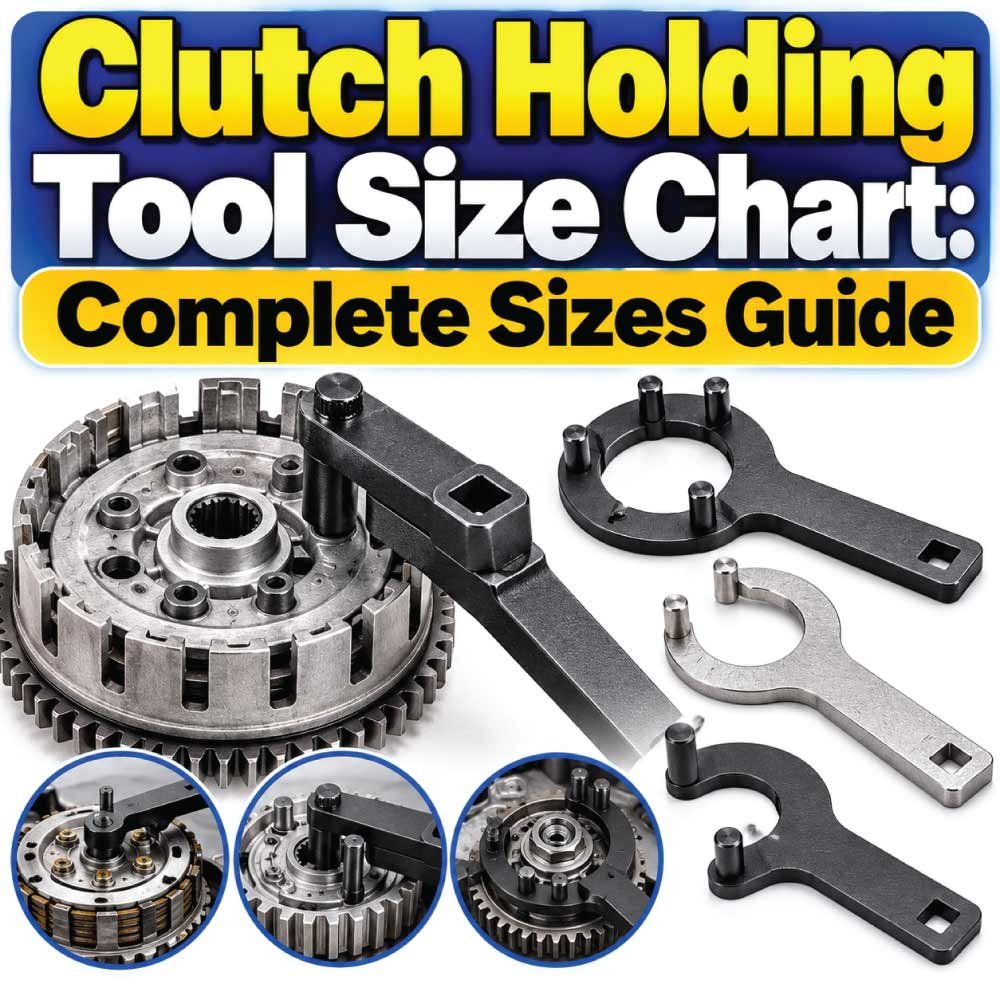
A clutch holding tool size chart helps you identify the dimensions and adjustment range needed to hold a clutch securely while removing or installing a clutch hub, basket, center nut, or related fastener. Choosing the correct tool is important because clutch assemblies differ considerably between vehicles, motorcycles, ATVs, and other powersports equipment.
There is no single universal clutch holding tool size that fits every clutch. Tools may use adjustable jaws, pins, hooks, plates, or specially shaped arms, and their working range can vary by design. The correct choice depends on the clutch’s outside diameter, available gripping points, hub or basket design, and the amount of clearance around the assembly.
This guide explains the important clutch holding tool dimensions, how to measure a clutch, how different tool designs work, and how to choose a suitable size without relying on an inaccurate universal dimension.
What Is a Clutch Holding Tool?
A clutch holding tool is a service tool used to prevent a clutch component from rotating while another component is loosened or tightened. It provides controlled counter-holding so the technician does not have to rely on makeshift methods.
Depending on the application, the tool may hold:
- Clutch basket
- Clutch hub
- Primary clutch
- Secondary clutch
- Drive clutch
- Driven clutch
- Flywheel-style clutch components
- Sprocket or gear connected to a clutch assembly
The tool normally grips a suitable part of the assembly while a socket, breaker bar, torque wrench, or other tool is used on the retaining fastener.
A clutch holding tool is particularly useful when the clutch rotates freely and there is no convenient way to lock the transmission or drivetrain.
Clutch Holding Tool Size Chart
Because clutch holding tools are not manufactured to one universal dimensional standard, the most useful size chart is based on the clutch dimensions and gripping arrangement that the tool must accommodate.
| Sizing Factor | What to Measure | Why It Matters |
|---|---|---|
| Clutch outside diameter | Maximum diameter across the gripping area | Determines required tool opening |
| Clutch inside diameter | Diameter of the accessible inner area | Important for internal gripping tools |
| Grip point spacing | Distance between opposing gripping points | Determines jaw or pin positioning |
| Jaw opening | Minimum and maximum jaw separation | Must cover the clutch’s working diameter |
| Pin spacing | Center-to-center distance between pins | Critical for pin-style holders |
| Pin diameter | Diameter of each locating pin | Must match the available holes or slots |
| Jaw thickness | Thickness of the gripping end | Affects access and engagement |
| Handle length | Overall lever length | Influences leverage and accessibility |
| Clutch shape | Round, slotted, toothed, or irregular | Determines suitable gripping design |
The most important measurement is not simply the clutch diameter. The tool must also engage a strong part of the clutch without interfering with springs, plates, teeth, housing, or other components.
Understanding Clutch Holding Tool Dimensions
A clutch holder can have several dimensions that determine whether it will work correctly. Understanding these measurements makes product descriptions and sizing specifications easier to interpret.
Working Diameter or Opening Range
The working diameter is the range across which the tool can grip the clutch.
For an adjustable holder, the manufacturer may specify a minimum and maximum opening. The clutch’s actual gripping diameter should fall comfortably within that range.
Do not choose a tool merely because its maximum opening is larger than the clutch. The jaws must also be capable of reaching a safe and structurally strong gripping location.
Jaw Opening
Jaw opening refers to the distance between the gripping surfaces when the tool is positioned around the clutch.
A larger jaw opening does not automatically mean a better tool. Excessive adjustment can reduce convenient access or place the jaws at an awkward angle.
Jaw Thickness and Profile
Jaw thickness is important when working in restricted spaces.
A thick jaw may provide strength but fail to fit between the clutch and surrounding components. A thinner jaw may provide better access but must still be strong enough for the intended application.
The jaw profile is equally important. Flat, hooked, pointed, and curved gripping surfaces behave differently on different clutch designs.
Pin Diameter and Spacing
Some clutch holding tools use pins rather than broad jaws.
For these tools, two measurements are especially important:
- Pin diameter
- Center-to-center pin spacing
The pins must fit securely into appropriate holes, slots, or openings without damaging the clutch.
Types of Clutch Holding Tools
Different clutch assemblies require different holding methods. Understanding the tool types can help narrow the appropriate size before measuring individual dimensions.
Adjustable Clutch Holder
An adjustable clutch holder normally uses movable jaws or arms.
Its advantage is flexibility. One tool can sometimes cover multiple clutch sizes, provided the clutch has suitable gripping points.
Typical characteristics include:
- Adjustable working width
- Replaceable or fixed gripping ends
- Long handle for leverage
- Broad application range
- Suitable for multiple clutch designs
The actual usable range depends on the tool’s construction and jaw configuration.
Pin-Type Clutch Holder
Pin-style holders use pins that engage holes or openings in a clutch component.
They are especially useful when the clutch provides clearly defined locating holes.
The critical measurements are pin diameter and pin spacing, rather than only the overall clutch diameter.
Hook or Tooth-Style Holder
Hook-style tools engage teeth, slots, or other suitable edges on the clutch.
Their dimensions must be selected according to the tooth or slot arrangement. The hook must engage securely without slipping over the edge.
Universal Clutch Holder
A universal clutch holder is designed to accommodate multiple configurations through adjustment or interchangeable gripping positions.
However, “universal” should not be interpreted as meaning that it fits every clutch. Always compare the tool’s specified operating range and gripping design with the actual clutch.
How to Measure a Clutch for a Holding Tool
Accurate measurement is usually more useful than trying to identify a tool by appearance alone.
Step 1: Identify the Component to Be Held
First determine exactly which component must remain stationary.
It could be:
- Clutch basket
- Clutch hub
- Primary clutch
- Driven clutch
- Drive clutch
- Gear or sprocket attached to the clutch
The holding tool must contact a component that can safely withstand the required counterforce.
Step 2: Measure the Outside Diameter
Use a caliper or suitable measuring device to determine the outside diameter across the area where the tool will grip.
Avoid measuring decorative covers or unrelated outer surfaces.
The measurement should represent the actual gripping diameter.
Step 3: Measure Available Clearance
Measure the space around the clutch.
Check the distance between the clutch and:
- Engine case
- Transmission housing
- Frame
- Guard
- Cover
- Adjacent gears
- Other components
This determines how much room the tool has to enter and rotate.
Step 4: Measure Grip Point Spacing
If the tool uses two jaws, measure the distance between the intended gripping points.
For pin-style tools, measure from the center of one hole to the center of the other.
This is often more important than the clutch’s total diameter.
Step 5: Check the Grip Surface
Look closely at the clutch surface.
Determine whether it has:
- Teeth
- Holes
- Slots
- Flat edges
- Grooves
- Tabs
- Cast features
The holding tool must be designed to engage that particular feature.
Step 6: Compare With Tool Specifications
Once measurements are recorded, compare them with the tool manufacturer’s stated dimensions.
Do not assume that a tool will fit because its overall size looks appropriate. The working range, jaw shape, pin dimensions, and clearance requirements all need to agree.
Key Measurements to Record
Before purchasing or selecting a clutch holder, create a small measurement record.
| Measurement | Recommended Unit | Purpose |
|---|---|---|
| Clutch gripping diameter | mm or in | Select opening range |
| Jaw-to-jaw distance | mm or in | Check adjustable holder fit |
| Pin diameter | mm or in | Match pin holes |
| Pin center spacing | mm or in | Match hole arrangement |
| Available clearance | mm or in | Check tool access |
| Grip thickness | mm or in | Verify jaw engagement |
| Overall tool clearance | mm or in | Ensure handle movement |
Using one measurement system throughout the selection process reduces conversion errors.
How to Choose the Correct Clutch Holding Tool Size
The correct clutch holder is determined by fit, engagement, strength, and access, rather than by overall tool size alone.
Match the Working Range
The clutch’s gripping dimension should fall within the tool’s specified working range.
For an adjustable holder, avoid selecting a tool that only reaches the required dimension at the extreme end of its adjustment if another suitable option provides a more practical working position.
Match the Gripping Method
A clutch with strong external teeth may work with a tooth or hook-style holder, while another clutch may require a pin or jaw arrangement.
The gripping method must correspond to the physical design of the clutch.
Check Clearance
A tool can have the correct diameter range and still be unsuitable if its jaws or handle cannot access the clutch.
Check the available space before applying force.
Consider Leverage
Holding a clutch against a stubborn fastener can require substantial counterforce.
A longer handle generally provides greater leverage, but excessive handle length can create clearance problems.
The appropriate balance depends on the application.
Also Read:
Clutch Holder Size by Application
Different applications use substantially different clutch designs. Therefore, application type is an important part of sizing.
| Application | Common Clutch Characteristics | Important Sizing Considerations |
|---|---|---|
| Motorcycle | Compact clutch assemblies | Jaw access, hub or basket diameter |
| ATV | Powersports clutch components | Working range and grip strength |
| Scooter | Compact centrifugal clutch systems | Internal clearance and gripping points |
| Automotive | Larger clutch-related assemblies | Component shape and access |
| Small engine | Compact rotating assemblies | Jaw profile and opening |
| Performance equipment | Specialized clutch designs | Manufacturer-specific dimensions |
These categories should be treated as application guidance, not universal dimensions. Two products within the same category can use very different clutch configurations.
Motorcycle Clutch Holding Tool Sizing
Motorcycle clutch holders are often compact because the clutch assembly is installed within a relatively confined engine area.
When selecting one, pay particular attention to:
- Clutch basket diameter
- Hub diameter
- Basket teeth
- Available access around the basket
- Jaw thickness
- Handle clearance
- Pin or hook arrangement
A tool that is physically large enough may still be difficult to position inside the engine.
For motorcycle work, accessibility can be just as important as maximum opening size.
Automotive Clutch Holding Tool Considerations
Automotive clutch systems can involve different holding requirements depending on the drivetrain and component being serviced.
Before selecting a tool, identify whether you are actually holding a clutch assembly, clutch hub, pulley, flywheel-related component, or another rotating component.
The correct service tool is determined by the component being restrained, not simply by the vehicle’s engine size.
For vehicle-specific work, the repair procedure and manufacturer’s service information should take precedence over a generic clutch holder.
Also Read:
Clutch Holding Tool vs. Clutch Alignment Tool
These tools perform completely different jobs and should not be confused.
| Feature | Clutch Holding Tool | Clutch Alignment Tool |
|---|---|---|
| Primary purpose | Prevents rotation | Centers clutch disc |
| Main action | Holds a component stationary | Aligns disc with pilot location |
| Key dimensions | Jaw opening, pin spacing, grip profile | Shaft diameter, spline profile, pilot diameter |
| Typical use | Removing or tightening fasteners | Installing clutch assembly |
| Fit requirement | Matches clutch gripping points | Matches clutch disc and pilot geometry |
A holding tool is primarily concerned with counter-holding, while an alignment tool is concerned with concentric positioning.
Why the Correct Size Matters
Using a correctly sized holder improves the likelihood of maintaining secure engagement during service.
An incorrectly sized tool may:
- Slip from the clutch
- Damage clutch teeth
- Bend or deform gripping surfaces
- Interfere with nearby components
- Make the job unnecessarily difficult
- Create an unstable position during fastener removal
The objective is not simply to find the largest tool that fits. The objective is to establish a stable, controlled connection with an appropriate gripping surface.
Common Clutch Holding Tool Sizing Mistakes
Several mistakes repeatedly cause problems during tool selection.
Choosing by Overall Tool Length
A long handle does not tell you whether the jaws fit the clutch.
Always examine the working dimensions separately from the overall tool length.
Using Clutch Diameter Alone
Two clutches can have similar outside diameters but completely different gripping arrangements.
Always inspect the actual contact area.
Ignoring Jaw Thickness
A jaw may have sufficient opening but be too thick to enter the available space.
Measuring the Wrong Component
Measuring an external cover rather than the actual clutch basket or hub can produce a misleading dimension.
Assuming Universal Means Universal
A universal tool normally means that it covers a broader range of applications through adjustment or configuration. It does not guarantee compatibility with every clutch.
Forcing a Poor Fit
If the jaws do not engage securely, increasing force is not an appropriate solution. Recheck the tool type and measurements.
Also Read:
How to Use a Clutch Holding Tool Safely
Correct sizing is only part of proper tool use. The holder must also be positioned correctly.
Before applying force:
- Inspect the clutch for damaged teeth, cracks, or weak gripping surfaces.
- Position the tool evenly.
- Ensure the jaws or pins are fully engaged.
- Keep the handle clear of moving or fragile components.
- Apply force gradually.
- Use the correct wrench or socket on the retaining fastener.
- Follow the applicable service procedure for the vehicle or machine.
Do not use a clutch holder on a component that is not designed to withstand the applied counterforce.
If the clutch begins to deform or the tool starts slipping, stop and reassess the setup.
Metric and Inch Clutch Holder Dimensions
Clutch tools may be specified in either millimeters or inches.
When comparing measurements, make sure the units are clearly identified.
| Measurement Type | Metric Example Format | Imperial Example Format |
|---|---|---|
| Diameter | mm | in |
| Pin diameter | mm | in |
| Pin spacing | mm | in |
| Jaw opening | mm | in |
| Handle length | mm | in |
Avoid treating a rounded conversion as an exact interchangeability guarantee. A small dimensional difference can matter when a tool depends on precise pin engagement or restricted clearance.
Universal vs. Vehicle-Specific Clutch Holders
A vehicle-specific holder is designed around a particular clutch arrangement. Its advantage is predictable engagement when the application matches the intended design.
A universal holder provides greater flexibility when servicing multiple machines.
Universal Tool Advantages
- Broader application potential
- Adjustable gripping positions
- Useful for general workshop work
- Can reduce the number of specialized tools required
Universal Tool Limitations
- May not reach every clutch
- May have clearance limitations
- Jaw design may not suit specialized clutch surfaces
- Adjustment range does not guarantee secure engagement
For repeated work on one known application, a dedicated tool may be preferable from a compatibility standpoint. For varied workshop applications, an adjustable design can provide broader coverage.
Clutch Holding Tool Size Selection Checklist
Use this checklist before purchasing or using a holder:
- Identify the exact clutch component that must be held.
- Measure the actual gripping diameter.
- Measure pin spacing if applicable.
- Measure pin diameter if the tool uses pins.
- Check jaw opening requirements.
- Inspect the gripping surface for teeth, holes, slots, or edges.
- Measure surrounding clearance.
- Check jaw thickness and profile.
- Compare the measurements with the manufacturer’s specifications.
- Confirm that the tool is designed for the required application.
- Check that the handle has enough room to move.
- Do not substitute an unsuitable holding method simply because it physically fits.
This approach is more reliable than selecting a tool based solely on a product photograph or a broad “universal” description.
Frequently Asked Questions
What size clutch holding tool do I need?
You need a tool whose working range and gripping design match the clutch component being held. Measure the gripping diameter, jaw spacing, pin dimensions, and available clearance before selecting the tool.
Are clutch holding tools universal?
Some are adjustable and marketed for multiple applications, but there is no guarantee that one holder fits every clutch. Compatibility depends on the clutch’s physical gripping features and the tool’s adjustment range.
How do I measure a clutch for a holding tool?
Measure the diameter at the actual gripping location, then measure the spacing and size of any holes, slots, teeth, or other engagement features. Also check clearance around the clutch.
Is clutch diameter the most important measurement?
Not always. Grip-point geometry can be more important than overall diameter, especially for pin-type or hook-style tools.
Can I use a clutch holding tool on any rotating component?
No. A holder should only be used where its gripping method is appropriate and the component can safely withstand the applied counterforce.
What is the difference between a clutch holder and an alignment tool?
A clutch holder prevents rotation during service, while a clutch alignment tool centers the clutch disc during installation.
Why does my clutch holding tool keep slipping?
Possible causes include incorrect jaw spacing, unsuitable gripping surfaces, inadequate engagement, incorrect tool design, or damaged clutch features. Recheck the measurements and engagement points before applying additional force.
Should I choose the largest available clutch holder?
No. Choose a holder whose working range provides a secure and practical fit for the specific clutch. The largest opening is not automatically the correct one.
Final Takeaway
A Clutch Holding Tool Size Chart is most useful when it is treated as a guide to the measurements that determine compatibility rather than as a universal list of fixed tool sizes. Clutch designs vary widely, so the correct holder depends on the working diameter, jaw opening, pin dimensions, grip-point spacing, jaw profile, and available clearance.
For reliable selection, measure the actual clutch component that must be restrained and compare those measurements with the tool’s stated specifications. When servicing a specific vehicle or machine, manufacturer-specific service information should take priority.
The right clutch holder should engage a strong gripping surface securely, provide adequate access, and allow controlled counterforce without damaging the clutch. Accurate measurement is therefore the most dependable starting point for choosing the correct size.

Engineer Hassan is a Mechanical Engineer with 16+ years of hands-on experience in mechanical hardware, fasteners, and workshop tools. He focuses on size selection, thread identification, and measurement, helping users choose the correct components with accuracy and safety.