
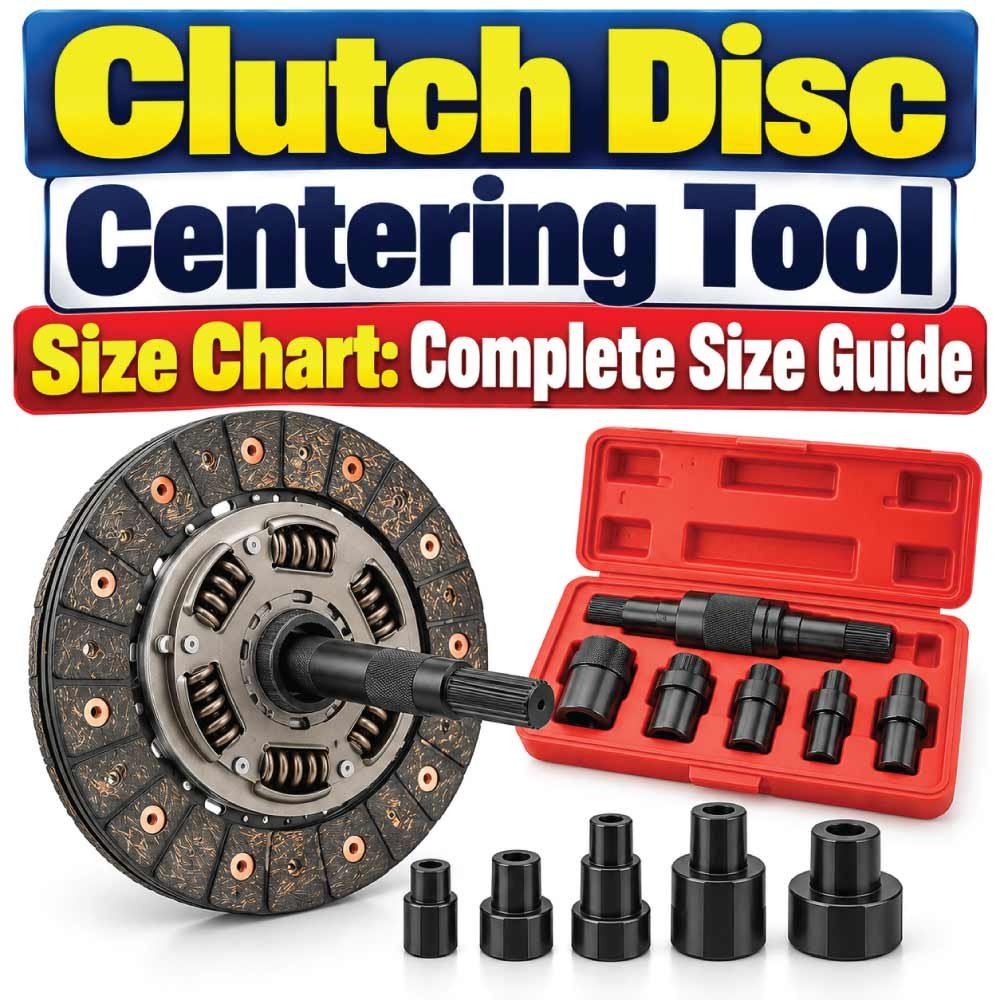
Choosing the correct clutch disc centering tool is important when installing a clutch because the disc must be positioned accurately in relation to the engine crankshaft or pilot bearing. If the disc is not centered, the transmission input shaft may be difficult or impossible to insert, even when the clutch components themselves are correct.
A clutch disc centering tool size chart helps identify the dimensions that matter, including the pilot diameter, clutch disc hub opening, transmission input shaft dimensions, and spline configuration. Different vehicles and clutch assemblies use different combinations, so there is no single universal size that fits every application.
This guide explains how clutch alignment tools are sized, what measurements to take, how universal alignment kits differ from fixed-size tools, and how to select the correct tool for a particular clutch installation.
What Is a Clutch Disc Centering Tool?
A clutch disc centering tool, also called a clutch alignment tool, is a device used to hold the clutch disc in the correct position while the pressure plate is installed and tightened.
The tool normally passes through the center of the clutch disc and engages with the pilot bearing, pilot bushing, or crankshaft center bore. Its purpose is not to transfer operating power. Instead, it temporarily establishes the correct relationship between the clutch disc and engine centerline.
A typical alignment tool consists of:
- A pilot section that locates in the crankshaft pilot bearing or bushing
- A shaft or mandrel passing through the clutch disc hub
- Splines, steps, or expanding sections that engage the disc hub
- A handle or end section used to hold the tool during installation
The exact construction depends on whether the tool is designed for a specific clutch, vehicle, or range of applications.
How Clutch Alignment Tool Sizes Are Determined
Clutch alignment tools are not normally selected by clutch disc diameter alone. A 9-inch clutch and a 10-inch clutch can potentially use similar centering dimensions, while two discs of the same outside diameter can require completely different tools.
The important dimensions are usually:
- Pilot diameter
- Clutch hub bore
- Spline diameter
- Spline count or profile
- Hub length and engagement position
- Overall tool length
- Crankshaft or pilot-bearing configuration
The pilot diameter is particularly important because the tool must locate concentrically with the engine crankshaft.
The clutch disc’s friction diameter tells you about the clutch assembly, but it does not by itself identify the correct alignment tool.
Clutch Disc Centering Tool Size Chart
The following chart provides a practical way to identify the measurements you should compare before selecting a tool. These are selection dimensions rather than universal standard tool sizes, because manufacturers use different mandrel designs and vehicle applications.
| Measurement | What to Measure | Why It Matters | Selection Requirement |
|---|---|---|---|
| Pilot diameter | Crankshaft pilot bearing/bushing ID | Centers the tool on the engine | Tool pilot must fit correctly |
| Disc hub bore | Center opening of clutch disc hub | Allows the shaft to pass through hub | Must accept tool shaft |
| Spline diameter | Diameter across mating spline area | Helps identify shaft/tool compatibility | Match application specification |
| Spline count | Number of hub splines | Identifies hub configuration | Must correspond to required profile |
| Hub length | Length of splined clutch hub | Determines engagement area | Tool must support hub adequately |
| Tool length | End-to-end mandrel length | Provides installation clearance | Must reach pilot location |
| Disc diameter | Outside friction surface diameter | Identifies clutch assembly size | Useful as supporting information |
This chart should be used together with the clutch manufacturer’s specifications or the original vehicle application information.
Common Clutch Alignment Tool Types
Clutch centering tools are available in several designs. The best choice depends on the clutch assembly and the range of vehicles or machines being serviced.
Fixed-Size Clutch Alignment Tools
A fixed-size tool is manufactured for a particular clutch hub and pilot configuration.
It generally has a predetermined pilot diameter and shaft profile. These tools are simple and can provide an accurate fit when the application is known.
They are particularly useful when:
- The clutch application is known
- The original specifications are available
- A workshop repeatedly services the same type of vehicle
- A replacement clutch kit specifies a particular alignment tool
The main limitation is that one fixed tool may not work with another clutch configuration.
Universal Clutch Alignment Tools
Universal kits use interchangeable components, stepped mandrels, or expandable adapters to accommodate different clutch discs.
They are useful for general automotive repair because one kit can cover many combinations.
However, “universal” does not mean literally every clutch. The usable range depends on the individual kit’s design and supplied adapters.
Pilot-Bearing Alignment Tools
Some tools are designed around a specific pilot-bearing diameter. The pilot section establishes the centerline while the disc is held by the tool’s shaft or hub section.
These tools are particularly dependent on accurate measurement of the crankshaft pilot opening.
Expandable Collet Tools
Expandable designs use a mechanism that enlarges the centering section inside the clutch hub.
They can accommodate multiple hub diameters within the manufacturer’s specified operating range. This design is convenient when several different clutch assemblies are serviced.
Pilot Diameter: The Most Important Measurement
The pilot diameter is one of the most important dimensions when choosing a clutch disc centering tool.
The pilot bearing or pilot bushing is located in the crankshaft and supports the transmission input shaft. During clutch installation, the alignment tool uses this location as its reference point.
If the tool’s pilot section is too small, it may not establish reliable concentric alignment. If it is too large, it may not enter the bearing or bushing.
For accurate measurement:
- Remove contamination from the pilot opening.
- Identify whether a bearing or bushing is present.
- Measure the inside diameter where the tool will locate.
- Use a precise measuring instrument when possible.
- Compare the measurement with the tool manufacturer’s specification.
Do not assume that a visually similar pilot diameter is close enough. Small dimensional differences can affect the fit.
Clutch Disc Hub Size and Spline Configuration
The clutch disc hub is the central portion of the disc that engages the transmission input shaft.
Its dimensions can include both the internal spline profile and the outside diameter of the hub.
A centering tool must properly engage the hub without damaging it or allowing excessive movement.
Important hub characteristics include:
- Spline count
- Spline diameter
- Spline form
- Hub bore
- Hub length
- Position of the hub relative to the friction disc
Spline count by itself is not always enough to identify compatibility. Two spline configurations can have similar counts while differing in diameter or profile.
For this reason, use the complete application specification rather than relying on spline count alone.
Clutch Alignment Tool Size Chart by Measurement
Instead of relying on arbitrary tool labels such as small, medium, or large, it is better to organize your selection around the dimensions you actually measure.
| Tool Selection Area | Measurement Needed | How to Use It |
|---|---|---|
| Pilot section | Pilot bearing/bushing inside diameter | Select matching pilot dimension |
| Hub section | Clutch disc center/hub opening | Confirm tool enters correctly |
| Spline section | Hub spline specification | Match the required clutch configuration |
| Support section | Hub length | Ensure sufficient engagement |
| Body length | Distance from disc to pilot location | Confirm the tool reaches the pilot |
| Clearance | Pressure plate and crankshaft area | Make sure the tool can be installed freely |
This measurement-based approach is more reliable than choosing a tool simply because the package describes it as “standard.”
How to Measure a Clutch Disc for an Alignment Tool
Measuring the clutch disc before installation can prevent many compatibility problems.
Measure the Clutch Disc Hub Opening
Start by examining the central hub of the clutch disc. Determine the opening and the shape of the area where the alignment tool will pass.
Avoid measuring the friction material or the outer disc diameter when trying to determine the centering tool size.
Measure the Pilot Location
The next measurement is the crankshaft pilot bearing or bushing.
A caliper can be useful for checking the inside diameter, provided the measurement is taken at the actual locating surface.
Identify the Spline Configuration
If the clutch disc is designed around a splined input shaft, identify the spline count and the relevant shaft dimensions.
When available, compare these details with the replacement clutch specifications.
Check the Tool’s Working Range
For a universal alignment tool, compare your measured dimensions with the manufacturer’s stated minimum and maximum ranges.
Never assume that an adjustable mechanism can accommodate dimensions outside its published range.
Clutch Disc Diameter vs. Centering Tool Size
One common mistake is assuming that clutch disc diameter determines the alignment tool.
It does not.
The clutch disc diameter describes the approximate size of the friction portion of the clutch disc. The alignment tool is concerned primarily with the disc’s centerline and hub configuration.
For example, two clutch discs may have similar outside diameters but different hub designs. Their alignment requirements can therefore be different.
When selecting a tool, prioritize:
- Pilot diameter
- Hub opening
- Spline configuration
- Hub length
- Application-specific specifications
Use disc diameter as additional identification information rather than the primary tool-sizing dimension.
How to Choose the Correct Clutch Centering Tool
Selecting the correct tool becomes straightforward when the measurements are checked in the right order.
1. Identify the Clutch Application
Start with the vehicle, engine, transmission, or equipment application.
The clutch kit part number can also be useful because the manufacturer may specify the compatible alignment method.
2. Check the Pilot Bearing or Bushing
Determine the pilot diameter and confirm whether the crankshaft uses a pilot bearing, pilot bushing, or another centering arrangement.
3. Check the Clutch Hub
Inspect the center of the disc and identify the hub configuration.
4. Match the Tool
For a fixed tool, verify that all relevant dimensions match.
For a universal tool, check every applicable adapter and its published operating range.
5. Confirm Installation Clearance
The tool should pass through the disc and reach the pilot location without interference.
6. Test the Fit Before Tightening
Position the disc and tool before completely tightening the pressure plate. The tool should establish a stable center position without excessive looseness.
Also Read:
Fixed Tool vs. Universal Tool
Both designs can be useful, but their advantages are different.
| Feature | Fixed-Size Tool | Universal Tool |
|---|---|---|
| Application range | Specific applications | Multiple applications |
| Adjustment | Usually limited or none | Adjustable or interchangeable |
| Setup | Simple | May require adapter selection |
| Storage | Compact | Larger kit |
| Repeatability | High for known application | Depends on setup |
| Workshop flexibility | Lower | Higher |
| Best use | Known clutch specification | Mixed clutch applications |
A fixed tool can be convenient when the application is known. A universal kit can be more practical for a workshop handling many clutch configurations.
How to Use a Clutch Disc Centering Tool
Correct use is just as important as selecting the correct size.
Step 1: Prepare the Components
Make sure the flywheel, clutch disc, pressure plate, pilot bearing or bushing, and alignment tool are clean and free from unnecessary contamination.
Check the clutch disc orientation before installation.
Step 2: Position the Disc
Place the clutch disc against the flywheel in the correct orientation.
The disc may have a protruding hub on one side. Follow the markings or installation instructions supplied with the clutch.
Step 3: Insert the Alignment Tool
Pass the centering tool through the clutch disc hub.
Guide the pilot section into the crankshaft pilot bearing or bushing.
The tool should locate naturally without being forced.
Step 4: Install the Pressure Plate
Position the pressure plate over the clutch disc while keeping the disc and tool centered.
Start the fasteners evenly.
Step 5: Tighten the Pressure Plate Gradually
Tighten the pressure plate according to the applicable manufacturer’s procedure and torque requirements.
An alignment tool should not be used to compensate for incorrectly positioned components.
Step 6: Remove the Tool
Once the pressure plate is securely installed, remove the alignment tool.
It should normally slide out without excessive force.
Also Read:
Signs of an Incorrect Alignment Tool Size
An unsuitable tool can reveal itself before the transmission is installed.
Watch for these conditions:
- The pilot section does not fit the pilot bearing or bushing.
- The tool has excessive movement inside the clutch hub.
- The disc can shift noticeably while the pressure plate is being installed.
- The tool does not reach the pilot location.
- The tool binds during insertion or removal.
- The disc appears visibly off-center.
- The tool’s expanding mechanism is being forced beyond its specified range.
If any of these conditions occur, stop and verify the measurements instead of forcing the tool.
Common Clutch Alignment Mistakes
Using the Wrong Pilot Diameter
The most important error is choosing a tool whose pilot section does not properly match the crankshaft locating point.
Selecting by Disc Diameter Alone
A large clutch disc does not automatically require a large alignment tool. The center hub and pilot dimensions are much more relevant.
Ignoring Hub Configuration
Spline count, diameter, and profile all contribute to compatibility.
Forcing an Adjustable Tool
An expandable tool should only be used within its specified operating range. Excessive adjustment can create an unstable or inaccurate setup.
Installing the Disc Backward
Even a correctly centered disc will not work correctly if it is installed in the wrong orientation.
Skipping the Pilot Component Check
The crankshaft pilot bearing or bushing is part of the alignment system and should be inspected before installation.
Also Read:
Clutch Alignment Tool Size Selection Checklist
Before purchasing or using a tool, verify the following:
- Vehicle or equipment application
- Clutch kit identification
- Pilot bearing or bushing inside diameter
- Clutch hub dimensions
- Spline count and configuration
- Required tool shaft dimensions
- Tool working length
- Universal-tool adjustment range
- Pressure plate clearance
- Manufacturer’s installation instructions
If one of these dimensions is unknown, obtain the specification rather than guessing.
Why Accurate Centering Matters
The purpose of clutch alignment is to position the disc concentrically with the crankshaft before the transmission is installed.
When the disc is correctly centered, the transmission input shaft can enter the clutch disc hub and reach the pilot bearing or bushing along the intended centerline.
Poor alignment can make transmission installation difficult and may lead to unnecessary force being applied during assembly.
The alignment tool therefore provides an important temporary reference. It does not replace proper inspection of the clutch, pilot bearing, flywheel, pressure plate, or transmission input shaft.
Clutch Alignment Tool Dimensions to Record
If you service several vehicles or machines, keeping a measurement record can make future tool selection faster.
A useful record can include:
| Specification | Record |
|---|---|
| Clutch disc outside diameter | Measure or record from specification |
| Pilot diameter | Record actual measured diameter |
| Pilot bearing/bushing type | Bearing or bushing |
| Hub configuration | Record application specification |
| Spline count | Record verified count |
| Spline diameter | Record verified dimension |
| Hub length | Record measured/specification value |
| Alignment tool type | Fixed or universal |
| Tool part number | Record manufacturer identification |
This information is especially helpful for repair shops that frequently work with similar clutch systems.
When a Universal Clutch Tool Is the Better Choice
A universal kit can be practical when a workshop works on many vehicles or when the clutch application is not associated with a dedicated alignment tool.
The main benefit is flexibility. Instead of keeping a separate fixed tool for every clutch configuration, a universal kit may provide multiple adapters or adjustable sections.
However, always verify the kit’s actual range. A universal kit that does not cover the required pilot diameter or hub configuration is not a suitable substitute for the correct dedicated tool.
When a Dedicated Tool Is Preferable
A dedicated alignment tool can be preferable when:
- The clutch application is known.
- The manufacturer specifies a particular tool.
- Precise repeatability is important.
- The clutch uses an unusual hub configuration.
- A universal tool does not provide the required dimensions.
- The same clutch system is serviced regularly.
The important principle is simple: fit the tool to the clutch and pilot dimensions, not the other way around.
Frequently Asked Questions
What size clutch disc centering tool do I need?
The required size depends primarily on the pilot diameter and clutch disc hub configuration. Check the pilot bearing or bushing diameter, hub dimensions, spline configuration, and the tool manufacturer’s specifications.
Is a clutch alignment tool universal?
Some are designed as universal tools with interchangeable or expandable components, while others are dedicated to a particular clutch configuration. Universal does not mean every clutch is covered.
Does clutch disc diameter determine alignment tool size?
No. Disc diameter is useful for identifying the clutch assembly, but the alignment tool must primarily match the center hub and pilot location.
Can I use an alignment tool without a pilot bearing?
The correct procedure depends on the particular crankshaft and clutch design. Some systems use a pilot bushing or another centering arrangement. Follow the applicable installation instructions rather than assuming every clutch uses the same setup.
How do I measure a clutch alignment tool pilot?
Measure the diameter of the tool’s locating section and compare it with the inside diameter of the crankshaft pilot bearing or bushing. Precision measurement is preferable to visual estimation.
Why won’t my transmission slide into the clutch?
One possible reason is that the clutch disc is not centered. Other causes can include incorrect clutch orientation, incompatible components, spline mismatch, pilot-bearing issues, or transmission alignment problems.
Can I reuse a clutch alignment tool?
A reusable tool can generally be used again if it remains within specification and is not damaged. Inspect the pilot section, shaft, splines, and adjustable components before reuse.
Should the alignment tool be tight inside the clutch hub?
It should provide sufficient support to center the disc without requiring excessive force. The exact fit depends on the tool design and clutch application.
Can I make my own clutch alignment tool?
A purpose-built tool is generally preferable because accurate centering depends on the correct dimensions. Any substitute must reproduce the necessary centerline accurately and must not damage the clutch hub or pilot component.
Final Clutch Disc Centering Tool Selection Guide
A clutch disc centering tool size chart is most useful when it is treated as a measurement guide rather than a list of universal dimensions. Clutch systems differ in pilot diameter, hub configuration, spline characteristics, and physical arrangement.
For reliable selection, identify the pilot bearing or bushing diameter first, then verify the clutch disc hub and spline configuration. Check the tool’s working range if using a universal kit, and confirm the application against the relevant clutch or vehicle documentation.
The key measurements to remember are pilot diameter, hub dimensions, spline configuration, hub length, and tool reach. Matching these correctly helps keep the clutch disc centered and makes transmission installation considerably easier.

Engineer Hassan is a Mechanical Engineer with 16+ years of hands-on experience in mechanical hardware, fasteners, and workshop tools. He focuses on size selection, thread identification, and measurement, helping users choose the correct components with accuracy and safety.