
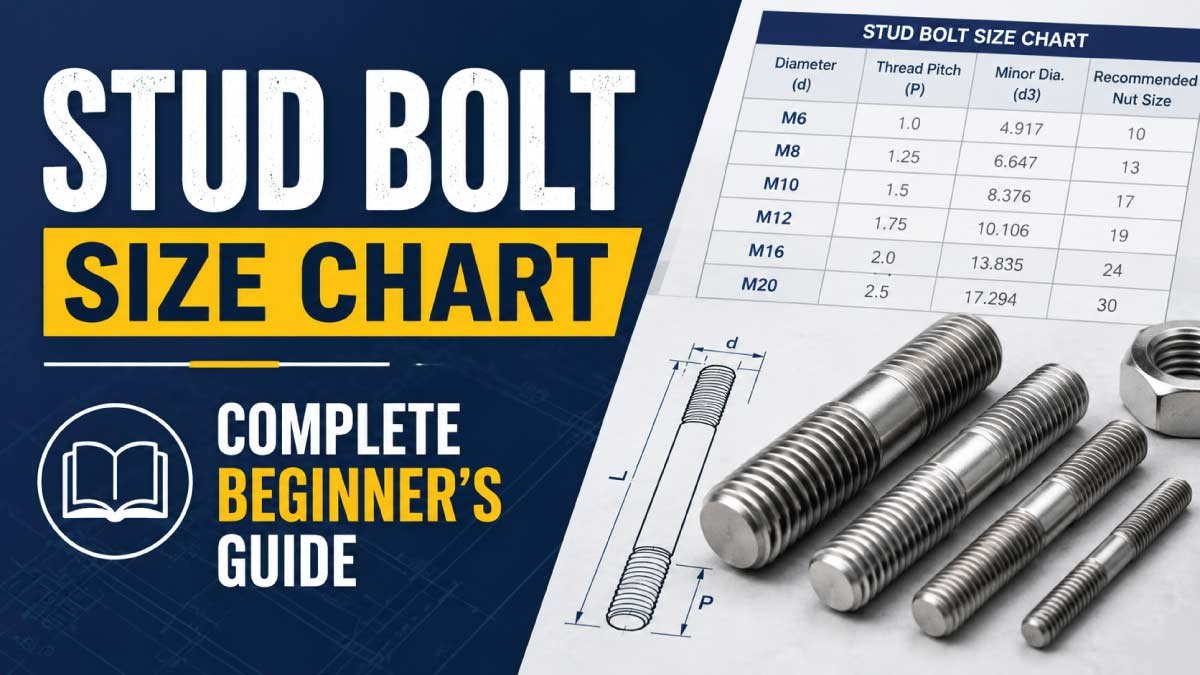
Stud bolts are one of the most important fastening components used in construction, oil and gas industries, pipelines, heavy machinery, pressure vessels, and structural applications. Choosing the correct stud bolt size is essential for safety, strength, and proper equipment performance.
In this detailed guide, you will learn everything about stud bolt size charts, dimensions, thread standards, materials, grades, and how to select the right stud bolt for different industrial applications.
What Is a Stud Bolt?
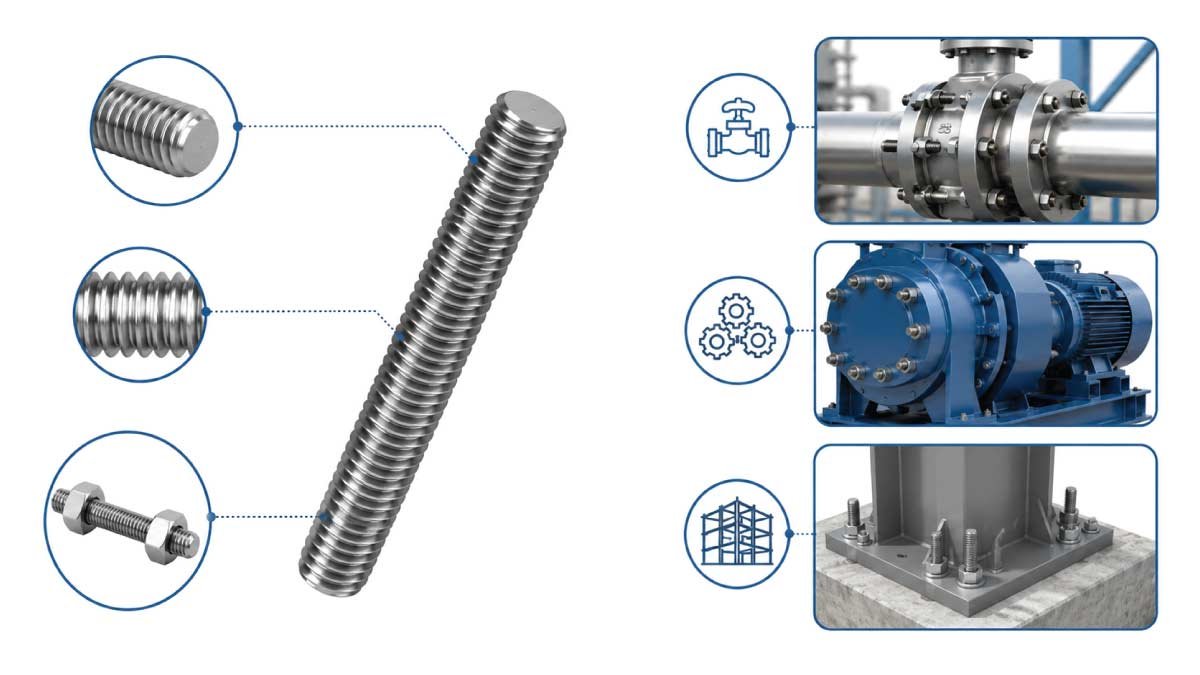
A stud bolt is a fully threaded fastener designed for strong and secure industrial connections. Unlike standard bolts, it does not have a head and is tightened using nuts on both ends. Stud bolts are widely used in piping systems, heavy machinery, and structural applications where high strength and reliable fastening performance are required.
Stud bolts are commonly used in:
- Pipe flanges
- Heat exchangers
- Pressure vessels
- Pumps
- Valves
- Structural steel connections
- Heavy equipment assembly
Unlike regular bolts, stud bolts provide better clamping force, even load distribution, and improved durability in demanding environments. They are especially suitable for high-pressure and high-temperature applications because they reduce the risk of loosening and help maintain secure flange connections over long periods of operation.
Types of Stud Bolts
Before understanding the stud bolt size chart, it is important to know the different types of stud bolts used in industrial applications. Each type is designed for specific fastening requirements, pressure conditions, and machinery setups. Selecting the correct stud bolt improves connection strength, safety, and long-term performance in piping systems and heavy equipment.
1. Fully Threaded Stud Bolt
A fully threaded stud bolt has threads running across the entire length of the fastener. This design provides maximum grip and flexibility for different flange thicknesses and industrial connections. It is widely used in industries where strong clamping force and easy adjustment are required during installation and maintenance operations.
Common Uses
- Pipe flanges
- Petrochemical plants
- Industrial machinery
2. Tap End Stud Bolt
A tap end stud bolt features one end with shorter threads and the opposite end with longer threads. The shorter threaded side is screwed into a tapped hole, while the longer side is secured with a nut. These bolts are commonly used in mechanical equipment requiring strong and permanent fastening connections.
Common Uses
- Engine blocks
- Pump housings
- Mechanical assemblies
3. Double End Stud Bolt
A double end stud bolt has equal threading on both ends with a smooth, unthreaded center section. This design helps maintain proper alignment and improves strength under heavy loads. Double end stud bolts are commonly used in high-pressure systems where secure and stable fastening is critical for safety and performance.
Common Uses
- High-pressure flange connections
- Structural applications
Stud Bolt Size Chart in Inches
The following chart shows standard stud bolt sizes commonly used in industrial applications.
| Nominal Size | Diameter (in) | Threads Per Inch (TPI) | Heavy Hex Nut Size | Common Applications |
|---|---|---|---|---|
| 1/4″ | 0.250 | 20 | 7/16″ | Small machinery |
| 5/16″ | 0.312 | 18 | 1/2″ | Equipment fastening |
| 3/8″ | 0.375 | 16 | 9/16″ | Structural work |
| 1/2″ | 0.500 | 13 | 3/4″ | Pipe flanges |
| 5/8″ | 0.625 | 11 | 15/16″ | Industrial piping |
| 3/4″ | 0.750 | 10 | 1-1/8″ | Heavy machinery |
| 7/8″ | 0.875 | 9 | 1-5/16″ | Pressure vessels |
| 1″ | 1.000 | 8 | 1-1/2″ | Refinery equipment |
| 1-1/8″ | 1.125 | 8 | 1-11/16″ | High-pressure systems |
| 1-1/4″ | 1.250 | 8 | 1-7/8″ | Structural steel |
| 1-1/2″ | 1.500 | 6 | 2-1/4″ | Large flanges |
| 2″ | 2.000 | 4.5 | 3″ | Heavy industrial applications |
Metric Stud Bolt Size Chart
Metric stud bolts are widely used in Europe, Asia, and modern engineering projects.
| Metric Size | Diameter (mm) | Thread Pitch | Nut Size (mm) | Common Use |
|---|---|---|---|---|
| M6 | 6 mm | 1.0 | 10 mm | Light equipment |
| M8 | 8 mm | 1.25 | 13 mm | Mechanical assembly |
| M10 | 10 mm | 1.5 | 17 mm | Automotive |
| M12 | 12 mm | 1.75 | 19 mm | Structural work |
| M16 | 16 mm | 2.0 | 24 mm | Pipe systems |
| M20 | 20 mm | 2.5 | 30 mm | Heavy equipment |
| M24 | 24 mm | 3.0 | 36 mm | Pressure vessels |
| M30 | 30 mm | 3.5 | 46 mm | Industrial plants |
| M36 | 36 mm | 4.0 | 55 mm | Large structures |
| M42 | 42 mm | 4.5 | 65 mm | Heavy-duty flanges |
Understand Stud Bolt Dimensions
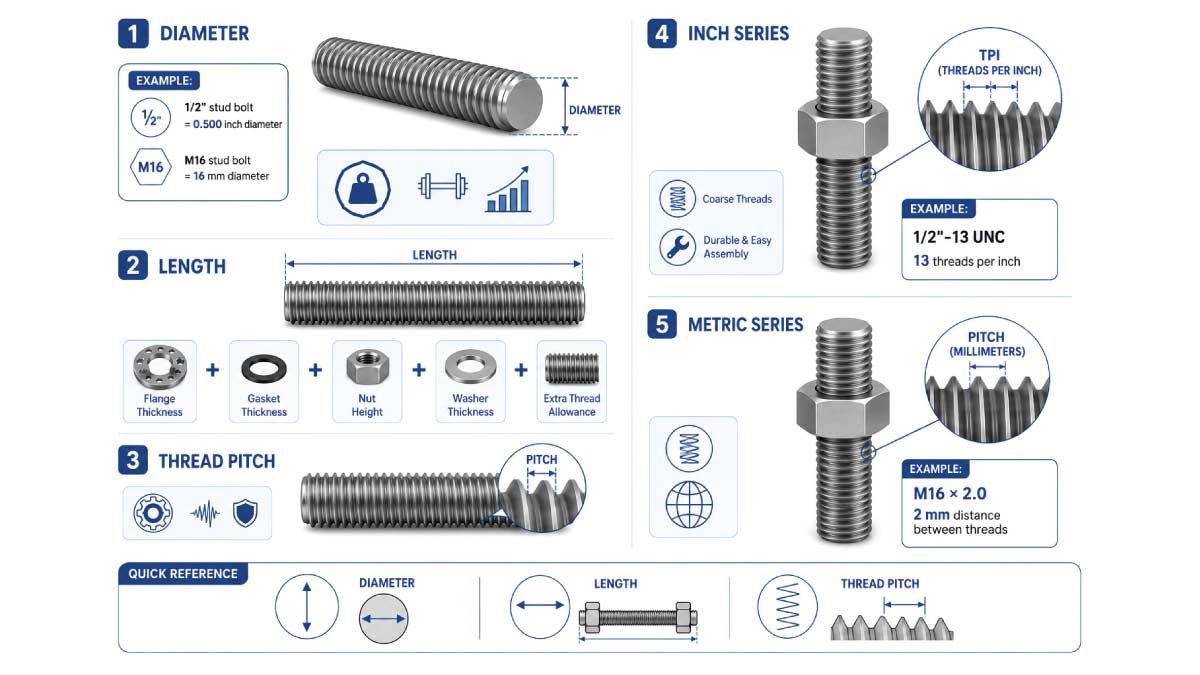
Stud bolt dimensions are determined using several important measurements that help ensure proper fit, strength, and performance in industrial applications. Understanding these dimensions is essential when selecting the correct stud bolt for flanges, pressure vessels, pumps, and structural connections. The three main measurements include diameter, length, and thread pitch.
1. Diameter
The diameter refers to the thickness of the stud bolt and is one of the most important factors affecting strength and load capacity. Larger diameters can handle higher pressure and heavier mechanical loads. Stud bolt diameters are available in both inch and metric sizes depending on the application and international standards being followed.
Example:
- 1/2″ stud bolt = 0.500 inch diameter
- M16 stud bolt = 16 mm diameter
Larger diameters provide higher strength and load capacity.
2. Length
Stud bolt length is measured from one end of the bolt to the other end. Choosing the correct length is important because the bolt must provide enough threading for proper nut engagement and secure clamping force. Incorrect bolt length may lead to weak connections, leakage, or installation difficulties in flange systems.
In flange applications, the length must include:
- Flange thickness
- Gasket thickness
- Nut height
- Washer thickness
- Extra thread allowance
3. Thread Pitch
Thread pitch defines the distance between threads and determines how tightly the nut moves along the stud bolt. Different thread pitches are used depending on load requirements, vibration conditions, and industrial standards. Thread pitch is measured differently in inch and metric systems, making it important to select compatible nuts and fasteners.
4. Inch Series
In the inch series, thread pitch is measured using TPI, which stands for Threads Per Inch. A higher TPI means finer threads, while a lower TPI means coarser threads. Coarse threads are commonly used for heavy-duty industrial applications because they are more durable and easier to assemble.
Measured in TPI (Threads Per Inch)
Example:
- 1/2″-13 UNC means 13 threads per inch
5. Metric Series
In the metric series, thread pitch is measured in millimeters and indicates the distance from one thread to the next. Metric stud bolts are widely used in modern machinery and international engineering projects because they follow standardized metric sizing systems for easier compatibility.
Measured in millimeters
Example:
- M16 × 2.0 means 2 mm distance between threads
UNC vs UNF Stud Bolt Threads
Stud bolts mainly use two thread standards.
| Thread Type | Full Name | Characteristics |
|---|---|---|
| UNC | Unified National Coarse | Deeper threads, easier installation |
| UNF | Unified National Fine | Better vibration resistance |
1. UNC Threads
Advantages:
- Faster assembly
- Better for soft materials
- Less thread damage
Used in:
- Construction
- Structural steel
- Heavy equipment
2. UNF Threads
Advantages:
- Greater clamping force
- Better vibration resistance
- Precise adjustment
Used in:
- Aerospace
- Automotive
- High-pressure systems
Standard Stud Bolt Materials
The material of a stud bolt plays a critical role in determining its strength, durability, corrosion resistance, and ability to perform under high pressure or extreme temperature conditions. Different industries choose specific materials based on operating environments such as chemical exposure, marine conditions, or heavy mechanical loads.
1. Carbon Steel Stud Bolts
Carbon steel stud bolts are the most commonly used type in industrial applications due to their excellent strength and affordability. They are available in different grades that offer varying mechanical properties depending on the application requirements. These bolts are suitable for general-purpose fastening where corrosion exposure is limited or controlled through coatings.
Common grades:
- ASTM A193 B7
- ASTM A307
Advantages:
- High strength
- Cost-effective
- Widely available
Applications:
- Oil and gas pipelines
- Structural steel
- General industrial equipment
2. Stainless Steel Stud Bolts
Stainless steel stud bolts are designed for environments where corrosion resistance is a major requirement. They perform well in humid, wet, and chemically aggressive conditions. These bolts also offer a long service life and maintain strength while resisting rust and oxidation over time, making them ideal for critical applications.
Popular grades:
- SS304
- SS316
- B8
- B8M
Advantages:
- Excellent corrosion resistance
- Long service life
- Suitable for marine environments
Applications:
- Food processing
- Chemical plants
- Offshore platforms
3. Alloy Steel Stud Bolts
Alloy steel stud bolts are engineered for demanding applications involving high temperature and high pressure. They provide superior mechanical strength and stability under extreme operating conditions. These bolts are commonly used in power generation and heavy industrial systems where reliability and safety are essential for continuous operation.
Common grades:
- ASTM A193 B16
- ASTM A320 L7
Applications:
- Refineries
- Boilers
- Power plants
Stud Bolt Grades and Strength
Different stud bolt grades provide different tensile strengths.
| Grade | Material Type | Tensile Strength |
|---|---|---|
| B7 | Alloy steel | High |
| B16 | Chromium-molybdenum steel | Very high |
| B8 | Stainless steel | Medium |
| L7 | Low-temperature alloy steel | High |
| 8.8 | Metric carbon steel | Medium-high |
| 10.9 | Metric alloy steel | High |
Selecting the wrong grade can lead to joint failure or leakage.
Stud Bolt Length Calculation for Flanges
Correct stud bolt length is critical for proper flange assembly, ensuring secure tightening, leak prevention, and safe operation under pressure. The length must be accurately calculated to accommodate all connected components so that sufficient thread engagement is available for nuts on both sides of the flange joint.
Standard Formula
Stud Bolt Length =
Flange Thickness + Gasket Thickness + Nut Heights + Washer Thickness + Extra Thread Projection
Example:
- Flange thickness = 50 mm
- Gasket thickness = 5 mm
- Two nuts = 40 mm
- Two washers = 6 mm
- Thread projection = 6 mm
Total Length:
50 + 5 + 40 + 6 + 6 = 107 mm
Choose the nearest standard size above 107 mm.
Common Stud Bolt Standards
Several international standards regulate stud bolt dimensions and materials.
| Standard | Description |
|---|---|
| ASTM A193 | High-temperature alloy steel bolts |
| ASTM A320 | Low-temperature bolting materials |
| ASME B16.5 | Flange dimensions |
| DIN 976 | Metric stud bolts |
| ISO 898 | Mechanical properties |
These standards ensure safety, compatibility, and performance.
Also Read:
Applications of Stud Bolts
Stud bolts are widely used in various industries where strong, reliable, and high-performance fastening is required. They are especially important in systems that operate under high pressure, vibration, or extreme temperature conditions. Their ability to provide secure clamping makes them essential for critical engineering and industrial assemblies.
1. Oil and Gas Industry
In the oil and gas sector, stud bolts are crucial for maintaining safe and leak-free connections in high-pressure environments. They are commonly used in pipelines, offshore structures, and refinery equipment where reliability and durability are extremely important. High-strength alloy steel stud bolts are typically preferred for these demanding conditions.
Applications include:
- Pipelines
- Pressure vessels
- Offshore rigs
- Refinery flanges
2. Construction Industry
In construction, stud bolts are used for heavy-duty structural connections that require strong and long-lasting fastening. They help secure steel frameworks and support systems that carry large loads. These bolts are also used in anchoring systems where stability and safety are essential for large-scale infrastructure projects.
Applications include:
- Steel structures
- Heavy equipment
- Anchor systems
3. Power Plants
Stud bolts play a key role in power generation facilities where equipment operates under high temperature and pressure. They are used in critical components that must remain tightly secured for efficient and safe operation. Heat-resistant stud bolt grades are essential to withstand continuous thermal stress.
Applications include:
- Boilers
- Turbines
- Heat exchangers
4. Automotive Industry
In the automotive sector, stud bolts are used in engine assemblies and mechanical components that require precise alignment and strong fastening. They help maintain engine stability and ensure that moving parts remain securely connected even under high vibration and stress conditions.
Applications include:
- Cylinder heads
- Wheel hubs
- Engine components
How to Choose the Correct Stud Bolt Size
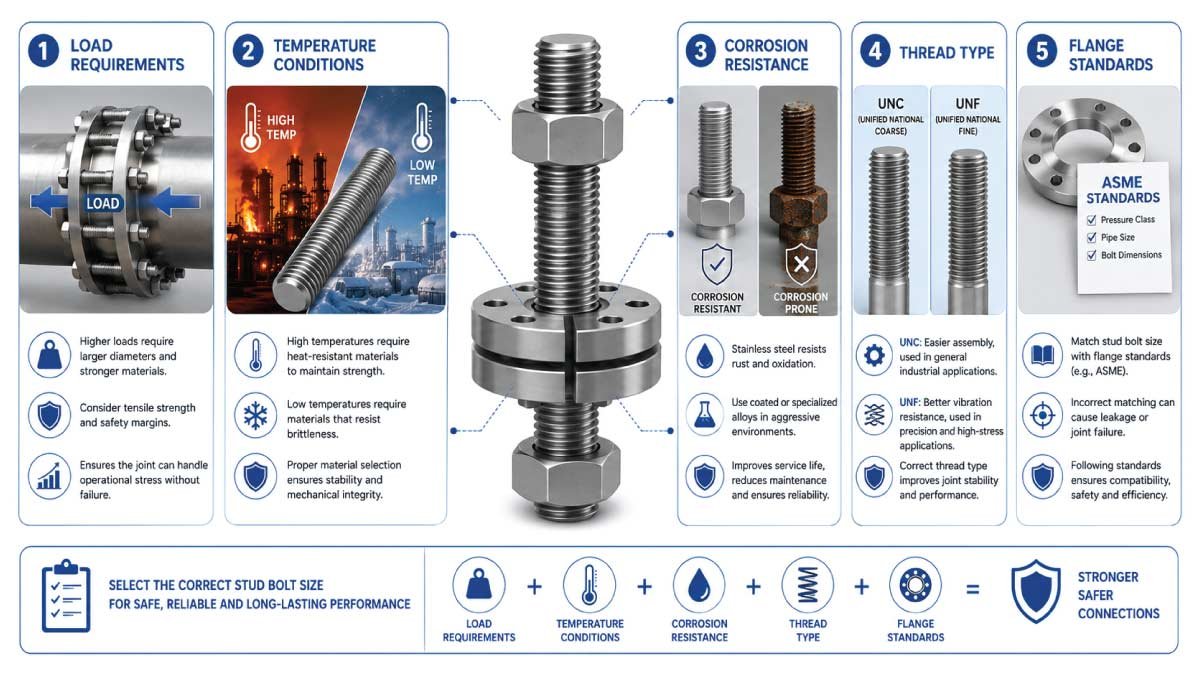
Selecting the correct stud bolt size is essential for ensuring safety, durability, and proper joint performance in mechanical and industrial applications. The selection process depends on load, temperature, corrosion conditions, thread type, and flange compatibility. Each factor directly affects strength, sealing ability, and long-term reliability of the assembly.
1. Load Requirements
Load requirements are one of the most important factors when selecting stud bolts. Higher loads demand larger diameters and stronger materials to prevent failure or deformation. Engineers also consider tensile strength and safety margins. Proper load matching ensures the bolted joint can handle operational stress without loosening or breaking under pressure.
2. Temperature Conditions
Temperature conditions significantly influence stud bolt performance. High-temperature environments require alloy steel or specially treated heat-resistant materials to maintain strength and prevent expansion issues. In low temperatures, brittleness must also be considered. Choosing the right material ensures the stud bolt maintains stability and mechanical integrity under extreme thermal conditions.
3. Corrosion Resistance
Corrosion resistance is critical in wet, chemical, or marine environments. Stainless steel stud bolts are commonly used because they resist rust and oxidation. In highly aggressive environments, coated or specialized alloys may be required. Proper corrosion protection extends service life, reduces maintenance costs, and ensures long-term structural reliability of the connection.
4. Thread Type
Thread type affects grip strength and vibration resistance. UNC (Unified National Coarse) threads are commonly used for general industrial applications due to easier assembly. UNF (Unified National Fine) threads provide better resistance to vibration and are preferred in precision or high-stress environments. Selecting the right thread improves joint stability and performance.
5. Flange Standards
Flange standards must always be matched with the correct stud bolt size to ensure proper fit and sealing. Standards such as ASME define pressure class, pipe size, and bolt dimensions. Incorrect matching can lead to leakage or joint failure. Following flange specifications ensures compatibility, safety, and efficient system performance in industrial setups.
Also Read:
Stud Bolt Installation Tips
Proper stud bolt installation is essential for achieving a safe, leak-free, and durable joint. Even high-quality bolts can fail if installed incorrectly. Following correct practices like cleaning, lubrication, controlled torque application, and proper tightening sequence helps ensure uniform load distribution and long-term reliability of flanged connections.
1. Clean Threads
Clean threads are crucial before installation because dirt, rust, or oil residue can affect torque accuracy and reduce clamping force. Contaminated threads may also cause uneven tightening, leading to joint failure. Always inspect and clean both bolt and nut threads to ensure smooth engagement and proper load transfer during tightening.
2. Use Proper Lubrication
Lubrication plays an important role in reducing friction between threads and preventing galling. It helps achieve accurate torque values by minimizing resistance during tightening. Proper lubricants also protect against wear and corrosion. However, the correct type of lubricant should always be used based on material compatibility and operating conditions.
3. Apply Correct Torque
Applying correct torque is critical for joint safety and performance. Over-tightening can damage threads, flanges, and gaskets, while under-tightening may lead to leakage or loosening under pressure. Using a calibrated torque wrench ensures accurate tightening. Following manufacturer specifications helps maintain proper preload and prevents mechanical or sealing failures.
4. Tighten in Sequence
Tightening stud bolts in the correct sequence ensures even pressure distribution across the flange. A star or cross pattern is commonly used to avoid uneven loading and gasket distortion. This method gradually balances the load, reducing stress concentration and ensuring a uniform seal, which improves the overall reliability of the joint.
Common Problems with Stud Bolts
Stud bolts can face several issues during operation, especially in harsh environments or due to improper installation. Common problems include corrosion, galling, and thread damage. These issues can reduce performance, weaken connections, and lead to failure if not addressed properly through correct material selection, lubrication, and careful handling.
1. Corrosion
Corrosion occurs when stud bolts are exposed to moisture, chemicals, or humid environments for long periods. It weakens the material and reduces structural integrity. This problem is common in marine and industrial settings. Using stainless steel or specially coated stud bolts helps prevent rust and extends service life significantly.
2. Solution (for Corrosion)
To prevent corrosion, it is recommended to use stainless steel, galvanized, or coated stud bolts depending on the environment. Regular inspection and maintenance also help detect early signs of rust. Applying protective coatings or selecting corrosion-resistant materials ensures long-term durability and reduces the risk of unexpected failure in critical applications.
3. Galling
Galling is a form of surface damage caused by friction between metal threads, especially in stainless steel fasteners. It leads to thread seizure and makes disassembly difficult. This issue often occurs during over-tightening or dry installation. Proper lubrication and controlled tightening help significantly reduce the risk of galling.
4. Solution (for Galling)
Using anti-seize lubricants is the most effective solution to prevent galling. These lubricants reduce friction and ensure smooth thread movement during tightening. Selecting compatible materials and avoiding excessive torque also helps. Proper installation practices combined with lubrication greatly improve fastener performance and make future maintenance easier and safer.
5. Thread Damage
Thread damage occurs due to improper handling, misalignment, or excessive tightening force. Damaged threads reduce holding strength and may cause joint failure. It is a common issue during rushed or unskilled installation. Regular inspection before use is important to identify defects and ensure proper engagement of stud bolts.
6. Solution (for Thread Damage)
To avoid thread damage, always inspect bolts and nuts before installation. Replace any worn or deformed components immediately. Proper alignment during tightening and the use of calibrated tools also help prevent damage. Following correct torque specifications ensures threads remain intact and the bolted joint maintains its required strength and reliability.
Difference Between Stud Bolts and Machine Bolts
| Feature | Stud Bolt | Machine Bolt |
|---|---|---|
| Head | No head | Has head |
| Threading | Both ends threaded | One end threaded |
| Clamping Force | Higher | Moderate |
| Applications | Flanges, pressure systems | General fastening |
Stud bolts are preferred in heavy industrial applications because they provide more reliable preload and easier maintenance.
Also Read:
Conclusion
Understanding the stud bolt size chart is essential for selecting the correct fastener in industrial and mechanical applications. Proper stud bolt sizing ensures joint integrity, leak prevention, structural stability, and long-term safety.
When choosing a stud bolt, always consider:
- Diameter
- Length
- Thread type
- Material grade
- Temperature conditions
- Pressure requirements
Using the correct stud bolt standard and installation method helps improve equipment reliability and reduces maintenance problems.
Whether you work in oil and gas, construction, automotive, or manufacturing, the right stud bolt size plays a critical role in the performance and safety of your entire system.

Engineer Hassan is a Mechanical Engineer with 16+ years of hands-on experience in mechanical hardware, fasteners, and workshop tools. He focuses on size selection, thread identification, and measurement, helping users choose the correct components with accuracy and safety.