
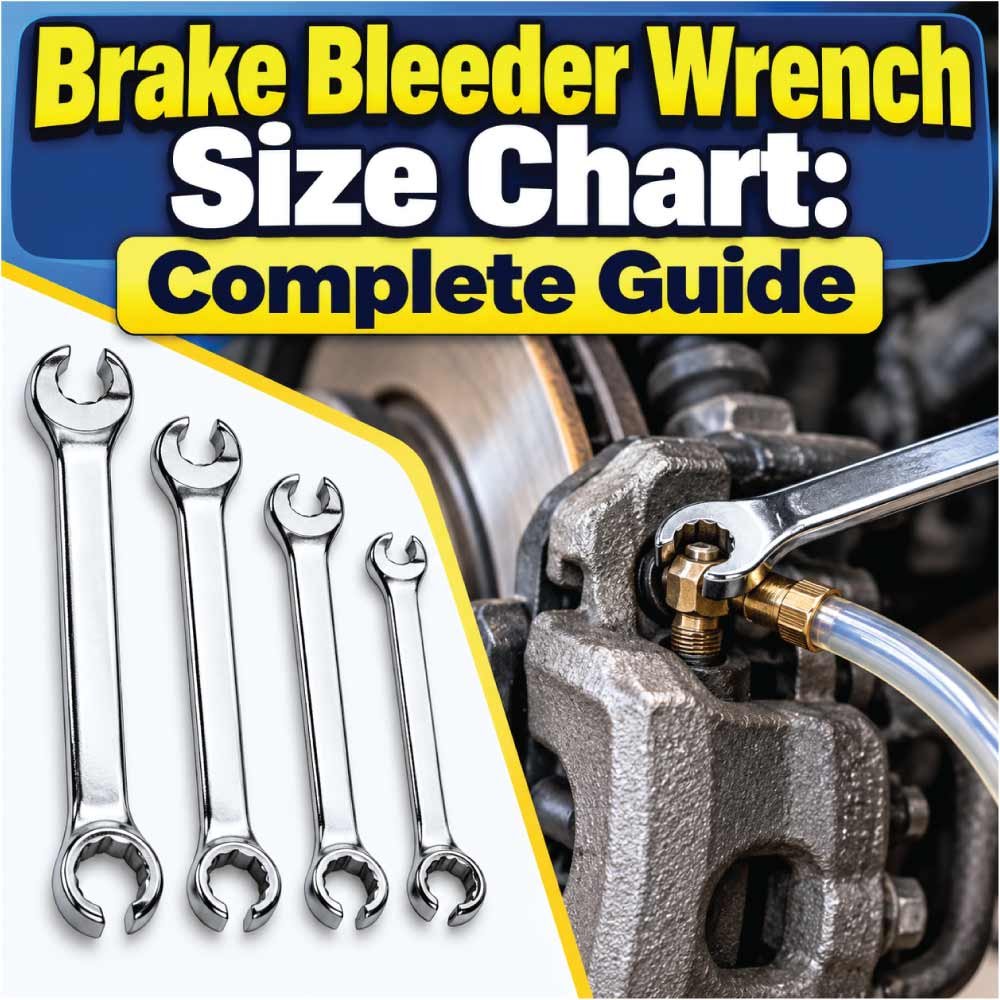
When servicing hydraulic brakes, choosing the correct wrench for the bleeder screw is essential. A brake bleeder wrench must fit the bleeder screw closely enough to turn it without rounding the small hex head. Because brake bleeder screws are available in different sizes and may use either metric or SAE dimensions, there is no single wrench size that fits every vehicle.
This brake bleeder wrench size chart covers commonly encountered metric and SAE sizes, explains how bleeder wrench dimensions are identified, and shows how to select the right tool for different brake systems. It also covers flare-nut-style bleeder wrenches, six-point versus twelve-point designs, methods for measuring a bleeder screw, common mistakes, and practical tips for loosening and tightening bleeder screws safely.
What Is a Brake Bleeder Wrench?
A brake bleeder wrench is a small hand tool designed specifically for opening and closing the brake bleeder screw, also called a bleeder valve or bleed screw. The screw is normally located on a brake caliper, wheel cylinder, or another hydraulic brake component.
During brake bleeding, the bleeder screw is opened slightly to allow trapped air and old brake fluid to escape. Once the system has been properly bled, the screw is closed again.
Unlike a general-purpose combination wrench, a dedicated bleeder wrench is designed to provide better engagement around the small hex head.
A proper fit helps reduce the possibility of:
- Rounding the bleeder screw
- Slipping during brake service
- Damaging corroded fittings
- Applying force at an awkward angle
- Making future brake bleeding more difficult
The wrench size refers to the distance across the wrench’s internal flats, which corresponds to the hex size of the bleeder screw.
Brake Bleeder Wrench Size Chart
The following chart shows common wrench sizes that may be encountered when servicing brake bleeder screws. These are common service sizes rather than a universal vehicle-by-vehicle specification. Always verify the actual bleeder screw before applying force.
| Wrench Size | Approx. Decimal Size | Measurement System | Common Service Use |
|---|---|---|---|
| 7 mm | 0.276 in | Metric | Some compact brake components |
| 8 mm | 0.315 in | Metric | Common small bleeder size |
| 9 mm | 0.354 in | Metric | Some automotive applications |
| 10 mm | 0.394 in | Metric | Common automotive service size |
| 11 mm | 0.433 in | Metric | Some brake and hydraulic applications |
| 3/8 in | 0.375 in | SAE | Common on some vehicles |
| 7/16 in | 0.438 in | SAE | Common SAE service size |
| 1/2 in | 0.500 in | SAE | Less common for typical bleeder screws |
The most useful sizes to have available for general automotive brake work are often 8 mm, 9 mm, 10 mm, 11 mm, 3/8 inch, and 7/16 inch. However, the correct size depends on the specific brake component.
Do not select a wrench solely because it looks close. A nearly correct wrench can damage a bleeder screw surprisingly quickly, especially when the screw is rusty or seized.
Common Metric Brake Bleeder Wrench Sizes
Metric bleeder screws are widely encountered in vehicles and brake components that use metric fasteners. Small hex sizes are particularly common because bleeder screws themselves are relatively small.
7 mm Brake Bleeder Wrench
A 7 mm brake bleeder wrench can be used with appropriately sized metric bleeder screws. Because 7 mm is relatively small, accurate engagement is especially important.
If a 7 mm wrench does not seat completely on the bleeder screw, do not force it. Check whether the fitting is damaged, contaminated, or actually a different size.
8 mm Brake Bleeder Wrench
An 8 mm wrench is one of the commonly encountered sizes for automotive brake bleeding. It is useful for small bleeder screws found on various calipers and wheel cylinders.
An 8 mm six-point wrench can provide secure contact when the bleeder has clean, undamaged flats.
9 mm Brake Bleeder Wrench
A 9 mm bleeder wrench is another size that may be required depending on the vehicle or brake component.
Because 9 mm and nearby SAE sizes can appear relatively close, it is important to identify the actual fitting instead of substituting a wrench that merely seems to fit.
10 mm Brake Bleeder Wrench
The 10 mm size is a particularly useful addition to an automotive brake-service tool collection. Some bleeder screws use a 10 mm hex.
As with all bleeder sizes, the exact specification should be verified against the vehicle or component rather than assumed from the vehicle’s general fastener system.
11 mm Brake Bleeder Wrench
An 11 mm wrench is also encountered on some hydraulic brake components. It can be useful when the more common smaller sizes do not fit.
A dedicated 11 mm bleeder wrench can provide better access than a standard combination wrench when the bleeder is located close to the caliper body.
Common SAE Brake Bleeder Wrench Sizes
Some vehicles and brake components use SAE or inch-based hardware. Two commonly encountered inch sizes include 3/8 inch and 7/16 inch.
3/8-Inch Brake Bleeder Wrench
A 3/8-inch wrench may fit certain bleeder screws on vehicles using inch-based brake hardware.
The decimal equivalent is 0.375 inch, which is relatively close to several metric sizes. That similarity makes correct identification important.
7/16-Inch Brake Bleeder Wrench
A 7/16-inch brake bleeder wrench is another common SAE option. It measures 0.4375 inch across the flats.
It should not be substituted automatically for an 11 mm wrench simply because the dimensions appear close. The actual bleeder should determine the tool size.
Metric vs. SAE Brake Bleeder Wrench Sizes
One of the most common causes of confusion is the similarity between some metric and SAE wrench dimensions.
For example, 11 mm is approximately 0.433 inch, while 7/16 inch is 0.4375 inch. Although the difference may look small, using the wrong wrench can create poor contact.
| Metric Size | Approx. SAE Equivalent | Important Note |
|---|---|---|
| 7 mm | 9/32 in | Not an exact interchangeable size |
| 8 mm | 5/16 in | Dimensions are close but not identical |
| 9 mm | 3/8 in | Do not assume interchangeability |
| 10 mm | 3/8 in | Different dimensions |
| 11 mm | 7/16 in | Very close, but not identical |
These comparisons are useful for understanding dimensions, but they should not be treated as recommendations for substituting one system for another.
The safest approach is to use the wrench that matches the bleeder screw’s actual hex dimension.
Types of Brake Bleeder Wrenches
Brake bleeder wrenches are available in several designs. The best choice depends on access, condition of the bleeder screw, and the amount of torque required.
Standard Combination Wrench
A conventional combination wrench has an open end and a box end.
The box end generally provides better contact than the open end, while the open end can be useful when access is limited.
For routine brake bleeding, a standard wrench can work when the bleeder is easy to reach and in good condition.
Dedicated Bleeder Wrench
A dedicated brake bleeder wrench is designed specifically for brake bleeding.
Many are relatively short and compact, allowing them to fit around brake calipers and other components. Some are designed with a box-style head that surrounds more of the bleeder screw.
Advantages can include:
- Better access
- Convenient compact shape
- Improved grip around small hexes
- Easier control during bleeding
- Reduced likelihood of slipping when correctly sized
Flare Nut or Bleeder Wrench
A flare-nut-style wrench partially surrounds the fitting while leaving an opening for access.
This design is especially useful for certain hydraulic fittings, although the exact design and application vary. It should still fit the bleeder screw properly and should not be used as a substitute for a correctly sized tool simply because it grips more surfaces.
Six-Point Wrench
A six-point wrench contacts the six primary flats of a hex head.
For a bleeder screw that is in good condition, a six-point design can provide strong engagement and help distribute the applied force across the hex.
Twelve-Point Wrench
A twelve-point wrench provides more angular positions for engagement but has smaller contact areas on the hex.
For a small, stubborn, or partially rounded bleeder screw, a six-point tool is generally preferable when access allows it.
How to Measure a Brake Bleeder Screw
If you do not know the correct brake bleeder wrench size, measuring the bleeder screw is usually more reliable than guessing.
Measure Across the Hex Flats
The relevant dimension is the distance across opposite flat surfaces of the hex head.
You can measure this with:
- A digital caliper
- A vernier caliper
- A suitable measuring gauge
- A set of known-size wrenches for comparison
A caliper gives a more direct measurement.
Place the measuring tool across two opposite flats rather than across the corners.
Compare the Measurement With Available Wrenches
Once you have the approximate dimension, compare it with your metric and SAE wrench set.
The correct wrench should:
- Slide fully onto the hex
- Seat squarely
- Have minimal side-to-side movement
- Engage the flats rather than the corners
- Remain seated while turning
If there is noticeable looseness, stop and test the next appropriate size.
Check for Damage Before Measuring
A worn or rounded bleeder screw can produce a misleading measurement.
Inspect the hex head for:
- Rounded corners
- Corrosion
- Dirt or rust
- Previous tool damage
- Deformed flats
- Paint or coating buildup
Clean the fitting carefully before deciding that an unusual wrench size is required.
Also Read:
How to Choose the Correct Brake Bleeder Wrench
Choosing the correct size involves more than identifying a number.
1. Identify the Exact Bleeder Size
Check the vehicle’s service information or component specifications when available. If that information is unavailable, physically measure the bleeder.
Do not assume all four wheels use identical components simply because they are part of the same brake system.
2. Use the Correct Measurement System
Determine whether the fitting is metric or SAE.
If the measurement falls close to both systems, use the exact matching size rather than forcing the closest-looking wrench.
3. Consider the Wrench Profile
A compact wrench may be easier to use around a caliper than a long general-purpose wrench.
Access can be limited by:
- Brake caliper shape
- Suspension components
- Brake hoses
- Wheel hubs
- Dust shields
- Nearby brackets
4. Check the Condition of the Bleeder
A clean, undamaged bleeder can tolerate normal wrench operation much better than a corroded or partially rounded fitting.
For a damaged bleeder, preventing further damage becomes more important than simply finding a wrench that fits loosely.
5. Choose Adequate Engagement
The wrench should sit fully on the hex.
Avoid operating a wrench when only the edge of the tool is touching the bleeder. This creates an increased risk of slipping or rounding the small hex.
Also Read:
Brake Bleeder Wrench Size Chart by Typical Use
The following is a practical organization of commonly encountered sizes. It is not a vehicle-specific fitment chart.
| Wrench Size | System | Typical Relevance | Fit Verification |
|---|---|---|---|
| 7 mm | Metric | Small brake bleeders | Required |
| 8 mm | Metric | Common small automotive bleeders | Required |
| 9 mm | Metric | Various brake components | Required |
| 10 mm | Metric | Common automotive service applications | Required |
| 11 mm | Metric | Some brake systems | Required |
| 3/8 in | SAE | Inch-based brake hardware | Required |
| 7/16 in | SAE | Inch-based brake hardware | Required |
| 1/2 in | SAE | Less typical for standard automotive bleeders | Required |
The key point is that size frequency does not replace fit verification. A commonly used size is not automatically the correct size for your vehicle.
How to Use a Brake Bleeder Wrench
Correct wrench selection is only part of successful brake bleeding.
Prepare the Brake Bleeder
Before placing the wrench on the screw, inspect the fitting.
Remove loose dirt and corrosion around the bleeder without pushing contamination into the opening. Make sure the wrench can seat completely.
Seat the Wrench Fully
Push the wrench onto the hex head as far as practical.
Keep the tool aligned with the bleeder rather than holding it at an angle.
Loosen the Bleeder Carefully
Apply controlled force rather than sudden excessive force.
A bleeder screw that has been exposed to moisture and road contamination may resist turning. Excessive force can damage the small hex or break the fitting.
Perform the Bleeding Procedure
The actual bleeding sequence depends on the brake system and the chosen bleeding method.
Common methods include:
- Manual two-person bleeding
- One-person bleeding systems
- Vacuum bleeding
- Pressure bleeding
Follow the appropriate vehicle or brake-component procedure.
Close the Bleeder Correctly
Once the bleeding process is complete, close the bleeder using the correct procedure and torque specification when one is provided.
Do not guess a torque value simply because the fitting is small. The appropriate specification can vary by component.
Also Read:
What Happens If the Wrong Wrench Size Is Used?
Using an incorrectly sized wrench can create several problems.
Rounded Bleeder Screw
A loose-fitting wrench can slip over the hex and round its corners. Once the flats are damaged, normal wrench engagement becomes much more difficult.
Difficulty With Future Service
A damaged bleeder may require additional tools or replacement rather than routine bleeding.
Bleeder Damage
Excessive force through an improperly fitted tool can damage the fitting.
Tool Slippage
A wrench that does not seat correctly can slip suddenly, potentially damaging nearby components or causing hand injuries.
For these reasons, correct fit is more important than convenience.
Brake Bleeder Wrench vs. Regular Wrench
A regular wrench can sometimes perform the same basic function, but a dedicated tool may be easier to use.
| Feature | Regular Wrench | Dedicated Bleeder Wrench |
|---|---|---|
| Size availability | Broad | Focused on common bleeder sizes |
| Access | Depends on design | Often designed for brake access |
| Portability | Varies | Usually compact |
| Bleeder-specific design | No | Yes |
| Routine brake service | Suitable when correctly sized | Specifically intended for the task |
| Small fitting access | Can be limited | Often better suited |
A dedicated bleeder wrench is not mandatory for every brake job, but it can be a useful addition to a brake-service tool kit.
Common Brake Bleeder Wrench Problems
Even with the correct size, bleeder screws can present problems.
Bleeder Screw Will Not Turn
Possible causes include corrosion, contamination, previous over-tightening, or damage.
Do not immediately increase force dramatically. Confirm that the wrench size is correct and that the tool is fully seated.
Wrench Keeps Slipping
Check for:
- Incorrect wrench size
- Rounded bleeder flats
- Wrench jaw damage
- Poor alignment
- Insufficient engagement
A slipping wrench should not be repeatedly forced onto the fitting.
Bleeder Screw Is Rusty
Rust can make identification and tool engagement difficult. Clean the external area carefully and inspect the hex before selecting the wrench.
Metric and SAE Sizes Seem Similar
This is a common source of confusion. Two wrench sizes may be physically close while still being different enough to create poor engagement.
When in doubt, measure the bleeder rather than choosing the closest available wrench.
Tips for Preventing Bleeder Screw Damage
Good technique can help preserve the bleeder screw for future brake service.
- Use the exact wrench size whenever possible.
- Clean the hex before fitting the wrench.
- Seat the wrench completely before turning.
- Keep the wrench aligned with the bleeder.
- Avoid repeatedly using a loose-fitting wrench.
- Inspect the bleeder before applying force.
- Replace a damaged bleeder when appropriate for the brake component.
- Follow the correct tightening specification rather than guessing.
- Keep the brake system clean during service.
- Use the vehicle or component service procedure for the bleeding sequence.
A small amount of care during routine maintenance can prevent a simple bleeding job from becoming a difficult repair.
Frequently Asked Questions
What is the most common brake bleeder wrench size?
Common sizes include 8 mm, 9 mm, 10 mm, 11 mm, 3/8 inch, and 7/16 inch, depending on the vehicle and brake component. There is no universal bleeder wrench size.
Is a brake bleeder wrench metric or SAE?
It can be either. Many modern brake components use metric sizes, while some vehicles and components use SAE dimensions. Always verify the specific bleeder.
Is an 11 mm wrench the same as 7/16 inch?
No. 11 mm and 7/16 inch are very close in size but are not identical. Substitution can result in poor engagement and possible damage to the bleeder.
Can I use a normal wrench on a bleeder screw?
Yes, provided it is the correct size and provides secure engagement. A dedicated bleeder wrench may offer better access or convenience.
Should I use a six-point or twelve-point wrench?
A six-point wrench generally provides more direct contact with the flats of a hex fitting. It can be particularly useful when protecting a small bleeder screw from rounding.
How do I know what size brake bleeder wrench I need?
Check the vehicle or brake-component specification, or measure the bleeder screw across its opposite flats. Then select the exact matching metric or SAE wrench.
Why does my brake bleeder wrench keep slipping?
The wrench may be the wrong size, the bleeder may be rounded or corroded, or the wrench may not be fully seated. Inspect the fitting before applying more force.
Do all four brake bleeder screws use the same size?
They may, but this should not be assumed. Different brake components can use different bleeder screw dimensions. Verify each component when necessary.
What sizes should be included in a brake bleeding tool kit?
For general automotive service, having several common metric and SAE sizes can be useful. A practical selection may include 7, 8, 9, 10, and 11 mm, along with 3/8-inch and 7/16-inch options.
Final Takeaway
The correct brake bleeder wrench size is the one that fits the bleeder screw’s hex precisely and provides full engagement. Common sizes include 8 mm, 9 mm, 10 mm, 11 mm, 3/8 inch, and 7/16 inch, but these should be treated as commonly encountered sizes rather than universal specifications.
For reliable brake service, measure the bleeder when its size is uncertain, distinguish metric from SAE dimensions, and choose a wrench that seats completely without excessive movement. A properly fitted tool helps reduce slipping and protects the small bleeder screw from unnecessary damage.
When a bleeder is corroded, rounded, seized, or otherwise damaged, avoid relying on force alone. Use the appropriate service procedure and verify component-specific specifications before proceeding.

Engineer Hassan is a Mechanical Engineer with 16+ years of hands-on experience in mechanical hardware, fasteners, and workshop tools. He focuses on size selection, thread identification, and measurement, helping users choose the correct components with accuracy and safety.